
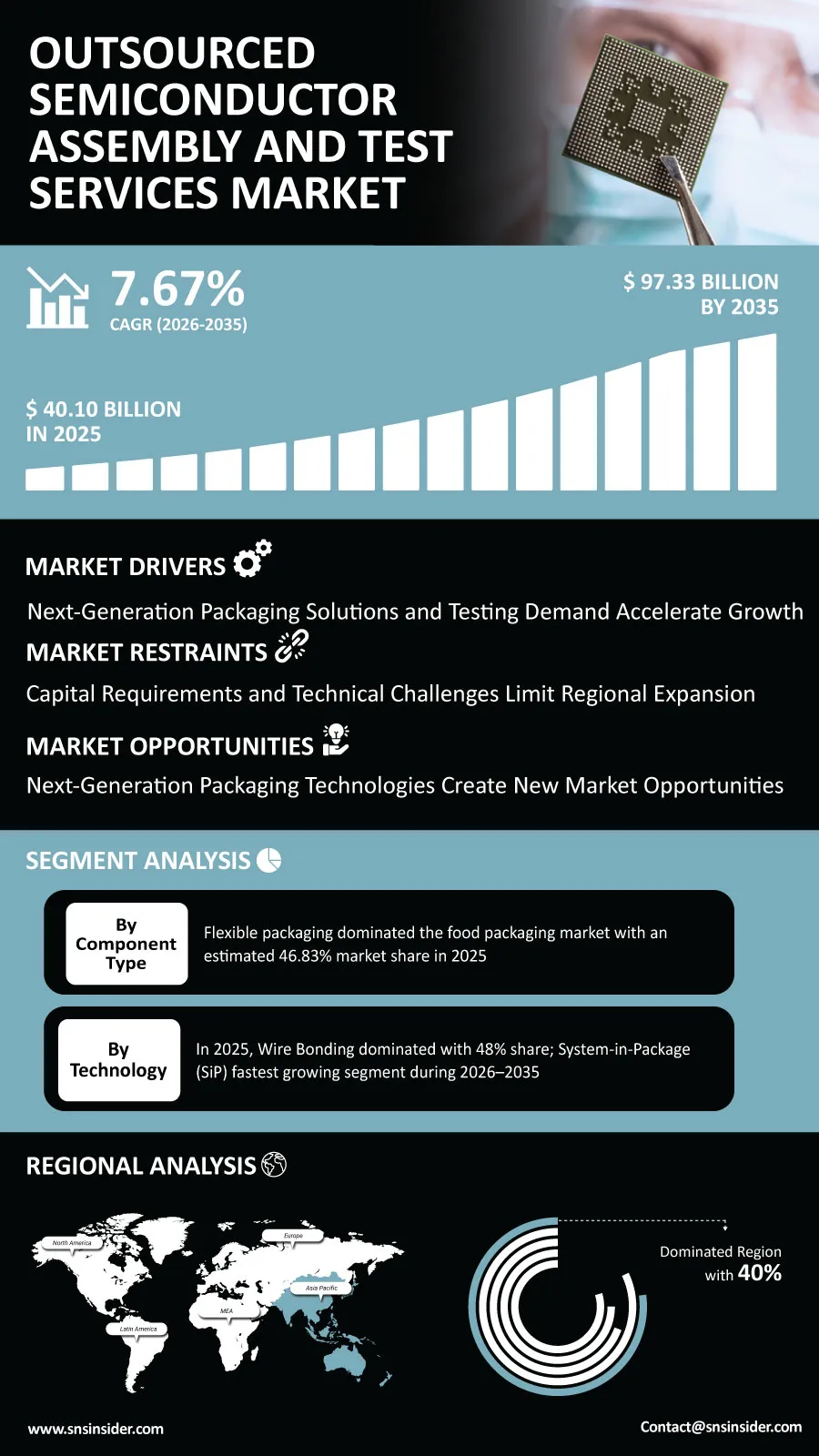
The global market for outsourced semiconductor assembly and test services is poised to experience robust growth due to the dependence of chip manufacturers on external specialists to manage sophisticated packaging, assembly, and test needs. According to a recent study by SNS Insider, the global Outsourced Semiconductor Assembly and Test (OSAT) Market size valued at USD 40.10 billion in 2025, is anticipated to grow to USD 97.33 billion by 2035, registering a CAGR of 7.67% over the 2026–2035 forecast period.
Due to the fast advancements in technologies such as AI, 5G, connected devices, automotive electronics, and advanced computing, there will be an increased demand for highly complex semiconductors. With complex chip designs becoming increasingly prevalent among semiconductor producers, the industry players are increasingly relying on the services of the OSAT companies and minimizing significant investments in assembly and test facilities.
The increasing consolidation of semiconductor manufacturing in Asia Pacific region also augurs well for the OSAT industry, as highly developed manufacturing infrastructure, skilled labor force, and well-developed electronics supply chain drive investments in packaging and testing services.
To Get Detailed Insights on the OSAT Market – Request a Sample Report
Advanced Packaging Investments Create New Growth Opportunities
The semiconductor industry is moving away from traditional packaging as more efficient computing capabilities are needed in the shrinking architecture of devices. The need for more sophisticated packaging techniques such as System-in-Package and Heterogeneous Integration is becoming more apparent for cases that require higher bandwidth, less energy consumption, and better thermal performance.
OSAT firms have reacted by developing more advanced packaging technology and using automation for inspection and testing of their products. Artificial Intelligence and Machine Learning have been used to detect defects and to optimize the testing process and production efficiency.
Outsourcing is still a good choice for semiconductor firms looking to shorten their time to market while avoiding the cost of owning sophisticated packaging technologies.
Key Market Insights Highlight Shifting Demand Patterns
By type of components, ICs and microchips are estimated to represent 50% of total market revenue in 2025 due to high demands from consumer electronics, data center, communication, and automotive applications. MEMS are forecast to have the highest CAGR from 2021 through 2035 as sensor technology plays an increasing role in connected devices, automobiles, machinery, and medical technologies.
By technology type, wire bonding is forecast to capture 48% of market revenue in 2025 due to its established presence in traditional semiconductor packaging technologies. SiP technology is estimated to be the fastest growing segment of the market driven by the need for small-size package integrating several components for smartphones, wearable technology, automotive and high performance computing.
By application, smartphones and consumer electronics are forecast to have 45% market share in 2025 due to consistent demand from mobile and connected device markets. Automotive electronics is estimated to have the highest CAGR driven by increased requirements for semiconductors in electric vehicles, ADAS, connected cars, and software-defined cars.
From the end-user perspective, it is anticipated that semiconductor vendors will generate 53% of total market revenues in 2025 since chip vendors are becoming more efficient in outsourcing their non-core functions. It is anticipated that the automotive sector will witness the highest growth rate as vehicles continue to become smarter.
Automotive and AI Applications Reshape OSAT Demand
An increase in the usage of semiconductors in automotive products is bringing about another avenue of growth in the requirement of dependable assembly and testing solutions. The electric powertrain, battery management system, sensors, connection platform, and ADAS features require semiconductor packages that are capable of operating in harsh temperature and reliability conditions.
On the other hand, the rise in AI processing tasks is driving up the requirement of advanced chips and packaging technology. This is why OSAT firms are making investments in such technologies.
Asia Pacific Holds 40% Semiconductor Packaging Market Share in 2025 as the Region Grows at Nearly a 10.5% CAGR Through 2035
Asia Pacific is expected to retain its dominance in being the largest and the fastest growing market, contributing almost 40% of the overall revenue by 2025 and achieving a CAGR of close to 10.5% all the way to 2035. China, Taiwan, South Korea, and Japan are expected to benefit from robust semiconductor ecosystem, electronics manufacturing, and investments in packaging and testing facilities.
North America will retain a dominant position owing to R&D in semiconductors, AI infrastructure, automotive electronics, and development of domestic semiconductor capabilities. Europe is expected to experience steady growth owing to demand for automotive semiconductors and industrial automation.
Industry Participants Focus on Advanced Packaging Capacity
The competitive environment will be increasingly influenced by advancements in packaging, automation, test facilities, and diverse geographical manufacturing capabilities. Some of the leading OSAT companies will be improving their ability to handle next-generation chips, and also devising solutions specifically for automotive, communication, consumer, and high-performance computing devices.
Key companies operating in the global Outsourced Semiconductor Assembly and Test (OSAT) Market include ASE Technology Holding Co., Ltd., Amkor Technology, Inc., Powertech Technology Inc., JCET Group Co., Ltd., ChipMOS Technologies Inc., Tianshui Huatian Technology Co., Ltd., Tongfu Microelectronics Co., Ltd., King Yuan Electronics Co., Ltd., UTAC Holdings Ltd, Unisem Group, Walton Advanced Engineering Inc., Carsem Malaysia, Integrated Micro-Electronics, Inc. (IMI), Lingsen Precision Industries, Ltd., STATS ChipPAC Ltd, Simec Group, Siliconware Precision Industries Co., Ltd., Qualcomm Technologies, Inc., Jiangsu Changjiang Electronics Technology Co., Ltd., and Nippon Chemi-Con Corporation.
An SNS Insider analyst Sushant Kadam commented, “The increasing complexity of semiconductor architectures is strengthening the strategic role of OSAT providers across the global chip ecosystem. Companies that expand advanced packaging capabilities, improve testing intelligence, and support demanding automotive and AI applications will be positioned to capture the next phase of semiconductor industry growth.”
About the Author

Get in touch




