According to the latest SNS Insider Oxygen Scavenger Market report, the global market is growing steadily. Food producers, drug makers and industrial plants all need better ways to control oxygen. Oxygen causes food to spoil, weakens sensitive drugs and corrodes boiler systems. Removing it protects product quality and lowers waste.
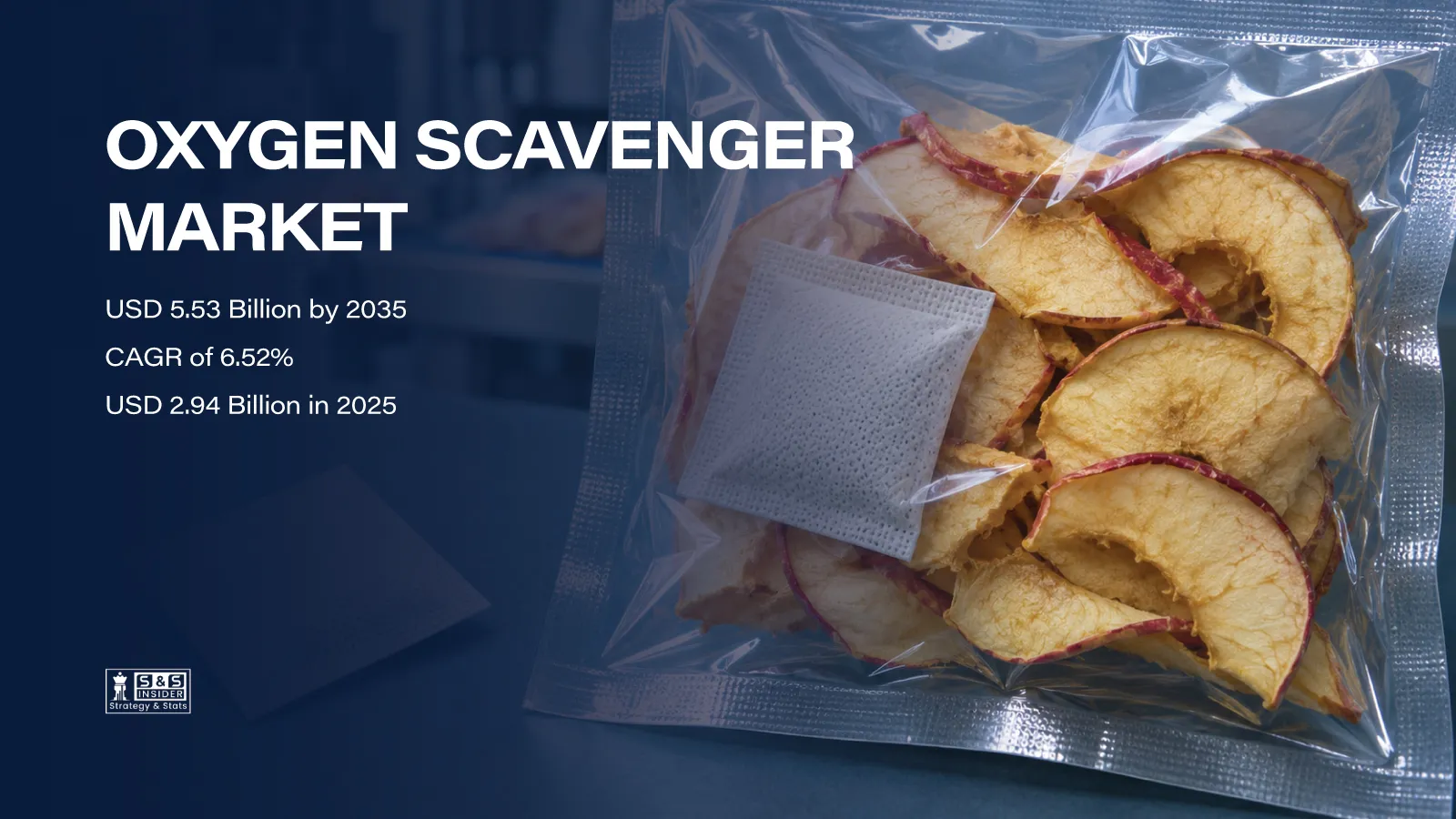
The global oxygen scavenger market was valued at USD 2.94 Billion in 2025 and is estimated to reach USD 3.13 Billion in 2026. It is expected to reach USD 5.53 Billion by 2035, growing at a CAGR of 6.52% during 2026–2035.
Packaging is moving from passive barriers to active designs that remove the oxygen left inside a pack. Sachets and canisters remain the most common format. Films and labels are growing faster because they can be built into the package itself.
Food and beverage packaging is the largest source of demand. Pharmaceutical packaging is growing fastest as more drugs need protection from oxygen and moisture. Industrial water treatment adds steady demand from power plants, refineries and chemical sites.
Asia Pacific is both the largest and the fastest-growing regional market, supported by large food processing and drug manufacturing bases. North America is the second-largest region.
To Get Detailed Insights on the Chlor-Alkali Market – Request a Sample Report
Demand Drivers and Constraints
Primary Demand Drivers
- Growth in packaged and convenience foods: More ready-to-eat and packaged food means more need for a longer shelf life and less spoilage.
- Food safety needs: Controlling oxygen limits spoilage, product recalls and food waste across supply chains.
- Pharmaceutical packaging standards: Oxygen-sensitive drugs and supplements need packs that protect them from the time they are made until they are used.
- Shift toward active packaging: Brand owners are adding scavengers to remove the oxygen left in a pack after sealing.
- Industrial water treatment: Power plants and refineries use chemical scavengers to protect boilers and pipes from corrosion.
Potential Growth Constraints
- Regulatory review and paperwork for food-contact and pharmaceutical uses.
- Recycling concerns with multilayer packs that contain scavengers.
- Competition from high-barrier films, vacuum packing and modified atmosphere packaging.
- Price pressure from large food companies and cost-sensitive buyers.
- High compliance costs and long approval times across many countries.
Demand Structure by Type
Inorganic and Iron-Based (2025 Market Share: 53.18%)
Inorganic and iron-based scavengers accounted for 53.18% of the global market in 2025. Iron powder absorbs oxygen quickly and costs little, so it has long been the standard choice for sachets used with dry foods, snacks, meat and baked goods. Producers trust its results because it has been used for decades. It also works in many temperature and moisture conditions. These products are expected to stay the base of the market through 2035, mostly in food packaging, where cost per unit matters most.
Current trend: Steady use of iron-based sachets in high-volume food packaging.
Major trends: Faster-absorbing iron formulas, moisture-activated sachets, packs for metal detection lines, and smaller sachet sizes.
Organic and Non-Metallic (Forecast CAGR: 7.86%)
Organic and non-metallic scavengers are projected to grow at the fastest CAGR of 7.86% during 2026–2035. These materials do not set off metal detectors on food lines, and they can go in microwavable packs. Organic types can also be built into films, bottle walls and closures, which removes the need for a separate sachet. Brand owners like this because the pack looks cleaner and is simpler to handle. Rising use in beverages, pharmaceuticals and ready meals is expected to support strong demand for these products.
Current trend: More use of non-metallic scavengers in microwavable and metal-detected packs.
Major trends: Polymer-based scavengers, bottle and closure liners, built-in film systems, and bio-based materials.
Demand Structure by Form
Sachets and Canisters (2025 Market Share: 41.36%)
Sachets and canisters held 41.36% of the market in 2025. These formats are simple to add to existing lines. Packers can drop them into bags, jars and bottles without changing the main package. They suit dry foods, nuts, jerky, supplements and tablets, which need low oxygen levels for long periods. Canisters are widely used in drug bottles, where they protect tablets and capsules after each opening. Low cost and proven results keep this format the most widely used option across food and health products.
Current trend: Continued use of sachets and canisters in food and supplement packs.
Major trends: High-speed sachet dispensing, strip packets on reels, combined oxygen and moisture absorbers, and child-safe canisters.
Films and Labels (Forecast CAGR: 7.62%)
Films and labels are expected to grow at a CAGR of 7.62% through 2035. These formats place the scavenger inside the package wall or on a label stuck to the inner surface. That removes loose sachets, which some buyers dislike and which can be swallowed by mistake. Films also allow wider use in trays, pouches and lidding for fresh and ready meals. As brand owners move toward cleaner pack designs and faster filling lines, demand for scavenging films and labels is expected to rise.
Current trend: Rising use of scavengers built into films and labels in place of loose sachets.
Major trends: Active barrier films, adhesive scavenger labels, recyclable single-material structures, and tray lidding.
Demand Structure by Application
Food and Beverage (2025 Market Share: 32.47%)
Food and beverage represented 32.47% of the market in 2025. Packaged meat, cheese, bakery goods, snacks, coffee and beer all lose quality when exposed to oxygen. Scavengers slow color change, flavor loss and mold growth, which gives producers and retailers more time to sell the product. Longer shelf life also cuts food waste across distribution networks. Growth in packaged and convenience foods, mostly in Asia Pacific and Latin America, is expected to keep this application the largest source of demand.
Current trend: Wider use of scavengers in meat, bakery and ready-meal packs.
Major trends: Shelf-life extension, oxygen-scavenging beverage closures, active packaging for fresh foods, and food waste reduction.
Pharmaceuticals (Forecast CAGR: 7.81%)
Pharmaceuticals are projected to grow at the fastest CAGR of 7.81% during 2026–2035. Many tablets, capsules, biologics and diagnostic kits break down when exposed to oxygen and moisture. Drug makers use scavengers to keep products stable through long supply chains and storage. Packaging standards are also becoming stricter, and companies must show that a product stays effective until its expiry date. Growth in generic drugs, nutritional supplements and specialty medicines is expected to keep demand rising in this segment.
Current trend: More use of oxygen control in drug and supplement packaging.
Major trends: Canisters for drug bottles, blister pack scavengers, diagnostic kit protection, and combined desiccant and oxygen absorbers.
Key Market Participants
The oxygen scavenger market includes specialty chemical companies, packaging material suppliers and water treatment providers.
Key participants include Mitsubishi Gas Chemical, Multisorb Technologies, Clariant, BASF, Ecolab, Solenis, Kemira, Sealed Air, Amcor, Avient, Arkema, Kuraray, Veolia and Desiccare.
Competition centers on absorption speed, regulatory approvals, compatibility with high-speed packing lines and recyclable package designs. Suppliers that offer proven food-contact and drug-grade products, along with technical support, are well placed to win long-term contracts.
Regional Market Dynamics
Asia Pacific (2025 Market Share: 36.92%)
Asia Pacific led the global market with a 36.92% share in 2025 and is expected to grow at the fastest CAGR of 7.38% through 2035. Japan has a long history with oxygen scavengers and a mature user base in food packaging. China, India and South Korea are growing quickly as packaged food use rises and drug output expands. Large food processing industries, rising incomes and the spread of modern retail all support demand. Expanding power generation and chemical plants also add demand for water treatment scavengers.
Direction: Continued regional leadership supported by packaged food growth and expanding drug manufacturing.
North America (Second-Largest Regional Market)
North America accounted for 31.48% of the market in 2025. The U.S. leads regional demand, with a market value of USD 718.20 Million in 2025 and an expected CAGR of 5.96% through 2035. Demand comes from a large packaged food industry, strict food safety standards and a strong drug manufacturing base. Supplement makers are also heavy users of sachets and canisters. Power plants and refineries add steady demand for boiler water treatment.
Direction: Stable growth supported by pharmaceutical packaging and food safety needs.
Overall, the oxygen scavenger market is set for steady expansion through 2035, with success depending more and more on regulatory approvals, recyclable designs, packing-line compatibility and proven shelf-life performance.
About the Author

Get in touch