
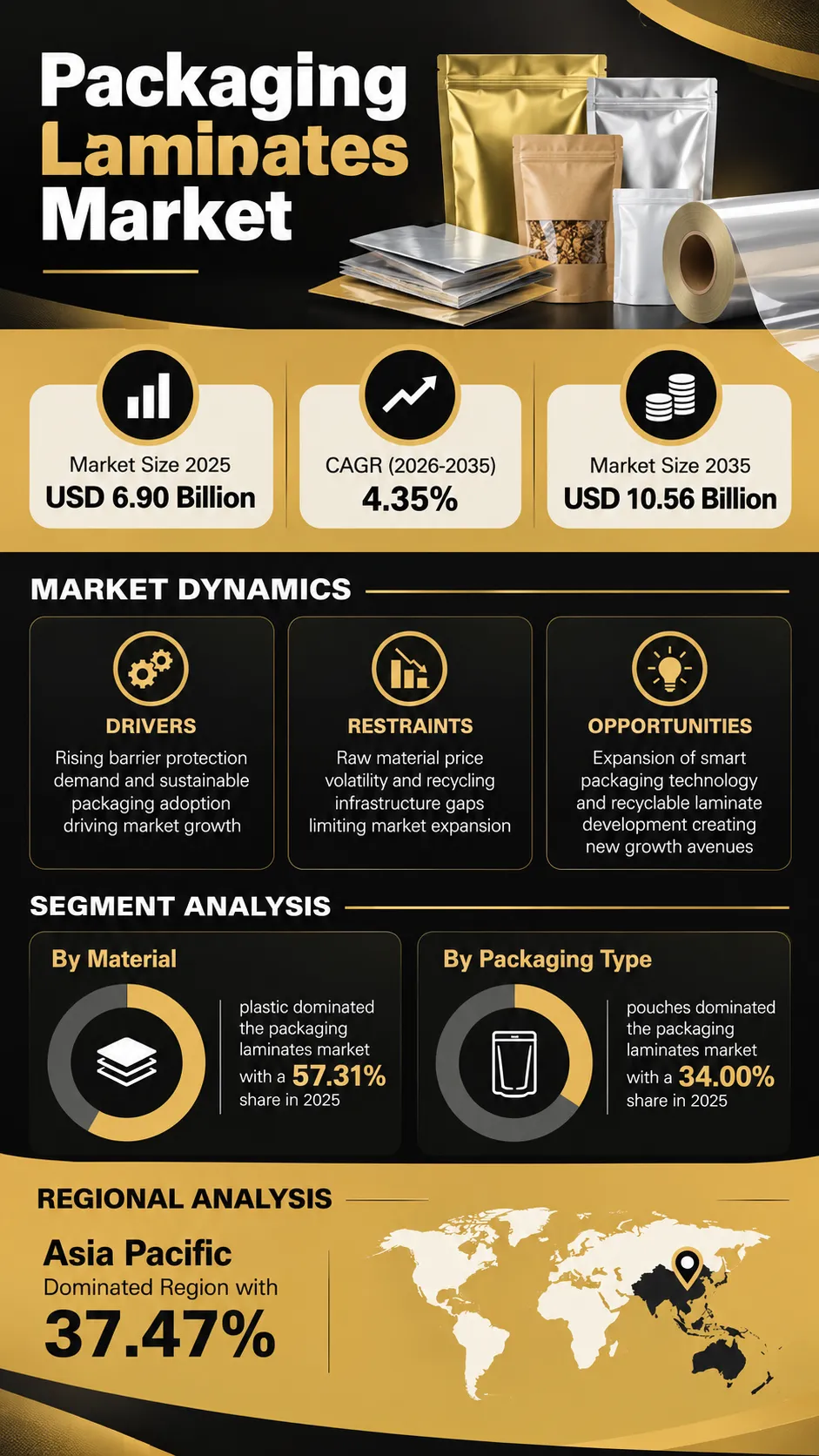
The global Packaging Laminates Market is set for steady expansion as barrier protection demand and sustainable packaging adoption continue to reshape multi-layer packaging worldwide. “According to a recent study by SNS Insider, the global Packaging Laminates Market size valued at USD 6.90 billion in 2025, is anticipated to grow to USD 10.56 billion by 2035, registering a CAGR of 4.35% over the 2026–2035 forecast period.”
There have been notable changes within laminate manufacturing and printing technology over time, due to which many manufacturers who aim at improving barrier performance and sustainability can take advantage of this trend. This includes the need for more advanced recyclable material and digital printing techniques that will provide food, beverage, and pharmaceutical companies with the ability to access high-performance, sustainable packaging. This applies in situations where packaging laminates support pouches, sachets, and rigid container applications. Manufacturers are constantly working hard to ensure that their laminate products perform better than before in order to meet various barrier performance and sustainability requirements.
To Get Detailed Insights on the Packaging Laminates Market – Request a Sample Report
Recyclable Materials and Smart Packaging Technology Create New Demand
The packaging laminates market has evolved from conventional multi-layer plastic structures to increasingly sophisticated, sustainable and technology-enhanced packaging solutions. The growing investment in recyclable film development, paper-based laminate technology, and smart packaging feature integration across manufacturers of all sizes has required the development of more versatile and sustainable laminate products.
New material and technology innovations can increase barrier performance, improve recyclability, and allow for expansion into increasingly diverse food, pharmaceutical, and personal care applications. This gives brand owners the possibility to deliver high-performance packaging while meeting growing consumer and regulatory sustainability expectations.
Laminate manufacturers, adhesive suppliers, and brand owners are increasingly cooperating thanks to the growing interest in developing future solutions for sustainable, technology-enhanced laminate packaging.
Key Market Findings Highlight High-Growth Segments
The plastic material segment dominated all categories in the packaging laminates market share with a 57.31% share in 2025 due to the surge in flexible packaging formats reliant on multilayer plastic laminates. The fastest growing category is expected to be paper and paperboard which will grow at a CAGR of 4.77% through the forecast period, owing to eco-conscious consumer segments and single-use plastic regulations.
By application, food and beverage dominated the industry with a 38.46% share in 2025 due to laminates' essential role extending shelf life and barrier protection. Pharmaceuticals will see significant growth in the forecast period, driven by growing demand for longer shelf life and high-barrier protection.
Based on packaging type, pouches contributed the biggest market share of 34% in 2025 thanks to versatile applications across food, beverage, and personal care products. On the other hand, sachets will be the segment recording the fastest revenue growth at a 6.60% CAGR, supported by growing pharmaceutical and personal care single-dose packaging demand.
Distributive printing technology trends are changing as well. Rotogravure contributed the biggest market share of 41% in 2025 owing to established, cost-effective high-volume production. But digital printing will turn out to be the fastest-growing printing technology through 2035, on the back of growing demand for shorter print runs and customizable packaging.
Barrier Performance, Sustainability, and Customization Gain Importance
In this regard, food, beverage, and pharmaceutical manufacturers have been looking at packaging laminate products that would deliver more consistent barrier performance while requiring greater sustainability credentials and customization flexibility.
Innovation in recyclable film development, paper-based laminate technology, and digital printing capability has been making it possible for companies to come up with products that appeal to increasingly quality-conscious and sustainability-focused brand owners. In addition to that, increasing emphasis on smart packaging feature integration is also making it possible for manufacturers to find solutions that enhance product traceability and consumer engagement. Such trends are likely to become even more prominent in the future.
Asia Pacific Emerges as the Largest Market with 37.47% Regional Revenue Share Amid Strong Automation Investment
The Asia Pacific region represented the largest share of regional market revenue in 2025 at 37.47%, owing to China's packaging laminates market being fueled by a strong push for automation in food processing and pharmaceutical sectors. On the other hand, North America continues to see strong demand during the forecast period through 2035, driven by increasing investment in progressive packaging technologies supporting product appearance and safety.
Leading Companies Drive Innovation and Competition
The environment continues to stay very dynamic since players continue innovating on recyclable materials and digital printing technology as well as forming partnerships in order to enhance their position in the industry. Some of the major companies that operate in the global packaging laminates market are Amcor, Berry Global Group, CCL Industries, Winpak, Cosmo Films, Coveris Holdings, Toray Industries, Glenroy, Sonoco Products Company, and Mondi Group.
An SNS Insider analyst Himanshu Sharma commented, "The growing convergence of barrier performance requirements and sustainability regulations is creating sustained demand for recyclable, high-performance laminate technology. Manufacturers that successfully combine recyclable material innovation, digital printing capability, and smart packaging integration will be best positioned to capitalize on emerging opportunities across food, pharmaceutical, and personal care segments."
About the Author

Get in touch




