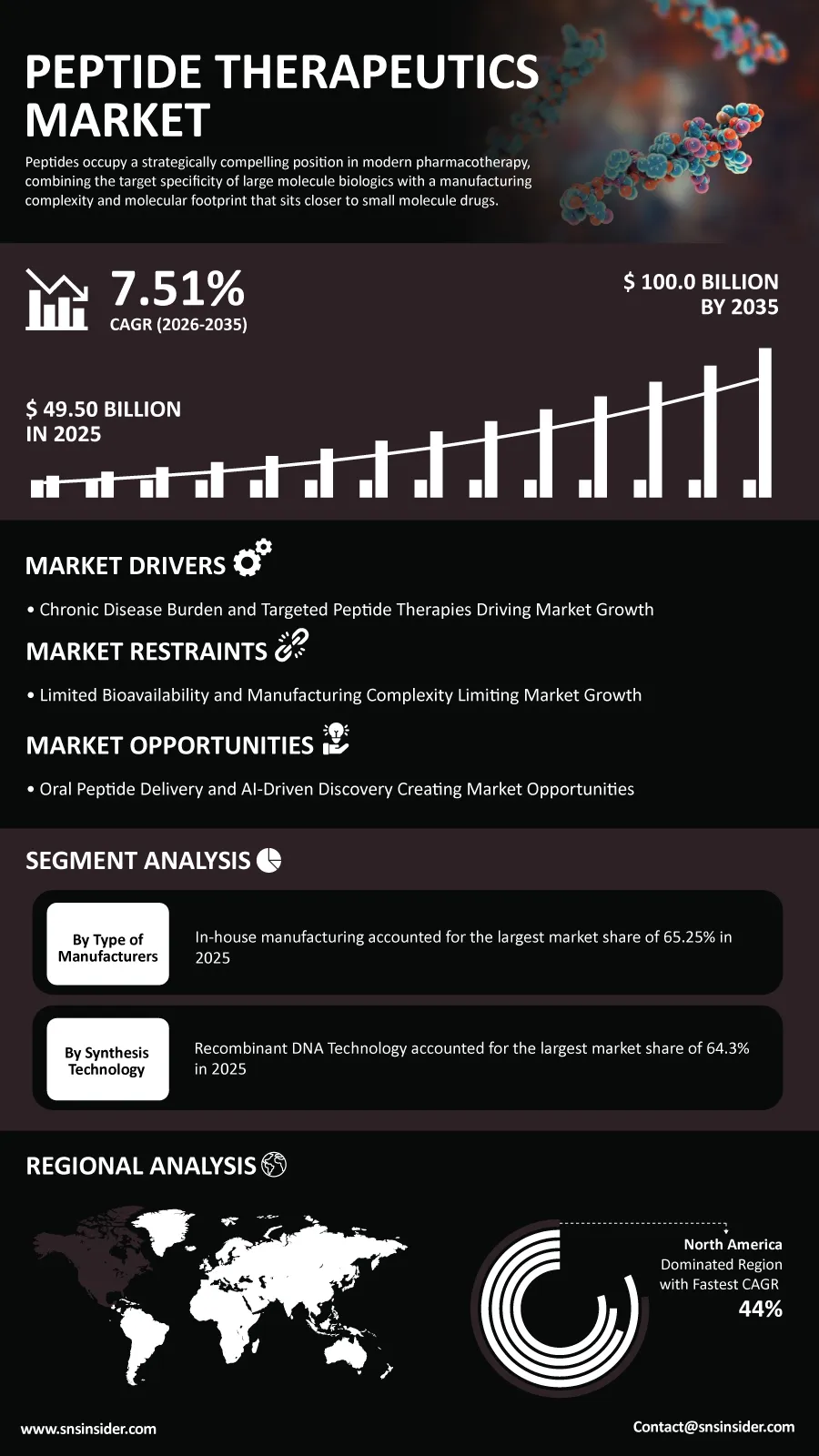
The global Peptide Therapeutics Market is witnessing robust momentum as pharmaceutical innovation shifts toward highly targeted therapies capable of addressing complex chronic diseases with improved efficacy and safety. According to a recent study by SNS Insider, the global Peptide Therapeutics Market size valued at USD 49.50 Billion in 2025, is anticipated to grow to USD 100.0 Billion by 2035, registering a CAGR of 7.51% over the 2026–2035 forecast period. Rising demand for precision medicine, continuous advances in peptide engineering, and expanding clinical success across metabolic and oncology treatments are positioning peptide-based medicines among the fastest-evolving drug categories globally.
The development and manufacturing of peptides are being intensified through better research pipelines and the introduction of manufacturing technology that can manufacture peptides that are more complex in nature on a commercial basis. Improved methods of synthesis, efficient delivery mechanisms, and the increased regulatory confidence are allowing peptide therapies to break away from their conventional use for hormone diseases to other more valuable disease states.
To Get Detailed Insights on the Peptide Therapeutics Market – Request a Sample Report
Breakthrough Drug Innovation Accelerates Market Expansion
Increased acceptance of peptide drugs is changing the way that pharmaceutical companies develop their drugs globally. Success in obesity and diabetes treatments through the use of peptide drugs shows the strong potential that lies within peptide drug development, thus motivating pharmaceutical companies to speed up the development of their drugs in different disease categories.
Researchers are working on developing technologies for oral drug delivery, drug targeting platforms, and new peptide engineering techniques that not only make treatment easier but also widen its scope. As technology develops further, peptides will play a pivotal role in future precision medicine approaches.
Key Market Findings Highlight High-Growth Segments
Based on type, innovative peptide therapeutics accounted for the largest market share in 2025, supported by strong patent portfolios and continuous product innovation. Generic peptides are projected to record the fastest growth through 2035 as key product patents approach expiration.
By manufacturer type, in-house manufacturing represented 65.25% of market revenue in 2025, while outsourced contract manufacturing is expected to register the fastest expansion during the forecast period.
Based on synthesis technology, Recombinant DNA Technology dominated with 64.3% market share in 2025 owing to its efficiency in producing complex therapeutic peptides. Liquid Phase Peptide Synthesis (LPPS) is anticipated to achieve the highest growth rate through 2035.
By route of administration, parenteral delivery segment maintained market leadership during 2025 because of its established clinical effectiveness. However, novel delivery routes, including oral, transdermal, nasal, and buccal administration, are expected to witness the fastest adoption.
Among applications, metabolic disorders generated the largest share of global revenue in 2025, driven by expanding GLP-1 therapies, while oncology is forecast to become the fastest-growing therapeutic application through 2035.
Advanced Manufacturing and Delivery Technologies Drive Competitive Advantage
Continued advances in technology are revolutionizing the field of peptide drug development from research through to manufacture. Through the use of automated synthesis technology, recombinant production facilities and enhanced purification technologies, pharmaceutical companies are able to enhance their production capabilities while still adhering to quality guidelines.
In addition to this, increased investments in oral delivery of peptides, nanoparticles, peptide-drug conjugates, and molecule discovery with the help of artificial intelligence will lead to greater innovations in the development process.
Regional Markets:
North America is estimated to dominate as the largest regional market in terms of market share in 2025, contributing around 44% of the global revenues. The U.S. Peptide Therapeutics Market stood at USD 21.90 Billion in 2025 and is further estimated to grow at a CAGR of 7.27%, reaching around USD 43.30 Billion by 2035.
The Asia Pacific region is forecasted to witness the highest growth rate among all regional markets throughout the forecast period. In 2025, the revenue contribution of Japan in the region was estimated at around 38%, while the advancements in pharmaceutical manufacturing capabilities in China and India will keep on improving the competitive position of the region.
Germany accounted for around 27% of the regional revenues in the Europe region, due to its advanced capabilities in the field of pharmaceutical manufacturing and research. In 2025, Brazil contributed around 48% of Latin American revenues, while Saudi Arabia contributed around 26% of Middle East & Africa revenues.
Leading Companies Strengthen Global Competition
The competitive landscape continues evolving through clinical research investments, manufacturing expansion, strategic partnerships, and pipeline diversification. Major companies operating in the global peptide therapeutics market include Novo Nordisk A/S, Eli Lilly and Company, Pfizer Inc., Sanofi S.A., AstraZeneca plc, Amgen Inc., Novartis AG, Takeda Pharmaceutical Company Limited, F. Hoffmann-La Roche Ltd., Ipsen S.A., AbbVie Inc., Merck & Co. Inc., Teva Pharmaceutical Industries Ltd., Sun Pharmaceutical Industries Ltd., Dr. Reddy's Laboratories Ltd., Bachem Holding AG, PolyPeptide Group AG, Lonza Group AG, Fresenius Kabi AG, and Biocon Limited.
An SNS Insider analyst Parry Kardani commented, "Peptide therapeutics are becoming one of the pharmaceutical industry's most strategically important treatment platforms as scientific advances improve targeting precision, manufacturing scalability, and patient accessibility. Organizations that combine innovative research with next-generation delivery technologies will be well positioned to capture future opportunities across metabolic diseases, oncology, and precision medicine."
About the Author

Get in touch