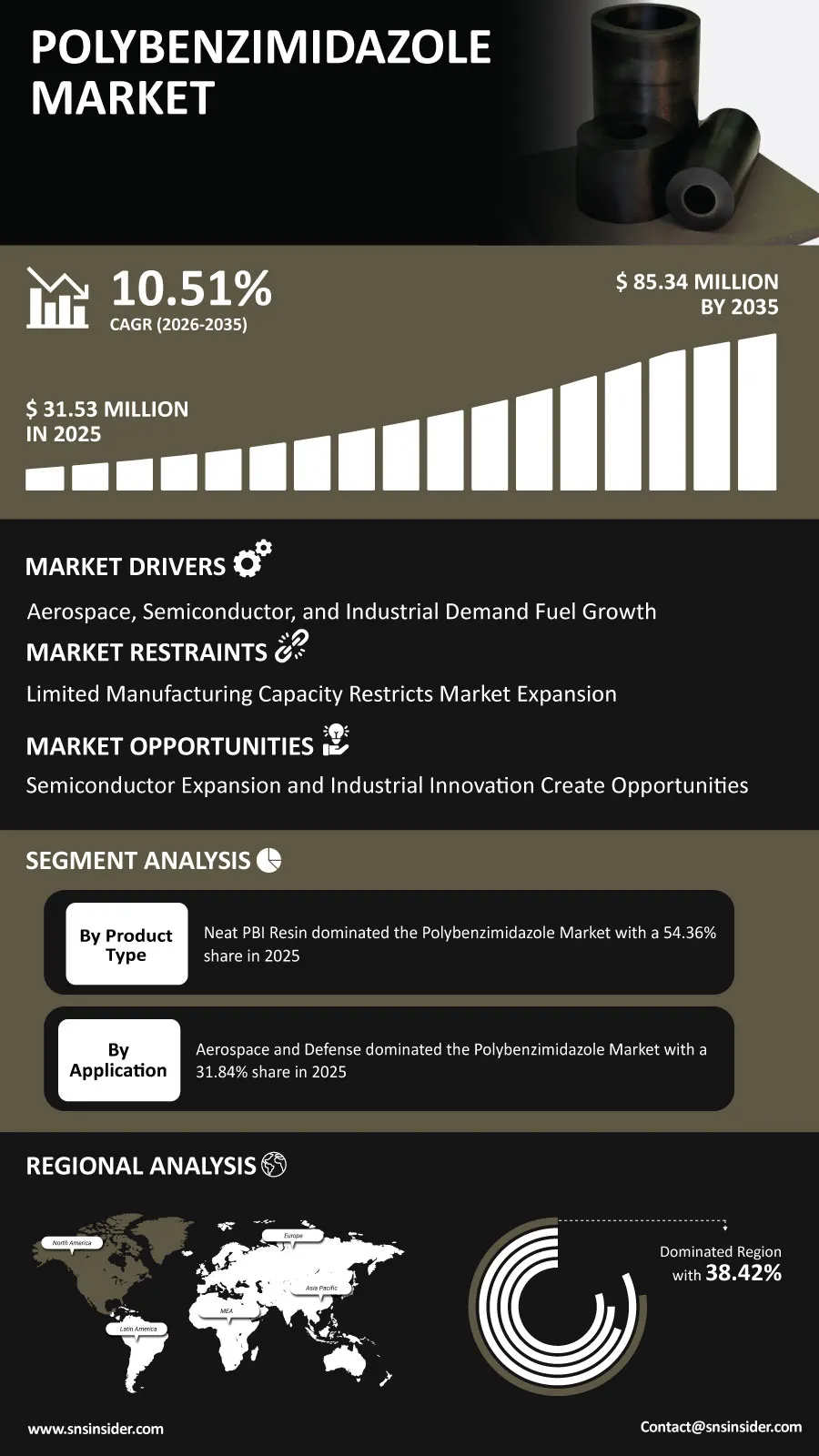
The Polybenzimidazole Market across the globe is expected to experience a high growth phase as demand rises among manufacturers from high-technology industries for materials that can withstand harsh thermal, chemical and mechanical stress. “According to a recent study by SNS Insider, the global Polybenzimidazole Market size valued at USD 31.53 Million in 2025, is anticipated to grow to USD 85.34 Million by 2035, registering a CAGR of 10.51% over the 2026–2035 forecast period.”
Polybenzimidazole, or PBI for short is finding favor in applications where traditional polymers fall short when it comes to necessary heat resistance, flame performance, durability and chemical stability. It is used in making aerospace components, defense equipment, semiconductor processing materials and tools, protective fabrics, industrial systems and specialized electronics. Increasing investment in sophisticated manufacturing is opening additional opportunities for fibers, resins, membranes and engineered components based on PBI.
To Get Detailed Insights on the Polybenzimidazole Market – Request a Sample Report
Advanced Materials Demand Creates New Commercial Opportunities
The wider semiconductor fabrication space appears to be a promising direction for PBI adoption. Semiconductor manufacturers need materials that can sustain other processes in extreme cases without dimensional change or cleanliness. PBI's high performance traits make it ideal for specialized handling equipment, insulation elements and in applications exposed to elevated temperatures and harsh processing environments.
At the same time, aerospace and defense programs are ramping up demand for lighter, flame-resistant materials. These PBI-based solutions can offer both thermal protection and insulation, protect structurally significant aircraft components, or create a critical protective apparel where reliability is key. On the other hand, increasing capital funding for domestic advanced-material supply chains is also motivating manufacturers to create specialized production capabilities and lower reliance on a narrow range of international supplies.
Key Market Insights Highlight Shifting Application Demand
On the basis of product type, Neat PBI Resin held the largest market share at 54.36% in 2025 owing to its wide range of applications that require strong thermal stability and chemical resistance with high mechanical strength. On the basis of fiber type, PBI Fibers are expected to witness the strongest growth, with a CAGR of 11.11% during the period between 2026 and 2035 as demand for firefighting gear (protective clothing), aerospace insulation, and special-purpose industrial textiles expands.
By fiber type, Filament was 42.68% of revenue in 2025 and it is anticipated to see the highest growth at a CAGR of 11.07%. By Application, Aerospace and Defense held the majority share of 31.84% in 2025. Conversely, Electronics is projected to be the fastest-growing application segment by occupying a share of 12.17% CAGR through 2035 along with growth in semiconductor manufacturing and electronics processing segments.
Aerospace Components accounted for 30.86% of market revenue in 2025, by end use Overall, the Semiconductor/Electronics segment is projected to be the fastest-growing with a CAGR of 12.15%, as spending on fabrication shops, wafer processing equipment, and contamination-sensitive manufacturing environments increases.
Semiconductor Expansion Accelerates PBI Technology Development
PBI manufacturers are also increasingly working with various high-performance applications aiming at more complex and improved formulations along with engineered compositions to comply with operational even demanding industrial specifications. The ongoing research on fibers, composites, membranes and specialty resins is enhancing the versatility of the material as well as improving processing performance.
Simultaneously, strategic collaborations among polymer manufacturers, research institutions, aerospace firms and electronics manufacturers are enabling the innovation of advanced-generation materials. The collaborations work toward tackling demands for more robustness, lighterweight components, and better thermal performance and service life.
Asia Pacific Emerges as the Fastest-Growing Regional Market
North America held the largest regional share in 2025 at 38.42%, aided by mature aerospace & defense sectors, semiconductor production, high-end industrial manufacturing, and polymers research. The US accounted for 82.97% of the North America market, owing to its clustering of high-value and end-use industries and advanced materials capabilities.
Asia Pacific electronics manufacturing sector is expected to show steady growth at a CAGR of 13.51% during the years 2026−2035 and to continue its dominance in terms of revenue through this period making it the fastest growing region globally. Regional demand is backed by semiconductor expansion, industrialization, aerospace manufacturing and specialty chemical investment. China, Japan, South Korea, India and Taiwan are supporting growth with investments in next-generation manufacturing and novel high-performance materials.
Applications such as aerospace, industrial engineering, electronics and specialty chemicals in Europe are also benefitting and Germany will sustain a strong position due to its leading advanced manufacturing ecosystem.
Industry Participants Focus on Specialized High-Performance Solutions
The competition is primarily focused on organisations utilising proprietary polymer technologies, optimised manufacturing facilities as well as strong long-term partnership with producers in the aerospace, electronics, industrial and protective equipment fields. With the demand from new markets becoming evident, numerous companies are focusing on product development, reliable supply, application-specific formulations and strategic partnerships.
Key companies operating in the global Polybenzimidazole Market include PBI Performance Products, Inc., Celanese Corporation, Toyobo Co., Ltd., Kaneka Corporation, 1-Material Inc., SABIC, Solvay S.A., Evonik Industries AG, Toray Industries, Inc., Teijin Limited, Mitsubishi Chemical Group Corporation, DuPont de Nemours, Inc., BASF SE, Saint-Gobain S.A., Kolon Industries, Inc., Huntsman Corporation, TCI Chemicals, Merck KGaA, Syensqo SA, and TenCate Protective Fabrics.
An SNS Insider analyst Himanshu Sharma commented, “The increasing complexity of aerospace, semiconductor, and advanced industrial applications is strengthening demand for polymers capable of maintaining performance under extreme conditions. As manufacturers expand specialized production and develop application-specific PBI solutions, the market is positioned for sustained growth across high-value technology sectors.”
About the Author

Get in touch