
Polybenzimidazole Market Report Scope & Overview:
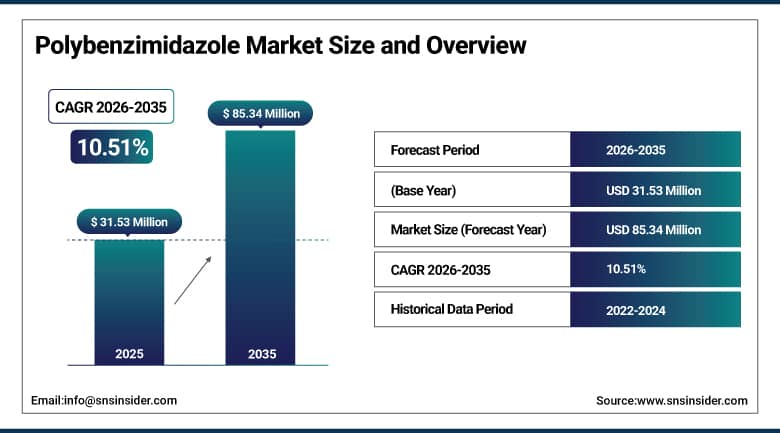
The Polybenzimidazole Market was valued at USD 31.53 Million in 2025 and is expected to reach USD 85.34 Million by 2035, growing at a CAGR of 10.51% from 2026 to 2035.
The polybenzimidazole market is poised for steady growth in the market with the rising demand for high performance polymers in Aerospace, Defence, Electronics, Industrial Processing and Semiconductor Manufacturing applications. Polybenzimidazole (PBI) is a high performance polymer with excellent thermal stability, flame resistance, mechanical strength and chemical resistance, making it suitable for extreme operating environments. Growing investment in sophisticated aerospace systems, semiconductor fabrication, personal protective equipment and specialised industrial components are driving the market. In addition, the market growth is supported by the continuous innovation in high temperature fibres, membranes, engineering resins and the rising adoption of advanced materials for the next generation of industrial and electronic applications.
In 2026, the Government of India expanded the initiatives supporting domestic manufacturing of advanced materials and speciality chemical supply chains through industrial incentive programmes. The policies aim to reduce reliance on imported high-value chemical materials and to boost the domestic production capacity of advanced speciality materials such as high-performance polymers.
To Get More Information On Polybenzimidazole Market - Request Free Sample Report
Polybenzimidazole Market Trends:
-
Increasing demand from aerospace, defense, and industrial sectors is driving adoption of Polybenzimidazole for high-temperature, flame-resistant, and mechanically demanding applications.
-
Growing semiconductor and electronics manufacturing is boosting the use of PBI materials in wafer handling, insulation components, and cleanroom processing equipment.
-
Rising preference for lightweight and chemically resistant materials is accelerating the adoption of PBI fibers and resins in advanced engineering applications.
-
Expanding investments in specialty polymers and high-performance materials are supporting innovation in PBI membranes, composites, and industrial-grade products.
-
Strategic collaborations among specialty chemical manufacturers and end-use industries are enhancing production capacity and advancing next-generation Polybenzimidazole technologies.
U.S. Polybenzimidazole Market Outlook:
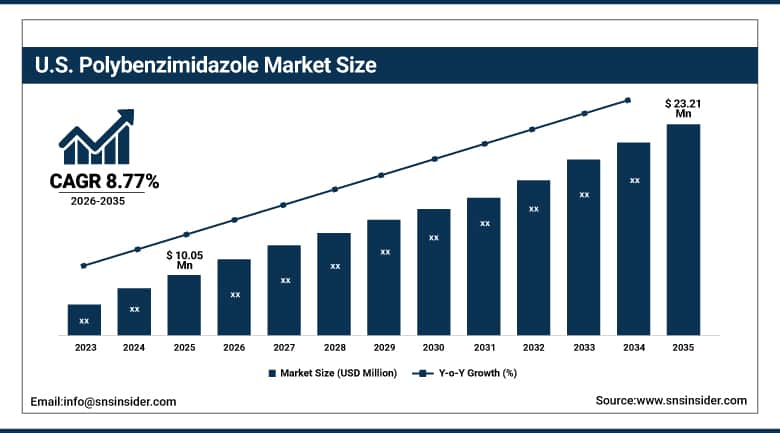
The U.S. Polybenzimidazole Market was valued at USD 10.05 Million in 2025 and is expected to reach USD 23.21 Million by 2035, growing at a CAGR of 8.77% from 2026 to 2035.
The growth of the United States Polybenzimidazole Market is driven by the rising demand for high-performance polymers in the aerospace, defence, semiconductor, electronics, and industrial manufacturing industries. The increasing investment in advanced materials, semiconductor fabrication and protective equipment fuels the adoption of PBI fibres, resins and engineered components. This material is of great importance for applications at extreme temperatures and aggressive environments due to its excellent thermal stability, flame resistance, chemical resistance and mechanical strength. Besides, increasing focus on domestic advanced manufacturing and speciality materials innovation is also expected to accelerate the market growth.
PBI Performance Products continued to be a leading supplier of PBI fibres and powders for aerospace, semiconductor, protective clothing and industrial use in 2026, and still had specialised production capabilities for high-temperature polymer materials used in extreme environments.
Polybenzimidazole Market Segment Analysis:
-
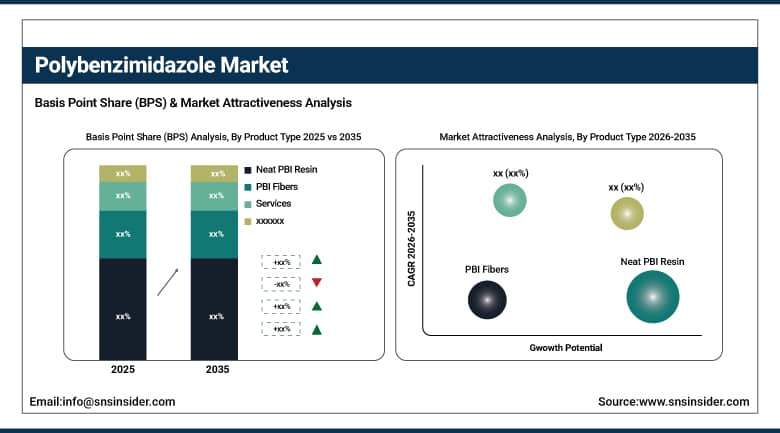
By Product Type, Neat PBI Resin dominated the Polybenzimidazole Market with a 54.36% share in 2025, while PBI Fibers is the fastest-growing product type segment with a CAGR of 11.11% from 2026–2035.
-
By Fiber Type, Filament dominated the Polybenzimidazole Market with a 42.68% share in 2025, while Chopped Fiber is the fastest-growing fiber type segment with a CAGR of 11.07% from 2026–2035.
-
By Application, Aerospace and Defense dominated the Polybenzimidazole Market with a 31.84% share in 2025, while Electronics is the fastest-growing application segment with a CAGR of 12.17% from 2026–2035.
-
By End Use, Aerospace Components dominated the Polybenzimidazole Market with a 30.86% share in 2025, while Semiconductor/Electronics is the fastest-growing end-use segment with a CAGR of 12.15% from 2026–2035.
By Product Type, Neat PBI Resin dominated the Polybenzimidazole Market, while PBI Fibers is expected to register the fastest growth.
The Neat PBI Resin segment dominated the Polybenzimidazole Market with a 54.36% revenue share in 2025. It’s dominance is supported by its widespread use in aerospace, industrial and high-temperature engineering applications requiring superior thermal stability, flame resistance and chemical durability. Neat PBI resin is used extensively in moulded components, insulation materials and speciality composites where high mechanical performance under extreme operating conditions is a must. Rising investments in advanced materials manufacturing continue to fuel demand for PBI resin.
The PBI Fibres segment is projected to witness the fastest CAGR of 11.11% during the forecast period of 2026-2035. The growth is driven by increasing adoption in protective clothing, aerospace insulation, semiconductor manufacturing, and high-performance industrial textiles. Increasing demand for lightweight, heat-resistant and flame retardant materials in key industries is driving the commercialisation of advanced PBI fibre products.
By Application, Aerospace and Defense dominated the Polybenzimidazole Market, while Electronics is expected to register the fastest growth.
The Aerospace and Defense segment dominated the Polybenzimidazole Market with a 31.84% revenue share in 2025. The segment’s growth is driven by the wide use of PBI materials in aircraft interiors, thermal insulation, protective equipment, and high-temperature structural components. Increasing defence modernisation programmes and a rise in commercial aircraft production are bolstering the demand for high-performance, advanced polymers.
Electronics segment is expected to register the fastest CAGR of 12.17% during the forecast period 2026-2035. The growth is fueled by the growing semiconductor manufacturing, increasing demand for cleanroom compatible materials, and increasing use of PBI in the wafer handling, insulation, and manufacturing of electronic components. Other investments in advanced semiconductor fabrication and electronics production are expected to further boost the market growth.
By End Use, Aerospace Components dominated the Polybenzimidazole Market, while Semiconductor/Electronics is expected to register the fastest growth.
The Aerospace Components segment dominated the Polybenzimidazole Market with a 30.86% revenue share in 2025. This segment is anticipated to maintain its dominance owing to the growing use of PBI in aircraft engine components, structural parts, insulation systems and thermal protection applications. This is due to the growing demand from aerospace manufacturers for lightweight materials that can withstand extreme temperatures and harsh operating conditions.
The Semiconductor/Electronics segment is expected to grow at the fastest CAGR of 12.15% during the forecast period. Drivers of growth are the rapid build-out of semiconductor fabrication facilities, increased demand for contamination-resistant materials, and greater use of PBI components in wafer processing, cleanroom equipment and high-end electronic manufacturing. “Demand is expected to remain resilient throughout the forecast period supported by ongoing investments in global semiconductor manufacturing.
Regional Analysis:
|
Region |
Major Country |
Share within Region, 2025 (%) |
|---|---|---|
|
North America |
United States |
82.96% |
|
Europe |
Germany |
32.60% |
|
Asia Pacific |
China |
54.80% |
|
Middle East & Africa |
UAE |
31.40% |
|
Latin America |
Brazil |
43.20% |
North America Polybenzimidazole Market Insights
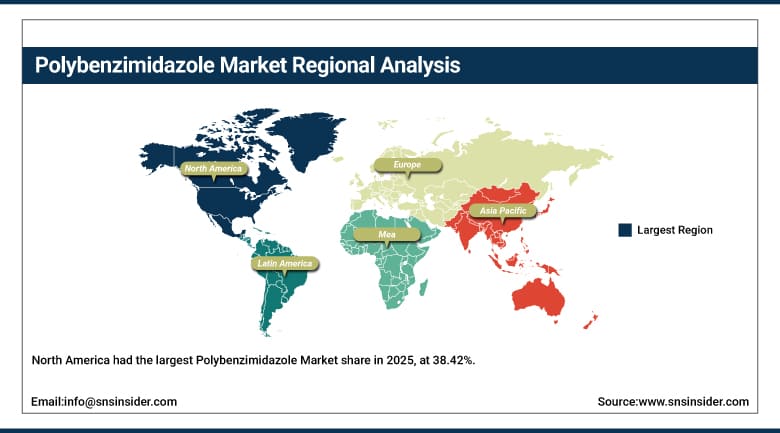
North America had the largest Polybenzimidazole Market share in 2025, at 38.42%. Strong demand from aerospace, defence, semiconductor and industrial manufacturing is driving regional growth. Market growth is being driven by increasing investment in high performance polymers, advanced composites and speciality engineering materials. The presence of leading manufacturers, research institutes and advanced manufacturing facilities for applications requiring excellent thermal stability, chemical resistance and long term mechanical performance is driving continuous innovation of heat resistant materials.
The U.S. held an 82.96% share of the North America Polybenzimidazole Market in 2025. The country’s established aerospace industry, expanding semiconductor manufacturing and growing adoption of speciality polymers in defence, industrial processing and protective equipment are supporting the country’s leadership. The demand for PBI fibres, resins and composite materials across a range of high-value industries is further fuelled by increased investments in advanced material research, domestic manufacturing and next-generation engineering applications.
Get Customized Report as Per Your Business Requirement - Enquiry Now
Europe Polybenzimidazole Market Insights
Europe Polybenzimidazole Market is likely to register a steady CAGR driven by increasing investments in advanced manufacturing, aerospace production, industrial engineering and speciality chemicals. The demand for high-performance polymers with high temperature resistance is growing in sectors like industrial processing, energy, transportation, and electronics. The European industrial landscape is seeing an increasing uptake of Polybenzimidazole products driven by the heightened focus on lightweight materials, sustainable manufacturing technologies and high-performance engineering solutions.
Germany is the largest country in the Europe Polybenzimidazole Market due to its strong industrial manufacturing capabilities, advanced engineering expertise, and well-established aerospace and automotive sectors. The country’s continuing investment in speciality materials, semiconductor manufacturing and industrial innovation is supporting market expansion. Research activity, development of advanced materials and increasing use of high-performance polymers in a variety of industrial applications have been seen in France, the United Kingdom, Italy and the Netherlands.
Asia Pacific Polybenzimidazole Market Insights
The Asia Pacific Polybenzimidazole market is projected to register the fastest CAGR of 13.51% during the forecast period. The regional market growth is driven by rapid industrialisation, growing semiconductor manufacturing, increasing aerospace production and rising demand for high performance engineering materials. Investments in speciality chemicals, advanced manufacturing technologies and industrial modernisation are fuelling the adoption of Polybenzimidazole products in several high-growth end-use industries in the region.
The Asia Pacific Polybenzimidazole Market is driven by the increasing demand from electronics, industrial manufacturing, automotive, aerospace and energy industries. China remains the biggest contributor thanks to its large speciality chemicals industry, growing semiconductor ecosystem and increasing production of advanced materials. Japan, South Korea, India and Taiwan are also driving regional growth with investments in industrial innovation, semiconductor fabrication, research activities and high-end polymer technologies.
Middle East & Africa and Latin America Polybenzimidazole Market Insights
Middle East & Africa and Latin America Polybenzimidazole Market is anticipated to grow at a steady CAGR due to increasing industrialisation, infrastructure development and investments in advanced manufacturing capabilities. New opportunities are being opened up by the increased usage of speciality polymers in energy, industrial processing, aerospace and protective equipment applications. Rising industrial diversification strategies and modernisation initiatives are driving the increased consumption of high-performance materials in these emerging regional markets.
Brazil is a major contributor to the Latin America Polybenzimidazole Market owing to growing industrial manufacturing, automotive production and increasing demand for advanced engineering materials. UAE and Saudi Arabia are investing in industrial diversification, aerospace development, energy infrastructure and speciality chemical manufacturing in the Middle East & Africa. In the long term, these investments will fuel demand for Polybenzimidazole products across various industrial uses.
Market Dynamics:
Growth Drivers: Rising demand for high-performance materials across aerospace, semiconductor, and industrial applications driving market growth
The global polybenzimidazole market is expected to register a steady CAGR over the forecast period due to the increasing demand for high performance polymers which can operate in extreme temperature and harsh chemical environments. Polybenzimidazole (PBI) materials are widely used in aerospace, defence, semiconductor manufacturing, industrial processing, protective clothing and energy applications due to their excellent thermal stability, flame resistance, chemical resistance and mechanical strength. The market growth is largely driven by increasing use of advanced materials in aerospace components, semiconductor fabrication equipment, and industrial filtration systems.
The advanced materials industry is moving at pace, with more money flowing into speciality polymers, high performance composites and next generation manufacturing technologies. Demand from aerospace manufacturers, semiconductor producers and industrial equipment suppliers is growing, and PBI producers are seeing big opportunities. Speciality chemical companies, research organisations, aerospace companies and electronics manufacturers are collaborating to speed up the discovery of new PBI resins, fibres and engineered parts that are better, longer lasting and more sustainable.
Restraints: High production costs and limited manufacturing capacity limiting market expansion
One of the major factors that limit the market growth is the high production cost of Polybenzimidazole. The production of PBI involves sophisticated polymerisation processes, special raw materials and advanced production technologies which result in substantially higher costs compared to conventional high performance polymers. Smaller and medium-sized manufacturers are often deterred by the high cost of PBI materials and the limited number of locations that can perform the specialised processing.
There is also the challenge of limited global production capacity and a complex supply chain for speciality high-performance polymers. Its production requires exacting quality control, sophisticated processing skills, and a reliable supply of raw material. Moreover, the aerospace, semiconductor manufacturing and defence industries have rigors application requirements that require extensive product qualification and certification, thus extending the time required for commercialisation. Market expansion may be further limited by supply chain disruptions, volatile raw material prices and a limited pool of qualified manufacturers.
Opportunities: Expansion of semiconductor manufacturing and advanced industrial applications creating new growth avenues
Increasing investments in semiconductor fabrication, aerospace modernisation, clean energy technologies and advanced industrial manufacturing are expected to benefit the polybenzimidazole market. The increasing demand for heat-resistant materials for processing semiconductor wafers, aerospace insulation, battery technologies, fuel cells and industrial filtration systems are providing great opportunities for PBI manufacturers. The increasing adoption of high-performance polymers in electric vehicles, hydrogen technologies and advanced electronics, is further broadening the addressable market.
Government programmes across North America, Europe and Asia Pacific are spurring homegrown semiconductor manufacturing, advanced materials production and industrial innovation, creating new opportunities. The product performance is expected to be enhanced and the application areas to be widened due to the continuous improvements in polymer engineering, composite technologies, lightweight materials and speciality fibre manufacturing. Strategic partnerships with speciality chemical manufacturers, aerospace companies, semiconductor manufacturers and research organisations will accelerate the development of next generation Polybenzimidazole materials to meet the exacting requirements of industrial and high-technology applications.
Recent Developments:
-
2025: 1-Material announced the launch of in-house Polybenzimidazole (PBI) production, expanding its high-performance polymer portfolio while addressing industry supply constraints and supporting advanced applications requiring exceptional thermal and chemical resistance.
-
2025: TenCate Protective Fabrics and PBI Performance Products advanced commercialization of PBI Peak5, combining PBI fibers with Enforce® technology to reduce firefighter garment weight while maintaining superior flame and thermal protection.
-
2025: Kaneka Corporation continued expanding its specialty polymer portfolio by developing heat-resistant and chemically stable materials designed for advanced industrial applications, addressing growing demand for high-performance polymers operating under extreme conditions.
Polybenzimidazole Market Key Players are:
-
PBI Performance Products, Inc.
-
Celanese Corporation
-
Toyobo Co., Ltd.
-
Kaneka Corporation
-
1-Material Inc.
-
SABIC
-
Solvay S.A.
-
Evonik Industries AG
-
Toray Industries, Inc.
-
Teijin Limited
-
Mitsubishi Chemical Group Corporation
-
DuPont de Nemours, Inc.
-
BASF SE
-
Saint-Gobain S.A.
-
Kolon Industries, Inc.
-
Huntsman Corporation
-
TCI Chemicals (Tokyo Chemical Industry Co., Ltd.)
-
Merck KGaA
-
Syensqo SA
-
TenCate Protective Fabrics
Polybenzimidazole Market Report Scope:
| Report Attributes | Details |
|---|---|
| Market Size in 2025 | USD 31.53 Million |
| Market Size by 2035 | USD 85.34 Million |
| CAGR | CAGR of 10.51% From 2026 to 2035 |
| Base Year | 2025 |
| Forecast Period | 2026-2035 |
| Historical Data | 2022-2024 |
| Report Scope & Coverage | Market Size, Segments Analysis, Competitive Landscape, Regional Analysis, DROC & SWOT Analysis, Forecast Outlook |
| Key Segments | • By Product Type (Neat PBI Resin, PBI Fibers) • By Fiber Type (Filament, Staple Fiber, Chopped Fiber) • By Application (Aerospace and Defense, Automotive, Electronics, Industrial, Textile, Fire Protection, Energy, Membrane) • By End-use (Aerospace Components, Semiconductor/Electronics, Industrial Components, Protective Equipment, and Others) |
| Regional Analysis/Coverage | North America (US, Canada), Europe (Germany, UK, France, Italy, Spain, Russia, Poland, Rest of Europe), Asia Pacific (China, India, Japan, South Korea, Australia, ASEAN Countries, Rest of Asia Pacific), Middle East & Africa (UAE, Saudi Arabia, Qatar, South Africa, Rest of Middle East & Africa), Latin America (Brazil, Argentina, Mexico, Colombia, Rest of Latin America). |
| Company Profiles | PBI Performance Products, Inc., Celanese Corporation, Toyobo Co., Ltd., Kaneka Corporation, 1-Material Inc., SABIC, Solvay S.A., Evonik Industries AG, Toray Industries, Inc., Teijin Limited, Mitsubishi Chemical Group Corporation, DuPont de Nemours, Inc., BASF SE, Saint-Gobain S.A., Kolon Industries, Inc., Huntsman Corporation, TCI Chemicals (Tokyo Chemical Industry Co., Ltd.), Merck KGaA, Syensqo SA, TenCate Protective Fabrics |
Frequently Asked Questions
The Polybenzimidazole Market is expected to grow at a CAGR of 10.51% from 2026 to 2035.
The Polybenzimidazole Market was valued at USD 31.53 Million in 2025.
The market is driven by rising demand for high-performance heat-resistant materials across aerospace, semiconductor, industrial, and protective equipment applications.
The Neat PBI Resin segment dominated the Polybenzimidazole Market in 2025, accounting for approximately 54.36% market share.
The North America region dominated the Polybenzimidazole Market in 2025, accounting for approximately 38.42% market share.
