
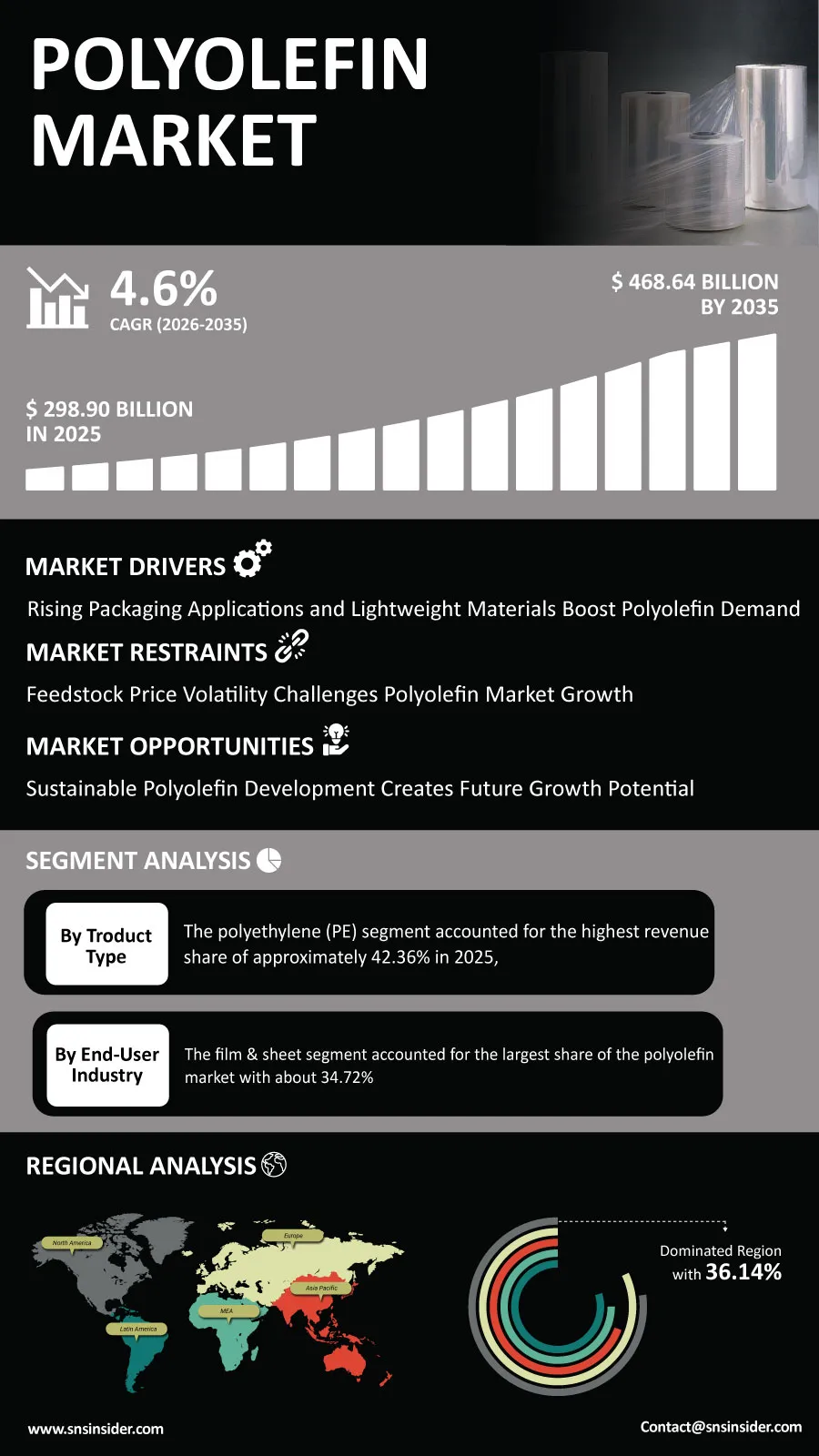
The global Polyolefin Market is witnessing steady expansion as manufacturers increase production of lightweight, durable, and cost-efficient polymer materials to meet evolving industrial requirements. “According to a recent study by SNS Insider, the global Polyolefin Market size valued at USD 298.90 Billion in 2025, is anticipated to grow to USD 468.64 Billion by 2035, registering a CAGR of 4.6% over the 2026–2035 forecast period.”
The demand for polyethylene, polypropylene, and thermoplastic polyolefin materials is still rising due to a preference among packaging makers, auto makers, and construction firms for products that offer both strength and efficiency during processing. Recycling of plastics, circular economy strategies, and sustainable manufacturing have all encouraged manufacturers to develop new types of resins and polymers. An increase in food packaging and industrial automation has strengthened the market outlook for the future.
To Get Detailed Insights on the Polyolefin Market – Request a Sample Report
Sustainable Polymer Innovation Creates Long-Term Market Opportunities
International initiatives for the reduction of plastic waste and enhancement of resource efficiency have resulted in new possibilities for the production of biodegradable and bio-derived polyolefin materials by manufacturers. Consumer brands are increasingly using recycled resin in packaging and also look for environmentally friendly materials as per the regulatory framework.
Chemical recycling, renewable feedstock sources, and high-end polymer compounding are revolutionizing product development practices in the industry. Efforts being made toward using post-consumer recycled resins, bio-based polyethylene, and improved compatibilities are aiding in achieving sustainable practices that also meet rising demand for packaging, consumer goods, and industrial applications. Such initiatives are anticipated to bolster growth potential in the coming years.
Key Market Insights Reflect Evolving Industry Demand
The major types of products include Polyethylene (PE), which is expected to generate approximately 42.36% of the global revenue by 2025 due to its wide usage in flexible packaging, blow molded packages, and industrial films. On the other hand, Thermoplastic Polyolefins (TPO) are anticipated to experience the fastest growth rate up to 2035 owing to increasing usage in automobiles.
According to end user industry, the Film & Sheet category accounted for approximately 34.72% of the market’s total revenue in 2025 driven by robust consumption from food packaging, industrial packaging, agricultural films, and logistics in e-commerce. On the other hand, the Fibers & Fabrics category is projected to grow at the highest rate over the forecast period due to rising production of hygiene products, medical nonwovens, geotextiles, and technical textiles.
Advanced Resin Technologies Accelerate Industry Transformation
Innovation continues to define the polyolefin sector due to the adoption of innovative catalytic systems, resin products, and digitization of manufacturing processes. Modern polyethylene based on the use of metallocenes and modern polypropylene resins exhibit better mechanical properties, increased clarity, processing efficiency, and lower weight requirements for a variety of end uses.
Manufacturers have also increased their investments in intelligent compounding, chemical recycling facilities, and resins for specific uses in order to enhance product performance and achieve sustainable goals at the same time. With these developments, converters are able to increase production efficiency and decrease waste creation, providing high-value polymers for various applications.
North America Captured Over 36.14% of the Global Market in 2025, While Asia Pacific Emerges as the Fastest-Growing Region Through 2035
North America had captured more than 36.14% of the total market revenue share in 2025 due to the presence of plentiful supplies of petrochemical raw materials, excellent polymer processing abilities, and high demand from the food packaging, consumer goods, and automotive sectors. The development of sustainable polymers and increased recycled resins and mono-material packaging will ensure the dominance of North America in the coming years.
Asia Pacific is expected to witness the highest rate of growth in the region up to 2035 because of the increase in petrochemicals capacity, increasing manufacturing operations, increasing packaging demand, and increasing automobile production in China, India, and other parts of Southeast Asia. Europe has been benefiting from strict environmental regulations, and Latin America, and Middle East & Africa have been witnessing steady growth through industrialization and urbanization.
Industry Participants Expand Sustainable Manufacturing Capabilities
Innovation, capacity enhancement, and circularity programs remain key areas of competition in the global Polyolefin Market. Major players in the market are investing in R&D along with advanced catalysts, chemical recycling techniques, sustainable raw materials, and performance-enhancing polymers to cater to evolving demands from customers in various industries.
Key companies operating in the global Polyolefin Market include LyondellBasell Industries N.V., SABIC (Saudi Basic Industries Corporation), ExxonMobil Chemical Company, Dow Inc., Borealis AG, TotalEnergies SE, Braskem S.A., Reliance Industries Limited, Chevron Phillips Chemical Company LLC, Formosa Plastics Corporation, Ineos Group Holdings S.A., Sinopec Corporation, PetroChina Company Limited, BASF SE, Covestro AG, Evonik Industries AG, Trinseo PLC, Celanese Corporation, Westlake Chemical Corporation, and Repsol S.A.
An SNS Insider analyst Himanshu Sharma commented, "The global transition toward recyclable materials, sustainable packaging, and lightweight engineering solutions is reshaping the competitive landscape of the polyolefin industry. Companies investing in advanced recycling technologies, bio-based polymers, and high-performance resin innovations will be well positioned to capture long-term growth opportunities as circular economy adoption accelerates across global manufacturing sectors."
About the Author

Get in touch




