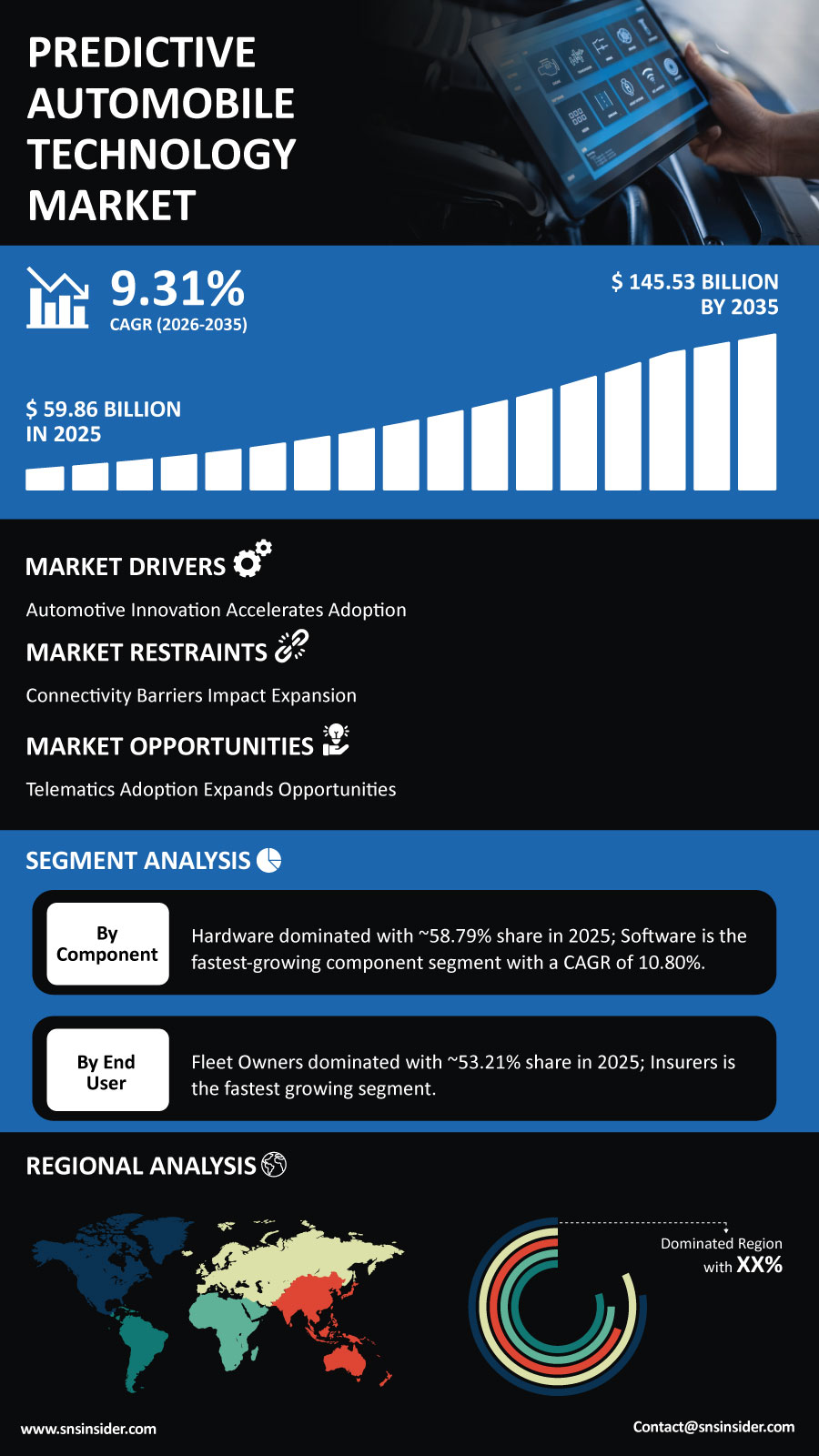
The global Predictive Automobile Technology Market is witnessing rapid transformation as automotive manufacturers, fleet operators, and technology providers increasingly adopt intelligent systems that enhance vehicle performance, safety, and operational efficiency. “According to a recent study by SNS Insider, the global Predictive Automobile Technology Market size valued at USD 59.86 billion in 2025, is anticipated to grow to USD 145.53 billion by 2035, registering a CAGR of 9.31% over the 2026–2035 forecast period.”
The growing trend toward connectivity, smart transportation systems, and intelligent vehicle management is driving up the need for predictive technology within both passengers and commercial vehicles. Automobile companies are deploying AI, sensor technology, cloud services, and analytics to achieve predictive maintenance, enhance driver safety, and optimize the lifecycle management of the vehicle.
The rising trend of electric vehicles, self-driving cars, and vehicle connectivity has created a greater push toward a market-oriented momentum. With the rise of large amounts of operational data in vehicles, predictive technologies have become key components in predicting future failure possibilities and enhancing energy efficiency.
To Get Detailed Insights on the Predictive Automobile Technology Market – Request a Sample Report
Connected Vehicle Ecosystem Expansion Creates New Growth Opportunities
Automobiles are gradually shifting their maintenance methods from conventional maintenance practices to smart systems that will enable constant monitoring of vehicle status. Predictive automobiles can assist car manufacturers and fleets in analyzing data collected by sensors and diagnostics modules to be aware of future maintenance needs even before something breaks.
Among the major users of such technologies are fleet owners, for whom predictive insights can help in reducing downtime and minimizing maintenance costs. More and more logistics and transportation businesses opt for cloud solutions for the effective management of their fleets.
Another factor driving the growth of the market is the implementation of cloud-based automotive solutions. Cloud computing gives the ability to manage information about vehicles in a central platform remotely.
Key Market Insights Highlight Emerging Technology Adoption Patterns
Based on vehicle type, passenger cars accounted for approximately 71.03% of the Predictive Automobile Technology Market share in 2025, supported by increasing integration of advanced safety systems, connected features, and intelligent monitoring solutions in modern vehicles. Growing consumer preference for technologically advanced automobiles is encouraging manufacturers to include predictive capabilities across multiple vehicle categories.
By component, hardware dominated the market with nearly 58.79% revenue share in 2025, driven by widespread deployment of sensors, communication modules, onboard computing units, and diagnostic systems required for predictive operations. Meanwhile, software is expected to expand at the fastest pace with a CAGR of 10.80%, as artificial intelligence platforms, predictive analytics tools, and cloud-based applications become central to automotive intelligence.
Based on deployment mode, on-premise solutions represented approximately 58.22% market share in 2025 due to their importance in real-time vehicle operations and safety-critical applications. However, cloud-based deployment is projected to grow rapidly at a CAGR of 11.20% as companies increasingly adopt scalable digital platforms for vehicle monitoring and analytics.
Predictive maintenance emerged as the leading application segment with around 31.20% share in 2025, as businesses prioritize reducing unexpected breakdowns and improving vehicle reliability. Fleet owners remained the largest end-user segment, accounting for nearly 53.21% market share, while insurance providers are witnessing increasing adoption of predictive driving analytics.
AI Integration and Vehicle Safety Priorities Shape Future Development
AI and machine learning are increasingly becoming important parts of future automotive technologies. Such technologies help the car understand different data patterns, detect abnormalities, and offer predictive suggestions that increase the safety of the car and improve its performance.
Additionally, initiatives to promote advanced driving assistance systems generate sustained demand for predictive technologies. The authorities from many countries where there is high production of vehicles are promoting safety-oriented vehicle technologies.
In addition to this, it is important to consider cybersecurity and data privacy issues, since the car will be collecting and analyzing large quantities of data related to the operation of the car and the driver. This is why the focus of the automotive industry is placed on data architecture and security mechanisms.
North America Maintains Significant Market Position; Asia Pacific Forecast to Expand at an 11.40% CAGR by 2035
North America continues to be an important region for predictive automobile technology because of high automotive innovation, widespread use of fleet telematics and connected car solutions. The US still remains one of the key contributors, fueled by advanced research and development in the field of automobiles and increased demands for intelligent transport systems.
The Asia Pacific region is projected to record the highest rate of growth over the forecast period, with the CAGR of 11.40% recorded up till 2035. High growth rates can be attributed to growing EVs adoption, development of smart cities projects, vehicle connectivity and investments into automotive artificial intelligence.
Europe is witnessing a stable adoption level due to the availability of advanced automotive manufacturing base, favorable regulatory environment and considerable investments into the development of connected mobility solutions by automobile companies.
Industry Participants Focus on Intelligent Mobility Innovation
The competitive landscape of the Predictive Automobile Technology Market remains highly dynamic as companies continue developing advanced software platforms, sensor technologies, and connected vehicle solutions. Market participants are focusing on improving predictive accuracy, enhancing cybersecurity, and creating integrated automotive ecosystems.
Key companies operating in the global Predictive Automobile Technology Market include Continental AG, Robert Bosch GmbH, ZF Friedrichshafen AG, Aptiv PLC, Valeo SA, Garrett Motion Inc., Harman International Industries, Visteon Corporation, NXP Semiconductors N.V., Aisin Corporation, Infineon Technologies AG, Qualcomm Technologies, Inc., Intel Corporation, Siemens AG, IBM Corporation, Microsoft Corporation, Verizon Communications Inc., AT&T Corporation, Huawei Technologies Co., Ltd., and Magna International Inc.
An SNS Insider analyst Santosh Bhul commented, “The combination of artificial intelligence, connected mobility, and advanced vehicle analytics is reshaping the automotive landscape. Companies that successfully integrate predictive capabilities with safety, efficiency, and user-focused solutions will be positioned to capture long-term opportunities in the evolving smart transportation ecosystem.”
About the Author

Get in touch