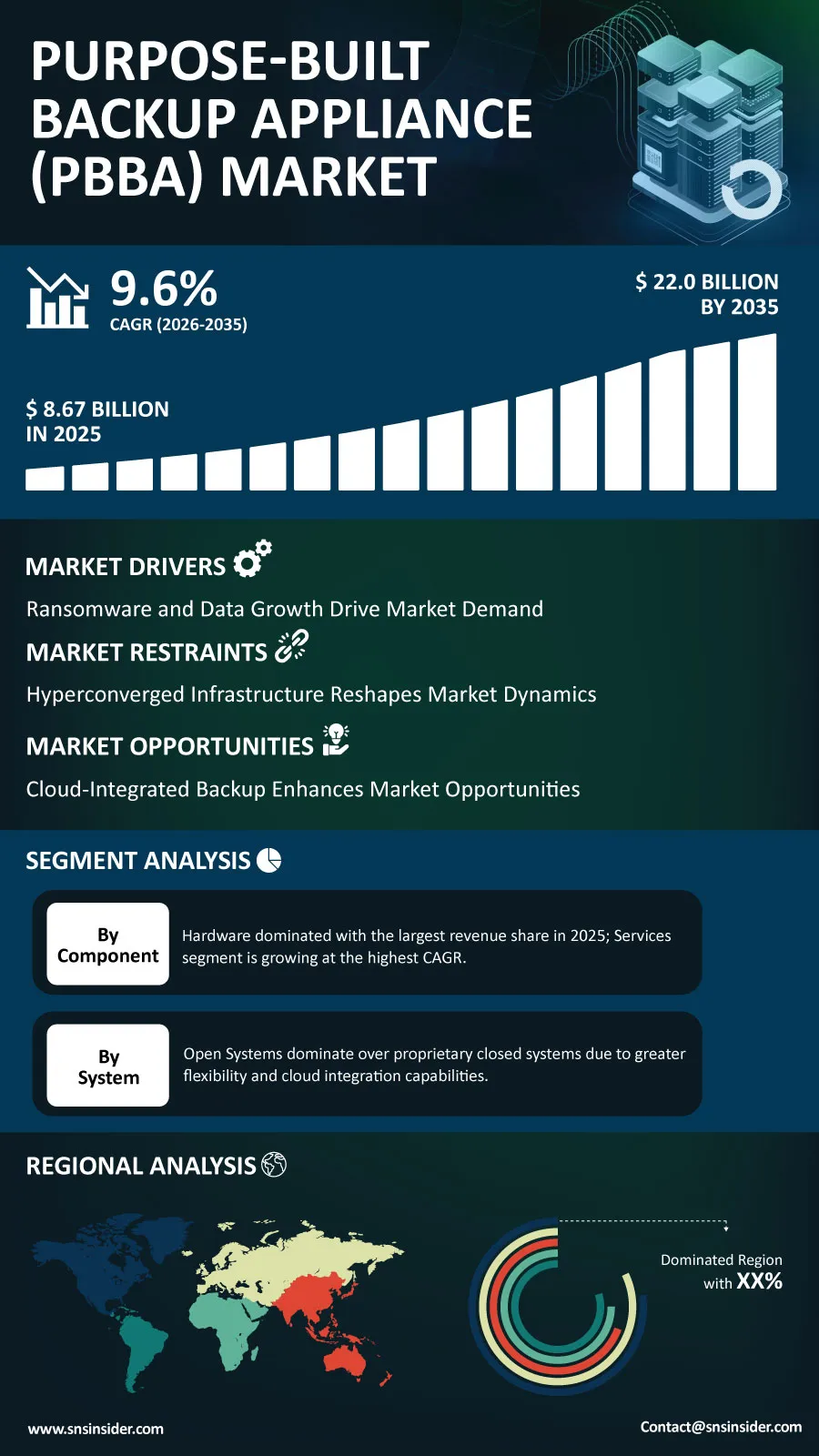
The global Purpose-Built Backup Appliance (PBBA) Market is gaining momentum as enterprises prioritize cyber resilience, rapid data recovery, and secure infrastructure amid rising digital workloads and increasingly sophisticated cyberattacks. According to a recent study by SNS Insider, the global Purpose-Built Backup Appliance Market size valued at USD 8.67 billion in 2025, is anticipated to grow to USD 22.0 billion by 2035, registering a CAGR of 9.6% over the 2026–2035 forecast period.
Enterprises are now rethinking their existing approaches to backup, as ransomware attacks begin targeting not only their live environment but also their data recovery stores. This trend is prompting organizations to develop new systems that can provide both speed and capacity of backup, along with storage optimization and encryption capabilities.
The amount of data that enterprises produce from their cloud apps, connected devices, AI-powered systems, and digital processes is making it all the more necessary for enterprises to have a robust backup system. Enterprises are now using both local appliance and cloud storage in combination to strike a balance.
To Get Detailed Insights on the Purpose-Built Backup Appliance Market – Request a Sample Report
Ransomware Resilience and Hybrid Infrastructure Create New Growth Opportunities
Backup infrastructure has become an essential element of business continuity because of the importance of cybersecurity today. Firms are looking for immutable storage, separate recovery environment, and enhanced monitoring functionality capable of ensuring the integrity of the recovery points despite attacks on production systems.
Another promising trend related to cloud-connected PBBA platforms that enable firms to ensure quick local recovery along with transferring non-volatile backup data to cloud storage in order to reduce infrastructure costs. Such solutions are especially beneficial for companies dealing with big data.
Artificial intelligence and behavioral analytics become more and more popular as modern backup and recovery platforms are being developed to identify any suspicious backup activities before they cause any serious consequences.
Key Market Insights Highlight Shifting Demand Patterns
Based on component, hardware is expected to maintain the largest revenue share in 2025, reflecting the importance of specialized storage systems, processing resources, networking capabilities, and dedicated data reduction technologies in enterprise backup environments. Services are projected to be the fastest-growing component as organizations increasingly require implementation, integration, managed backup, training, and technical support for complex cyber recovery environments.
By system, open systems continue to lead due to their ability to operate across heterogeneous enterprise environments and support diverse workloads, including physical servers, virtual machines, databases, containers, and cloud applications. Their interoperability and integration flexibility make them increasingly attractive to enterprises operating multi-platform IT infrastructures.
Based on enterprise size, large enterprises are expected to account for the largest share of market demand because of their extensive data volumes, complex technology environments, and stringent recovery requirements. Small and medium-sized enterprises are projected to experience the fastest growth as compact appliances, managed services, and more accessible pricing bring advanced backup protection within reach of organizations with limited IT resources.
By industry vertical, banking, financial services, and insurance, along with healthcare, represent major areas of adoption due to strict data protection requirements and the high consequences associated with data loss. IT and telecommunications are anticipated to record the fastest growth as service providers manage expanding customer datasets and require reliable recovery infrastructure to maintain service-level commitments.
Cyber Resilience Becomes a Core Enterprise Priority
Due to the rising number of ransomware attacks, organizations are now evaluating their ability to recover from such attacks. Backup appliances are designed specifically for data deduplication, fast restore, data encryption, and safe backup storage for enterprises that need resiliency against potential cyberattacks.
On the other hand, data created from artificial intelligence tasks, digital offerings, Internet of Things, and cloud computing increases the amount of data that needs to be stored. As a result, companies are searching for a backup solution that scales efficiently but does not burden the company financially.
North America Maintains Market Leadership While Asia Pacific Accelerates Data Recovery Adoption
North America is expected to remain the leading regional market, supported by a high concentration of enterprise data centers, advanced cybersecurity awareness, stringent regulatory requirements, and strong demand for ransomware-resistant infrastructure. The United States continues to represent the region's largest market as businesses across financial services, healthcare, government, and technology invest heavily in data recovery capabilities.
Asia Pacific is projected to experience the fastest expansion as rapid digitalization, growing enterprise IT infrastructure, and increasing awareness of cyber risks drive demand for modern backup systems. China represents a major regional market, while India, Japan, and South Korea are also creating opportunities through cloud adoption and expanding digital business operations.
Industry Participants Focus on Secure and Integrated Backup Solutions
The competitive landscape is evolving as vendors focus on strengthening cyber recovery, integrating cloud services, and improving automation across enterprise backup environments. Companies are investing in immutable storage, AI-based threat detection, hybrid cloud orchestration, and efficient data reduction technologies to address increasingly complex recovery requirements.
Key companies operating in the global Purpose-Built Backup Appliance Market include Dell Technologies Inc., Veritas Technologies LLC, IBM Corporation, Oracle Corporation, Hewlett Packard Enterprise, Commvault Systems Inc., Barracuda Networks, Arcserve LLC, Quantum Corporation, ExaGrid Systems Inc., Veeam Software, Cohesity Inc., Rubrik Inc., Druva Inc., Zerto (HPE), NetApp Inc., Hitachi Vantara LLC, Huawei Technologies Co., Ltd., Lenovo Group Limited, and StoneFly Inc.
An SNS Insider analyst Sushant Kadam commented, “Ransomware exposure, expanding enterprise data volumes, and stricter expectations for operational resilience are making reliable recovery infrastructure a strategic priority. Providers that combine immutable protection, intelligent threat detection, cloud integration, and rapid recovery capabilities will be well positioned to capture growing enterprise demand for next-generation backup solutions.”
About the Author

Get in touch