
Key Market Highlights:
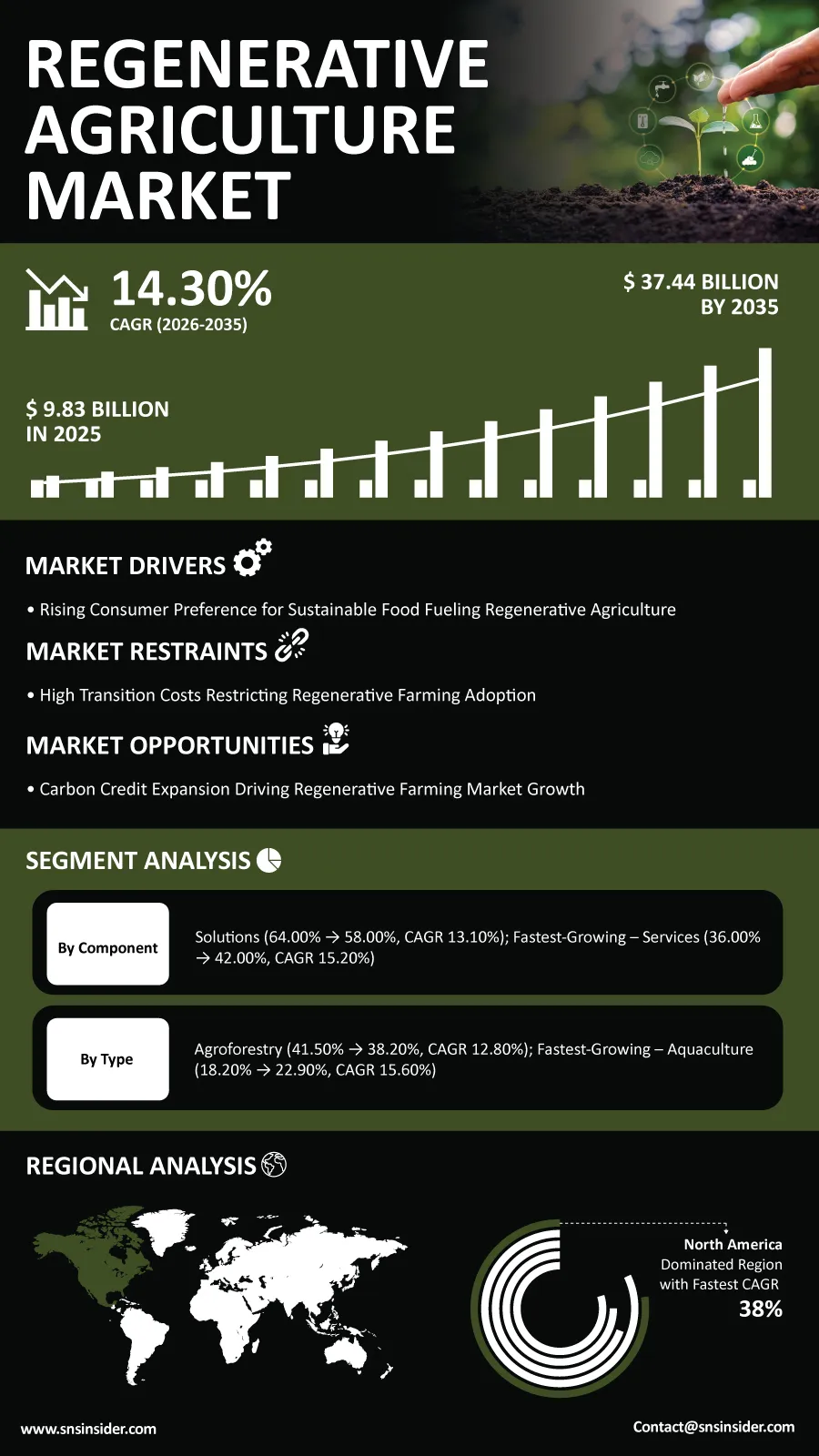
- The Global Regenerative Agriculture Market is anticipated to be USD 37.44 billion by 2035.
- The market is expected to grow at a CAGR of 14.30%.
- The U.S. Regenerative Agriculture Market is expected to be valued at USD 12.45 billion by 2035 at a CAGR of 14.80%.
- North America held a market share of more than 38% of the global revenue in 2025, whereas the Asia Pacific region is forecast to grow at more than 15.5% CAGR.
- Solutions segment held a market share of 64.00% in 2025, whereas the Services segment is expected to grow at a CAGR of 15.20%.
- The Agroforestry segment was valued at 41.50% of the market in 2025, whereas the Aquaculture segment is projected to grow at a CAGR of 15.60%.
- The Farmers segment was valued at 52.30% of the market in 2025, whereas the Financial Institutions segment is expected to register a CAGR of 16.10%.
- The Soil Health Improvement segment was valued at 46.80% of the market in 2025, while Carbon Sequestration is expected to grow at a 16.50% CAGR.
Market Overview:
The global Regenerative Agriculture Market size valued at USD 9.83 billion in 2025, is anticipated to grow to USD 37.44 billion by 2035, registering a CAGR of 14.30% over the 2026–2035 forecast period. The increasing investments in climate smart agriculture, increasing use of sustainable farming practices, and sustainability efforts along the food value chain have resulted in a powerful push towards regenerative agriculture.
To Get Detailed Insights on the Regenerative Agriculture Market – Request a Sample Report
Why is the Regenerative Agriculture Market Growing?
Agricultural producers are embracing agricultural practices that help to enhance the quality of their soils and ensure sustainability. The increasing concern about the degradation of land, increased demand by consumers for sustainable products, and the presence of enabling policies in both the public and private sectors are motivating farmers to embrace regenerative agricultural practices. The use of digital agriculture is also enhancing agricultural profitability.
How is Technology Accelerating Sustainable Farming?
The sophisticated technology of precision agriculture is revolutionizing regenerative agriculture using artificial intelligence, internet of things-based field surveillance, satellite imaging, and soil analysis. Such technologies enable farmers to make calculated decisions about plant growth, water consumption, nutrition, and carbon measurement. In addition, with increasing focus on sustainable reporting, digital technologies are playing an essential role in assessing environmental impacts and sustainable sourcing efforts.
Which Market Segments are Driving Industry Growth?
Component
In 2025, the Solutions segment held the major share of the market due to increasing usage of biotechnology, soil management solutions, and digital farm technologies. The Services segment is expected to grow the fastest due to the increase in demands for consultation services.
Type
Agroforestry dominated the industry in 2025 owing to its efficiency in promoting biodiversity, improving soil fertility, and diversification of farming revenue. It is expected that aquaculture will grow at the fastest pace owing to growing investments in sustainable fish farming and aquaculture.
End User
The farmers were the leaders in the market income in 2025 as more people adopted sustainable agricultural techniques. The Financial Institutions sector is projected to have the most growth due to increased investments in sustainable agriculture financing and environment-related activities.
Application
Soil Health Improvement dominated the market share in 2025, indicating the priority given to restoring soil productivity in the industry. Carbon Sequestration is expected to grow at the highest rate owing to the growing number of carbon credits programs.
Technology Trends Accelerating Industry Innovation
The regenerative agriculture industry will remain supported by technological advancements that combine sustainability with precise farming practices. These technologies include artificial intelligence, remote sensing, satellite technology, and farm management systems that can enhance productivity and lessen the environmental footprint. Other examples include carbon accounting technology, biological crop protection, and decision support technologies.
Why Does North America Lead While Asia Pacific Emerges as the Fastest-Growing Region?
North America was still the largest regional market in 2025 in terms of market revenue. Government backing, extensive commercial farming systems, increased sustainability measures by corporations, and adoption of new-age agricultural technology have all been helping the region to maintain its dominance.
The Asia Pacific region is anticipated to see the most rapid expansion during the forecast period. Agricultural advancements, rising food demand, government initiatives, and sustainable agriculture awareness in countries such as India, China, and Australia are propelling regional market development.
Competitive Landscape:
Competition in the Regenerative Agriculture Market continues to intensify as agritech firms, sustainability experts, food processors, and technology firms continue to invest in agriculture solutions that help combat climate change. Companies in the industry are developing various technologies like digital platforms, AI-enabled farm management systems, biologics, and carbon management solutions to assist farmers and achieve sustainable supply chains.
Key companies operating in the global Regenerative Agriculture Market include:
Vayda, Terramera Inc., Agreed.Earth, Biotrex, Ecorobotix SA, Ruumi, Continuum Ag, Aker Technologies, Inc., Indigo Ag, Inc., Tortuga Agricultural Technologies, Inc., Astanor Ventures, SATELLIGENCE, Nestlé S.A., Danone S.A., General Mills, Inc., Cargill Incorporated, Unilever PLC, Grounded, and Soil Capital Belgium SPRL.
An SNS Insider analyst Sushant Kadam commented, "The regenerative agriculture market is entering a new phase of growth as environmental sustainability, carbon management, and digital farming technologies become central to modern agricultural strategies. Organizations that successfully combine advanced agronomic solutions with measurable environmental outcomes are expected to strengthen their competitive position as global demand for sustainable food production continues to expand."
About the Author

Get in touch




