
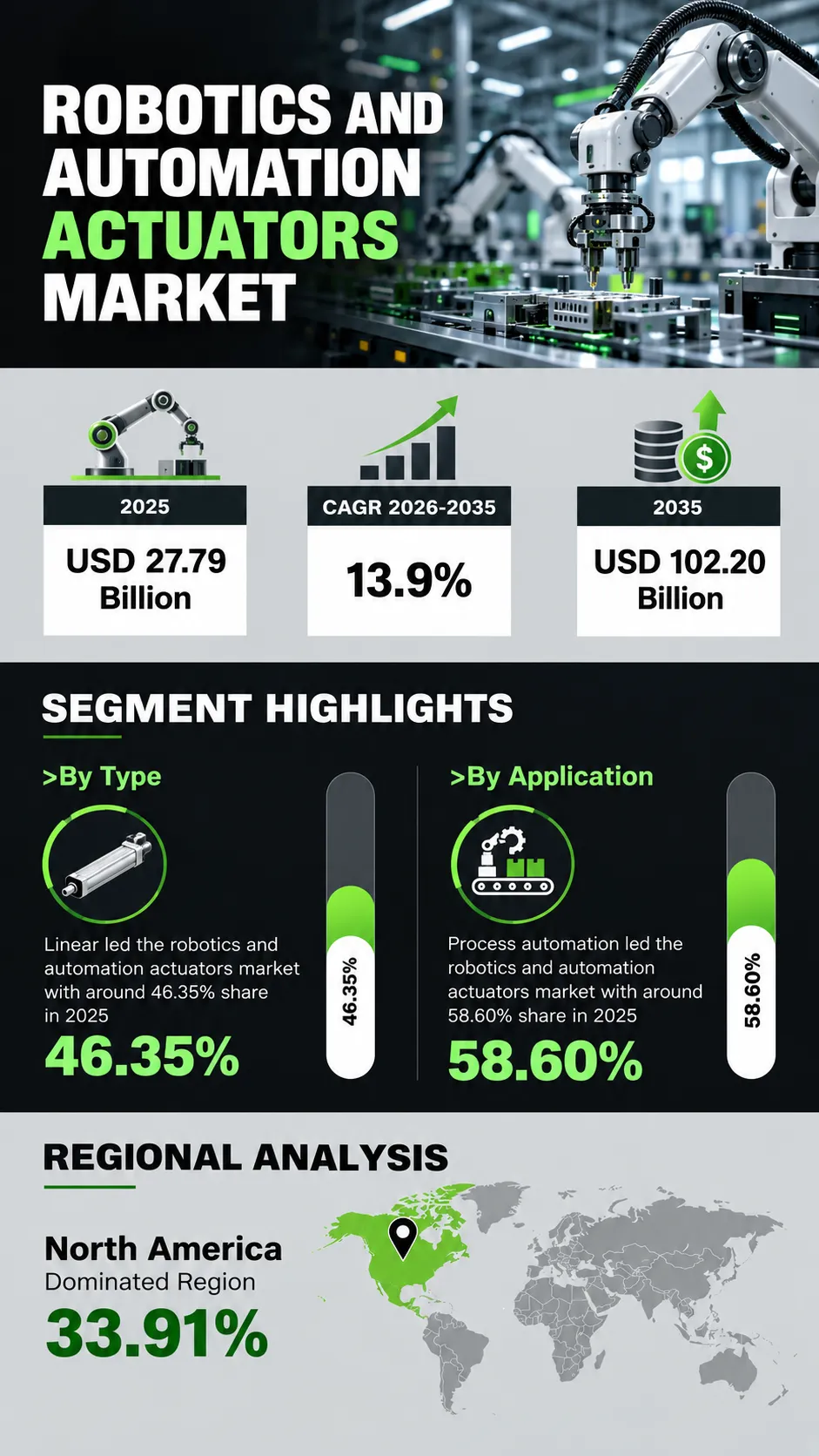
The global Robotics and Automation Actuators Market is set for extraordinary expansion as manufacturers worldwide continue automating precision motion control systems. "According to a recent study by SNS Insider, the global Robotics and Automation Actuators Market size valued at USD 27.79 billion in 2025, is anticipated to grow to USD 102.20 billion by 2035, registering a CAGR of 13.9% over the 2026-2035 forecast period."
There have been tremendous changes within actuator design and manufacturing technology over time due to which many manufacturers who aim at improving precision can take advantage of this trend. This includes the need for more advanced, energy-efficient systems that will provide manufacturers with the ability to achieve precise motion control. This applies in situations where robotics and automation actuators are used across process automation and robotics applications.
Manufacturers are constantly working hard to ensure that their actuator systems perform better than before in order to meet various needs of industrial automation customers worldwide.
To Get Detailed Insights on the Robotics and Automation Actuators Market – Request a Sample Report
Precision Motion Control Ecosystems Create New Demand
The robotics and automation actuators market has evolved from basic pneumatic systems to more advanced electric and AI-integrated use cases. The growing investment in sensor fusion, embedded control, and additive manufacturing technology for a variety of applications has required the development of more efficient and reliable actuator systems.
New designs of robotics and automation actuators can increase precision, reduce energy consumption, and allow for broader integration across collaborative and autonomous robotic platforms. This gives manufacturers the possibility to be more effective when serving automotive, aerospace, and industrial customers and doing better operational efficiency.
Actuator manufacturers, robotics companies, and computing platform providers are increasingly cooperating thanks to the growing interest in developing future solutions for precision motion control.
Key Market Findings Highlight High-Growth Segments
The linear segment dominated all categories in the robotics and automation actuators market share with a market revenue share of 46.35% in 2025 due to accurate and controlled motion delivery.
The fastest growing category is expected to be rotary actuators which will grow at a CAGR of 11.20% through 2035. This will be possible owing to the increasing autonomous vehicle and drone reliance on precision motion control.
By actuation method, electric actuators held the largest share of total market revenue of 48.27% in 2025 due to superior precision and energy efficiency. The pneumatic segment will see the fastest growth in revenue generation at a CAGR of 15.50%.
Based on end-user, automotive generated a share of 25.80% of market revenue in 2025 thanks to extensive automation across vehicle manufacturing and assembly. On the other hand, aerospace and defense will be the segment recording the fastest revenue growth at a CAGR of 11.60%.
Distributive trends are changing as well. Process automation applications remain substantial, but robotics applications will turn out to be the fastest-growing category through 2035, on the back of collaborative robot and service robot deployment growth.
Precision, Energy Efficiency, and AI Integration Gain Importance
In this regard, manufacturers have been looking at actuator systems that would make their operations more precise and require less energy consumption and be more AI-integrated.
Innovation in electric actuator technology, sensor fusion, and collaborative robot compatibility has been making it possible for companies to come up with systems that can meet increasingly demanding smart manufacturing expectations. In addition to that, increasing emphasis on green manufacturing and recyclable composite materials is also making it possible for companies to find solutions that optimize environmental compliance.
Such trends are likely to become even more prominent in the future.
North America Emerges as the Largest Market with 33.91% Revenue Share Amid Rising Industry 4.0 Adoption
The North America region represented 33.91% share of global market revenue in 2025 and was the largest regional market, owing to a well-established manufacturing ecosystem and government policies incentivizing Industry 4.0 adoption. In addition, Asia Pacific exhibits the fastest growth in the market, propelled by rapid industrialization and government automation initiatives across the region's fast-growing manufacturing industries.
On the other hand, Europe represented a meaningful share of global market revenue in 2025, aided by diverse manufacturing sectors across Germany and Italy amplifying demand for industrial robots.
Leading Companies Drive Innovation and Competition
The environment continues to stay very dynamic since players continue innovating on products and technologies as well as forming partnerships in order to enhance their position in the industry.
Some of the major companies that operate in the global robotics and automation actuators market are Parker Hannifin Corporation, ABB Ltd, FANUC Corporation, Rockwell Automation Inc., Siemens AG, Moog Inc., THK Co. Ltd., SMC Corporation, Festo SE & Co. KG, and Curtiss-Wright Corporation.
An SNS Insider Analyst Sushant Kadam commented, "The rapid convergence of AI and robotics technology is creating unprecedented demand for high-precision, energy-efficient actuator solutions. Manufacturers that successfully combine electric actuator innovation, sensor fusion capability, collaborative robot compatibility, and advanced manufacturing scale will be best positioned to capitalize on emerging opportunities across automotive, aerospace, and industrial applications."
About the Author

Get in touch




