
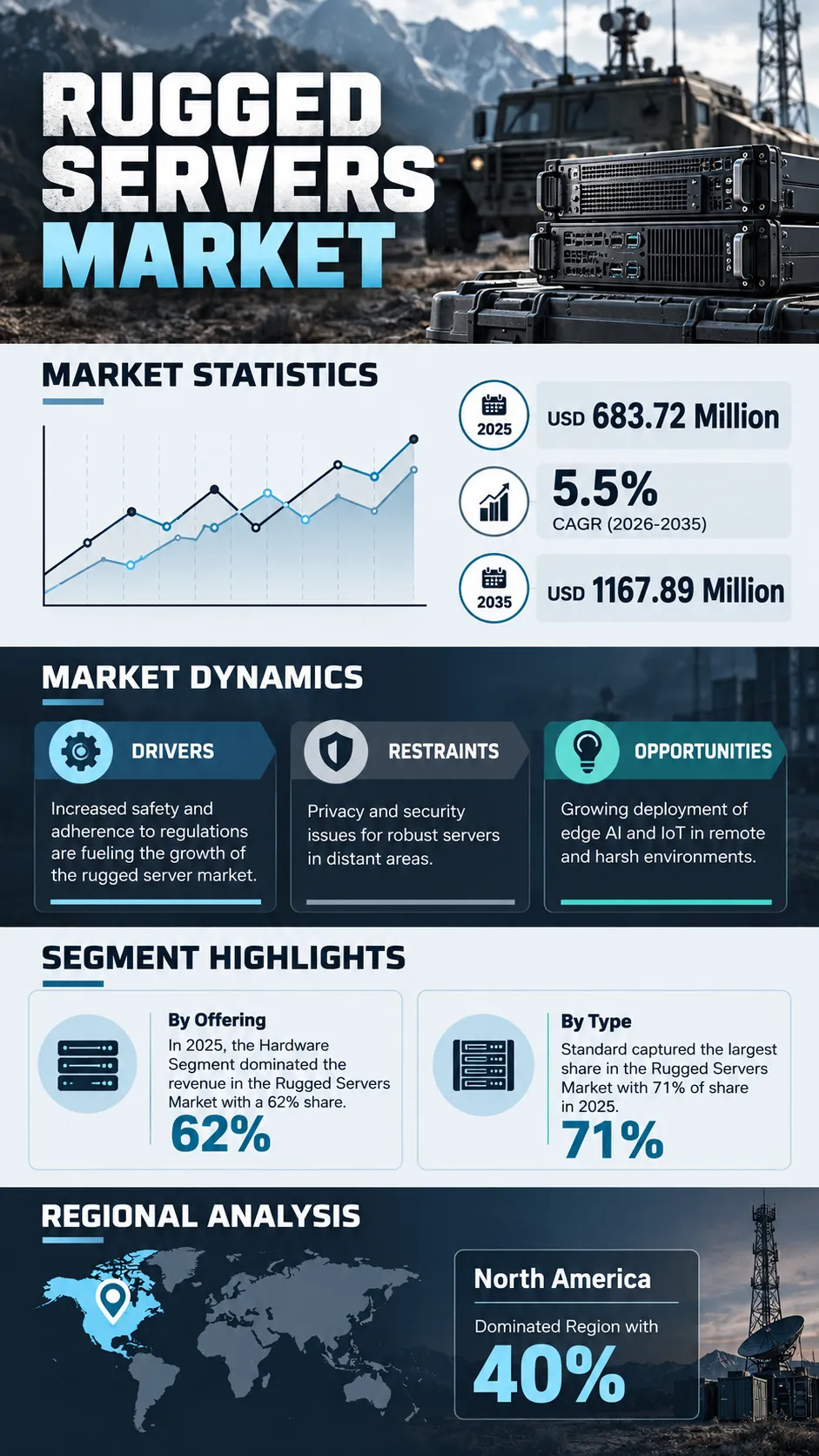
The global Rugged Servers Market is set to grow steadily as military agencies, industrial companies, and providers of critical infrastructure make more investments in computers that can work under tough conditions. “According to a recent study by SNS Insider, the global Rugged Servers Market size valued at USD 683.72 million in 2025, is anticipated to grow to USD 1,167.89 million by 2035, registering a CAGR of 5.5% over the 2026–2035 forecast period.”
With the expanding use of connected devices, edge computing, artificial intelligence, and industrial automation, there has been an increased demand for computing systems capable of delivering dependable performance beyond traditional data centers. Military sites, transportation networks, power stations, factories, and remote industrial facilities now need computing capacity that can perform despite being exposed to vibrations, dust, humidity, temperature changes, and physical shock.
Rugged computing systems are also getting more and more significant because of the trend of moving data processing closer to the location of operations. This shift enables faster decision-making, supports autonomous systems, and reduces dependence on centralized infrastructure in mission-critical environments.
To Get Detailed Insights on the Rugged Servers Market – Request a Sample Report
Edge Computing and Mission-Critical Operations Create New Growth Opportunities
With the rise of edge computing, there are now many chances for rugged server suppliers to cater to enterprise needs of performing computations in proximity to their machinery, sensors, vehicles, or other equipment. For instance, localized computational devices will be used in industry for predictive maintenance and automated manufacturing, machine vision, and analytics.
At the same time, defense and aerospace sectors are helping the market expand by replacing their outdated equipment with new command and control centers, communications equipment, sensors, surveillance technology, and autonomous systems. All those applications require computing solutions that are able to function in harsh environmental conditions.
Meanwhile, growing regulatory attention to operational safety, cybersecurity, and equipment reliability is encouraging organizations to select computing platforms capable of meeting industry-specific technical and environmental standards.
Key Market Insights Highlight Shifting Demand Patterns
By offering, hardware was projected to constitute about 62% of the global market revenue by 2025. The demand is high owing to the need for rugged hardware that can endure environmental stresses that would affect regular computer hardware. The development of more efficient hardware is driving adoption in military, industry, and edge computing applications.
Based on type, standard rugged servers were projected to hold the leading position with a 71% revenue share in 2025. The versatility of the servers, which can be applied in several industries, such as transport, telecommunications, industrial operations, among others, has aided in the popularity of these servers. Their ability to combine environmental protection with general-purpose computing functionality makes them suitable for diverse operational requirements.
The market is also benefiting from growing requirements for real-time processing. AI and machine learning workloads, IoT deployments, autonomous systems, and advanced industrial applications are increasing demand for rugged platforms that deliver higher processing capacity while maintaining reliability in non-traditional computing environments.
Durable Computing Becomes Essential for Industrial Digitalization
Rugged servers are being incorporated by manufacturers into Industry 4.0 scenarios in which uninterrupted computation is critical for automation and asset tracking processes. In oil and gas extraction, mining plants, utilities, and transport networks, there are also computing requirements that have to be performed in distant or harsh physical environments.
The other growing factor is that of cybersecurity. Rugged servers placed away from protected data centers become more vulnerable to potential cyber and physical attacks, thus necessitating systems built for security.
It means that the features of durability, intelligence, networking, and security result in a transition of rugged servers from dedicated military systems to a broader class of industrial computer infrastructure.
North America Maintains 40% Rugged Servers Market Share as Europe and Asia Pacific Strengthen Adoption
North America was projected to hold around 40% share in the total global Rugged Servers Market in 2025 due to the significant expenditure on defense and aerospace, initiatives related to military modernization and growing use of edge computing. Industrial automation and digitalization are helping to drive demand within the region.
Europe and Asia Pacific regions are also observing steady market development with increasing investments being made by governments and businesses for computing infrastructure, defense modernization, smart city programs and industrial automation. The rapid industrial growth and increasing technology investments within the Asia Pacific are driving demand.
Latin America and Middle East & Africa regions are undergoing gradual adoption especially within mining, oil & gas, defense, infrastructure and other industries where computing systems have to perform under extreme environmental conditions.
Industry Participants Focus on High-Performance Rugged Computing
The competitive landscape remains focused on improving processing performance, environmental protection, modularity, connectivity, and cybersecurity. Manufacturers are developing systems capable of supporting increasingly demanding AI, IoT, and edge workloads while maintaining compliance with military and industrial requirements.
Key companies operating in the global Rugged Servers Market include Dell Technologies, Siemens AG, Crystal Group, Inc., Core Systems, CP Technologies, Portwell, Inc., Symmatrix, Mercury Systems, Trenton Systems, One Stop Systems, ADLINK Technology Inc., Advantech Co., Ltd., General Micro Systems, Inc., GETAC, Kontron, Westek Technology, Moxa, Systel, Shenzhen Lexic Technology, and Octagon Systems.
An SNS Insider analyst Sushant Kadam commented, “The growing convergence of edge computing, industrial automation, AI, and mission-critical operations is creating sustained demand for computing platforms capable of performing reliably beyond conventional data-center environments. Manufacturers that combine processing performance with environmental durability, cybersecurity, and flexible deployment architectures will find expanding opportunities across defense and industrial markets.”About the Author

Get in touch




