
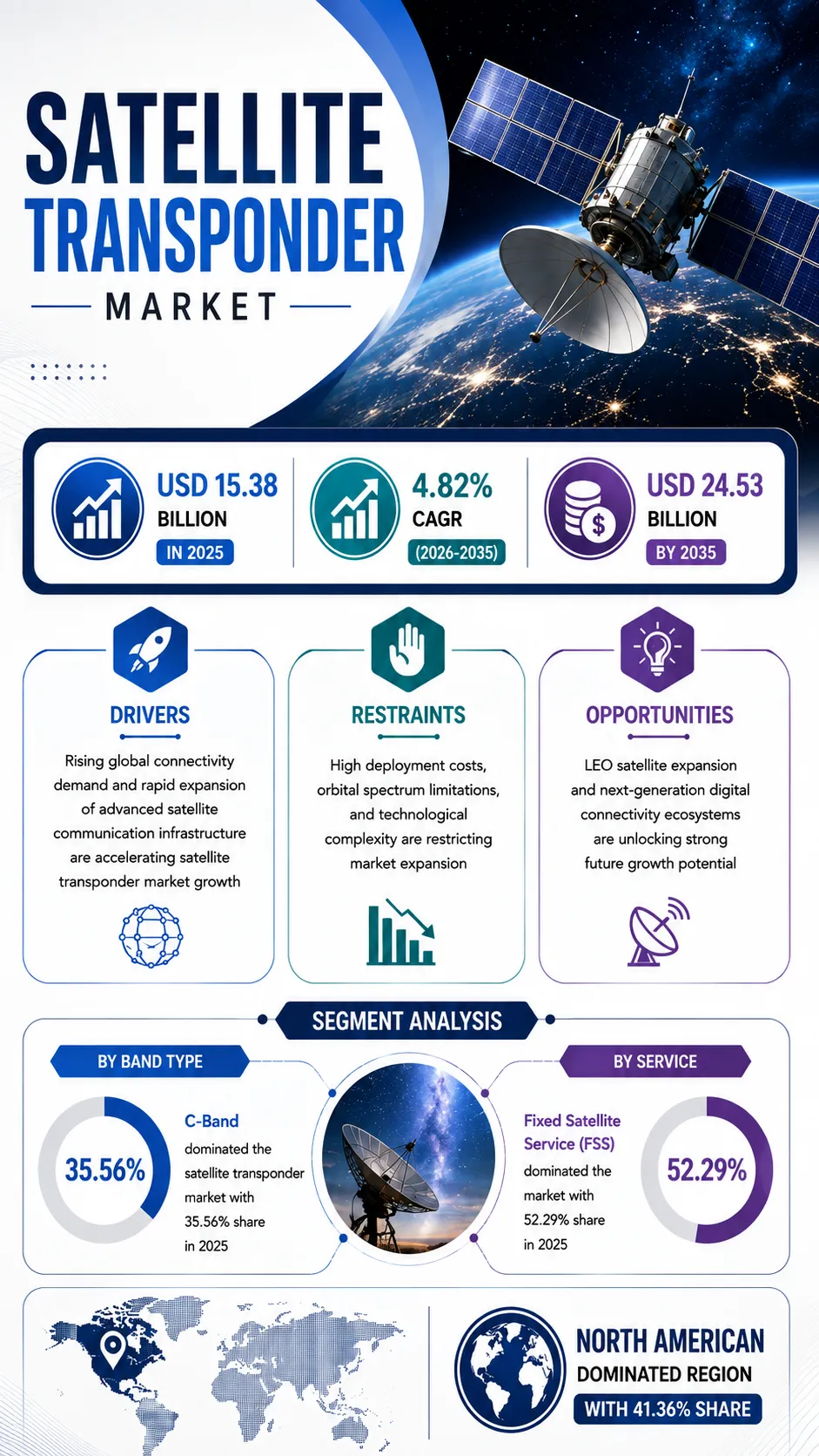
The global Satellite Transponder Market is poised for steady expansion as demand grows for dependable broadband, broadcasting, mobility, and secure communication services across increasingly connected economies. “According to a recent study by SNS Insider, the global Satellite Transponder Market size valued at USD 15.38 billion in 2025, is anticipated to grow to USD 24.53 billion by 2035, registering a CAGR of 4.82% over the 2026–2035 forecast period.”
Satellite networks will become increasingly important as an essential part of communication infrastructure in order to provide connectivity outside the scope of the traditional terrestrial network. The increasing demands for high-bandwidth data transfers in air, sea, isolated areas, disaster zones, and government networks have been encouraging investment in next-generation transponders.
The satellite communications industry is also seeing benefits from advancements in high-throughput satellites, flexible digital payload, and multi-orbital architecture. These developments will allow operators to increase their efficiency by improving bandwidth usage and adapt to changing connectivity demands.
To Get Detailed Insights on the Satellite Transponder Market – Request a Sample Report
Multi-Orbit Networks and Digital Connectivity Create New Market Opportunities
The integration of geostationary, medium earth orbit, and low earth orbit satellites is creating an expanded communications environment for satellite operators and service providers. This trend will allow networks to offer wide area coverage in addition to low latency and more flexible capacity.
There is going to be continued demand from users who need broadband services in regions that currently lack them. Airline companies and maritime businesses will continue to invest in connectivity services for improving passenger experience and communications needs such as navigation and data exchange.
Another factor making new opportunities possible is software-defined satellites which allow satellite operators to have more flexibility with regard to how they allocate capacity. With the global development of digital infrastructure, there will be increasing demand for flexible transponder solutions.
Key Market Insights Highlight Changing Connectivity Requirements
By band type, in 2025, C-Band had captured a market share of 35.56%, thanks to its presence in broadcasting, governmental communications, and enterprise connectivity. It is estimated that Ka-Band would achieve the highest growth till 2035 owing to rising demands for high-speed broadband and data-based services.
By service, Fixed Satellite Service (FSS) captured 52.29% share of revenue in the market in 2025 because it was widely used in TV transmission, commercial communications, and organizational communications. Mobile Satellite Service (MSS) is expected to grow rapidly due to increasing demand for transport and defense industry where communication on the move is a necessity.
In the application segment, Video Broadcasting represented 32.42% of market revenue in 2025, while Broadband & Data Connectivity is forecast to achieve the fastest growth. By end user, the Commercial segment led with 37.36% share, whereas Aviation & Maritime is anticipated to see the strongest expansion.
By satellite orbit, Geostationary Earth Orbit (GEO) captured 66.29% of the market in 2025. Low Earth Orbit (LEO) is expected to grow at the fastest rate as new constellation deployments reshape global connectivity networks.
Next-Generation Satellite Technologies Accelerate Industry Transformation
In satellite communications, there is a trend towards becoming adaptive and digitally-controlled. With high throughput, more bandwidth is provided, and through advanced payload technology, it has been made possible to route and switch capacity in communication.
The implementation of software-defined technologies is another aspect that is making it easier to adapt satellite capacity according to regional traffic needs. The integration of space networks with terrestrial networks will be crucial in providing continuous connectivity for customers.
Such developments in technology are pushing the satellite firms to upgrade their current fleet of satellites while designing systems that are flexible, efficient, and compatible with various satellite orbits.
North America Accounted for 41.36% Market Share in 2025; Asia Pacific Forecast to Expand at a 5.46% CAGR by 2035
North America made up 41.36% of market revenue in 2025 owing to its large satellite infrastructure and advanced commercial and government communication demands. Investments will be made towards future generation space systems, high throughput systems, and multi-orbit networks.
Asia Pacific is predicted to grow at a rate of 5.46% CAGR till 2035 because of rising needs for broadband internet services, expansion of national space programs, and investments in digital infrastructure. China, India, Japan, and other Southeast Asian countries will play a vital role in growing revenues from Asia Pacific region.
Europe is another major market owing to its secure communications requirement, broadcasting, and international communications. At the same time, the Middle East & Africa, as well as Latin America, are creating opportunities with their rural connectivity, smart infrastructure, and satellite-based services.
Industry Participants Focus on Capacity Expansion and Flexible Communications Solutions
The competitive landscape is evolving as satellite operators invest in high-throughput capacity, digital payloads, and multi-orbit connectivity. Companies are seeking to strengthen service portfolios for enterprise customers, government organizations, broadcasters, and mobility providers.
Key companies operating in the global Satellite Transponder Market include Intelsat S.A., SES S.A., Eutelsat Group, Viasat Inc., Telesat Corporation, Arabsat, Thaicom Public Company Limited, Asia Satellite Telecommunications Company Limited, Hispasat S.A., JSAT Corporation, EchoStar Corporation, Inmarsat Maritime (Viasat), ABS Global Ltd., China Satcom Co., Ltd., Turksat A.S., Russian Satellite Communications Company, Yahsat Space Services, KT SAT Corporation, Nilesat, and Spacecom Satellite Communications Ltd.
An SNS Insider analyst Santosh Bhul commented, “The growing need for universal connectivity is expanding the strategic importance of satellite communication infrastructure. Companies investing in high-capacity networks, flexible payload technologies, and integrated multi-orbit platforms will be better positioned to support the next phase of global digital connectivity.”
About the Author

Get in touch




