
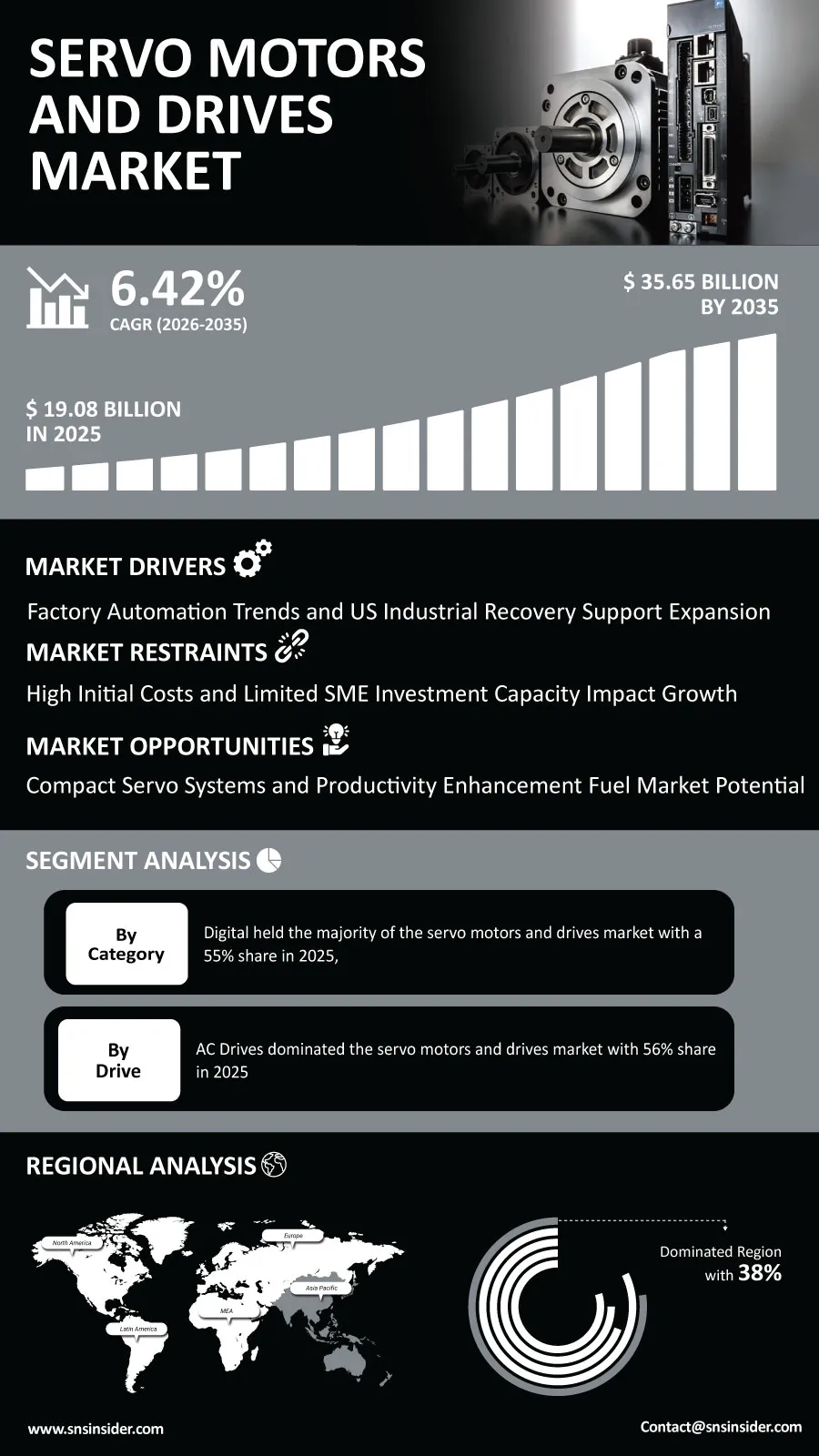
The global Servo Motors and Drives Market is booming because of increased investment by companies into automation and precision motion control systems. According to a recent study by SNS Insider, the global Servo Motors and Drives Market size valued at USD 19.08 billion in 2025, is anticipated to grow to USD 35.65 billion by 2035, registering a CAGR of 6.42% over the 2026–2035 forecast period.
Manufacturing businesses have also begun to use servo-controlled systems more and more in order to increase the precision of control over the movement of machines and to streamline production. The need for such systems is especially great for production in the automotive industry, electronics, packaging, robotics, and automation of material handling.
The advent of smart factories adds another dimension to the usage of servos. The modern systems allow for exchanging operation data with the industrial network, making it easier to monitor equipment and detect any problems.
To Get Detailed Insights on the Servo Motors and Drives Market – Request a Sample Report
Smart Manufacturing Investments Create New Growth Opportunities
There are positive conditions being created through the shift towards Industry 4.0 in the world. Factories are looking for machinery that will be able to deliver repeatable motions, precision positioning, and quick reactions while fitting well within the programmable controller and industrial communication networks.
The other key demand driver for servo motors is increased use of robotics and automated storage and retrieval systems in warehouses. In this regard, the need for increasing production capacities amidst limited availability of workforce makes the use of servo motors in robotics and automation processes more relevant.
Advances in technology are also resulting in increased compactness and efficiency of servos. Tuning assisted by AI, better design of motors, and improved connectivity are facilitating lesser commissioning needs and better responsiveness of machines.
Key Market Insights Highlight Shifting Demand Patterns
By product type, digital servos are forecast to command a 55% market revenue share by 2025 due to demand for programmable motion control, diagnostics improvement, and connectivity with modern factory automation systems. Analog servo systems will continue to cater to cost-efficient machinery and existing machines which require simple control architecture.
By drive technology, AC drives are projected to capture a 56% market share by 2025 because of their capability to provide accurate speed and torque control in complex industrial environments. DC drives will still be useful in certain applications requiring simpler architectures and unique power supply considerations.
On the basis of end use application, robotics and material handling systems have emerged as significant sources of demand due to rising automation spending in factories and warehouses. The semiconductor fabrication sector presents additional opportunities as nations and manufacturers work to increase their indigenous production capacities with advanced manufacturing machines.
Precision Automation Strengthens Industrial Demand
The importance of servo systems in the industrial environment is gaining momentum where speed and repeatability of operations play a major role. Assembly, inspection, packaging, cutting, printing, and material handling equipment needs precision in motion control, hence the need for sophisticated servo technology.
The inclusion of industrial IoT is also contributing towards improving the capabilities of the systems. Servo drives, which are connected to the system, may feed information about their performance to the factory management systems.
Miniaturization is providing opportunities in small machines and robotics as well. The smaller motors with higher power densities are helping equipment makers design smaller and more flexible machines without compromising on their movement.
Asia Pacific Accounts for 38% Market Share in 2025 as China Generates 44.8% of Regional Revenue
The Asia Pacific region is expected to remain the leading regional market, generating around 38% of total revenue in 2025. Robust manufacturing growth, widespread electronics manufacturing, growing industrial automation, and investments in new production technologies have been driving the regional demand for this product. The market share in the Asia Pacific region is driven by China, which holds approximately 44.8% of the market revenue.
The North American region is forecast to show rapid growth due to the growth in reshoring of manufacturing activities, investments in semiconductors, clean energy production, and the growing adoption of smart factories. The U.S. generates approximately 82.5% of the revenue from this market in North America.
Europe continues to reap the rewards of its existing industrial automation ecosystem, energy efficiency concerns, and adoption of Industry 4.0 technology.
Industry Participants Focus on Intelligent Motion Solutions
The competitive environment is still very much alive as manufacturers are constantly innovating their servo platforms to be more energy-efficient, better connected, safer, and easier to commission. Companies are also working towards producing smaller and more automated machines that can meet the needs of the increasingly connected production environment.
Key companies operating in the global Servo Motors and Drives Market include ABB Ltd., Advanced Motion Controls, Allied Motion Inc., Baumüller GmbH, Bosch Rexroth AG, Danfoss A/S, Delta Electronics Inc., ESTUN Automation Co. Ltd., Fuji Electric Co. Ltd., Hitachi Ltd., KEB Automation KG, Kollmorgen Corporation, Mitsubishi Electric Corporation, NIDEC Corporation, Panasonic Corporation, Rockwell Automation Inc., Schneider Electric SE, Siemens AG, YASKAWA Electric Corporation, and Emerson Electric Co.
An SNS Insider analyst Sushant Kadam commented, “The expansion of smart manufacturing, robotics, and connected production environments is creating sustained demand for precise and intelligent motion-control technologies. Servo manufacturers that combine energy efficiency, compact engineering, connectivity, and simplified commissioning will be well positioned to benefit from the next phase of industrial automation investment.”
About the Author

Get in touch




