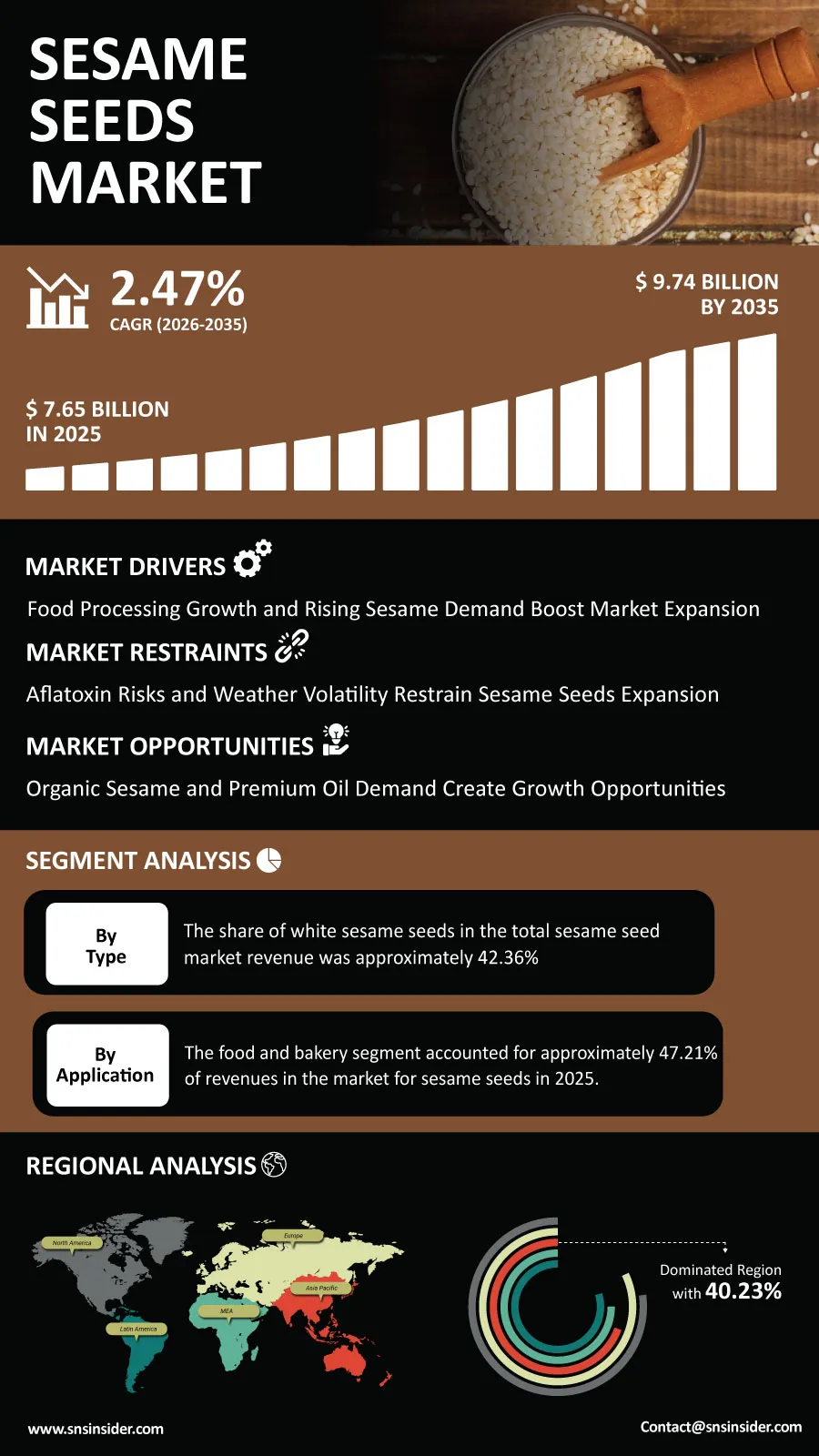
The global market for Sesame Seeds is growing steadily due to the incorporation of nutritional ingredients by food producers into various products like bakery products, packaged foods, and edible oils. “According to a recent study by SNS Insider, the global Sesame Seeds Market size valued at USD 7.65 Billion in 2025, is anticipated to grow to USD 9.74 Billion by 2035, registering a CAGR of 2.47% over the 2026–2035 forecast period.”
Evolving consumer behaviour and rising interest in natural food additives, have led to increased commercialisation of sesame for both mature and growth economies. Food manufacturers have broadened their range with clean-label offerings, while consumers are still reaching for ingredients that imply nutritional value and functional health advantages. These trends are fuelling sustainable long-term end-use demand across food processing, retail and special nutrition sectors.
As importing nations seek to strengthen the resilience of their supply chains through diversification, international trade remains an essential avenue for expanding markets. Investments in infrastructure to support additional processing, ramping up of food quality assurance programs and developing export supply chains are having a positive impact for more consistent, greater participation in premium global food markets.
To Get Detailed Insights on the Sesame Seeds Market – Request a Sample Report
Rising Demand for Functional Foods Creates New Growth Opportunities
The increase in awareness of balanced nutrition is motivating producers to include sesame ingredients into a wider variety of food products. Sesame is newly used in bakery, snack foods, spreads, cooking oils and nutritional formulations for flavor and nutrition.
The need for organic and traceable agricultural ingredients is also bringing new opportunities along the value chain. Consumer ExpectationsFood manufacturers are developing supply chains that meet the new consumer crave for certified products.
Moreover, premium cooking products inspired by Asian and Middle Eastern culinary traditions are also on the rise throughout North America and Europe further expanding revenue generating opportunities for sesame ingredients and value-added food products.
Key Market Insights Reflect Evolving Consumer Preferences
According to type, White Sesame harbored 42.36% of the total market revenue in 2025 due to its wide application in bakery goods, confectionery, cooking oils and food processor. By 2035, Black Sesame is expected to register fastest growth as premium food manufacturers introduce new products that are aimed at health-conscious consumers.
The Food & Bakery segment accounted for 47.21% of the total revenue share in terms of revenue, owing to steady global demand for breads, snacks, confectionery and processed foods by application in 2025. As consumers move towards plant-based nutritional ingredients, the market for Health Supplements is anticipated to register maximum growth in the forecast period.
By distribution channel, Supermarkets and Hypermarkets accounted for 44.67% of total market revenue in 2025, while Online Retail is projected to increase at the highest rate during 2035 due to enhanced global product accessibility resulting from digital grocery platforms.
In 2025, certain source types like Conventional Sesame Seeds held the most significant share and thus remained on top in market leadership while Organic Sesame Seeds were projected to grow at the highest rate with an increase as certified sources of sustainable ingredients are taken into use by manufacturers.
Innovation Across Processing and Supply Chains Strengthens Market Competitiveness
Investments are being made by agricultural producers and food processors to implement mechanized harvesting techniques, more advanced cleaning systems, and modern quality control technologies that can address these two challenges. These advancements are enabling suppliers to provide better quality products that meet rising international food safety standards.
Digital traceability systems are beginning to be adopted across agricultural supply chains, increasing transparency from cultivation right through to export. When paired with investments in certification processes for storage and testing infrastructures, these developments are reinforcing international trade while lending support for high-end marketing positioning of quality sesame products.
Asia Pacific Accounted for 40.23% Market Share in 2025; North America Forecast to Expand at a 3.33% CAGR by 2035
In 2025 Asia Pacific remained the largest market for sesame, representing 40.23% share of total revenue supported by production capacities in several Asian countries along with wide scale utilization of sesame seeds in culinary purpose with ground or crude form as well as combination with soybeans and other oils which is expected to augment the growth over forecast period. India, China, Japan and key Southeast Asian economies remain central to production and consumption-first leadership in the region as they are essential components that support Asia's overall dominance in the global arena.
The latest report an incisive and deep analysis about Food Emulsifiers Market dynamics and its consequences for the market worldwide. The growing retail accessibility of tahini and functional food ingredients in the region is further augmenting growth over the sesame-containing product market.
Many people in Europe continue to purchase food products that are driven by demand for certified ingredients and high-quality finished foods, while the Middle East & Africa and Latin America would be shown growth opportunities through agricultural production, propelled exports and rise domestic consumption.
Industry Participants Expand Global Supply Networks and Product Innovation
Competition in the sector of sesame seeds is still in development stage as the producers, processors, and exporters try to enhance their capacity to source products, improve quality, and develop value-added products. Investing in processing technology, certification programs, sustainable farming practices, and distribution networks internationally is assisting the companies to cope with changing consumer demands.
Key companies operating in the global Sesame Seeds Market include Olam International Ltd., Sanjay Agro Industries, Agro Products and Agencies, Dipasa Group, Avi-Agro Industries Ltd., BIO Sesame Ltd., Sardin Food Industries Ltd., Shyam Industries, Siam Sesame Co. Ltd., Selet Hulling PLC, SunOpta Inc., Purity Foods Inc., Sesacom SA, Bunge Limited, Louis Dreyfus Company, ADM (Archer Daniels Midland), Once Again Nut Butter, Dipasa USA Inc., Yakin Maritime Trading, and Ethiopian Oil Seeds and Pulses Export Association.
An SNS Insider analyst Santosh Bhul commented, "The global sesame seeds industry is benefiting from rising consumer interest in nutritious ingredients, premium food products, and sustainable agricultural sourcing. Companies investing in quality assurance, supply chain modernization, and value-added product innovation will be well positioned to capitalize on evolving global food consumption trends over the coming decade."
About the Author

Get in touch