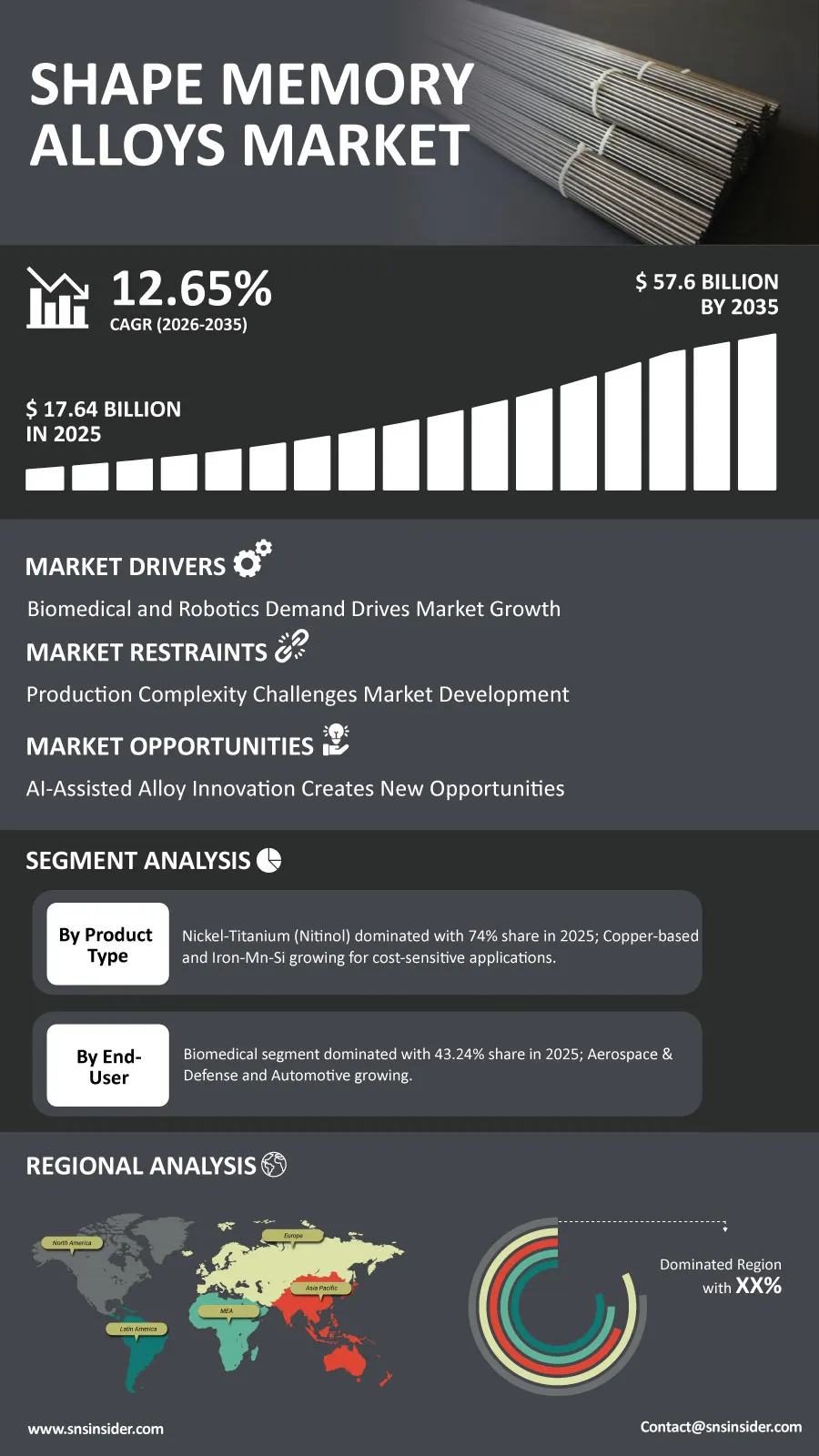
The global Shape Memory Alloys Market is witnessing strong momentum as manufacturers increasingly adopt intelligent materials capable of responding to temperature and mechanical stimuli across critical industries. “According to a recent study by SNS Insider, the global Shape Memory Alloys Market size valued at USD 17.64 billion in 2025, is anticipated to grow to USD 57.6 billion by 2035, registering a CAGR of 12.65% over the 2026–2035 forecast period.”
Increasing popularity of smart materials owing to their light weight, precision movements, and increased durability has led to wider application in the healthcare, aerospace, automotive, robotics, and industrial automation fields. Shape memory alloys offer specific functionalities which make the machinery easier and more efficient than traditional metals.
Moreover, advancements in alloy processing, digital manufacturing, and material science are being rapidly made by the manufacturers to enhance the performance and increase the applications commercially. The need for smart materials will continue to grow in the coming years due to innovation in different industries.
To Get Detailed Insights on the Shape Memory Alloys Market – Request a Sample Report
Advanced Manufacturing and Medical Innovation Expand Commercial Opportunities
As the development of minimally invasive operations advances rapidly, new opportunities keep emerging in the field of shape memory alloy products. The use of materials with exceptional performance features that can provide precision and flexibility in highly challenging environments is needed by healthcare practitioners.
In addition to healthcare applications, industrial automation and advanced manufacturing technology is paving the way to other growth areas. Advanced actuators and lightweight mechanical parts have become an integral part of robotics and factory automation. Moreover, new opportunities have been created in manufacturing technologies with the advent of additive manufacturing.
Artificial intelligence is also accelerating material development by helping researchers optimize alloy compositions, thermal characteristics, and fatigue performance for specialized commercial applications.
Key Market Insights Reflect Expanding End-Use Adoption
Based on product type, Nickel-Titanium (Nitinol) accounted for approximately 74% of global market revenue in 2025, supported by its widespread use across medical devices, precision engineering, and high-performance industrial applications. Copper-based alloys and Iron-Mn-Si alloys continue gaining traction where cost efficiency remains a primary purchasing consideration.
By end user, the Biomedical segment represented 43.24% of total market revenue during 2025, reflecting continued investment in advanced implantable devices, minimally invasive procedures, and innovative surgical technologies. Meanwhile, Aerospace & Defense and Automotive applications are expected to register the strongest growth through 2035 as manufacturers increasingly deploy adaptive materials for lightweight engineering solutions and intelligent actuation systems.
The diversification of application areas is steadily reducing dependence on any single industry while creating additional long-term revenue opportunities for market participants.
Smart Materials Drive the Next Phase of Industrial Transformation
Shape memory alloys are emerging as an essential material for future generations of engineering due to the need for light, efficient, and sensitive mechanical systems in various industries. Advances in alloy fabrication, durability, and production precision have enabled their wider commercial use under harsh conditions.
In addition, advances in the application of digital manufacturing techniques, such as 3D printing and AI-driven material design will continue to contribute to the growth of innovations. These techniques allow manufacturers to reduce development time and provide customized performance of material for particular needs.
Given the increasing emphasis on intelligent automation, precision engineering, and miniaturization of products in various industries, smart materials are likely to become a critical factor in future product development.
North America Accounted for 36% Market Share in 2025; Asia Pacific Forecast to Expand at the Fastest CAGR by 2035
North America holds the largest share of around 36% of the total market revenue in 2025, attributed to its well-developed medical devices industry, aerospace industry, and continuous research and investment in materials science. The US will remain the leading regional demand generator with its innovative developments in healthcare, defense, and engineering sectors.
The Asia Pacific region will experience the fastest growth rate throughout the forecast period owing to growing manufacturing of medical devices, increasing automation, and investment in advanced materials in countries, such as Japan, China, and other developing economies. Continuous government efforts to upgrade and develop technology-based manufacturing is contributing towards regional market growth.
Similarly, Europe also holds an important share in the overall market due to its well-established automotive, healthcare, and industrial manufacturing segments. Latin America and Middle East & Africa are also growing regions with growing healthcare infrastructure and manufacturing.
Industry Participants Strengthen Research and Product Innovation Globally
Competition within the global Shape Memory Alloys Market remains innovation-driven as manufacturers expand production capacity, enhance material performance, and develop specialized alloy solutions for high-value applications. Continued investments in research, precision manufacturing, and advanced metallurgy are enabling companies to address growing demand across medical technology, aerospace, industrial automation, and consumer electronics.
Key companies operating in the global Shape Memory Alloys Market include ATI Inc., Baoji Seabird Metal Material Co., Ltd., Confluent Medical Technologies, Fort Wayne Metals Research Products LLC, SAES Getters S.p.A., Memry Corporation (SAES), Furukawa Electric Co., Ltd., G.RAU GmbH & Co. KG, Metalwerks Inc., Dynalloy Inc., TiNi Aerospace Inc., Euroflex GmbH, Johnson Matthey plc, Special Metals Corporation, Nitinol Devices & Components Inc., SMA Inc. (Shape Memory Applications), Nippon Steel Corporation, Buehler Ltd., Allegheny Technologies Inc., Alfa Aesar (Thermo Fisher), and Pulv-EX Ltd.
An SNS Insider analyst Santosh Bhul commented, “The convergence of advanced healthcare technologies, intelligent manufacturing, and smart material innovation is creating sustained demand for shape memory alloys worldwide. Organizations investing in next-generation alloy development, precision processing technologies, and high-performance engineering applications are expected to secure significant competitive advantages as commercial adoption continues to expand across multiple industries.”
About the Author

Get in touch