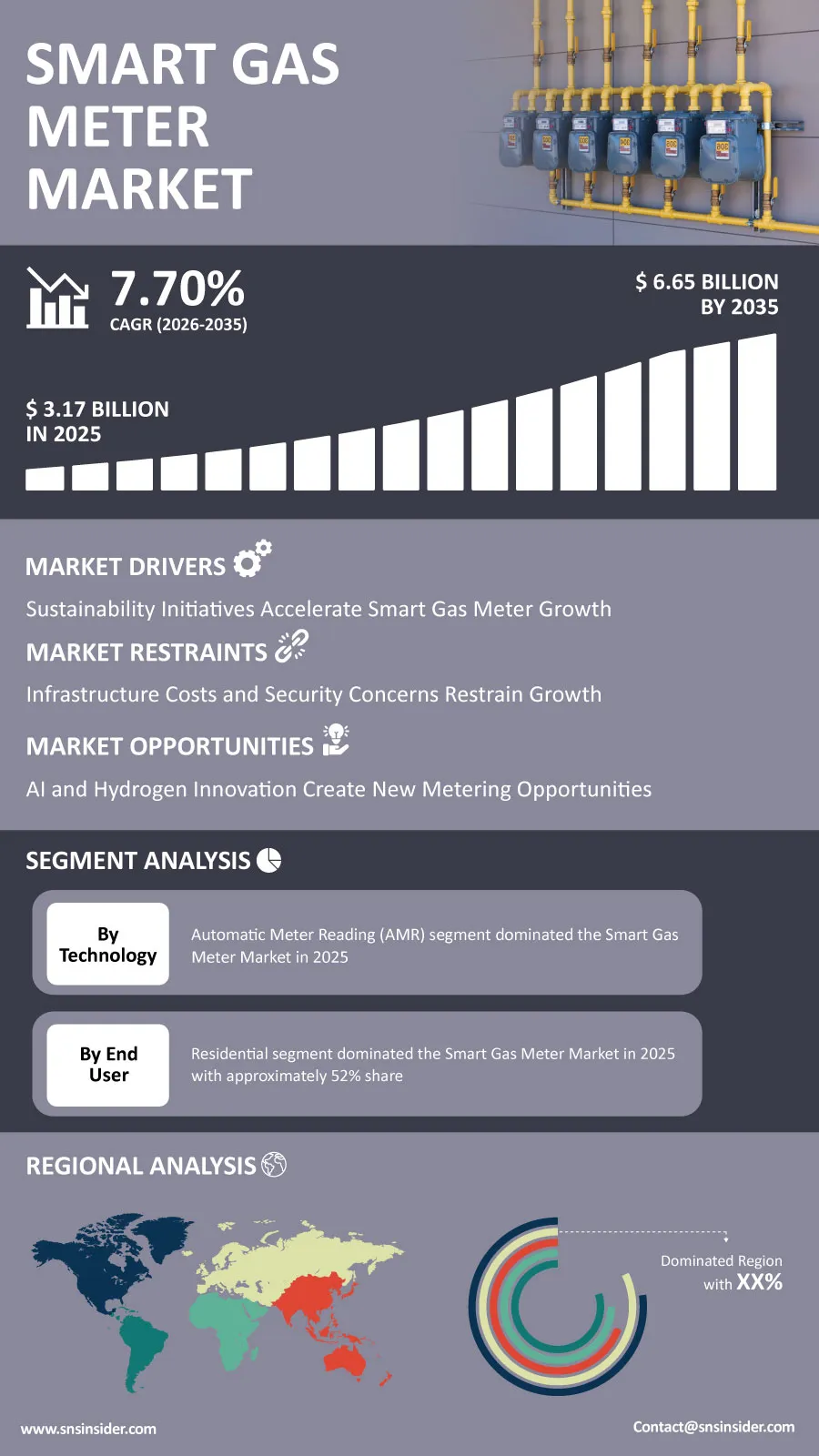
The global Smart Gas Meter Market is witnessing steady expansion as utility providers accelerate digital transformation initiatives to modernize gas distribution networks and improve operational efficiency. “According to a recent study by SNS Insider, the global Smart Gas Meter Market size valued at USD 3.17 billion in 2025, is anticipated to grow to USD 6.65 billion by 2035, registering a CAGR of 7.70% over the 2026–2035 forecast period.”
Rapid urbanization, increasing demand for intelligent utility infrastructure, and the growing emphasis on energy conservation are encouraging widespread deployment of smart gas metering technologies. These advanced systems enable real-time consumption monitoring, automated billing, remote diagnostics, and faster identification of leaks, allowing utilities to enhance customer service while improving network reliability.
As governments continue introducing policies that promote digital energy management and efficient resource utilization, utilities are replacing conventional metering systems with connected solutions capable of delivering accurate usage data and supporting predictive maintenance. The combination of cloud computing, IoT connectivity, and advanced analytics is further strengthening the long-term outlook for the market.
To Get Detailed Insights on the Smart Gas Meter Market – Request a Sample Report
Utility Modernization and Connected Infrastructure Create New Growth Opportunities
Investment in smart utility infrastructure has become a strategic priority across developed and emerging economies. Energy providers are focusing on intelligent metering platforms that improve operational visibility while reducing manual intervention and maintenance costs.
The transition toward connected utility networks is also supporting the adoption of advanced communication technologies that enable continuous data transmission and remote meter management. As utilities seek greater efficiency in billing, demand forecasting, and asset monitoring, smart gas meters are becoming an essential component of modern distribution systems.
Emerging technologies including artificial intelligence, cloud-based analytics, and hydrogen-compatible metering solutions are expected to create additional opportunities for manufacturers over the coming decade. These innovations are helping utilities prepare for evolving energy systems while supporting sustainability objectives and long-term infrastructure resilience.
Key Market Insights Reflect Growing Demand Across Utility Networks
Based on type, the Smart Diaphragm Gas Meter segment accounted for approximately 62% of global market revenue in 2025 due to its affordability, proven reliability, and compatibility with existing gas distribution infrastructure. The Smart Ultrasonic Gas Meter segment is anticipated to record the fastest growth through 2035 as utilities increasingly prioritize higher measurement accuracy and reduced maintenance requirements.
By technology, Automatic Meter Reading (AMR) maintained the leading market position in 2025 owing to its extensive deployment across utility networks. Advanced Metering Infrastructure (AMI) is forecast to experience the strongest expansion during the forecast period as utilities continue investing in two-way communication, remote configuration, and real-time network intelligence.
In terms of component, the Hardware segment generated the highest revenue in 2025 because of large-scale installation of smart metering devices and communication modules. Meanwhile, the Software segment is expected to witness the fastest growth, supported by increasing adoption of cloud-based analytics, predictive maintenance platforms, and intelligent billing applications.
By end user, the Residential sector captured nearly 52% of total market revenue in 2025, driven by government-led smart meter rollout programs. The Commercial segment is projected to expand at the fastest pace as businesses invest in digital energy management and sustainability initiatives.
Intelligent Metering Technologies Transform Gas Distribution Networks
Technology innovation continues to reshape the competitive landscape as manufacturers introduce highly efficient metering systems with advanced connectivity and enhanced operational capabilities. Integration of AI-powered analytics, IoT communication, and cloud-based monitoring platforms is allowing utilities to improve demand forecasting, optimize maintenance schedules, and strengthen overall network performance.
Hydrogen-ready smart gas meters are also emerging as an important area of development, supporting the transition toward cleaner energy sources without requiring complete infrastructure replacement. These next-generation solutions provide utilities with greater flexibility while helping prepare gas distribution systems for future energy requirements.
The increasing adoption of digital twins, automated asset management, and intelligent monitoring technologies is expected to further accelerate innovation across the global smart gas meter industry.
Europe Accounted for the Largest Market Share in 2025; Asia Pacific Forecast to Expand at the Fastest CAGR by 2035
Europe maintained its leadership position in the global Smart Gas Meter Market during 2025, supported by well-established smart meter deployment programs, stringent energy efficiency regulations, and ongoing modernization of gas distribution infrastructure. Countries including the United Kingdom, Italy, France, and the Netherlands continue expanding intelligent metering installations to improve operational efficiency and consumer energy management.
Asia Pacific is expected to register the fastest growth through 2035 as urbanization, expanding gas distribution networks, and government-backed smart utility initiatives drive large-scale deployment across China, India, and Southeast Asia. Increasing infrastructure investments and rising energy consumption are creating substantial opportunities for advanced metering technologies throughout the region.
North America continues to experience healthy market growth through investments in grid modernization, remote monitoring capabilities, and digital utility management, while Latin America and the Middle East & Africa are steadily increasing smart meter adoption as part of broader smart city and infrastructure development strategies.
Industry Participants Accelerate Innovation Through Digital Utility Solutions
Competition within the Smart Gas Meter Market remains strong as leading manufacturers invest in advanced communication technologies, AI-enabled software platforms, hydrogen-ready metering systems, and next-generation utility management solutions. Strategic partnerships, product innovation, and continuous research and development are enabling companies to strengthen their global market presence while addressing evolving customer requirements.
Key companies operating in the global Smart Gas Meter Market include Landis+Gyr, Honeywell International Inc., Itron Inc., Apator SA, Diehl Stiftung & Co. KG, Sensus (Xylem), EDMI Limited, Chongqing Shancheng Gas Equipment Co. Ltd., ZENNER International GmbH & Co. KG, Master Meter, Aclara Technologies, Raychem RPG, CHINT Group, Dongfa (Group), Siemens AG, Schneider Electric, Kamstrup AS, DIEHL Metering, Badger Meter Inc., and Elster Group.
An SNS Insider analyst Santosh Bhul commented, “The continued digital transformation of utility infrastructure, together with advances in intelligent metering technologies and connected energy management platforms, is creating long-term growth opportunities across the Smart Gas Meter Market. Organizations investing in innovative communication capabilities, predictive analytics, and future-ready metering solutions will be well positioned to support the next generation of efficient and sustainable gas distribution networks.”
About the Author

Get in touch