
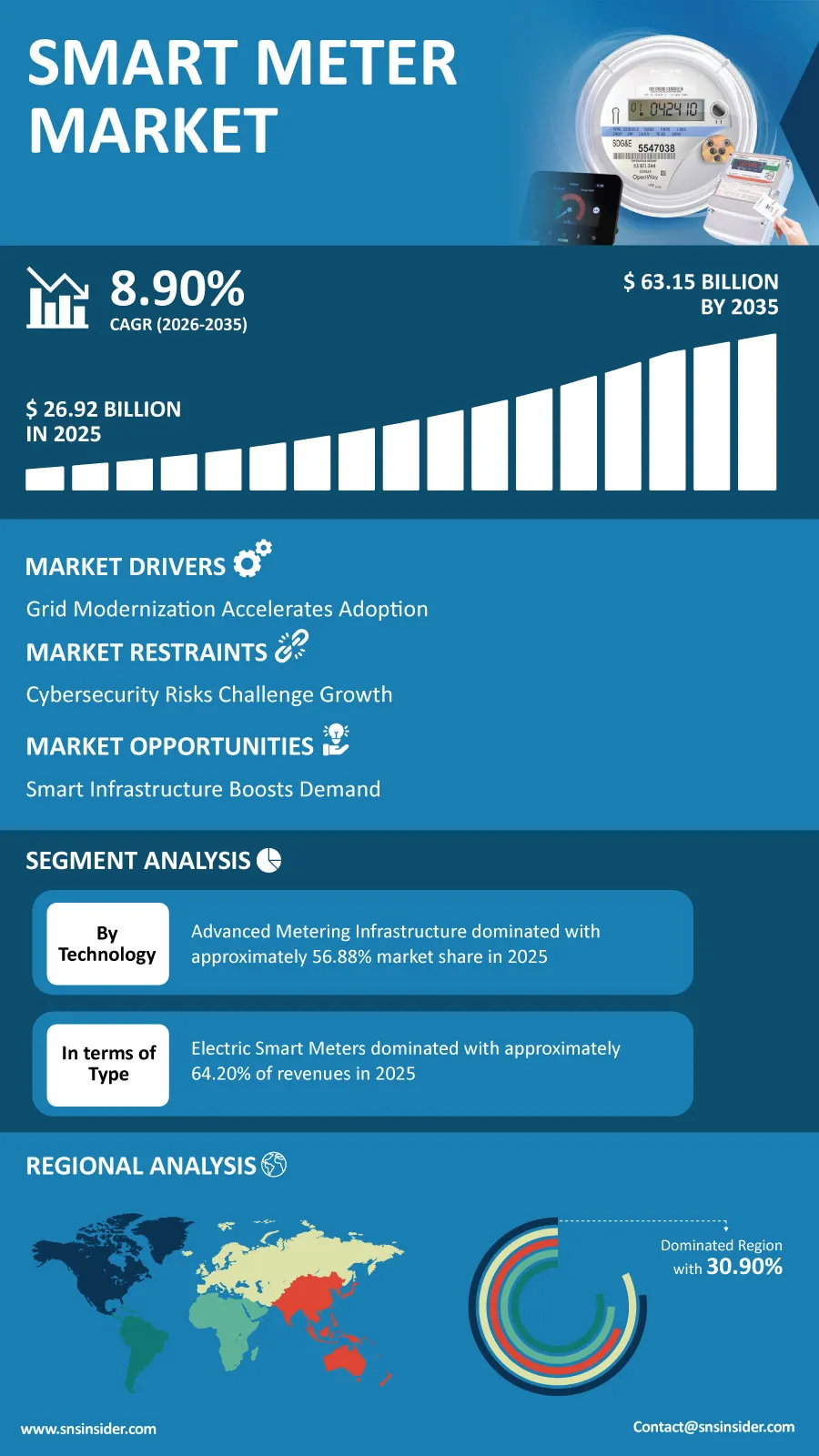
The global Smart Meter Market is poised for robust growth as utilities worldwide accelerate the transition toward intelligent energy infrastructure and digital grid management. According to a recent study by SNS Insider, the global Smart Meter Market size valued at USD 26.92 billion in 2025, is anticipated to grow to USD 63.15 billion by 2035, registering a CAGR of 8.90% over the 2026–2035 forecast period.
Due to the growing importance of energy distribution efficiency, energy consumption control and higher grid reliability, governments and utility organizations are moving towards adopting advanced digital meters instead of traditional metering systems. Intelligent meters have become an essential part of contemporary power, natural gas and water distribution grids that help in collecting data automatically, monitoring remotely and increasing efficiency.
The rapid expansion of renewable energy generation, electric vehicle adoption, and smart city initiatives is further strengthening demand for intelligent metering infrastructure. Utilities are investing in next-generation metering technologies to improve demand forecasting, optimize energy distribution, and deliver more responsive customer services.
To Get Detailed Insights on the Smart Meter Market – Request a Sample Report
Grid Modernization Programs Continue to Unlock Growth Opportunities
Investments on large scale in digital utilities are fostering a positive environment for deploying smart meters across not only developed but also emerging markets. Modernization projects which improve resilience of the grids, reduce losses in transmission, and ensure efficient energy management are continually being rolled out by governments.
Integrating artificial intelligence, cloud technologies, and analytics within smart meters systems is assisting utilities in gaining greater visibility into their operations and in detecting outages, conducting predictive maintenance, and managing demand. It is contributing to the investment in AMI.
Increasing deployment of smart water meters and connected utility platforms is also expanding the addressable market, as water providers seek better leak detection, consumption monitoring, and infrastructure optimization.
Key Market Insights Highlight Shifting Demand Patterns
By component, hardware is expected to account for approximately 77.20% of global market revenue in 2025, supported by continued investments in smart metering devices, communication modules, and supporting network infrastructure. Software is projected to register the fastest growth, expanding at a CAGR of 9.09% through 2035 as utilities increasingly adopt AI-driven analytics, meter data management platforms, and predictive grid applications.
Based on type, electric smart meters are anticipated to contribute approximately 64.20% of market revenue in 2025 due to extensive deployment across residential, commercial, and industrial electricity networks. Water smart meters are forecast to experience the fastest growth at a CAGR of 9.62% as utilities prioritize water conservation, leak detection, and intelligent resource management.
By technology, Advanced Metering Infrastructure (AMI) is expected to account for approximately 56.88% of market revenue in 2025 while also emerging as the fastest-growing technology segment through 2035. Utilities continue expanding AMI deployments to enable two-way communication, remote meter management, and real-time grid intelligence.
By end user, the residential sector remains the largest deployment category, reflecting ongoing smart meter rollout programs across household utility networks. Industrial users are projected to witness the fastest growth as organizations increase investments in energy optimization, sustainability initiatives, and digital facility management.
Intelligent Utility Networks Drive Industry Transformation
Energy companies are making more use of smart meters in their operations to make things more efficient and more transparent for customers. The ability to monitor energy usage, bill automatically, connect remotely, and price dynamically has changed the entire equation when it comes to the utility-customer relationship.
In addition, the market is experiencing advantages through the increasing integration of the network with electric vehicles, renewables, and grid intelligence solutions. With the growth of digital ecosystem development by utilities, smart meters have become an integral part of energy management solutions.
Asia Pacific Holds 30.90% of Global Revenue in 2025 While Expanding at a 9.74% CAGR
Asia-Pacific will have the lead in the global Smart Meters Market share in 2025 with about 30.90% of global revenues as well as fastest growth among all regions in CAGR of 9.74%. High level of governmental mandates, fast urbanization, smart cities' projects, and major investments in grid modernization in China, India, and Japan will continue driving regional supremacy.
North America will still be a well-established region with a strategic importance due to the implementation of the advanced metering infrastructure and second generation of smart meters and investments in digital utility networks' modernization. Europe will keep expanding the number of smart meters due to regulatory efforts aimed at improving the energy efficiency and modernizing utility network.
Industry Participants Focus on Digital Innovation
Competition within the smart meter industry continues to intensify as technology providers invest in advanced communication platforms, cybersecurity, artificial intelligence, and cloud-enabled utility management solutions. Companies are strengthening product portfolios with next-generation smart meters capable of supporting real-time analytics, distributed energy integration, and intelligent grid operations.
Key companies operating in the global Smart Meter Market include Landis+Gyr Group AG, Itron Inc., Siemens AG, Honeywell International Inc., Kamstrup AS, Schneider Electric SE, Sensus, Elster Group GmbH, Jiangsu Linyang Energy Co. Ltd., Wasion Group Holdings Ltd., Aclara Technologies LLC, Energizer Holdings Inc., Murata Manufacturing Co. Ltd., Diehl Metering GmbH, Holley Technology Ltd., Shenzhen Kaifa Technology Co. Ltd., ADD GRUP, Arad Group, Neptune Technology Group Inc., and Master Meter Inc.
An SNS Insider analyst Sushant Kadam commented, “Growing investments in smart grid modernization, renewable energy integration, and intelligent utility management are creating sustained demand for advanced metering technologies. Companies that combine secure connectivity, AI-powered analytics, and scalable digital infrastructure will be well positioned to capitalize on the market's long-term growth opportunities.”
About the Author

Get in touch




