
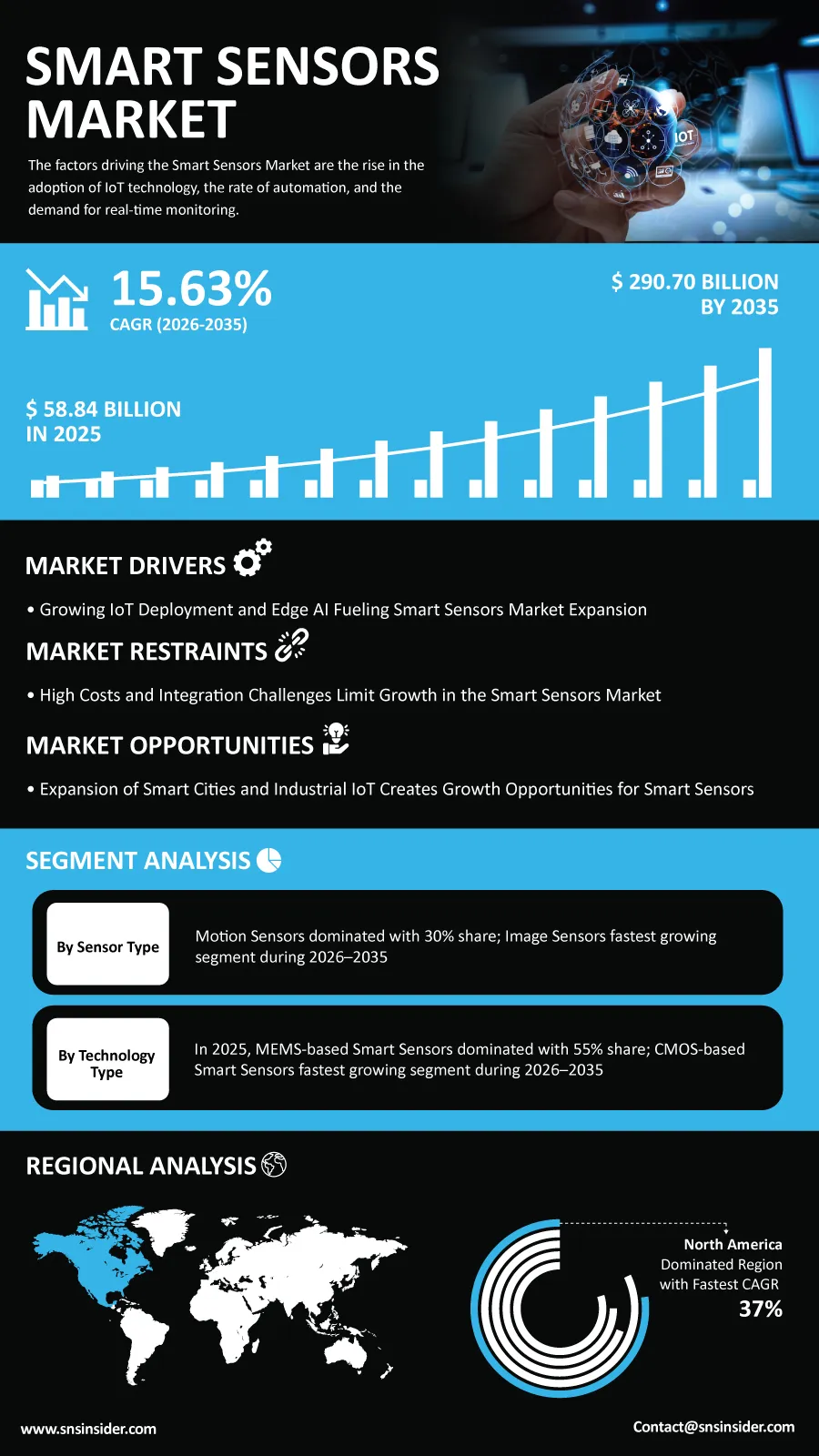
The global Smart Sensors Market is entering a high-growth phase as industries accelerate digital transformation, connected infrastructure, and intelligent automation initiatives. According to a recent study by SNS Insider, the global Smart Sensors Market size valued at USD 58.84 billion in 2025, is anticipated to grow to USD 290.70 billion by 2035, registering a CAGR of 15.63% over the 2026–2035 forecast period.
The growing use of IoT networks has been leading to a high demand for sensors that can be used to gather, process, and transmit data without much human involvement. This is evident from the use of intelligent sensors in different applications ranging from cars to industrial machinery, medical devices to smart buildings, among others.
The progress in microelectromechanical systems, artificial intelligence, and edge computing is expected to provide an even stronger boost to the market’s future prospects. These developments are helping create more compact, power-efficient sensors that will be able to analyze data at or near the location of its gathering.
To Get Detailed Insights on the Smart Sensors Market – Request a Sample Report
Smart Infrastructure and Industrial Automation Create New Growth Opportunities
Growth of smart cities and industrial IoT is creating new prospects for smart sensor makers. Intelligent sensor-based technologies are being used more often for equipment monitoring, energy management, infrastructure optimization, and automation.
The incorporation of sensors by manufacturers for use in predictive maintenance is another strategy that enables industrial operators to detect machine problems before they lead to expensive breakdowns. The move from reactive maintenance to condition-based maintenance has led to increased investment in various industries.
On the other hand, the rising number of devices and systems related to the practice of remote patient monitoring is driving an increase in the need for better sensors to provide ongoing health data.
Key Market Insights Highlight Shifting Demand Patterns
By sensor type, motion sensors segment comprised approximately 30% of the total market revenue share globally in 2025, driven by extensive usage in smartphones, automobiles, security solutions, gaming consoles, and automation systems. The image sensors segment is expected to witness the highest growth rate up until 2035 due to the increasing demand for intelligent imagery applications in automotive, consumer, security, and connected devices.
Based on technology type, MEMS-based smart sensors segment held the maximum market share, close to 55%, in 2025, owing to their compact size, low power requirements, and high applicability in consumer devices, automobiles, and wearable devices. The CMOS-based smart sensors segment is projected to witness the highest growth due to increasing use of image and vision technologies.
By component, microcontrollers segment was holding the largest share of 35% share 2025, due to their central role in processing and managing sensor data. Analog-to-Digital Converters (ADCs) segment is expected to be the fastest-growing component category as increasingly sophisticated sensing devices require efficient conversion of real-world signals into digital information.
In terms of end use, consumer electronics held around 33% of market revenue in 2025, supported by widespread integration into smartphones, wearables, smart home products, and connected devices. Healthcare is projected to be the fastest-growing segment as remote monitoring, digital diagnostics, wearable medical devices, and personalized care solutions gain wider acceptance.
Intelligent Sensing Strengthens Predictive and Sustainable Operations
With the increased focus on efficiency, the use of intelligent sensors for constant monitoring and analysis is becoming increasingly popular. Intelligent sensors in industrial plants can assist in identifying any abnormal condition of the equipment and reduce any unforeseen disruption in manufacturing processes.
Smart sensors are also contributing increasingly in environmental monitoring and energy management. Uses that include the measuring of air and water quality to the optimizing of renewable energy sources are helping sustainability efforts while giving companies more insight into their resource usage.
However, integration with existing infrastructure, cybersecurity threats, privacy considerations, and high deployment costs pose difficulties for enterprises looking to adopt large-scale connected sensor networks.
North America Leads with 37% Revenue Share While Asia Pacific Advances at a 15.28% CAGR
North America will continue to dominate the regional market share, holding about 37% of the global market revenue by 2025. The development of the IoT infrastructure, industrial automation, implementation of health care technologies, and investments in connected automobiles is driving North American leadership.
The Asia-Pacific region will emerge as the fastest growing region with a growth rate of CAGR 15.28% during 2035. The reasons for this high rate of growth include industrialization, consumer electronics production, investments in smart cities, and the implementation of connected technologies in China, India, and Japan.
Across Europe, smart manufacturing, automotive advancements, applications in aerospace and Industry 4.0 remain driving market growth. The developments in industrial infrastructure in Latin America are driving the market there, whereas Middle East and Africa are utilizing the smart sensor technology for energy management, utilities, transport, and smart cities.
Industry Participants Focus on Sensor Innovation
The competitive landscape remains dynamic tech companies are putting their money into miniaturization, energy efficiency, AI-based sensing, and improved connectivity. The market players are now trying to create sensor platforms that can be used for analytics and integrate themselves seamlessly into IoT and edge computing ecosystems.
Key companies operating in the global Smart Sensors Market include Honeywell International, Bosch Sensortec, STMicroelectronics, Analog Devices Inc., Infineon Technologies, TE Connectivity, ABB Ltd., OmniVision Technologies, NXP Semiconductors, DENSO Corporation, Eaton Corporation, Emerson Electric Co., Vishay Intertechnology, Legrand, AMETEK Inc., Microchip Technology Inc., Balluff GmbH, Siemens AG, Texas Instruments, and Alpha MOS.
An SNS Insider analyst Sushant Kadam commented, “The convergence of IoT, AI, edge computing, and industrial automation is positioning smart sensors as a foundational technology for the next generation of connected systems. Companies that deliver energy-efficient, secure, and highly integrated sensing solutions will be well positioned to capture opportunities across healthcare, automotive, manufacturing, and smart infrastructure.”
About the Author

Get in touch




