
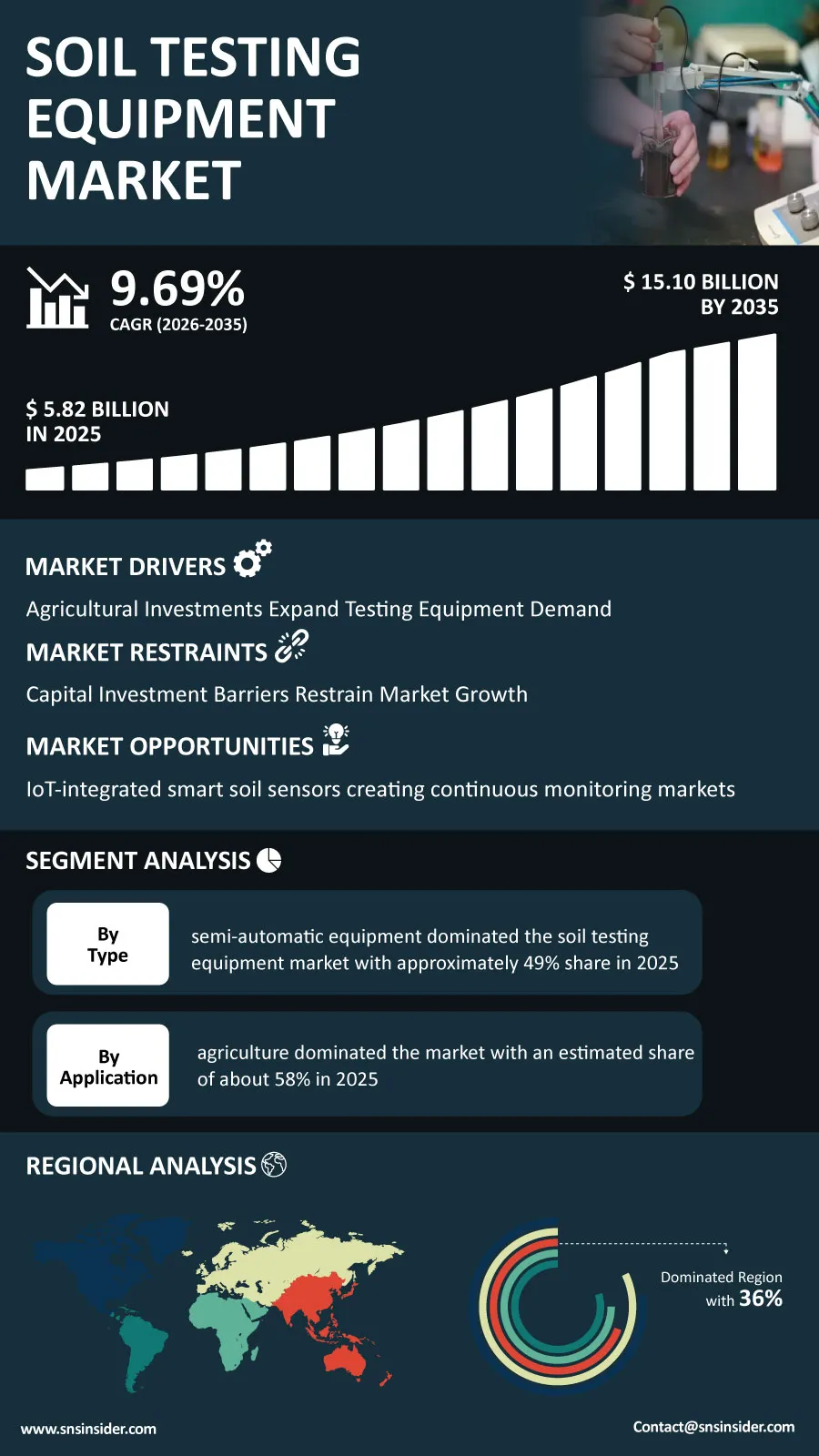
The Global Soil Testing Equipment Market is showing consistent momentum as agricultural modernization and development of infrastructure lead to increasing requirement for soil testing around the world. “According to a recent study by SNS Insider, the global Soil Testing Equipment Market size valued at USD 5.82 billion in 2025, is anticipated to grow to USD 15.10 billion by 2035, registering a CAGR of 9.69% over the 2026–2035 forecast period.”
Increased focus on precision farming, sustainable land management, and developments of resilient infrastructure are catalyzing advancements in soil testing technologies. Why You Should Use the Data You need accurate soil data to maximize agricultural yields, optimize fertilizer applications and support geotechnical engineering projects. With governments tightening environmental regulations and promoting prudent mechanisms of resource usage, investment in modern soil testing solutions has been on the rise globally, driven by developed as well as developing nations.
The manufacturers are launching portable analyzers, automated laboratory systems, and digital monitoring platforms offering rapid and precise results. By empowering farmers in decision-making, aiding research institutions, environmental agencies and construction companies to enhance operational efficiency, these innovations are proving to be useful.
To Get Detailed Insights on This Market – Request a Sample Report
Precision Agriculture and Infrastructure Investments Fuel Long-Term Market Growth
The global farming landscape is witnessing a burgeoning adoption of precision agriculture, accompanied by an emphasis on the imperative of data-driven soil analysis in crop management strategies. Farming practices routinely use sophisticated testing tools that provide information on nutritional content, moisture presence, and soil health to produce greater yields from smaller fertilizer applications.
Infrastructure development is opening up yet another key avenue of growth for the market. Genus is the first, and only, construction management company to invest heavily in digital data about urban geophysical conditions. The soil testing equipment market is expected to have a steady growth rate during the forecast period, as regulatory agencies continue to stress upon safety and environmental compliance.
The fast evolution of technology such as IoT-based monitoring systems, cloud-based data platforms, and portable field-testing devices are also opening up more ways for commercialization by providing real-time analytical solutions enabling faster decision-making.
Key Market Insights Reflect Expanding Technology Adoption
By type, the Semi-Automatic Equipment segment generates nearly 49% of revenue in 2025 as it offers a balanced combination of affordability and operational efficiency. As laboratories continue to automate their analytical workflows, Automatic Equipment (including robotic liquid handling) is expected to grow fastest through 2035.
Physical Tests held around 41% share of the overall market revenue in 2025, as this type is a primarily used in agriculture and civil engineering system. By type, the Residual Tests segment is expected to have the highest growth rate during the forecast period due to growing environmental monitoring activities across the globe.
By application, Agriculture emerged as the largest segment in 2025 on global market revenue, accounting for about 58% of the share owing to rising adoption of precision farming technologies. As per the type of application, construction is anticipated to be the fastest-growing segments owing to growing investments on infrastructure and increasing requirements for geotechnical evaluation.
Smart Technologies Transform Soil Analysis Capabilities
The soil testing equipment industry in this firm is continuously evolving with the advancement of automation, intelligent analytics, and connected monitoring platforms. We are bringing in AI, IoT connectivity and cloud-based reporting systems into testing equipment manufacturing which not only boosts the accuracy within a process but also halves turnaround times.
Portable testing quality solutions are also being used more and more by agricultural professionals who want immediate information at the field level instead of sending samples for laboratory analysis. These advances allow users to make quicker agronomic decisions while increasing productivity and resource use efficiency.
Rising investment in environmental-monitoring initiatives is also catalyzing the adoption of advanced analytical techniques able to facilitate sustainable agriculture, contaminant risk assessment and climate resilience programs.
Asia Pacific Accounted for 36% Market Share in 2025; North America Forecast to Expand at the Fastest CAGR by 2035
In 2025, Asia Pacific contributed about 36% to the global market revenue,given its large-scale agricultural activities, swift development of infrastructure and government initiatives aimed at promoting sustainable soil health management practices. Regional demand for advanced soil testing equipment is bolstered by investments in precision farming technologies and a host of large-scale construction projects, as seen in China and India.
North America will continue to experience the fastest growth through 2035 as adoption of precision agriculture expands among commercial farming operations and infrastructure modernization initiatives further drive geotechnical testing demand. Investments in industrial restoration, community envir-tech, digital farming technologies and smart monitoring are likely to result in more sustainable organic acquisition opportunities that will further stimulate regional market growth.
Europe continues to be an already well-established key technology market, supported by strict environmental legislation and sustainable agriculture policy, while new opportunities continue to blossom through agricultural modernization as well as growing investment in infrastructure across LATAM and MEA.
Industry Participants Focus on Automation and Digital Innovation
The global soil testing equipment market continues to be highly competitive given investments in automation, portable diagnostic technologies, and intelligent data management platforms by manufacturers. The companies are enhancing on research and development capabilities, increasing product offering aimed at improving testing speed, analytical accuracy, and flexibility of operations in agriculture, construction, environmental monitoring as well as research applications.
Key companies operating in the global Soil Testing Equipment Market include Thermo Fisher Scientific Inc., ELE International, Humboldt Mfg. Co., Controls Group S.p.A., Martin Lishman Ltd., LaMotte Company, Gilson Company Inc., Alfa Testing Equipment S.r.l., Matest S.p.A., Aimil Limited, FANN Instrument Company, UTEST Material Testing Equipment, Cooper Research Technology, Durham Geo Slope Indicator (DGSI), AgroCares B.V., Spectrum Technologies Inc., Decagon Devices (Meter Group), Stevens Water Monitoring Systems, Sentek Technologies, and ICT International Pty Ltd.
An SNS Insider analyst Santosh Bhul commented, "Growing demand for precision agriculture, expanding infrastructure investment, and rapid digital transformation are reshaping the global soil testing equipment market. Organizations investing in intelligent automation, portable testing technologies, and integrated data platforms are expected to strengthen their competitive position as demand for accurate soil intelligence continues to increase across agricultural and industrial sectors."
About the Author

Get in touch




