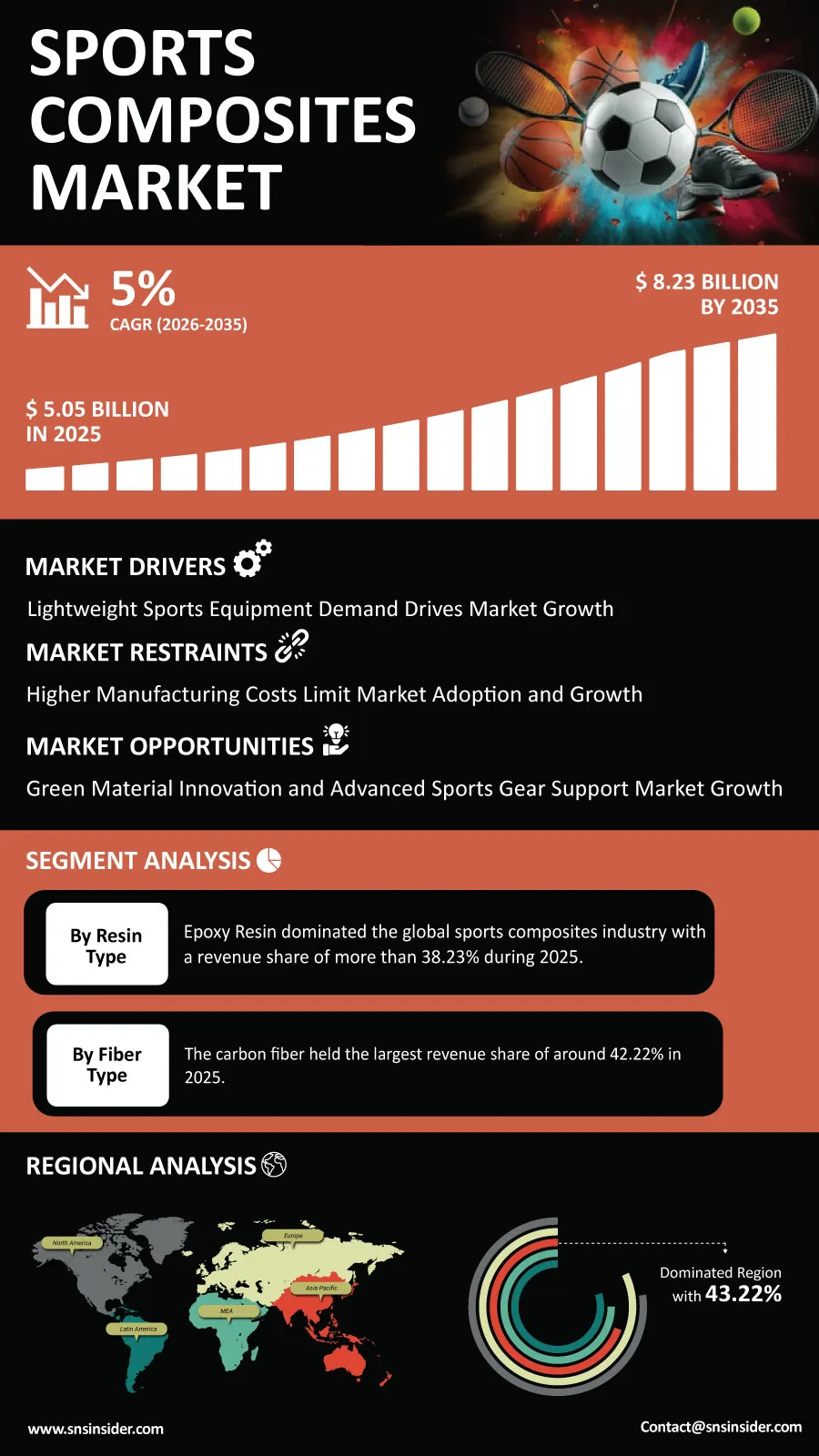
The global Sports Composites Market is expected to witness steady growth as manufacturers increasingly adopt advanced composite materials to improve athletic performance, durability, and equipment efficiency. “According to a recent study by SNS Insider, the global Sports Composites Market size valued at USD 5.05 Billion in 2025, is anticipated to grow to USD 8.23 Billion by 2035, registering a CAGR of 5% over the 2026–2035 forecast period.”
The increasing demand for light-weight and high strength sporting products is prompting companies to opt for advanced composites instead of traditional materials in various sports. Composite materials, such as carbon fiber, fiberglass and hybrid composite, have been increasingly being used due to their excellent stiffness, toughness, vibration resistance, and impact resistance properties along with reduced weight of the equipment. Increased investment in sports infrastructure and fitness activities is helping the growth of the market.
To Get Detailed Insights on the Sports Composites Market – Request a Sample Report
Performance-Driven Innovation Creates New Market Opportunities
The rising participation in competitive sports and outdoor sports activities is fueling the growing demand for next-generation sports equipment. The need for sports equipment that provides high responsiveness, comfort, and longevity, but at the same time does not carry any excess weight, is the driving force behind the trend. It forces companies to invest more into composite engineering and custom product design.
Furthermore, sustainability is another area of innovation in the field of sports equipment design. Sports equipment manufacturers are investigating recyclable composites, bio-based resins, and efficient manufacturing techniques along with modern production technologies including automated lay-up systems and additive manufacturing technologies. It will positively impact the growth potential of the industry in categories of cycling, golf, winter sports, racquet sports, fishing, and protective sports equipment.
Key Market Insights Highlight Material and Application Leadership
Epoxy Resin contributed 38.23% of market revenue in 2025 based on its superior adhesive properties, mechanical strength, and suitability for reinforcing with carbon fiber and glass fiber. The extensive use of this material in making high-end bicycles, golf clubs, skis, and racquet sports equipment further helped the segment retain its market leadership position.
Carbon Fiber emerged as the leading material, contributing 42.22% of market revenue in 2025 because of its superior strength to weight ratio, stiffness, and fatigue resistance. Companies continued increasing the use of carbon fiber in bicycles, hockey sticks, tennis rackets, golf shafts, and other sports equipment applications where the lightweight nature provides performance gains.
The Bicycle application led the Sports Composites Market, contributing 39.56% of revenue share in 2025. The growing demand for high-end road bicycles, mountain bicycles, racing bicycles, and electric bicycles has driven the use of composite bicycle frames, which are stiffer, more aerodynamic, and efficient to ride.
Advanced Composite Technologies Enhance Equipment Performance
Constant innovation in materials is still one of the main features of the industry of sports composites. The companies develop better resin systems, more accurate methods of fiber placement and better surface treatments that make the products more durable and less dependent on maintenance. This allows the sporting goods companies to offer products that will endure the challenging conditions of competition.
Institutions of research and material suppliers are also working together with sports equipment producers to create custom composites for various types of sports. The digital modeling, automation of production processes and advanced engineering solutions help reduce the time of product development and improve quality.
Asia Pacific Captured 43.22% of Sports Composites Market Revenue in 2025 as Global Demand for Advanced Sporting Materials Accelerates
The Asia Pacific contributed to approximately 43.22% of the Sports Composites Market revenues in 2025 owing to high levels of disposable income, greater participation in sports activities, and investments in sports infrastructures across China, India, Japan, and other regional economies. Higher manufacturing capabilities within the region and growing demands for premium quality sporting equipment contribute significantly to the market dominance in the region.
North America continues to be a key regional market owing to high levels of adoption of technologically advanced sporting equipment, investments in research and development, and participation in sports activities at professional and leisure levels. Europe is another key regional market that is witnessing strong growth with contributions from established sports equipment manufacturers, innovations in products, and use of lightweight and sustainable materials.
Industry Participants Focus on Lightweight Innovation and Sustainable Manufacturing
The Competition in the Global Sports Composites Market is still focused on new materials, efficient manufacturing processes, and innovations in products. The main players in the market are making increased investments in carbon fibers, eco-friendly composite systems, and future sports equipment, which would perform better, be lighter, and more durable.
Key companies operating in the global Sports Composites Market include Rossignol, Fischer Sports, Amer Sports, Fujikura Composites, True Temper, Newell Brands, Topkey Corporation, Callaway Golf, ALDILA, Inc., ProKennex, Easton Sports, Mitsubishi Chemical Carbon Fiber and Composites, Hexcel Corporation, Toray Industries, Inc., SGL Carbon, Teijin Limited, Zoltek, Gurit Holding AG, Solvay S.A., Owens Corning, Shimano, BMC, and Giant Manufacturing Co. Ltd.
An SNS Insider analyst Himanshu Sharma commented, "Growing demand for lightweight, durable, and high-performance sporting equipment is accelerating innovation across the sports composites industry. Manufacturers investing in advanced carbon fiber technologies, sustainable composite materials, and precision manufacturing capabilities are expected to strengthen their competitive advantage as athletes and consumers increasingly prioritize performance, durability, and product quality."
About the Author

Get in touch