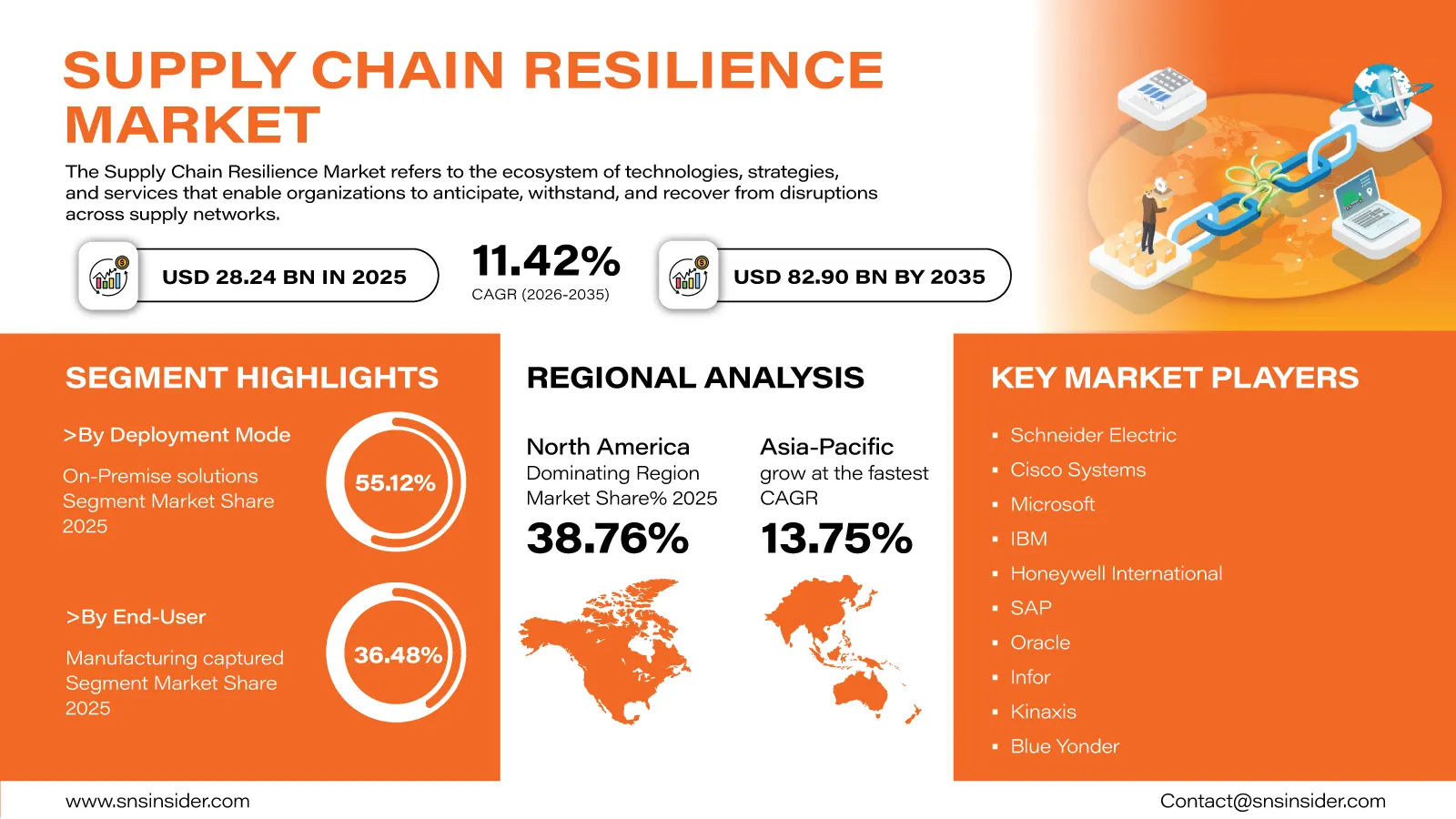
The global Supply Chain Resilience Market is expected to witness substantial growth as organizations strengthen their ability to manage disruptions, improve operational continuity, and build more agile supply networks. “According to a recent study by SNS Insider, the global Supply Chain Resilience Market size valued at USD 28.24 billion in 2025, is anticipated to grow to USD 82.90 billion by 2035, registering a CAGR of 11.42% over the 2026–2035 forecast period.”
Uncertainty in the areas of international commerce, geopolitics, climate change, and consumer behavior is driving companies to upgrade their supply chains through the use of cutting-edge technologies. Technologies that can give visibility, predictability, and quick response capabilities are being deployed by companies to manage their operations.
To Get Detailed Insights on the Supply Chain Resilience Market – Request a Free Sample Report
The rapid implementation of AI, digital twin, cloud computing analytics, and supplier intelligence platforms is revolutionizing the world of supply chain management. Through this technology, organizations can be able to forecast possible disruptions, explore various options on how to respond and improve their decision-making processes regarding procurement and logistics.
Digital Supply Chain Modernization Creates Long-Term Growth Opportunities
The increasing amount of money being spent by companies within manufacturing, health care, retailing, and logistics to strengthen their resilience is an indication that enterprises are becoming more flexible and less dependent on a sole supplier. Sourcing from several locations, supplier diversification, and effective risk management are becoming key priorities among firms that are in need of supply chain resilience.
Increasing regulatory demands about supplier transparency, sustainability reports, and monitoring are driving the need for resilient technologies as well. Many organizations are adopting continuous monitoring software which assesses the performance of the supplier, its geographical location, its financial condition, and environmental sustainability.
Cloud-native platforms are allowing middle-size firms to adopt resilience technologies. The adoption of advanced artificial intelligence, automation, and analytics is allowing organizations to be more prepared for fast-changing situations within the markets.
Key Market Insights Highlight Shifting Demand Patterns
On the basis of solution type, Risk Management & Monitoring Solutions are expected to capture 31.64% of total revenue in the global market during 2025 as they are capable of detecting disruptions, monitor the supplier performance, and increase operational continuity in global supply chains. Inventory & Warehouse Management Solutions are expected to grow at the highest rate till 2035 as the focus would be on optimizing inventory, automation of warehouses, and real-time visibility of operations.
With respect to application, Risk Identification & Mitigation solutions are expected to contribute 34.57% of total market revenue by 2025 as the enterprise spending on the management of disruptions and continuity of business operations is likely to increase. Supplier Risk & Performance Management solutions are likely to grow at the highest rate in the coming years as the companies want more transparency, supplier collaboration, and continuous monitoring of performance.
In case of end-user, Manufacturing segment captured 36.48% of total market share in 2025 due to its extensive global supply network and requirement of minimization of production disruptions. In addition, the Healthcare & Pharmaceuticals segment will show the highest growth rate till 2035 due to rising focus on uninterrupted availability of medical supplies and compliance with regulations.
On the basis of deployment mode, On-premise Solutions captured 55.12% of total revenue in 2025 while Cloud-Based solutions are expected to witness the highest growth rate as enterprises pursue scalable, collaborative, and data-driven supply chain management platforms.
Artificial Intelligence and Digital Twins Accelerate Industry Transformation
The rate of development of resilience technologies is fast in supply chains due to incorporation of artificial intelligence, machine learning, digital twin simulation and predictive analytics. This allows companies to conduct simulations on the potential disruptions and examine different sources, as well as improving logistics before any risk affects production and delivery to customers.
At the same time, manufacturers and technology vendors continue making investments in intelligent control towers, supplier monitoring and decision support systems. These changes allow companies to increase their visibility and improve resilience against disruptions, as well as reducing costs.
Regional Markets Demonstrate Strong Growth Potential
The North American region is anticipated to account for 38.76% of the market revenue by 2025 due to its well-developed enterprise software environment, adoption of cloud computing based supply chain solutions and investments in digital transformation initiatives in manufacturing, pharmaceuticals and critical infrastructure sectors.
The Asia Pacific region is anticipated to become the fastest growing region until 2035. This can be attributed to the fast industrialization process, expansion of manufacturing capabilities, supply chain modernization initiatives and adoption of technology in countries such as China, Japan, South Korea, India and Southeast Asia.
As organizations worldwide continue diversifying supplier networks, strengthening procurement strategies, and investing in intelligent supply chain technologies, demand for comprehensive resilience platforms is expected to accelerate across both developed and emerging economies.
Industry Participants Focus on AI-Driven Visibility and Intelligent Risk Management
The competitive landscape remains highly dynamic as leading technology companies continue investing in artificial intelligence, cloud-native supply chain platforms, predictive analytics, and digital twin technologies. Strategic acquisitions, product innovation, and enterprise software integration initiatives are enabling vendors to deliver more comprehensive resilience capabilities while addressing the growing demand for end-to-end supply chain visibility.
Key companies operating in the global Supply Chain Resilience Market include Schneider Electric, Cisco Systems, Microsoft, IBM, Honeywell International, SAP, Oracle, Infor, Kinaxis, Blue Yonder, Manhattan Associates, Coupa Software, Descartes Systems Group, E2open, Project44, FourKites, Resilinc, Everstream Analytics, Accenture, and Deloitte.
An SNS Insider analyst Sakshi Kale commented, “As supply chains become increasingly interconnected and exposed to global disruptions, organizations are prioritizing resilience as a long-term strategic investment rather than a reactive capability. Companies advancing AI-powered visibility, predictive risk intelligence, and intelligent supply chain orchestration will be well positioned to capitalize on the next phase of digital supply chain transformation.”
About the Author

Get in touch