
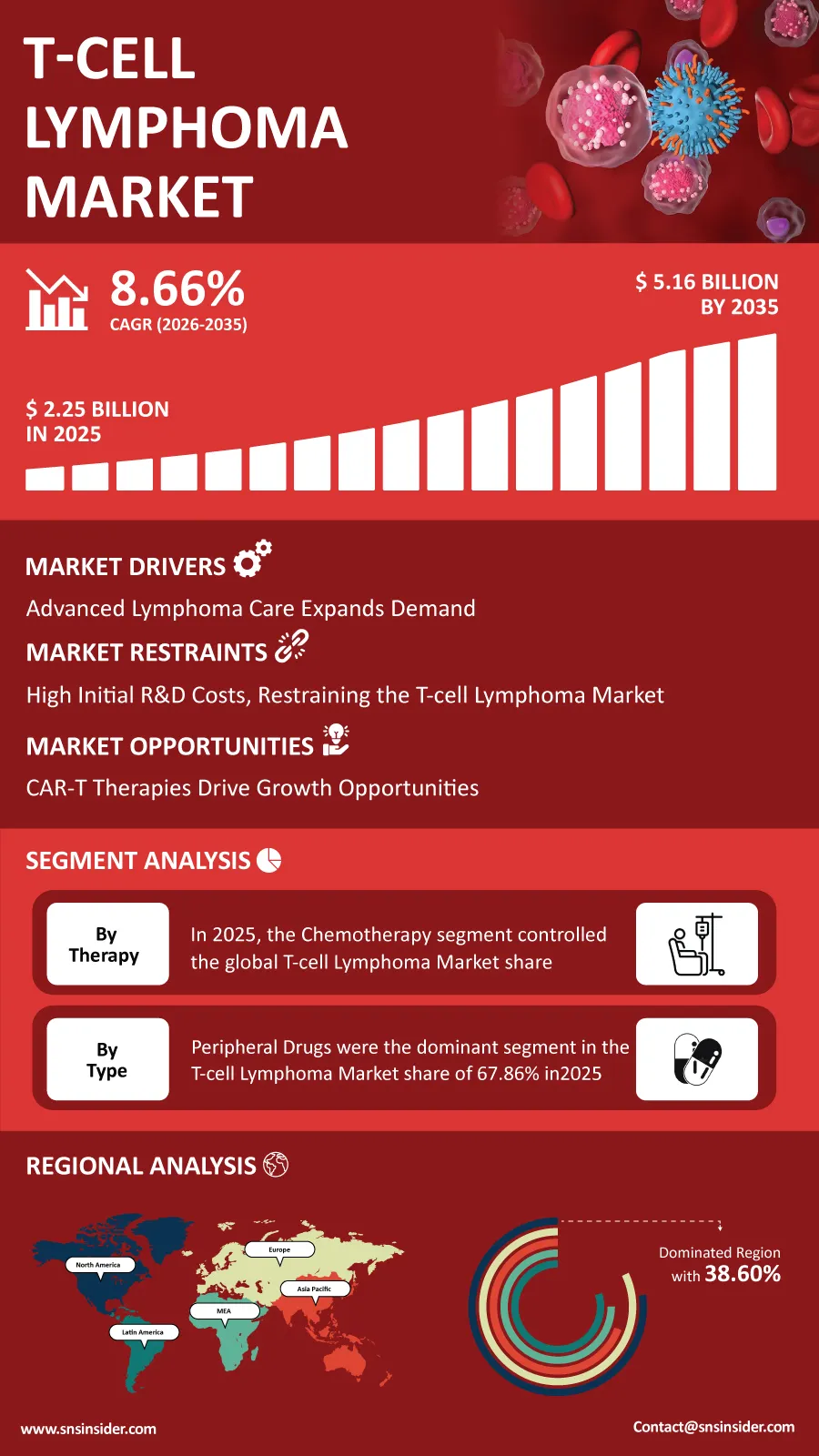
The global T-cell Lymphoma Market is expected to witness significant expansion over the next decade as healthcare providers increasingly adopt advanced treatment strategies for rare and aggressive hematologic cancers. “According to a recent study by SNS Insider, the global T-cell Lymphoma Market size valued at USD 2.25 billion in 2025, is anticipated to grow to USD 5.16 billion by 2035, registering a CAGR of 8.66% over the 2026–2035 forecast period.”
Oncology innovations through increased investment, accessibility of specialized treatment for cancer, and improvements in the use of targeted therapies are transforming the way T-cell lymphoma treatments are approached around the world. There is an intensified focus on the development of innovative drugs that could enhance patients' clinical results despite their existing medical needs.
The increasing emphasis on personalized medicine is also transforming therapeutic development, enabling clinicians to deliver more individualized treatment strategies based on molecular and genetic characteristics.
To Get Detailed Insights on the T-cell Lymphoma Market – Request a Sample Report
Innovation in Immunotherapy and Precision Medicine Accelerates Market Development
Continued rapid developments in the fields of immuno-oncology, cell therapy, and molecular diagnostics have helped to significantly change the approach to treating hematological cancers. Healthcare professionals now use new types of therapies to effectively treat the disease and help their patients achieve positive results.
Innovative technologies, such as using artificial intelligence to discover new drugs and identify new biomarkers, contribute to developing even more powerful research abilities to develop new cancer drugs. Pharmaceutical and biotechnology companies' growing cooperation is also helping to create a more vibrant environment for innovations.
As clinical research expands globally, patients are gaining broader access to emerging treatment options through growing numbers of investigational studies and precision medicine programs.
Key Market Findings Highlight Emerging Opportunities
Among therapy categories, chemotherapy accounted for the largest share of the global market in 2025, reflecting its continued role in established treatment protocols for multiple T-cell lymphoma subtypes.
Meanwhile, immunotherapy is expected to emerge as the fastest-growing therapy segment throughout the forecast period, supported by expanding clinical adoption of monoclonal antibodies, immune-based treatments, and combination therapeutic approaches.
By disease type, Peripheral T-cell Lymphoma accounted for 67.86% of global market revenue in 2025, maintaining its position as the leading segment due to increasing diagnosis rates and continued utilization of targeted treatment strategies. At the same time, lymphoblastic T-cell lymphoma is projected to record the fastest growth, expanding at a CAGR of 9.00% through 2035, driven by growing research activity and advances in treatment protocols.
Expanding Research Activities Continue to Strengthen the Market
Innovations in therapeutic treatments of hematologic cancers are being propelled forward by increased investments in oncology research on a global scale. The pharmaceutical companies are stepping up their clinical development and making strategic collaborations towards developing new therapy platforms.
There are many more awareness campaigns, improved diagnostics, and more availability of dedicated cancer care centers which will ensure an early diagnosis of the disease and access to better treatments. This will result in a steady growth in the market share.
Healthcare systems are also strengthening precision oncology programs by integrating genomic profiling, biomarker testing, and personalized treatment planning into routine clinical practice.
Regional Markets Present Strong Growth Potential
The share of North America in the total market revenue in 2025 was 38.60%, which was due to the presence of advanced oncology infrastructure, research, favorable regulatory landscape, and innovations in cancer treatments. The region is expected to experience significant growth owing to the use of advanced treatment technologies and clinical research.
On the other hand, Asia Pacific region is expected to witness the highest rate of growth among all regions during the forecast period, registering a CAGR of 9.16%. Increasing investments in the healthcare sector, increasing oncology services, rising diagnosis rate, and innovations in cancer treatments have been driving the market in the region.
Leading Companies Continue to Advance Oncology Innovation
Competition within the T-cell lymphoma market remains highly dynamic as pharmaceutical companies continue investing in clinical research, product innovation, regulatory approvals, and strategic collaborations to strengthen their oncology portfolios.
Key companies operating in the global T-cell lymphoma market include Takeda Pharmaceutical Company, Bristol Myers Squibb, Novartis, Johnson & Johnson, Merck & Co., Roche, Acrotech Biopharma, Daiichi Sankyo, Genmab, and Autolus Therapeutics.
An SNS Insider analyst Parry Kardani commented, "The convergence of precision medicine, immunotherapy, and advanced cellular therapies is reshaping the treatment landscape for T-cell lymphoma. Continued scientific innovation and expanding clinical research are expected to create meaningful opportunities for improving patient outcomes while driving long-term market growth."
About the Author

Get in touch




