
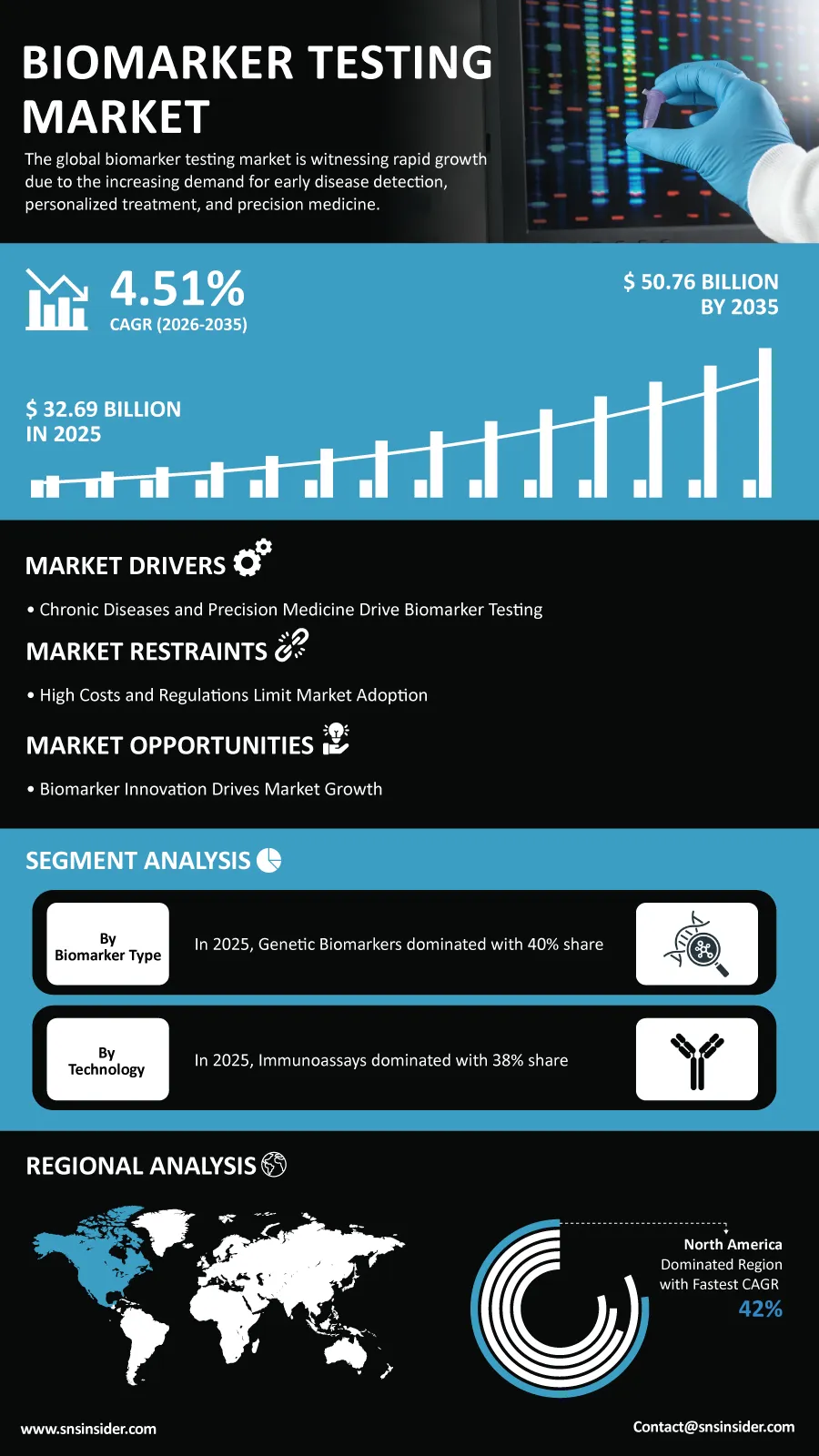
The global Biomarker Testing Market is projected to witness sustained expansion over the coming decade as healthcare systems increasingly prioritize precision medicine, early diagnosis, and data-driven clinical decision-making. “According to a recent study by SNS Insider, the global Biomarker Testing Market size valued at USD 32.69 billion in 2025, is anticipated to grow to USD 50.76 billion by 2035, registering a CAGR of 4.51% over the 2026–2035 forecast period.”
The increasing prevalence of chronic conditions, the need for personalized treatment approaches, and technological innovation have led to a complete transformation of the role of biomarkers testing within the current healthcare setting. Advanced solutions in testing are gradually being incorporated into the daily practices of healthcare facilities in order to enhance diagnostics and facilitate treatment and disease monitoring.
In light of the transition toward value-based care by healthcare providers, biomarker testing has become increasingly important in the management of diseases in hospitals, diagnostic centers, research institutes, and pharma industries.
To Get Detailed Insights on the Biomarker Testing Market – Request a Sample Report
Precision Healthcare Accelerates Industry Transformation
Precision medicine remains an increasingly popular concept in the healthcare field and results in a high demand for tests that can offer relevant information about the biology of diseases. The ongoing progress in molecular diagnostics, laboratory automation, and digital healthcare technologies allows physicians to make timely and well-grounded treatment decisions.
Increasing cooperation between pharmaceutical companies, biotech firms, universities, and diagnostic test producers facilitates innovations in the biomarker industry and contributes to the discovery of new biomarkers as well as makes clinical research more efficient.
Healthcare providers are also adopting next-generation analytical platforms that improve laboratory productivity, reduce turnaround times, and support more personalized patient care.
Key Market Findings Highlight Strong Growth Potential
Among biomarker categories, genetic biomarkers accounted for approximately 40% of total market revenue in 2025, reflecting their critical role in precision medicine and disease-specific therapeutic decision-making.
Meanwhile, protein biomarkers are projected to emerge as the fastest-growing biomarker category through 2035, supported by expanding applications across multiple disease areas and increasing research activity.
From a technology perspective, immunoassays represented nearly 38% of global market revenue in 2025, maintaining widespread adoption across clinical laboratories due to their reliability and broad diagnostic applications. At the same time, molecular diagnostics, including PCR and next-generation sequencing technologies, are expected to witness the fastest expansion during the forecast period, driven by increasing demand for highly sensitive and precision-focused testing solutions.
Application trends also continue to evolve. Oncology accounted for approximately 45% of market revenue in 2025, highlighting the growing importance of biomarker-guided approaches in cancer diagnosis, treatment selection, and disease monitoring. Meanwhile, cardiovascular and neurological disease applications are expected to record the strongest growth over the next decade, supported by increasing emphasis on early intervention and personalized therapeutic strategies.
Among end users, hospitals and diagnostic centers accounted for nearly 50% of total market revenue in 2025, while research and academic institutions are expected to experience the fastest expansion, reflecting increasing investments in biomarker discovery, translational research, and clinical innovation.
Innovation Continues to Expand Clinical Applications
Technological developments in laboratory equipment, digital analytics, and less invasive tests are increasing the value of biomarker testing in various medical sectors. More health institutions are adopting advanced test systems that will help in the stratification of diseases, formulation of better treatment options, and monitoring patients in the long run.
The adoption of artificial intelligence, predictive analytics, and other advanced data analysis technologies has improved efficiency in diagnoses while making it easier for research scientists to discover new biological markers. The technology is set to offer more growth prospects to diagnostics firms and healthcare institutions.
Regional Markets Continue to Create New Opportunities
The North American region constituted about 42% of the total global market revenue in 2025 due to the presence of advanced healthcare systems and high investments in precision medicines as well as the use of innovative diagnostics in the region. However, the region still benefits from various research initiatives, good reimbursement scenarios, and pharmaceutical investments.
On the other hand, the Asia Pacific region will continue to experience rapid growth in the coming years at a CAGR of 9.60% until 2035 due to increasing healthcare spending, increased diagnostic capacity, research activities, and growing awareness of personalized medicine.
Leading Companies Strengthen Innovation Strategies
Competition within the biomarker testing market remains dynamic as industry leaders continue investing in research, product development, strategic collaborations, and advanced diagnostic technologies designed to improve clinical outcomes and laboratory efficiency.
Key companies operating in the global biomarker testing market include Roche Diagnostics, Abbott Laboratories, Thermo Fisher Scientific, QIAGEN, Danaher Corporation, Bio-Rad Laboratories, Siemens Healthineers, Hologic, Illumina, and Guardant Health.
An SNS Insider analyst Parry Kardani commented, "The rapid convergence of precision medicine, molecular diagnostics, and data-driven healthcare is fundamentally changing the future of disease management. Organizations investing in advanced biomarker technologies and personalized diagnostic solutions are expected to benefit from significant long-term growth opportunities as healthcare continues to evolve toward more individualized patient care."
About the Author

Get in touch




