
Transplant Diagnostics Market is entering a period of expanding clinical adoption as transplant facilities will be using more molecular diagnostics, compatibility testing, and blood monitoring to manage their patients. Increased transplant procedures, developments in HLA testing, and non-invasive detection of rejection processes are creating demand for diagnostic solutions within the transplant space.
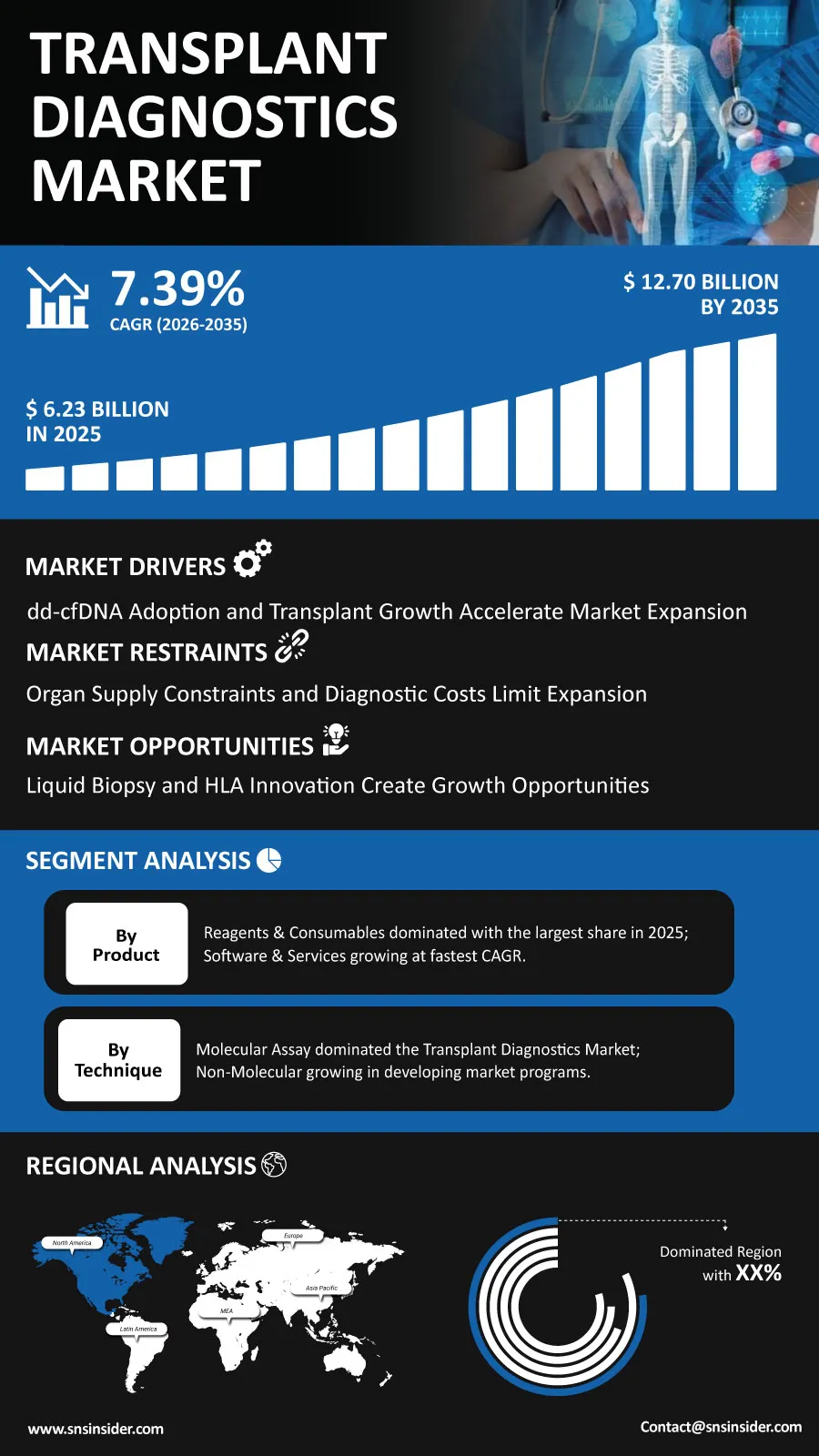
According to a recent study by SNS Insider, the global Transplant Diagnostics Market size valued at USD 6.23 billion in 2025, is anticipated to grow to USD 12.70 billion by 2035, registering a CAGR of 7.39% over the 2026–2035 forecast period. The market is benefiting from advances in precision diagnostics and the increasing clinical need to identify compatibility risks and potential graft complications at earlier stages.
To Get Detailed Insights on the Transplant Diagnostics Market – Request a Sample Report
Advanced Testing Reshapes Transplant Care
The current trend is a move towards more advanced diagnostic techniques which will allow obtaining more precise information prior to and after surgery. With the help of next-generation sequencing, more precise HLA profiling can be achieved. In addition, complex antibody testing may assist clinicians in assessing the compatibility of donors and recipients better.
Donor-derived cell-free DNA testing is yet another innovation which is becoming very popular these days. This test can allow checking the state of the transplanted organ by analyzing its genetic material circulating in the bloodstream of the patient. Thus, with the development of the liquid biopsy approaches, a new way of assessing transplant recipients' condition is being developed.
Artificial intelligence systems are increasingly being used for compatibility testing as well. These data-driven systems analyze complicated information regarding donors and recipients and help in quick decision making, which is essential during time-bound organ transplant processes.
Reagents Remain Core Revenue Segment
Reagents and Consumables was the largest segment in 2025, driven by the continuous demand for HLA typing reagents, antibody screening tests, crossmatch reagents, and monitoring tests. These products create an ongoing need in the laboratory during the patient’s entire transplant process.
The Software & Services category is anticipated to witness the fastest growth as transplant programs implement analytical tools for compatibility prediction, lab processes, and analysis of more complex molecular data sets.
In terms of technology, molecular techniques were the largest technology, as molecular and genetic data has become increasingly significant in transplantation. Non-molecular technologies are still very much relevant, especially in less developed healthcare systems where lab infrastructures are not well-established.
Kidney Transplants Lead Diagnostic Demand
Transplant of solid organs was the highest in transplant-type segments in 2025, with kidney transplant making the lead among individual procedures. The high number of kidney transplants translates to increased demand for pre-transplant compatibility tests and post-transplant monitoring.
Stem cell and bone marrow transplants make important contributions to diagnostic testing, especially with regards to HLA matching and engraftment monitoring. Advances in transplant medicine mean that there are many tests now involved in different transplant types.
United States Maintains Regional Leadership
North America was the leader in terms of region in 2025 due to the presence of well-established transplant networks, advanced lab capabilities, and the use of emerging monitoring technology. North America generated around 90% of total revenues in the region.
The U.S. Transplant Diagnostics Market size was USD 1.57 billion in 2025 and is expected to grow to USD 2.67 billion from 2025 to 2035, growing at a 5.46% CAGR. Increase in transplant surgeries, higher incidence of kidney and liver diseases, and adoption of molecular diagnostics have driven the demand for transplantation services in the country.
Asia Pacific is expected to emerge as the fastest-growing regional market due to the development of transplantation facilities in China, India, Japan, and South Korea. China held around 38% of total revenues in the region. Germany held 27% of the European market, while Israel accounted for 42% of Mideast and Africa. Brazil held 52% of Latin America's regional market.
Technology Creates New Growth Opportunities
The ongoing trend towards high-resolution HLA testing offers a significant opportunity for the diagnostics industry. As automated sequencing technology becomes more widespread, advanced testing may become possible not only at major academic transplant centers but at many other hospitals.
The development of liquid biopsy testing is yet another interesting field. Increasing the utilization of donor-derived cell-free DNA testing in kidney, heart, lung, and liver transplantation will allow creating additional sources of recurring testing as well as offer additional information for the monitoring of patients.
Despite the progress in the diagnostics industry, the lack of available organs and expenses related to the full-scale diagnostics are still challenging issues for the industry. Every year, about 100,000 people are waiting for a transplant in the USA, while around 6,000 people are dying per year waiting for their organs.
Diagnostic Companies Advance Next-Generation Solutions
Recent industry developments are reinforcing the shift toward automated and comprehensive transplant testing. CareDx introduced AlloSeq cfDNA 2.0 in 2026, expanding blood-based post-transplant assessment. Thermo Fisher Scientific also launched the VeriFlex HLA Typing System in 2025, targeting faster high-resolution HLA analysis across major loci.
Key companies operating in the global Transplant Diagnostics Market include CareDx Inc., Thermo Fisher Scientific Inc. (One Lambda), Bio-Rad Laboratories Inc., Immucor Inc. (Werfen), Luminex Corporation (DiaSorin), Bio-Techne Corporation, F. Hoffmann-La Roche AG, Abbott Laboratories, Illumina Inc., Pacific Biosciences (PacBio), GenDx BV, Inno-Train Diagnostik GmbH, Grifols SA, Transmedics Group Inc., Beckman Coulter Life Sciences, QIAGEN NV, Miltenyi Biotec GmbH, Hemacare Corporation, Hologic Inc., and Agena Bioscience Inc.
An SNS Insider analyst Parry Kardani commented, “Transplant diagnostics is moving toward faster, more precise and increasingly non-invasive patient assessment. The combination of high-resolution HLA testing, molecular monitoring and data-driven compatibility analysis is creating meaningful opportunities to improve transplant decision-making while expanding the role of diagnostics throughout the patient's care pathway.”
About the Author

Get in touch




