
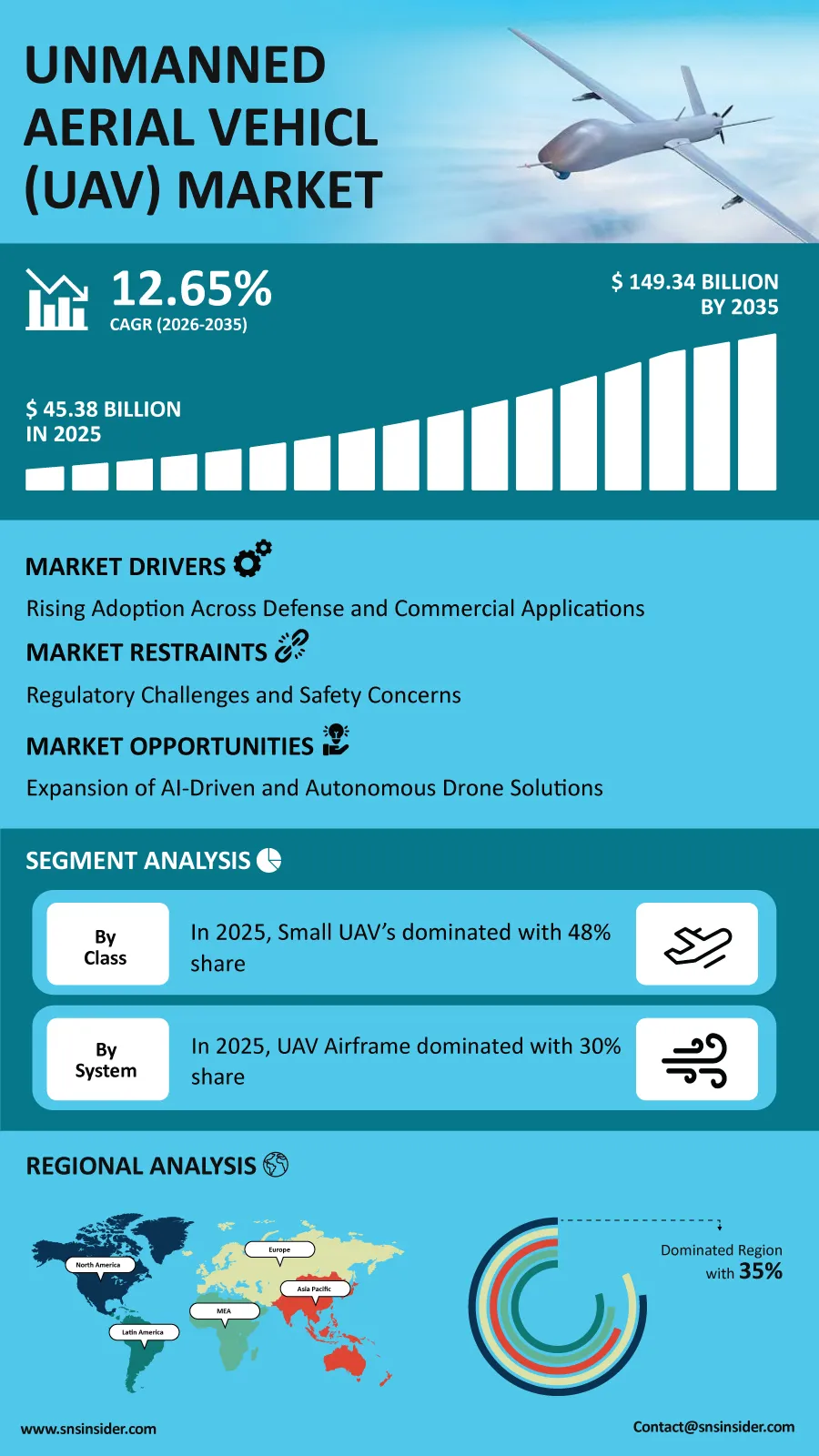
The global Unmanned Aerial Vehicles (UAV) Market is entering a new phase of accelerated growth as governments and commercial enterprises expand investments in intelligent aerial technologies for surveillance, industrial operations, and data-driven decision-making. “According to a recent study by SNS Insider, the global Unmanned Aerial Vehicles Market size valued at USD 45.38 billion in 2025, is anticipated to grow to USD 149.34 billion by 2035, registering a CAGR of 12.65% over the 2026–2035 forecast period.”
The increasing use of UAVs in military, agriculture, logistics, energy, and infrastructure inspection is redefining the way companies conduct asset management, optimize processes, and promote safety. Advancements in technology, especially in autonomous navigation, artificial intelligence, sensor technology, and communication technology, have enabled the UAVs to become useful tools in many industries.
Companies are also adopting unmanned technology due to its low cost and high productivity in performing tasks that pose more risks when done by traditional means. Business opportunities are being generated continuously as regulations favor commercial drones, especially in developing countries.
To Get Detailed Insights on the Unmanned Aerial Vehicles Market – Request a Sample Report
Autonomous Aviation Technologies Unlock New Commercial Opportunities
Advances in artificial intelligence and real-time analysis are turning the UAVs into autonomous devices that can carry out complicated tasks with minimum human assistance. This progress is contributing to wider use in such areas as precision agriculture, disaster relief operations, environment observation, construction, mining, and public safety.
Increasing efforts in developing smart cities infrastructure have created the need for aerial surveillance systems that can be used for traffic control, infrastructure inspection, emergency management, and urban planning projects. Simultaneously, logistics companies are making intensive efforts in studying autonomous delivery services aimed at improving efficiency and lowering costs of the process.
As part of the digital transformation efforts, the UAVs become an integral part of intelligent ecosystems.
Key Market Insights Highlight Evolving Demand Patterns
Among UAV classes, Small UAVs accounted for 48% of global market revenue in 2025, supported by widespread deployment across commercial applications, defense operations, and industrial inspections. Tactical UAVs are projected to register the fastest expansion throughout the forecast period due to increasing military modernization initiatives and extended operational capabilities.
Within system components, UAV Airframes generated approximately 30% of market revenue in 2025, reflecting continued investments in lightweight materials, structural durability, and enhanced payload capacity. Meanwhile, UAV Software is expected to emerge as the fastest-growing segment as autonomous flight control, AI-powered navigation, and advanced mission planning become increasingly important.
By technology, Remotely Operated UAVs maintained a dominant 52% market share during 2025 because of their proven reliability across military and commercial operations. However, Fully Autonomous UAVs are forecast to witness the highest growth through 2035 as artificial intelligence continues improving independent flight capabilities.
The Military segment represented 55% of overall market revenue in 2025 owing to continued investments in surveillance, intelligence gathering, reconnaissance, and national security. At the same time, commercial applications are anticipated to experience the fastest expansion as drone adoption accelerates across logistics, agriculture, infrastructure management, and industrial inspection.
Innovation and Digital Integration Continue Driving Industry Transformation
In recent years, drone manufacturers have shifted their focus towards bettering endurance, stability, payload capabilities, and autonomy features in accordance with customers' needs. The main emphasis in product development has been put on the incorporation of advanced cameras, smart sensors, obstacle detection capabilities, and mission planning algorithms through artificial intelligence into the new generation of unmanned aerial vehicles.
The introduction of improved batteries and lightweight composite materials allows drones to fly farther distances in more efficient ways. This will lead drones to be capable of performing more complex tasks in industries that require precision and dependability.
Increasing cooperation between aerospace manufacturers, software providers, and artificial intelligence companies is expected to facilitate the process of commercializing intelligent unmanned air vehicles in the next decade.
North America Accounted for 35% Market Share in 2025; Asia Pacific Forecast to Expand at a 14.8% CAGR by 2035
North America held nearly 35% of total revenue generated from the UAV market in 2025 owing to significant spending on defense sector, advanced technology related to aerospace sector, significant amount of research activities and early adaptation of autonomy technologies.
Asia Pacific region is expected to register highest growth rate during 2026-2035 with CAGR of 14.8%. Increased manufacturing ability, modernization of defense sector, increased usage of drones commercially and government support for latest aviation technologies further boosting market growth.
The Europe region is expanding with high pace due to increased need of UAVs for environmental monitoring, infrastructure monitoring, public safety and creation of smart cities. The Latin America and Middle East regions are also registering significant adoption of UAV technology.
Industry Participants Accelerate Product Development Strategies
Competition across the global Unmanned Aerial Vehicles Market remains highly dynamic as leading manufacturers continue investing in autonomous technologies, advanced flight software, sensor integration, and mission-specific drone platforms. Companies are strengthening their competitive positions by expanding product portfolios capable of supporting both military and commercial applications while addressing rapidly evolving operational requirements.
Key companies operating in the global Unmanned Aerial Vehicles Market include Northrop Grumman, DJI, General Atomics Aeronautical Systems, Boeing (Insitu), Lockheed Martin, AeroVironment, Israel Aerospace Industries, Textron Systems, Kratos Defense & Security Solutions, Parrot SA, BAE Systems, Elbit Systems Ltd., Airbus Defence and Space, Leonardo S.p.A., Aviation Industry Corporation of China (AVIC), Turkish Aerospace Industries, Baykar, Adcom Systems, Wingcopter, and Yuneec International.
An SNS Insider analyst Santosh Bhul commented, "The growing convergence of artificial intelligence, autonomous navigation, advanced sensing technologies, and commercial drone applications is fundamentally reshaping the unmanned aviation industry. Organizations investing in intelligent UAV platforms capable of delivering operational efficiency, enhanced situational awareness, and scalable mission capabilities are expected to lead the next phase of market growth."
About the Author

Get in touch




