
Tactical UAV Market Report Scope & Overview:
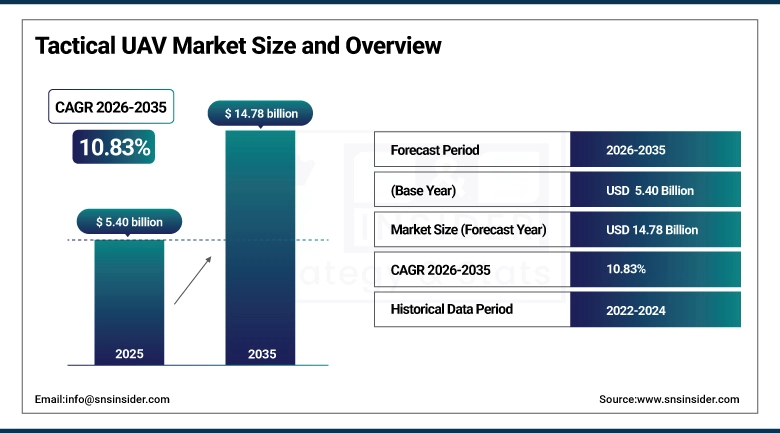
The Tactical UAV Market size is valued at USD 5.40 Billion in 2025 and is projected to reach USD 14.78 Billion by 2035, growing at a CAGR of 10.83% during the forecast period 2026–2035.
Insights on the Tactical UAV Market provide a comprehensive analysis of defense modernization trends, battlefield surveillance requirements, and the growing integration of advanced unmanned systems across military and homeland security operations. The growth drivers of the market include growing adoption of ISR platforms, demand for autonomous and semi-autonomous UAVs, quick integration of advanced payloads, such as EO/IR, radar, SIGINT, and armed systems, and the requirement for border monitoring and combat support. The increased spending on defense modernization projects, rising security issues on the borders, and innovations in AI-based navigation systems, secure communication systems, and hybrid/VTOL UAV platforms will drive the market during the forecast period from 2026 to 2035.
Tactical UAV deployments support thousands of active defense and surveillance missions worldwide by 2025, and are expected to expand rapidly with next-generation autonomous combat and reconnaissance UAV programs by 2035.
Market Size and Forecast:
-
Market Size in 2025: USD 5.40 Billion
-
Market Size by 2035: USD 14.78 Billion
-
CAGR: 10.83% from 2026 to 2035
-
Base Year: 2025
-
Forecast Period: 2026–2035
-
Historical Data: 2022–2024
To Get more information on Tactical UAV Market - Request Free Sample Report
Tactical UAV Market Trends:
-
Rapid growth in border security and maritime surveillance is accelerating demand for long-endurance and hybrid/VTOL tactical UAVs.
-
Integration of weaponized payloads and precision-strike systems is transforming tactical UAVs into multi-role combat platforms.
-
Rising adoption of hybrid/VTOL tactical UAVs is improving operational flexibility in complex and remote terrains.
-
Increasing defense modernization and indigenous manufacturing programs are driving next-generation tactical UAV procurement.
-
Expansion of secure data links, SATCOM, and EW-resistant systems is ensuring reliable operations in contested environments.
-
Growing use of swarm intelligence and AI-based target recognition is reshaping tactical UAV mission capabilities.
U.S. Tactical UAV Market Insights:
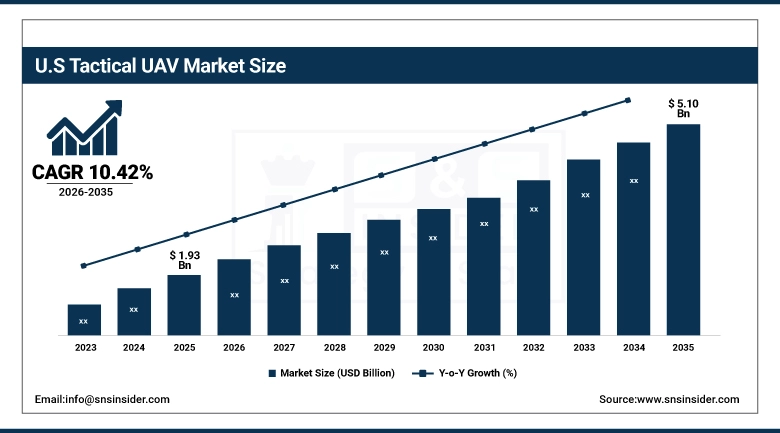
The Tactical UAV Market is projected to grow from USD 1.93 Billion in 2025 to USD 5.10 Billion by 2035, at a CAGR of 10.42%. Some positive influences on the growth of this industry sector are the growing usage of tactical drones for ISR operations, border surveillance, and combat support operations, increased use of state-of-the-art payloads like EO/IR sensors, radar, SIGINT gear, and weapons, and growing use of AI-based navigation and intelligence capabilities. Some other positive growth trends are the increased inclination towards VTOL/hybrid drones, communication networks that are resilient to jamming/electronic attacks, and expansion of defense modernization programs and indigenous UAV production in the coming decade from 2026 through 2035.
Tactical UAV Market Growth Drivers:
-
Rising deployment of tactical UAV platforms across defense forces and border surveillance operations is driving demand for real-time intelligence and battlefield awareness.
Due to the rapid development of autonomous capabilities through AI, communication systems that are secured, and sensor integration technologies, there is accelerated uptake of advanced tactical UAVs equipped with EO/IR sensors, radars, SIGINT capability, and armed payloads to enhance surveillance, target detection, and combat operations. Military modernization initiatives, increased use of drones for warfare purposes, and investment in UAVs used for combat and reconnaissance missions are boosting the demand for tactical UAVs around the world.
More than 50% of newly procured tactical UAV systems globally are expected to feature semi-autonomous or fully autonomous mission capabilities as of 2025.
Tactical UAV Market Restraints:
-
High cost, integration complexity, and maintenance burden of advanced tactical UAV systems and multi-sensor payloads are limiting large-scale adoption, particularly in budget-constrained defense and security programs globally.
Tactical UAV Market is constrained by continued dependence on legacy unmanned aerial systems with limited autonomy, single-mission configurations, and outdated avionics architectures that remain deeply embedded in existing defense UAV fleets. The high cost of integrating next-generation capabilities such as AI-enabled autonomous navigation, EO/IR and radar-based ISR payloads, electronic warfare systems, secure SATCOM communication links, and modular plug-and-play mission architectures is limiting rapid fleet modernization.
Tactical UAV Market Opportunities:
-
Rapid expansion of precision strike-enabled ISR platforms and AI-assisted mission autonomy is creating strong growth opportunities for next-generation tactical UAV systems globally.
The Tactical UAVs Market has immense potential owing to the rise in demand for real-time battlefield intelligence and fast-action unmanned combat solutions within contemporary defense systems. Growing adoption of network-enabled UAV formations, command and control system integration, and cross-domain awareness solutions is leading to the synchronization of operations using data-based approaches. Moreover, increased attention to tactical UAV platforms that are low observable and have long endurance in GPS denied conditions is boosting the market.
Furthermore, nearly 55% of upcoming defense UAV procurement programs are expected to prioritize multi-role tactical UAVs with embedded AI decision-support systems and adaptive mission reconfiguration capabilities by 2035.
Tactical UAV Market Segmentation Analysis:
-
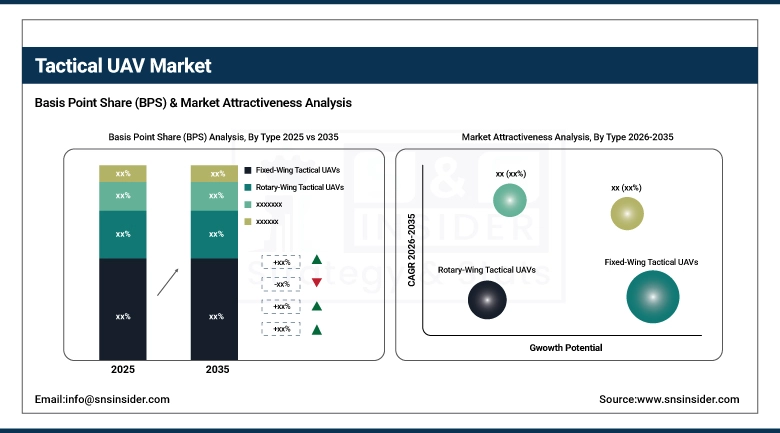
By Type, Fixed-Wing Tactical UAVs held the largest market share of 48.55% in 2025, while Hybrid/VTOL Tactical UAVs are expected to grow at the fastest CAGR of 12.37% during 2026–2035.
-
By Payload Type, EO/IR Payloads held the largest market share of 34.45% in 2025, while Communication Relay Payloads are expected to grow at the fastest CAGR of 12.27% during 2026–2035.
-
By Application, Intelligence, Surveillance & Reconnaissance (ISR) dominated with 39.85% market share in 2025, while Tactical Strike / Combat Operations is expected to grow at the fastest CAGR of 13.54% during 2026–2035.
-
By End User, Military & Defense Forces held the largest share of 72.45% in 2025, while Homeland Security / Border Patrol is expected to grow at the fastest CAGR of 11.87% during 2026–2035.
-
By Mode of Operation, Remotely Operated UAVs held the largest market share of 58.24% in 2025, while Fully Autonomous UAVs are expected to grow at the fastest CAGR of 14.65% during 2026–2035.
By Type, Fixed-Wing Tactical UAVs Dominates While Hybrid/VTOL Tactical UAVs Grows Rapidly:
Fixed-Wing Tactical UAVs segment dominated the market because of its long endurance, higher operational range, and suitability for persistent ISR missions. The extensive usage of these systems in border surveillance, sea patrols, and battlefield recon missions has contributed to its topmost market position among tactical UAVs.
Hybrid/VTOL Tactical UAVs is the fastest-growing segment, due to the increasing requirement for versatility in the missions and terrain that require vertical takeoff capacity. The segment is expected to grow owing to its increasing usage in urban warfare scenarios and battlefield operations.
By Payload Type, EO/IR Payloads Dominates While Communication Relay Payloads Grows Rapidly:
EO/IR Payloads segment dominated the market, owing to the wide implementation of EO/IR payloads for surveillance, targeting, and reconnaissance applications through defense UAVs. With the capability to provide sharp visuals in both day and nighttime missions, it forms the core payload technology used in tactical operations.
Communication Relay Payloads is the fastest-growing segment, mainly because of rising need for secure and continuous communication on the battlefield, especially while transmitting mission critical information from one place to another.
By Application, ISR Dominates While Tactical Strike / Combat Operations Grows Rapidly:
Intelligence, Surveillance & Reconnaissance (ISR) segment dominated the market because of its importance in battlefield intelligence gathering and surveillance. The constant usage of UAVs for persistent surveillance has made sure that it retains its dominance in the tactical segment.
Tactical Strike/Combat Operations Segment is the fastest growing segment as more and more weapon’s equipped UAVs are being used for precise strikes in combat situations. The increasing use of combat UAVs in asymmetric warfare is driving growth.
By End User, Defense & Military Forces Dominates While Homeland Security / Border Patrol Grows Rapidly:
Defense & Military Forces segment dominated the market because of heavy investment and usage of tactical UAVs equipped with cutting-edge EO/IR sensors, radar, SIGINT, and weaponized payloads. The continuous upgrading of the defense fleet, geopolitical uncertainties, and growing need for live intelligence on the battlefield have helped maintain the dominance of this segment within the market.
The Homeland Security / Border Patrol segment is the fastest growing, mainly because of the growing need for surveillance and border patrol through UAV technology for anti-terrorism purposes. Increasing use of endurance platforms, AI-based tracking systems, and communication subsystems is making it easier to secure the borders through UAVs.
By Mode of Operation, Remotely Operated Dominates While Fully Autonomous Grows Rapidly:
Remotely Operated segment dominated the market due to its extensive usage in current tactical UAVs, with reliable operation, established methodologies, and relatively low technology risks.
Fully Autonomous is the fastest-growing segment, supported by the rapid evolution of Artificial Intelligence (AI) for navigation and decision making and swarm intelligence technologies. Growth in this segment has been attributed to the increasing need for reduced human intervention and more efficient operations in contested environments.
Tactical UAV Market Regional Analysis:
North America Tactical UAV Market Insights:
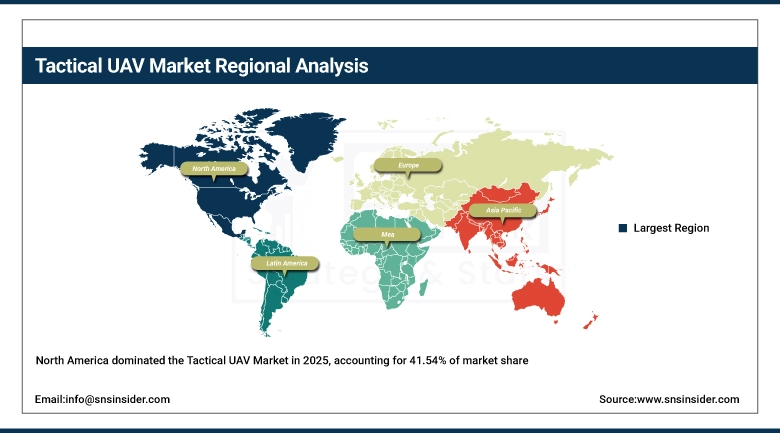
The North America Tactical UAV Market dominates the global landscape, holding a 41.54% share in 2025, fuelled by robust defense infrastructures, robust production and supply chains for unmanned aircraft, and significant adoption of next-generation UAV technology within military and homeland security missions. The region gains from sustained investment in AI-enabled tactical UAVs, ISR systems, and payload technology including electro-optical infrared sensors, radar, SIGINT, and electronic warfare systems. Extensive deployment of tactical UAVs for border control, reconnaissance, maritime surveillance, and infrastructure monitoring purposes will help sustain future demand. Availability of key defense players along with fast-paced modernization of unmanned combat systems will continue to make the region the leader in tactical UAV deployments and system integration.
Get Customized Report as per Your Business Requirement - Enquiry Now
United States Tactical UAV Market Insights:
The US Tactical UAV Market holds the leading position in the regional market owing to defense modernization initiatives, R&D investments, and early adoptions of autonomous UAV systems. The nation is concentrating on developing AI-based mission systems, UAV weapons platforms, and multi-sensor payloads to gain intelligence superiority over competitors. Deploying swarm-enabled UAVs, securing communication networks, and leveraging edge processing capabilities is further improving tactical UAV missions.
Asia-Pacific Tactical UAV Market Insights:
The Asia-Pacific Tactical UAV Market is the fastest-growing region, projected to expand at a CAGR of 11.96% during 2026–2035. The growth in the market is fueled by fast-paced military advancements, increasing security threats across borders, and the widespread implementation of unmanned technologies in both military and civil applications. Nations like China, India, Japan, and South Korea have been investing extensively in the design and manufacture of their own UAVs, along with intelligent surveillance technologies, as well as the latest payload integration technologies. The increasing application of UAVs in border surveillance, maritime patrol, emergency relief, and urban policing activities is fueling the growth in demand.
China Tactical UAV Market Insights:
There are several factors behind the swift growth of China’s tactical UAV market, such as indigenous production ability for UAVs, extensive military expenditure, and development in UAVs with autonomous features. The incorporation of payloads with advanced ISR technologies, target recognition through AI technology, and communication over vast distances are adding to the effectiveness of the UAV system.
Europe Tactical UAV Market Insights:
The factors driving the growth of the Europe Tactical UAV Market include the presence of strong aerospace engineering industry in the region, defense procurements and modernization projects along with increasing focus on autonomous battlefield systems in Europe. Various countries like France, Germany, the UK, and Italy have been working on developing next generation tactical UAV platforms with advanced ISR payload and electronic warfare systems and artificial intelligence technologies for mission control solutions. UAVs have also been gaining popularity in Europe owing to their use in border and coastal patrol operations and in carrying out joint military operations through NATO aligned initiatives.
Germany Tactical UAV Market Insights:
The Germany Tactical UAV Market has been growing because of Germany's advanced aerospace manufacturing capabilities and its active role in European UAV modernization projects. Germany is investing significantly in developing tactical UAV platforms capable of operating autonomously with advanced navigation systems and secure communications networks. Germany has been increasingly working on improving its capabilities to integrate various subsystems for UAV platforms using artificial intelligence.
Latin America Tactical UAV Market Insights:
The Latin America Tactical UAV Market is slowly growing because of the increasing number of countries adopting UAVs for applications related to border surveillance, internal security, and surveillance of infrastructure. Some of the nations that have been using tactical UAVs include Brazil, Mexico, and Colombia for applications related to counter narcotics, environmental surveillance, and large-scale agricultural surveillance. Defense modernization budget constraints in the region have led to increased adoption of tactical UAVs in order to avoid expensive procurement programs and focus more on surveillance and reconnaissance payloads as opposed to advanced combat payloads. Increasing partnerships between nations in the region and international UAV manufacturers is also contributing to growth of the regional tactical UAV market.
Middle East & Africa Tactical UAV Market Trends:
The Middle East & Africa Tactical UAV Market is experiencing high growth rates, primarily driven by growing initiatives for defense modernization, regional security threats, and advancements in unmanned technologies. Nations including the UAE, Saudi Arabia, Israel, and South Africa have been focusing on tactical UAVs that possess extended flight time and incorporate ISR payloads and electronic warfare capabilities. The growing applications of tactical UAVs in border patrol, securing important installations, and monitoring oil and gas facilities are fueling demand in the market.
Tactical UAV Market Competitive Landscape:
General Atomics Aeronautical Systems, Inc., is one of the world's leading providers of unmanned aerial systems (UASs), and it is also a market leader in the development of tactical UAVs. General Atomics is well-known for its expertise in designing UAV airframes, developing mission avionics, incorporating sensors, and using artificial intelligence-based autonomous flight control systems. It derives its competitive advantage from its seamless collaboration with ISR defense projects, its track record in combat UAV operations, and improvements in payload flexibility and multi-mission UAV systems.
-
In March 2025, General Atomics enhanced its next-generation UAV autonomy framework by integrating advanced AI-based mission planning and multi-sensor fusion capabilities into its tactical UAV platforms, improving real-time ISR accuracy and operational endurance in contested environments.
Lockheed Martin Corporation is one of the major companies involved in the production of advanced aerospace and defense products. The company is experienced in developing advanced unmanned vehicles, autonomous missions, and battlefield intelligence platforms. Lockheed Martin is very important in the development of tactical UAVs concentrating on stealth missions, AI missions, and multi-domain communication platforms. The company enjoys an advantage due to its expertise in defense programs, autonomy, and ISR & combat UAVs developed for high-threat operational environments.
-
In May 2025, Lockheed Martin advanced its autonomous UAV ecosystem by expanding AI-enabled collaborative mission capabilities and secure data-link technologies for next-generation tactical ISR and electronic warfare UAV platforms, strengthening multi-domain operational performance.
Northrop Grumman Corporation is a leading global participant in the field of aerospace systems and unmanned systems technology, possessing unique skills in the development of autonomous UAV platforms, stealth surveillance systems, and defense electronics systems. The firm is expert in developing ISR products, electronic warfare products, and network-centric UAVs suited to battlefield conditions. The strengths of the firm are its close integration with U.S. military projects, autonomy mission system leadership, and sensor fusion and stealth systems as well as long-range surveillance UAVs.
-
In June 2025, Northrop Grumman advanced its autonomous ISR UAV capabilities by enhancing AI-driven sensor fusion systems and expanding long-endurance stealth surveillance platform integration for next-generation defense reconnaissance and electronic warfare missions.
Tactical UAV Market Key Players:
Some of the Tactical UAV Market Companies are:
-
General Atomics Aeronautical Systems, Inc.
-
Lockheed Martin Corporation
-
Northrop Grumman Corporation
-
Israel Aerospace Industries Ltd.
-
Elbit Systems Ltd.
-
The Boeing Company
-
AeroVironment, Inc.
-
Textron Systems Corporation
-
Baykar Technologies
-
Leonardo S.p.A.
-
Saab AB
-
Safran S.A.
-
Kratos Defense & Security Solutions, Inc.
-
Aeronautics Ltd.
-
BlueBird Aero Systems Ltd.
-
Turkish Aerospace Industries
-
RTX Corporation
-
Thales Group
-
Rheinmetall AG
-
SZ DJI Technology Co., Ltd.
| Report Attributes | Details |
|---|---|
| Market Size in 2025 | USD 5.40 Billion |
| Market Size by 2035 | USD 14.78 Billion |
| CAGR | CAGR of 10.83% From 2026 to 2035 |
| Base Year | 2025 |
| Forecast Period | 2026-2035 |
| Historical Data | 2022-2024 |
| Report Scope & Coverage | Market Size, Segments Analysis, Competitive Landscape, Regional Analysis, DROC & SWOT Analysis, Forecast Outlook |
| Key Segments | • By Type (Fixed-Wing Tactical UAVs, Rotary-Wing Tactical UAVs, Hybrid/VTOL Tactical UAVs, Others) • By Payload Type (EO/IR Payloads, Radar / SAR Payloads, SIGINT / EW Payloads, Communication Relay Payloads, Weaponized Payloads) • By Application (Intelligence, Surveillance & Reconnaissance (ISR), Target Acquisition, Border & Maritime Surveillance, Tactical Strike / Combat Operations, Communication Relay / Electronic Warfare) • By End User (Military & Defense Forces, Homeland Security / Border Patrol, Law Enforcement Agencies) • By Mode of Operation (Remotely Operated, Semi-Autonomous, Fully Autonomous) |
| Regional Analysis/Coverage | North America (US, Canada), Europe (Germany, UK, France, Italy, Spain, Russia, Poland, Rest of Europe), Asia Pacific (China, India, Japan, South Korea, Australia, ASEAN Countries, Rest of Asia Pacific), Middle East & Africa (UAE, Saudi Arabia, Qatar, South Africa, Rest of Middle East & Africa), Latin America (Brazil, Argentina, Mexico, Colombia, Rest of Latin America). |
| Company Profiles | General Atomics Aeronautical Systems, Inc., Lockheed Martin Corporation, Northrop Grumman Corporation, Israel Aerospace Industries Ltd., Elbit Systems Ltd., The Boeing Company, AeroVironment, Inc., Textron Systems Corporation, Baykar Technologies, Leonardo S.p.A., Saab AB, Safran S.A., Kratos Defense & Security Solutions, Inc., Aeronautics Ltd., BlueBird Aero Systems Ltd., Turkish Aerospace Industries, RTX Corporation, Thales Group, Rheinmetall AG, SZ DJI Technology Co., Ltd.. |
Frequently Asked Questions
North America dominated with a 41.54% share in 2025, while Asia-Pacific is the fastest-growing region, expected to expand at a CAGR of 11.96% during 2026–2035.
EO/IR Payloads dominated with a 34.45% share in 2025, while Communication Relay Payloads are projected to grow at the fastest CAGR of 12.27% during 2026–2035.
Growth is driven by demand for real-time battlefield intelligence, rising ISR UAV deployment, and rapid adoption of AI-enabled autonomous systems and secure communication technologies.
The market is valued at USD 5.40 Billion in 2025 and is projected to reach USD 14.78 Billion by 2035.
The Tactical UAV Markets projected to grow at a CAGR of 10.83% during 2026–2035.
