
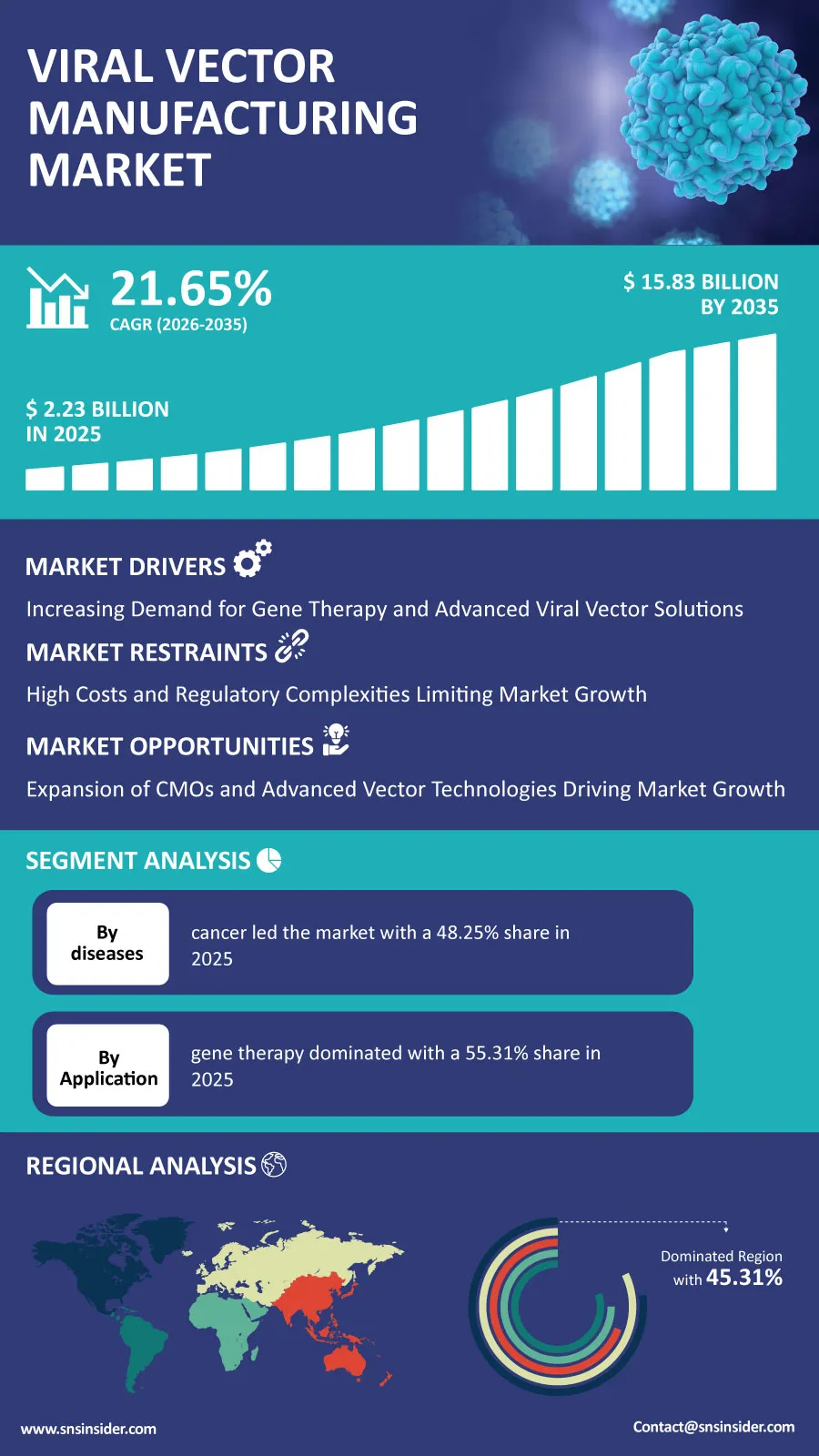
The global Viral Vector Manufacturing Market is entering a period of rapid expansion as gene-based medicines transition from research laboratories to commercial healthcare applications. “According to a recent study by SNS Insider, the global Viral Vector Manufacturing Market size valued at USD 2.23 billion in 2025, is anticipated to grow to USD 15.83 billion by 2035, registering a CAGR of 21.65% over the 2026–2035 forecast period.”
As the field of advanced therapies matures, there is increasing commercialization for sustained demand for dependable viral vector production in clinical and large-scale manufacturing settings. Pharmaceutical innovators are investing in production technologies and dedicated manufacturing partners continue scaling capacity to keep pace with an accelerating gene therapy pipeline. An accelerating momentum of regulation, innovation in the field and industry collaboration is filtering through and strengthening the outlook on a global scale.
To Get Detailed Insights on the Viral Vector Manufacturing Market – Request a Sample Report
Gene Therapy Expansion Accelerates Manufacturing Investments
The increasing number of gene therapy programs is transforming viral vector production into one of the most strategic areas within the biotechnology industry. In 2025, more than 1,200 gene therapy clinical trials were active worldwide, with over 70% utilizing viral vectors, particularly adeno-associated virus (AAV) and lentiviral platforms. At the same time, more than 30 viral vector-based gene therapies had reached commercial launch globally, with oncology and rare genetic disorders accounting for over 80% of approved indications.
To meet this demand, manufacturers are adopting automated bioreactor technologies, higher-yield production systems, and next-generation vector platforms that improve scalability while maintaining product quality. The industry's growing reliance on contract manufacturing organizations is also enabling biotechnology companies to accelerate clinical development without making substantial capital investments in dedicated facilities.
Key Market Findings Highlight Fastest-Growing Segments
Disease applications continue to shape investment priorities across the industry. Cancer accounted for 48.25% of market revenue in 2025, reflecting strong demand for advanced oncology therapies, while genetic disorders are projected to register the fastest growth at a CAGR of 18.14% through 2035.
Gene therapy remained the leading application with a 55.31% revenue share in 2025 because of its expanding clinical adoption. Meanwhile, vaccinology is expected to record the fastest expansion, advancing at a 16.53% CAGR as viral vector technologies gain broader applications in infectious disease prevention.
Among vector types, adeno-associated viral (AAV) vectors captured 34.23% of market revenue in 2025 due to their established safety profile and therapeutic versatility. Lentiviral vectors are forecast to achieve the highest growth rate at 15.47% CAGR, supported by increasing demand for CAR-T cell therapies and regenerative medicine.
Manufacturing preferences are also evolving. In-house manufacturing represented 51.68% of global revenue in 2025 as major pharmaceutical companies maintained direct production capabilities. However, CDMOs are anticipated to be the fastest-growing manufacturing model, expanding at a 17.44% CAGR as outsourcing becomes increasingly important for commercial-scale production.
Capacity Expansion and Outsourcing Define Industry Strategy
Manufacturing infrastructure is growing rapidly in preparation for future demand. In 2025, global contract manufacturing organizations invested over USD 5 billion to expand viral vector production facilities, commissioning more than 40 new GMP manufacturing suites for commercial-scale gene therapy manufacturing.
This investment wave is a reflection of the industry’s focus on improving production efficiency, increasing manufacturing flexibility and shortening development timelines. The trend is growing of biotech innovators and manufacturing experts partnering together to strengthen supply chains while navigating regulatory compliance across international markets.
Regional Markets Continue Building Production Leadership
North America dominated the market with a share of 45.31% of the global market revenue in 2025, owing to its advanced biotechnology infrastructure, favorable regulatory pathways, and a significant concentration of gene therapy developers. The US is the major growth engine of the region, with its domestic market worth at USD 0.73 billion in 2025 and expected to reach USD 5.02 billion by 2035, registering a CAGR of 21.26%.
Asia Pacific is expected to grow at the highest CAGR of 22.39% during the forecast period. Countries such as China, Japan, South Korea and Australia are making ongoing investments in manufacturing facilities, biotechnology research and clinical development programs to strengthen regional production capabilities.
Europe also continues expanding its presence through increasing investments in biotechnology infrastructure, manufacturing partnerships, and research initiatives supporting next-generation therapies.
Leading Companies Strengthen Global Manufacturing Networks
Competition continues to intensify as manufacturers expand production capabilities, introduce advanced processing technologies, and establish strategic collaborations across the value chain.
Major companies operating in the global Viral Vector Manufacturing Market include Lonza, Thermo Fisher Scientific, Charles River Laboratories, Fujifilm Diosynth Biotechnologies, Catalent, Kaneka Eurogentec, Merck KGaA (MilliporeSigma), Oxford Biomedica, uniQure NV, Spark Therapeutics (Roche), Cytiva (Danaher), Yposkesi (Servier), Viralgen Vector Core, Aldevron, Vibalogics, Waisman Biomanufacturing, Novasep, Genezen, bluebird Bio, and REGENXBIO.
An SNS Insider analyst Parry Kardani commented, "The accelerating transition of gene therapies from clinical development to commercial adoption is fundamentally reshaping viral vector manufacturing. Organizations that successfully expand scalable production capacity while maintaining quality and regulatory excellence will be well positioned to capture long-term opportunities across the rapidly evolving cell and gene therapy ecosystem.
About the Author

Get in touch




