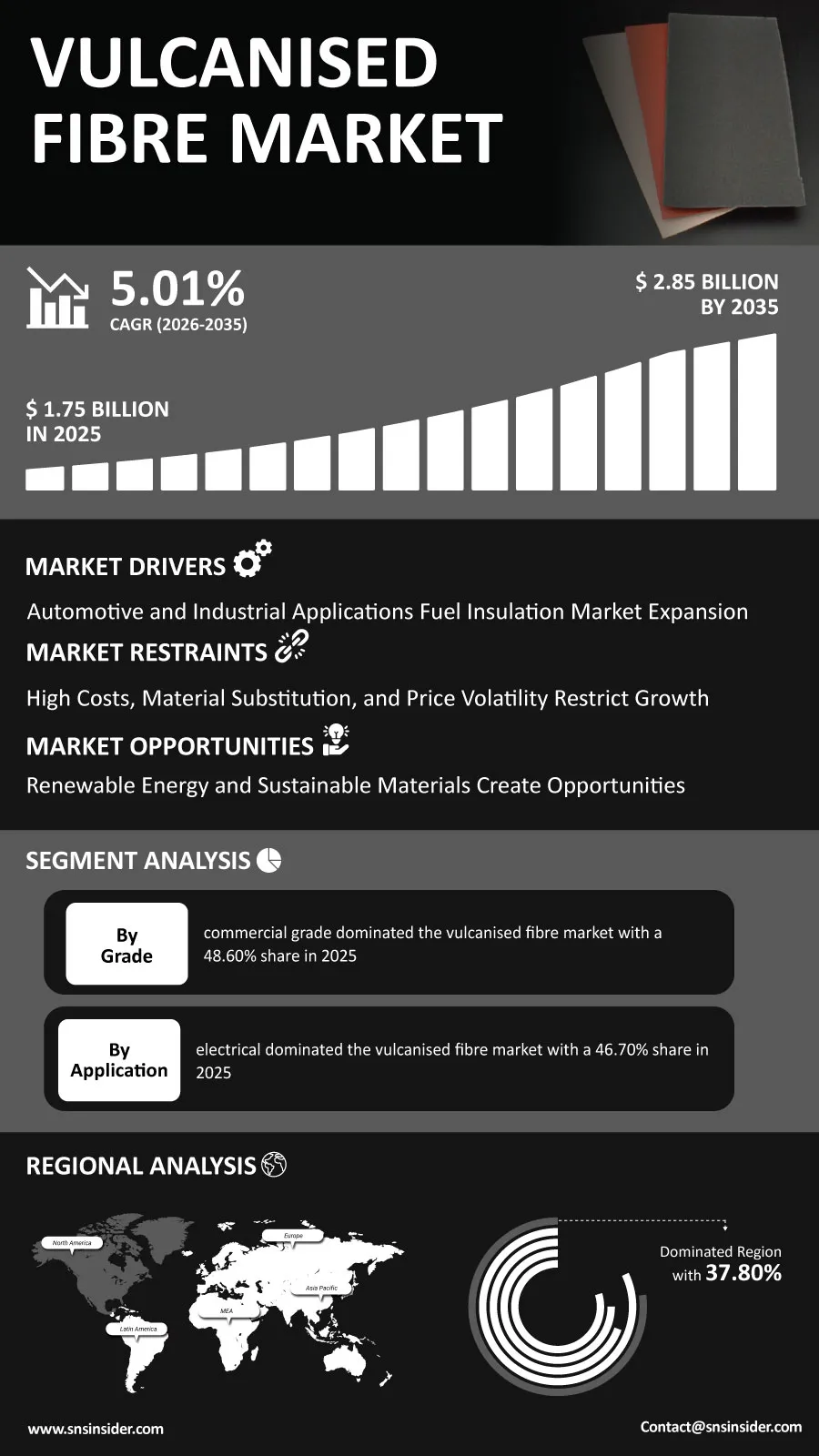
The world market for Vulcanized Fibre is experiencing a period of continuous growth since the manufacturers are looking for light-weight material that could provide mechanical strength, electrical insulation and reliable performance under challenging conditions. “According to a recent study by SNS Insider, the global Vulcanised Fibre Market size valued at 1.75 Billion in 2025, is anticipated to grow to USD 2.85 Billion by 2035, registering a CAGR of 5.01% over the 2026–2035 forecast period.”
Demand is being fuelled through continuous investments in the electricity distribution network, automobile manufacturing, industrial machinery, and electronics. Vulcanized fibre is being used more commonly wherever manufacturers need to use parts that are both strong and relatively light in weight for insulation, gasket, washer, protective components, etc. Another factor affecting demand is the increased usage of electric vehicles and the need for lightweight and good insulating capabilities.
To Get Detailed Insights on the Vulcanised Fibre Market – Request a Sample Report
Electrification and Sustainable Engineering Create New Opportunities
The growing trend towards electrification and alternative energy sources is expanding the range of opportunities for use of the vulcanized fibre material. The power equipment, transformers, motors, switchgears, chargers and other electricity-related devices require materials that are able to preserve performance despite of various temperature and mechanical influences. It stimulates the development of special types of such materials to meet demands of more complicated designs of equipment.
The issue of sustainability is gaining its importance in the process of material choice. Recyclable and cellulose-based engineering materials can take advantage of the attempts by the manufacturers to decrease the consumption of standard synthetic products. The advances in the processing technologies allow increasing dimensional stability, flexibility, strength and thermal properties of the materials.
Key Market Insights Highlight Evolving Application Demand
In terms of grades, Commercial Grade dominated the market with a market share of 48.60% in 2025 due to its extensive usage in insulation, gaskets, washers, abrasives, baggage, and industrial applications. The Electrical Grade is anticipated to exhibit the highest growth rate at a CAGR of 6.88% up to 2035 owing to growing demand for efficient insulation in electrified machinery, power equipment, and electric vehicles.
Among the applications, Electrical dominated the market with a 46.70% market share in 2025 because of its extensive use in transformers, switchgears, circuit breakers, and other electrical components. The Automotive application segment is expected to register the highest growth rate at a CAGR of 7.22% up to 2035 owing to growing vehicle electrification and demand for light weight insulation and sealants.
Among end-use industries, Electrical & Electronics was the largest market in 2025 with a share of 43.80% in the market while Automotive is anticipated to experience the highest growth rate at a CAGR of 7.01% up to 2035.
Advanced Manufacturing Supports Higher-Performance Materials
Process improvements are now being used by manufacturers to ensure that the produced vulcanized fiber products have higher dimensional stability and improved functionality. The product development is being concentrated on thermal stability, mechanical stability, elasticity, and performance of the products in specialized applications.
Modern automated manufacturing systems are also contributing in making the process more efficient and minimizing wastage. This has become more significant as the electrical and automotive industries require components with higher precision specifications.
Asia Pacific Emerges as the Fastest-Growing Regional Market
The North American region was the largest regional market with 37.80% of the global revenue share in 2025. In 2025, the U.S. accounted for 84.60% of North America's market owing to the existing manufacturing of electrical equipment, vehicles, industries, and high demand for insulation materials. The market size in the U.S. is estimated to increase from USD 0.56 billion in 2025 to USD 0.79 billion in 2035, growing at a CAGR of 3.51%.
Asia Pacific is expected to be the fastest-growing regional market with a CAGR of 6.16% from 2025 to 2035. The increased manufacturing of electronics, industrialization, electric vehicles, renewable energy investments, and electricity infrastructure are increasing the demand in China and other developed countries. China accounted for 41.50% of the regional market in 2025.
Europe continues to be an important market due to advanced automotive and industrial manufacturing in the region, and the Middle East & Africa and Latin America regions benefit from infrastructure development and industrial applications.
Industry Participants Focus on Product Innovation
The environment of competition includes companies offering specialty fibre materials along with their development in electrical, automotive, and industrial fields. Companies are focusing on performance improvements, production efficiency, customization, and sustainable materials to meet the needs of customers.
Key companies operating in the global Vulcanised Fibre Market include BASF SE, Nippon Shokubai Co., Ltd., Thermo Fisher Scientific Inc., Polysciences, Inc., Merck KGaA, Tokyo Chemical Industry Co., Ltd. (TCI), Santa Cruz Biotechnology, Inc., SERVA Electrophoresis GmbH, MP Biomedicals, LLC, FUJIFILM Wako Pure Chemical Corporation, Alfa Chemistry, Acros Organics, Biosynth Ltd., Chemodex Ltd., Hanse Chemie AG, Ward's Science, Spectrum Chemical Mfg. Corp., VWR International, LLC (Avantor, Inc.), Xiamen Hisunny Chemical Co., Ltd., and Henan Tianfu Chemical Co., Ltd.
An SNS Insider analyst Himanshu Sharma commented, “Electrification, expanding electrical infrastructure, and the automotive industry's focus on lightweight engineering are creating new avenues for vulcanised fibre applications. Companies that combine reliable insulation performance with sustainable production and application-specific material development will be positioned to capture emerging opportunities across global industrial markets.”
About the Author

Get in touch