
Vulcanised Fibre Market Report Scope & Overview:
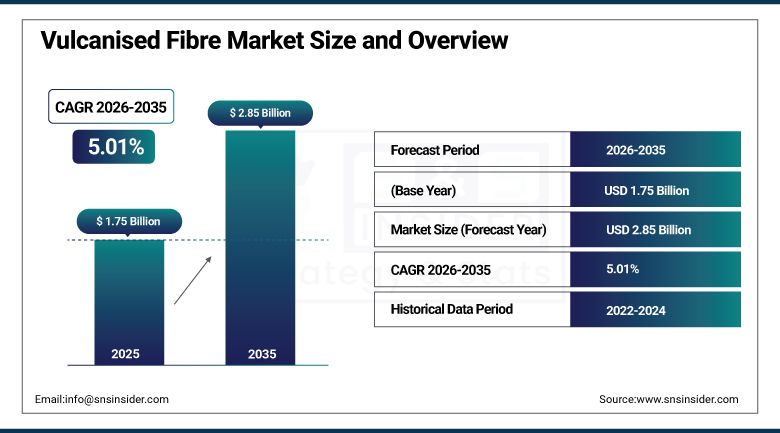
The Vulcanised Fibre Market was valued at USD 1.75 billion in 2025 and is expected to reach USD 2.85 billion by 2035, growing at a CAGR of 5.01% from 2026–2035.
The growth of the global vulcanised fibre market is driven by the increasing demand for lightweight, durable, and high-strength insulation materials across the electrical & electronics, automotive, textile, and industrial manufacturing sectors. Rising adoption of vulcanised fibre in electrical insulation applications, coupled with the growing production of electric vehicles and advancements in automotive components, is accelerating market growth. Furthermore, increasing emphasis on sustainable and recyclable materials, continuous innovations in manufacturing technologies, and expanding applications in industrial and specialty engineering products are further supporting the growth of the global vulcanised fibre market.
In April 2026, DuPont expanded its portfolio of high-performance electrical insulation materials by introducing advanced vulcanised fibre solutions designed for electrical equipment, automotive components, and industrial applications, offering enhanced mechanical strength, thermal resistance, and durability
Market Size and Forecast
-
Market Size 2026E: USD 1.83 billion
-
Market Size 2035: USD 2.85 billion
-
CAGR: 5.01% from 2026 to 2035
-
Fastest Growing Region: Asia-Pacific
-
Largest Region: North America
To Get more information On Vulcanised Fibre Market - Request Free Sample Report
Vulcanised Fibre Market Trends
-
Increasing demand for electrical insulation materials is driving vulcanised fibre adoption across industrial and automotive applications.
-
Growing electric vehicle production is accelerating vulcanised fibre usage in lightweight, heat-resistant electrical insulation components globally.
-
Rising preference for sustainable engineering materials is boosting demand for recyclable and durable vulcanized fibre products.
-
Advancements in manufacturing technologies are enhancing vulcanized fibre performance, strength, flexibility, and thermal resistance significantly.
-
Expanding electrical, automotive, and industrial manufacturing sectors are increasing demand for high-performance vulcanised fibre components.
The U.S. Vulcanised Fibre Market Outlook
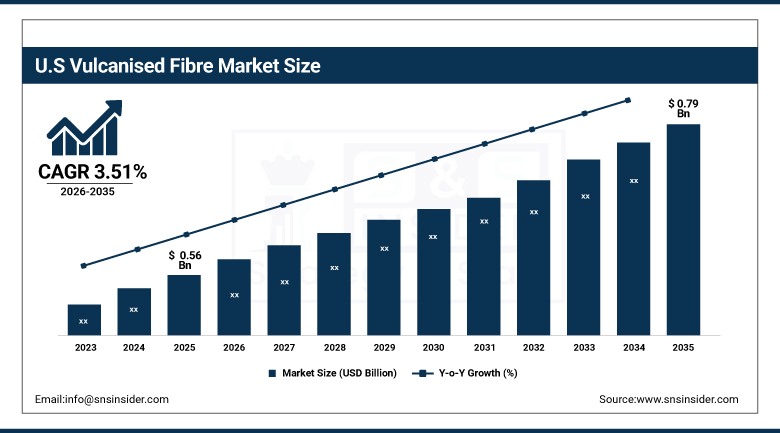
The U.S. Vulcanised Fibre Market was valued at USD 0.56 billion in 2025 and is expected to reach around USD 0.79 billion by 2035, growing at a CAGR of 3.51% from 2026–2035.
The US vulcanised fibre market is growing steadily due to increasing demand from the electrical & electronics, automotive, industrial manufacturing, and textile sectors. Rising adoption of lightweight, durable, and high-strength insulation materials in electrical equipment and automotive components is supporting market expansion. Manufacturers are focusing on developing sustainable and high-performance vulcanised fibre products with improved mechanical strength, thermal resistance, and dimensional stability to meet evolving industry requirements. Additionally, continuous advancements in manufacturing technologies, growing investments in industrial infrastructure, and increasing demand for eco-friendly engineering materials are expected to further support the growth of the vulcanised fibre market in the US during the forecast period.
In January 2026, DuPont expanded its U.S. production capacity for high-performance electrical insulation materials, including vulcanised fibre solutions, to meet rising demand from the electrical & electronics, automotive, and industrial manufacturing sectors.
Vulcanised Fibre Market Segment Analysis
-
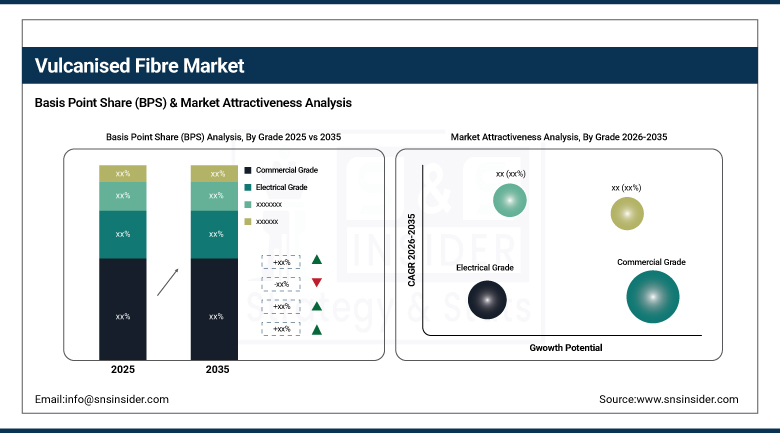
By Grade, commercial grade dominated the vulcanised fibre market with a 48.60% share in 2025; while electrical grade is the fastest-growing segment with a 6.88% CAGR during 2026–2035.
-
By Application, electrical dominated the vulcanised fibre market with a 46.70% share in 2025; while automotive is the fastest-growing segment with a 7.22% CAGR during 2026–2035.
-
By End-use Industry, electrical & electronics dominated the vulcanised fibre market with a 43.80% share in 2025; while automotive is the fastest-growing segment with a 7.01% CAGR during 2026–2035.
By Grade, Commercial grade dominated the vulcanised fibre market, while the Electrical grade segment is expected to grow fastest
Commercial grade dominated the market in 2025 owing to its widespread use in electrical insulation, luggage, industrial washers, gaskets, abrasive discs, and general engineering applications. Its cost-effectiveness, high mechanical strength, excellent dielectric properties,and ease of fabrication make it the preferred choice across multiple end-use industries. Growing demand from automotive, industrial manufacturing, and electrical & electronics sectors continues to support the dominance of this grade.
The Electrical grade segment is projected to register the highest CAGR during the forecast period due to increasing demand for high-performance electrical insulation materials in electric vehicles, renewable energy systems, power distribution equipment, transformers, and electronic components. Superior dielectric strength, heat resistance, and dimensional stability, coupled with rising investments in electrification, grid modernization, and advanced electrical equipment manufacturing, are expected to accelerate the growth of this segment through 2035.
By Application, Electrical dominated the vulcanised fibre market, while the Automotive segment is expected to grow fastest.
The Electrical segment accounted for the largest market share in 2025 owing to the extensive use of vulcanised fibre in electrical insulation, switchgear, transformers, circuit breakers, washers, and other electrical components. Its excellent dielectric strength, high mechanical durability, lightweight nature, and resistance to heat and wear make it a preferred material for electrical and electronic applications. The growing demand for reliable insulation materials across power infrastructure and industrial equipment further supports the dominance of this segment.
The Automotive segment is projected to register the highest CAGR during the forecast period due to increasing adoption of lightweight, durable, and environmentally friendly materials in vehicle manufacturing. Rising electric vehicle production, greater focus on component weight reduction, and expanding use of vulcanised fibre in gaskets, insulation components, washers, and protective parts are expected to drive strong growth in this segment through 2035.
By End-use Industry, Electrical & Electronics dominated the vulcanised fibre market, while the Automotive segment is expected to grow fastest.
The Electrical & Electronics segment accounted for the largest market share in 2025 due to the widespread use of vulcanised fibre in electrical insulation, switchgear, transformers, motors, circuit breakers, and electronic components. Its excellent dielectric strength, high mechanical durability, lightweight properties, and heat resistance make it a preferred material for electrical and electronic manufacturing. Increasing investments in power infrastructure, renewable energy, and electronic device production continue to support the dominance of this segment.
The Automotive segment is projected to register the highest CAGR during the forecast period owing to the rising adoption of lightweight, durable, and sustainable materials in vehicle manufacturing. Increasing electric vehicle production, growing vehicle electrification, and expanding use of vulcanised fibre in insulation components, gaskets, washers, and protective parts are expected to drive the growth of this segment through 2035.
Regional Analysis
|
Region |
Major Country |
Share within Region, 2025(%) |
|---|---|---|
|
North America |
United States |
88.00% |
|
Europe |
Germany |
21.50% |
|
Asia Pacific |
China |
42.80% |
|
Middle East & Africa |
Saudi Arabia |
29.50% |
|
Latin America |
Brazil |
38.50% |
North America Vulcanised Fibre Market Insights.
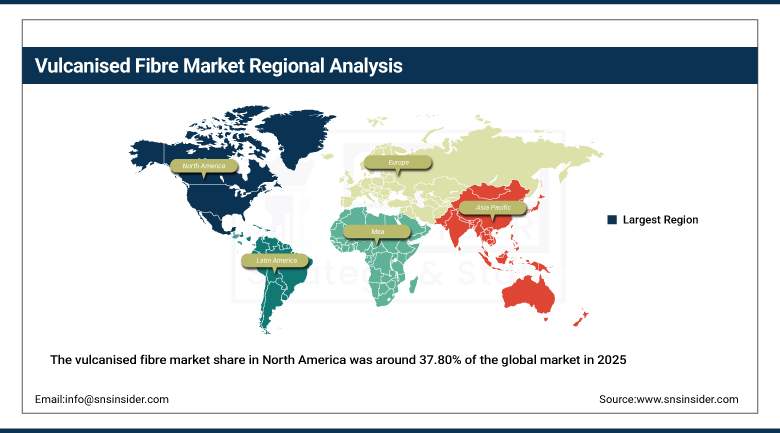
The vulcanised fibre market share in North America was around 37.80% of the global market in 2025, driven by strong demand from the electrical & electronics, automotive, and industrial manufacturing sectors. The United States accounted for approximately 84.60% of the North American vulcanised fibre market in 2025, supported by its well-established manufacturing base, advanced electrical equipment industry, and increasing adoption of high-performance insulation materials.
Growing investments in electrical infrastructure, expanding electric vehicle production, and rising demand for lightweight, durable, and sustainable engineering materials are driving market growth across the region. Furthermore, continuous advancements in insulation technologies, industrial automation, and specialty manufacturing processes are expected to support the growth of the vulcanised fibre market in the United States throughout the forecast period.
Get Customized Report as per Your Business Requirement - Enquiry Now
Europe Vulcanised Fibre Market Insights
Europe continues to be one of the key regions in the vulcanised fibre market owing to its well-established electrical & electronics, automotive, and industrial manufacturing industries, along with increasing demand for high-performance insulation materials. Germany is the leading contributor in the region, accounting for approximately 23.80% of the Europe vulcanised fibre market in 2025, supported by its strong manufacturing base, advanced engineering capabilities, and growing adoption of lightweight, durable industrial materials.
Growing investments in electrical infrastructure, increasing production of electric vehicles, rising demand for sustainable engineering materials, and continuous advancements in industrial manufacturing technologies are among the key factors driving the growth of the vulcanised fibre market in Europe.
Asia Pacific Vulcanised Fibre Market Insights
Asia Pacific is expected to grow at the fastest CAGR of 6.16% between 2025 and 2035, driven by rapid industrialization, expanding electrical & electronics manufacturing, and increasing demand for vulcanised fibre across automotive, industrial manufacturing, and insulation applications. The region is witnessing significant investments in electrical infrastructure, electric vehicle production, and advanced manufacturing capabilities to support growing industrial demand. China is the major contributor in the region, accounting for approximately 41.50% of the Asia Pacific vulcanised fibre market in 2025, supported by its large-scale manufacturing base, expanding industrial sector, and strong demand from end-use industries.
Increasing investments in renewable energy, rising production of electrical equipment and electric vehicles, growing demand for lightweight and sustainable engineering materials, and continuous advancements in industrial manufacturing technologies are creating significant growth opportunities across the region. Continued investments in industrial modernization, electrical infrastructure, and high-performance insulation materials are expected to further accelerate the growth of the vulcanised fibre market in Asia Pacific.
Middle East & Africa and Latin America Insights
The Middle East & Africa vulcanised fibre market is witnessing steady growth due to increasing investments in electrical infrastructure, industrial manufacturing, and automotive production. Saudi Arabia plays a significant role in the market, accounting for an estimated 31.20% share of the Middle East & Africa vulcanised fibre market in 2025, supported by expanding industrial diversification initiatives, infrastructure development, and growing demand for high-performance insulation materials. Rising adoption of electrical equipment, renewable energy projects, and advanced industrial applications is further supporting market growth across the region.
The Latin America vulcanised fibre market is experiencing stable growth owing to increasing demand from the electrical & electronics, automotive, and industrial manufacturing sectors. Brazil is the largest contributor in the region, accounting for approximately 39.80% of the Latin America vulcanised fibre market in 2025. The country's growth is driven by expanding manufacturing activities, increasing investments in industrial infrastructure, and rising adoption of lightweight, durable engineering materials across industrial applications. Continuous investments in electrical infrastructure, automotive manufacturing, and sustainable industrial development are expected to further support market expansion.
Market Dynamics
Growth Driver: Rising demand for electrical insulation materials and expanding applications across automotive and industrial manufacturing
The increasing demand for lightweight, durable, and high-performance electrical insulation materials has significantly boosted the adoption of vulcanised fibre across multiple industries. Electrical equipment manufacturers, automotive companies, and industrial manufacturers are increasingly utilizing vulcanised fibre in insulation components, gaskets, washers, and specialty engineering products due to its excellent dielectric strength, mechanical durability, and thermal resistance. In addition, growing demand from electric vehicles, renewable energy systems, and advanced electrical equipment is further supporting market expansion.
Increasing investments in electrical infrastructure, rapid industrialization, and continuous advancements in manufacturing technologies are further driving demand for vulcanised fibre. Rising adoption in electric vehicles, industrial automation, and high-performance engineering applications, coupled with the growing focus on sustainable and recyclable materials, is expected to accelerate the growth of the vulcanised fibre market throughout the forecast period.
Restraints: High production costs, availability of alternative insulation materials, and raw material price fluctuations may limit market growth.
High production costs and raw material price fluctuations remain major challenges for the vulcanised fibre market. The production of vulcanised fibre depends on high-quality cellulose paper, zinc chloride treatment, and specialized manufacturing processes, making production costs sensitive to changes in raw material prices and energy costs. These cost pressures can reduce manufacturers' profit margins and limit product adoption, particularly in price-sensitive industries and emerging markets.
In addition, the availability of alternative insulation and engineering materials, including plastics, composites, and synthetic polymers with comparable performance in certain applications, intensifies competitive pressure. Manufacturers must continuously invest in product innovation, process optimization, and sustainable manufacturing technologies to meet evolving industry requirements and environmental standards. These factors are expected to restrain the growth of the vulcanised fibre market during the forecast period.
Opportunities: Expanding applications in electric vehicles, renewable energy, and sustainable engineering materials.
The growing adoption of electric vehicles, renewable energy systems, and advanced electrical equipment presents significant growth opportunities for the vulcanised fibre market. Increasing demand for lightweight, durable, and high-performance insulation materials in batteries, motors, transformers, and switchgear is driving the use of vulcanised fibre across modern electrical applications. Continuous advancements in manufacturing technologies are further enhancing its mechanical strength, thermal resistance, and application potential in high-performance engineering products.
In addition, rising investments in industrial automation, electrical infrastructure, and sustainable manufacturing are creating new opportunities for market participants. Growing demand for recyclable and eco-friendly engineering materials across the automotive, electrical & electronics, and industrial manufacturing sectors, coupled with ongoing product innovation and expanding industrial applications, is expected to support the long-term growth of the vulcanised fibre market.
Recent Developments
-
2026: DuPont expanded its portfolio of high-performance electrical insulation materials, including vulcanised fibre solutions, to support growing demand from the electrical equipment, automotive, and industrial manufacturing sectors.
-
2025: Sachsenröder introduced advanced vulcanised fibre materials with enhanced mechanical strength and thermal resistance for electrical insulation, sealing, and industrial engineering applications.
-
2025: New Process Fibre Company, Inc. expanded its manufacturing capabilities to meet increasing demand for custom vulcanised fibre components used in electrical, automotive, and industrial markets.
-
2024: Hokuetsu Toyo Fibre Co., Ltd. strengthened its specialty fibre product portfolio by enhancing vulcanised fibre production for high-performance insulation and precision industrial applications.
Vulcanised Fibre Market Key Players are:
-
BASF SE
-
Nippon Shokubai Co., Ltd.
-
Thermo Fisher Scientific Inc
-
Polysciences, Inc.
-
Merck KGaA
-
Tokyo Chemical Industry Co., Ltd. (TCI)
-
Santa Cruz Biotechnology, Inc
-
SERVA Electrophoresis GmbH
-
MP Biomedicals, LLC
-
FUJIFILM Wako Pure Chemical Corporation
-
Alfa Chemistry
-
Acros Organics (Thermo Fisher Scientific Inc.)
-
Biosynth Ltd.
-
Chemodex Ltd.
-
Hanse Chemie AG
-
Ward's Science
-
Spectrum Chemical Mfg. Corp.
-
VWR International, LLC (Avantor, Inc.
-
Xiamen Hisunny Chemical Co., Ltd.
-
Henan Tianfu Chemical Co., Ltd.
Vulcanised Fibre Market Report Scope:
| Report Attributes | Details |
|---|---|
| Market Size in 2025 | USD 1.75 Billion |
| Market Size by 2035 | USD 2.85 Billion |
| CAGR | CAGR of 5.01% From 2026 to 2035 |
| Base Year | 2025 |
| Forecast Period | 2026-2035 |
| Historical Data | 2022-2024 |
| Report Scope & Coverage | Market Size, Segments Analysis, Competitive Landscape, Regional Analysis, DROC & SWOT Analysis, Forecast Outlook |
| Key Segments | • By Grade (Commercial grade, Electrical grade, Abrasive grade, Flexible grade) • By Application (Electrical, Automotive, Textile, Abrasive, Others) • By End-use Industry (Electrical & Electronics, Automotive, Industrial Manufacturing, Textile, Others) |
| Regional Analysis/Coverage | North America (US, Canada, Mexico), Europe (Eastern Europe [Poland, Romania, Hungary, Turkey, Rest of Eastern Europe] Western Europe] Germany, France, UK, Italy, Spain, Netherlands, Switzerland, Austria, Rest of Western Europe]), Asia Pacific (China, India, Japan, South Korea, Vietnam, Singapore, Australia, Rest of Asia Pacific), Middle East & Africa (Middle East [UAE, Egypt, Saudi Arabia, Qatar, Rest of Middle East], Africa [Nigeria, South Africa, Rest of Africa], Latin America (Brazil, Argentina, Colombia, Rest of Latin America) |
| Company Profiles | BASF SE (Germany), Nippon Shokubai Co., Ltd. (Japan), Thermo Fisher Scientific Inc. (US), Polysciences, Inc. (US), Merck KGaA (Germany), Tokyo Chemical Industry Co., Ltd. (TCI) (Japan), Santa Cruz Biotechnology, Inc. (US), SERVA Electrophoresis GmbH (Germany), MP Biomedicals, LLC (US), FUJIFILM Wako Pure Chemical Corporation (Japan), Alfa Chemistry (US), Acros Organics (Thermo Fisher Scientific Inc.) (US), Biosynth Ltd. (Switzerland), Chemodex Ltd. (Switzerland), Hanse Chemie AG (Germany), Ward's Science (US), Spectrum Chemical Mfg. Corp. (US), VWR International, LLC (Avantor, Inc.) (US), Xiamen Hisunny Chemical Co., Ltd. (China), Henan Tianfu Chemical Co., Ltd. (China) |
Frequently Asked Questions
The Vulcanised Fibre Market is expected to grow at a CAGR of 5.01% from 2026 to 2035.
The Vulcanised Fibre Market was valued at USD 2.85 billion in 2025.
The Commercial Grade Vulcanised Fibre segment dominated the market in 2025 with a 48.60% share.
