
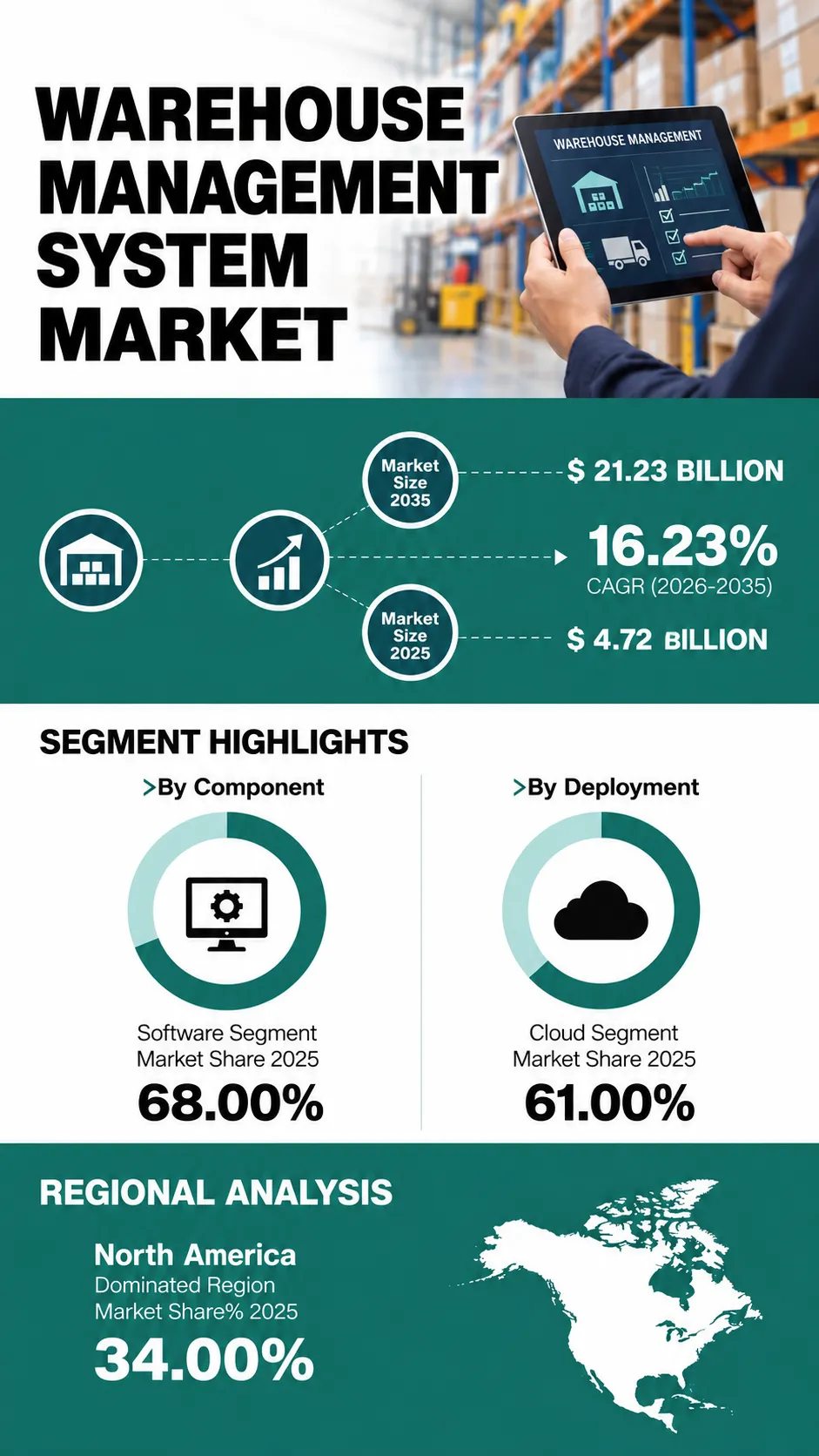
The Global Warehouse Management System Market is set to enter an era of rapid growth driven by the need for automation in logistics and effective inventory management. “According to a recent study by SNS Insider, the global Warehouse Management System Market size valued at USD 4.72 billion in 2025, is anticipated to grow to USD 21.23 billion by 2035, registering a CAGR of 16.23% over the 2026–2035 forecast period.”
E-commerce and omnichannel retail are rapidly evolving, which forces organizations to upgrade their warehouse structures and increase their capability to handle ever-growing and more complex orders. Modernization is being achieved in the context of WMSs, which will integrate the processes of inventory, labor, fulfillment, and automation through a common digital platform.
Simultaneously, AI, cloud technology, robotics, and connectivity are transforming the way warehouses work. More organizations are looking for solutions that would give them real-time operational intelligence and automate fulfillment tasks.
To Get Detailed Insights on the Warehouse Management System Market – Request a Sample Report
Warehouse Automation Creates New Growth Opportunities
Use of autonomous mobile systems, automated guided vehicles, robot pickers, and smart sorting solutions is providing new openings for providers of WMS solutions. Software solutions for management of these solutions would enable warehouses to handle increasing volumes of activity while retaining visibility into all inventories and activities.
Adoption of cloud solutions would make it easier for organizations requiring scalable warehouse infrastructures to implement such solutions without corresponding costs for IT infrastructure. Cloud-based WMS solutions would provide organizations flexibility to grow without requiring corresponding investment in IT infrastructure.
The increasing digitalization of supply chains is also encouraging organizations to connect WMS platforms with transportation management, enterprise resource planning, and customer-facing commerce systems.
Key Market Insights Highlight Shifting Demand Patterns
By component, the source data identifies services as holding a substantial position in 2025, while software is expected to experience rapid expansion as enterprises adopt increasingly sophisticated warehouse automation and analytics capabilities. Implementation, consulting, integration, and training services remain important because businesses require specialized support when connecting WMS platforms with existing operational systems.
Based on deployment, cloud-based WMS solutions segment held around 61% of market revenue in 2025. Their scalability, accessibility, and lower infrastructure requirements continue to support adoption among organizations modernizing warehouse operations. On-premises systems are also expected to maintain steady demand among businesses that prioritize direct control over infrastructure, data governance, and customization.
By application, retail segment accounted for 21% of market revenue in 2025, supported by the need to coordinate inventory, replenishment, and order processing across increasingly complex distribution networks. E-commerce is expected to be the fastest-growing application segment as online retailers handle rising order volumes and increasingly stringent delivery expectations.
AI and Robotics Reshape Warehouse Operations
Warehouse owners are now increasingly utilizing WMS solutions in combination with robotics and advanced analytics to establish highly responsive fulfillment facilities. Inventory tracking provides real-time data about inventory discrepancies and helps organize better inventory replenishment and product allocation.
Forecasting through analytics is assisting organizations in understanding demand variations and resource allocation needs. At the same time, automated picking, sorting, and transport systems are helping reduce dependency on manual activities.
Returns management is another important area of development as retailers and e-commerce companies seek more efficient processes for inspecting, restocking, and redirecting returned merchandise.
North America Leads WMS Market with 34% Share as Europe Grows at 15% CAGR
It is predicted that North America will continue to lead in the global Warehouse Management System Market by contributing around 34% of market revenues in 2025 due to the early implementation of warehouse automation systems, well-developed logistics network, active participation of e-commerce activities, and availability of technology companies in the region.
Europe is forecasted to be the fastest growing regional market with a CAGR of around 15% during 2035 due to high investments in warehouse automation systems, digital supply chain infrastructure, and inventory management solutions.
Demand is also rising strongly in the Asia Pacific region due to industrialization, growth of e-commerce activities, upgrade of warehouses, and logistics investments. Latin America and Middle East & Africa are gradually growing owing to digitalization of supply chain processes and development of organized retailing.
Industry Participants Focus on Intelligent Warehouse Solutions
Competition remains active as technology providers expand cloud capabilities, artificial intelligence features, automation integration, and real-time analytics across their WMS portfolios. Vendors are increasingly focusing on scalable platforms that can connect warehouse operations with broader supply chain ecosystems.
Key companies operating in the global Warehouse Management System Market include Epicor, Körber AG, Infor, Made4net, Manhattan Associates, Oracle, PSI Logistics, Reply, SAP, Softeon, Synergy Ltd, Tecsys, Blue Yonder Group, Microsoft, IBM, Descartes Systems Group, Ehrhardt Partner Group, Fishbowl Warehouse, Infoplus, and ShipHero.
An SNS Insider analyst Sushant Kadam commented, “The convergence of warehouse automation, cloud computing, artificial intelligence, and e-commerce is accelerating demand for intelligent warehouse management platforms. Providers that deliver scalable systems, strong integration capabilities, and real-time operational visibility will have significant opportunities as businesses modernize their logistics infrastructure.”About the Author

Get in touch




