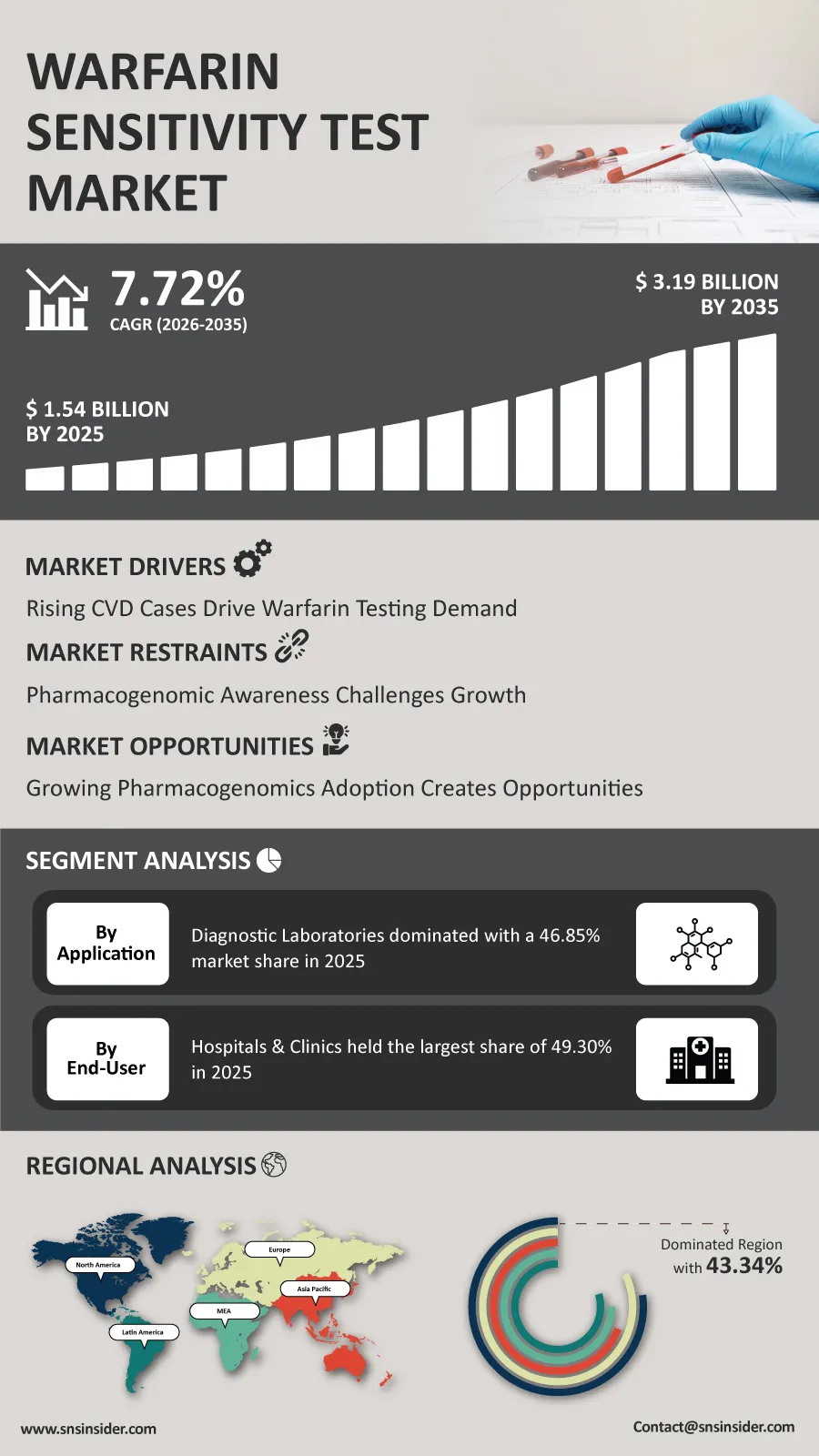
The global Warfarin Sensitivity Test Market is projected to witness sustained expansion over the next decade as healthcare providers increasingly incorporate genetic testing into clinical decision-making to improve medication safety and therapeutic outcomes. “According to a recent study by SNS Insider, the global Warfarin Sensitivity Test Market size valued at USD 1.54 billion in 2025, is anticipated to grow to USD 3.19 billion by 2035, registering a CAGR of 7.72% over the 2026–2035 forecast period.”
The growing trend towards personalized medicine is changing the way that anticoagulant management takes place all around the globe. The use of highly sophisticated molecular diagnostic technologies is helping clinicians adopt treatment approaches customized according to patient genetics to help with better drug dosing and decrease the probability of drug side effects.
With the increasing relevance of pharmacogenomics in regular healthcare practices, there will be growing demand for genetic testing technologies that would facilitate patient-tailored treatments.
To Get Detailed Insights on the Warfarin Sensitivity Test Market – Request a Sample Report
Precision Medicine Continues to Transform Anticoagulant Therapy
An increasing number of personalized medicine applications will lead to an increased implementation of genomic technologies, which will help implement evidence-based prescription practices. The development of molecular diagnostics, automation of laboratory procedures, and the use of digital healthcare innovations will increase testing efficiencies and allow healthcare specialists to provide more customized care.
Physicians are currently using genetic data to improve their clinical workflow and make more efficient therapy decisions. It is expected that constant progress in testing innovations and bioinformatics will promote the application of pharmacogenomics in cardiovascular disease treatment in the future.
Increasing cooperation between healthcare facilities, diagnostic companies, and research centers will promote innovation in the field of precision medicine and molecular diagnostics.
Key Market Findings Highlight Emerging Opportunities
Among product categories, reagents and kits accounted for 58.25% of total market revenue in 2025, reflecting their essential role in routine pharmacogenomic testing across clinical laboratories worldwide.
Meanwhile, software and services are projected to register the fastest growth through 2035, expanding at a CAGR of 9.01%, supported by increasing demand for clinical decision-support platforms, laboratory automation, and integrated data management solutions.
From a technology perspective, PCR-based testing represented 52.05% of global market revenue in 2025, maintaining its position as the preferred testing approach due to its speed, reliability, and widespread clinical acceptance. At the same time, DNA sequencing is expected to witness the fastest growth, advancing at a CAGR of 8.96%, driven by broader adoption of comprehensive genomic testing and advances in sequencing technologies.
By gene category, CYP2C9 testing accounted for 41.85% of market revenue in 2025, highlighting its continued importance in supporting individualized anticoagulant therapy. However, combined gene testing is anticipated to record the fastest growth at a CAGR of 9.40% during the forecast period, reflecting increasing interest in multi-gene analysis to improve dosing precision.
Across healthcare settings, hospitals and clinics represented 49.30% of total market revenue in 2025, while diagnostic centers are expected to expand at the fastest CAGR of 8.60% through 2035, supported by growing investments in specialized molecular testing services.
Expanding Precision Healthcare Creates Long-Term Growth Potential
Global health systems keep on making investments in precision medicine approaches, which focus on enhancing the effectiveness of treatments while reducing medication-related problems that could be avoided. Genomic data usage in making treatment decisions is opening up new possibilities in the field of molecular diagnostics in the management of cardiovascular conditions.
Automation of laboratories, artificial intelligence, and cloud-based decision support for clinicians are making genetic information more accessible and understandable. All these trends are projected to enhance the uptake of molecular diagnostics globally.
North America Accounted for 43.34% of the Market in 2025; Asia Pacific to Expand at 8.96% CAGR
North America was the highest revenue generating region in 2025, contributing 43.34% to the overall market, owing to its advanced health care systems, the use of precision medicine and molecular diagnostics, and increasing investment in molecular diagnostics.
On the other hand, Asia Pacific is expected to be the fastest growing region in terms of CAGR, at 8.96%, from 2026 to 2035, due to rising investment in healthcare, rising awareness about personalized medicines, expansion of the diagnostic laboratories, and enhanced genome testing capabilities in the region.
Industry Leaders Continue to Advance Molecular Diagnostics
Competition within the warfarin sensitivity test market remains dynamic as leading diagnostic companies continue investing in next-generation molecular technologies, laboratory automation, and precision medicine solutions.
Key companies operating in the global Warfarin Sensitivity Test Market include F. Hoffmann-La Roche, Thermo Fisher Scientific, Abbott Laboratories, Illumina, QIAGEN, Siemens Healthineers, Bio-Rad Laboratories, Becton Dickinson, Danaher Corporation, and Agilent Technologies.
An SNS Insider analyst Parry Kardani commented, "The increasing integration of pharmacogenomics into routine clinical practice is redefining anticoagulant therapy by enabling more personalized treatment decisions. Continued advancements in molecular diagnostics, genomic technologies, and digital healthcare platforms are expected to strengthen long-term market growth while supporting safer and more effective patient care."
About the Author

Get in touch