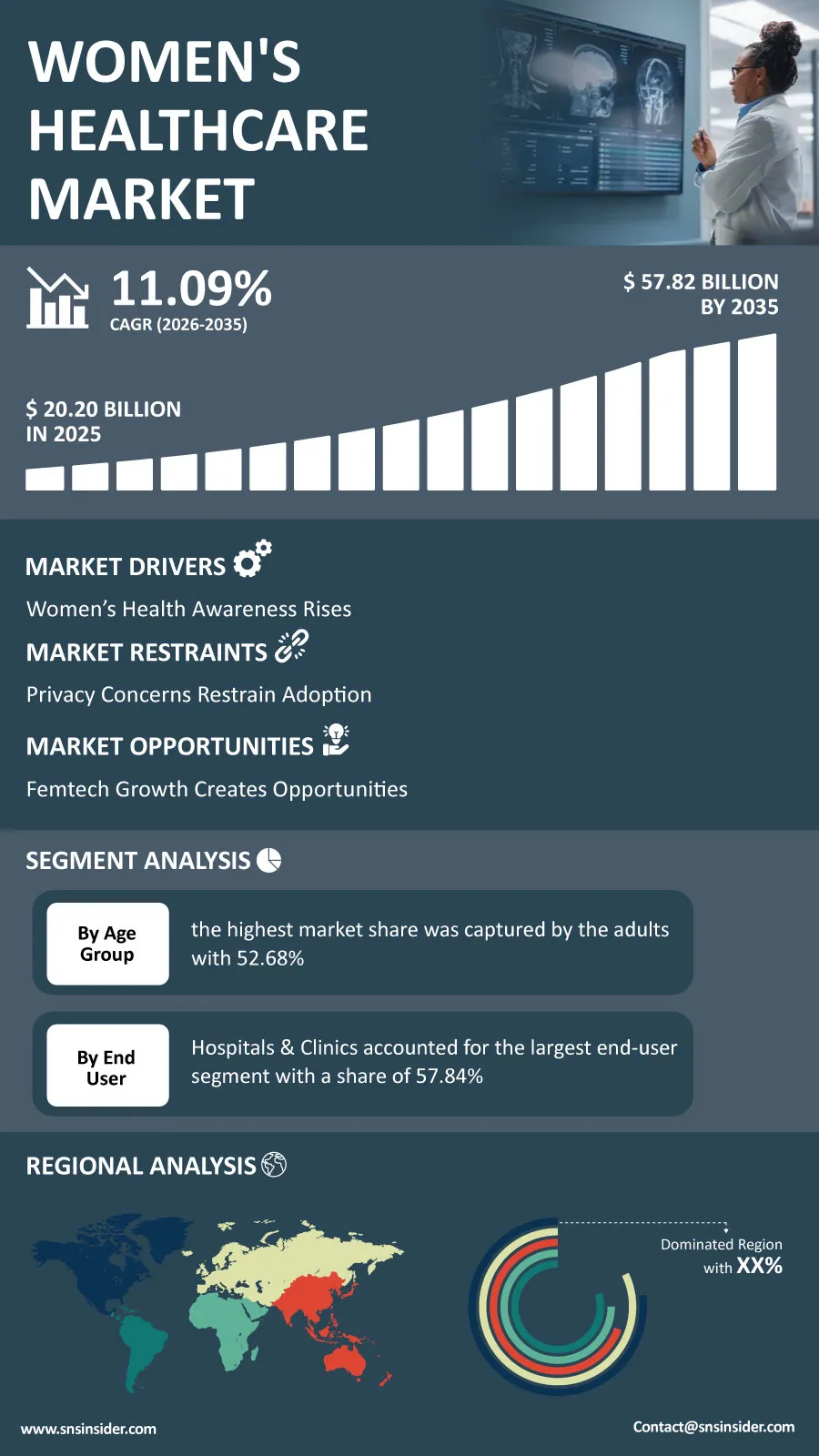
The global Women's Healthcare Market is entering a new phase of transformation as healthcare systems prioritize preventive medicine, reproductive health, and digital care solutions for women across all age groups. “According to a recent study by SNS Insider, the global Women's Healthcare Market size valued at USD 20.20 billion in 2025, is anticipated to grow to USD 57.82 billion by 2035, registering a CAGR of 11.09% over the 2026–2035 forecast period.”
With rising awareness about women's health and growing demand for more specialized healthcare services, coupled with the process of digital transformation of the healthcare system, the healthcare industry is experiencing some changes. The healthcare providers are adopting innovations that facilitate better disease identification, treatment, and management of patients from afar, as well as programs aimed at enhancing accessibility of healthcare services for women.
To Get Detailed Insights on the Women's Healthcare Market – Request a Sample Report
Digital Healthcare and Preventive Care Accelerate Industry Growth
The provision of women’s healthcare services is expanding from the conventional practice of delivering healthcare services in a hospital setup to a holistic and connected model through the use of telemedicine, artificial intelligence, and personalized care. Teleconsultation has enabled easier access to gynecology, fertility counseling, pregnancy, and menopausal healthcare services.
Healthcare service providers are also making use of artificial intelligence technologies in diagnosing breast cancer, cervical cancer, and other women’s health issues. On the other hand, increased funding in femtech products such as fertility tracking, menstrual health apps, hormonal balancing applications, and wellness programs presents new possibilities for both patients and providers.
Key Market Findings Highlight Fastest-Growing Opportunities
Adults remained the largest age-group segment, accounting for 52.68% of market revenue in 2025 due to continued demand for reproductive healthcare, preventive screening, and chronic disease management. Teenagers are projected to record the fastest expansion, advancing at a 12.14% CAGR through 2035 as awareness of sexual health, mental wellness, and digital healthcare services increases.
Diagnostics represented the leading service category with a 41.37% market share in 2025, supported by strong utilization of imaging, laboratory testing, and cancer screening programs. Telehealth is forecast to be the fastest-growing service segment, expanding at a 13.09% CAGR as virtual consultations become a preferred healthcare option.
Hospitals and clinics generated the largest end-user share at 57.84% in 2025 because of their comprehensive diagnostic and treatment capabilities. Meanwhile, online healthcare platforms are expected to witness the strongest growth, registering a 12.68% CAGR as consumers increasingly embrace digital consultations, prescription services, and personalized health management.
Women's healthcare utilization also continues to expand globally, with healthcare visits surpassing 1.2 billion during 2025 across hospitals, clinics, and telehealth providers, reflecting growing emphasis on preventive care and reproductive health.
Innovation Continues to Reshape Women's Healthcare Services
Precision medicine, artificial intelligence-driven diagnostic solutions, and personal hormone therapy have all begun to play an important role in clinical practice. These advancements contribute to the success of treatment and help to identify complex diseases sooner.
Employer programs providing health care for women have been growing quickly. These programs include fertility solutions, menopause-related assistance, maternal care, and mental health programs. At the same time, increased investments in femtech companies promote the development of new digital health platforms.
Regional Markets Demonstrate Strong Momentum
North America continues to be the largest market geographically in 2025 owing to its advanced healthcare infrastructure, efficient reimbursement system, and speedy adoption of digital healthcare. In North America, contribution from the United States accounted for 84.6% of total regional revenues, while the revenue for the U.S. alone was recorded at USD 8.08 billion in 2025 and is estimated to be at USD 23.05 billion in 2035 at 11.05% CAGR.
Asia Pacific is projected to witness the highest rate of market growth during the forecast period owing to growing healthcare investments in emerging nations. China was the biggest contributor geographically in Asia Pacific, contributing 41.8% share in 2025, whereas healthcare spending in India, Japan, South Korea, and South-East Asia is boosting market prospects.
In Europe, contribution from the UK stood at 26.3% geographically due to increased focus on reproductive health and preventive measures for women. Geographically, in Latin America, contribution from Brazil was 44.2%, while in Middle East & Africa region, UAE contributed to 27.9%.
Leading Companies Strengthen Market Competition
Industry participants continue investing in innovative diagnostics, digital platforms, pharmaceuticals, and specialized women's health services to strengthen their competitive position. Strategic collaborations, product launches, and technology-driven healthcare solutions remain central to long-term growth strategies.
Major companies operating in the global Women's Healthcare Market include Hologic Inc., Bayer AG, AbbVie Inc., Pfizer Inc., Johnson & Johnson, Organon & Co., AstraZeneca plc, Merck & Co. Inc., Becton Dickinson and Company, Siemens Healthineers AG, GE HealthCare Technologies Inc., Maven Clinic, Gennev Inc., Ovia Health (Labcorp), Flo Health Inc., Clue (BioWink GmbH), Progyny Inc., CCRM Fertility, Kindbody Inc., and Tia Inc.
An SNS Insider analyst Parry Kardani commented, "Women's healthcare is becoming increasingly technology-driven, with telemedicine, artificial intelligence, and personalized medicine transforming patient experiences. Organizations that successfully combine digital innovation with accessible, preventive, and patient-centered care will be well positioned to benefit from the market's long-term expansion."
About the Author

Get in touch