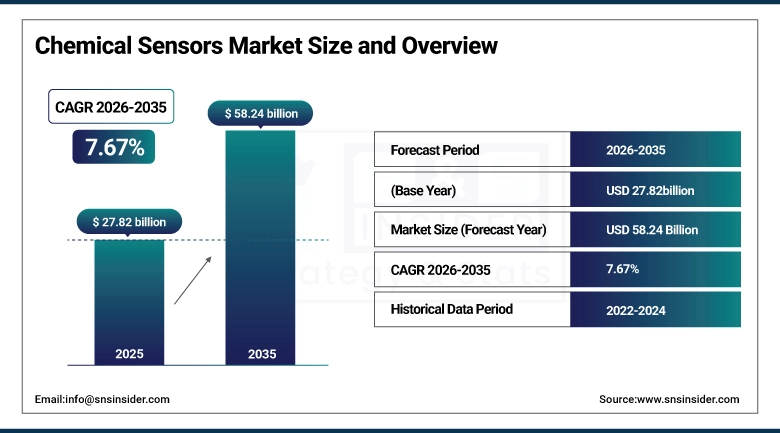
As per the SNS Insider Report titled, Chemical Sensors Market by Type, by Application, by Technology, by End Use, and Region | Global Forecast 2026-2035, “The global Chemical Sensors Market size valued at USD 27.82 billion in 2025, is anticipated to grow to USD 58.24 billion by 2035, registering a CAGR of 7.67% over the 2026–2035 forecast period.”
Key Takeaways
-
Gas Sensors accounted for nearly 53.70% of the market share in 2025, driven by increasing demand for gas detection, air quality monitoring, industrial safety, and emission control applications.
-
Solid Sensors are projected to witness the fastest growth during 2026–2035 due to advancements in material science, miniaturization technologies, and expanding adoption across healthcare and automotive sectors.
-
Industrial applications dominated the market with a 41.80% revenue share in 2025 owing to widespread deployment of chemical sensors in process monitoring, manufacturing automation, and workplace safety systems.
-
Environmental Monitoring is expected to register the fastest growth through 2035 as governments and industries increase investments in pollution monitoring, air quality assessment, and environmental compliance programs.
-
Electrochemical technology held approximately 36.40% share in 2025, supported by its high sensitivity, reliability, and broad applicability across gas sensing and healthcare diagnostics.
-
Thermometric sensors are anticipated to emerge as the fastest-growing technology segment during the forecast period due to increasing adoption in specialized industrial and analytical applications.
-
Healthcare represented nearly 36.50% of the market revenue in 2025 owing to growing utilization of chemical sensors in diagnostic devices, patient monitoring systems, and point-of-care testing solutions.
-
Automotive is projected to record the fastest growth from 2026 to 2035 driven by increasing integration of sensors in vehicle emission monitoring, cabin air quality management, and advanced automotive safety systems.
-
Asia-Pacific captured around 43.70% of total market revenue in 2025 and is expected to strengthen its market position further through 2035 supported by expanding industrialization, environmental initiatives, and healthcare infrastructure development.
-
North America accounted for approximately 27.60% of the global market share in 2025 driven by strong adoption of advanced sensing technologies and stringent environmental regulations.
Why Chemical Sensors Market is Growing?
The Chemical Sensors Market is growing at a steady pace due to the increasing demand for real-time monitoring, environmental safety, industrial automation, and healthcare diagnostics. Chemical sensors are of utmost importance for detection and measurement of chemical compounds, gases and biological substances in a wide variety of industries.
Increasing concerns related to air pollution, industrial emissions, workplace safety and environmental sustainability are significantly propelling the market growth. Governments and regulatory bodies around the world are introducing more stringent standards for environmental monitoring, with a growing use of advanced chemical sensing technologies.
Healthcare sector is also contributing significantly towards market growth with increasing demand for diagnostic equipment, wearable health monitoring devices and point-of-care testing solutions. Chemical sensors provide fast and accurate detection of biomarkers, gases and chemical compounds important for modern medical diagnosis.
Moreover, the fast developments in miniaturization of sensors, nanotechnology, connectivity of IoT and smart sensing platforms are additionally propelling the market growth. The integration of chemical sensors into connected devices and smart monitoring systems is enhancing operational efficiency and broadening application opportunities across industries.
Chemical Sensors Market Statistics
-
Strong global demand for gas and chemical sensing technologies in industrial safety and process control applications.
-
Growth in adoption of air quality monitoring programs is driven by increased use of advanced chemical sensors in urban and industrial environments.
-
Health-care providers are integrating chemical sensors into diagnostic tools, wearable devices and remote patient monitoring systems.
-
Chemical sensors are used by automotive manufacturers in emission control systems, fuel monitoring and cabin air quality management.
-
Electrochemical sensing technologies remain the most popular sensor class due to their high sensitivity and reliability.
-
Smart city initiatives make available new opportunities for environmental monitoring and pollution detection systems.
-
Asia-Pacific continues to lead global demand owing to increasing industrial activities, manufacturing growth and investment in environmental monitoring.
Emerging Trends
The Chemical Sensors Market is experiencing multiple transformational trends such as growth in adoption of IoT-enabled sensing platforms, wireless monitoring systems, and AI-powered analytics solutions. Organizations are focusing on deploying smart sensor networks capable of delivering real-time monitoring and predictive insights in industrial and environmental deployments.
Environmental monitoring is becoming a major growth area as concerns grow over climate change, air quality and industrial pollution. Advanced chemical sensing systems are increasingly used for the continuous monitoring of greenhouse gases, hazardous chemicals and water contaminants.
Further, there is a growing trend of integration of nanotechnology, flexible electronics and miniaturized sensor architectures in the market to enhance sensitivity, portability and performance. Further, higher investments in wearable healthcare devices, connected vehicles and smart manufacturing technologies are projected to substantially drive the demand for advanced chemical sensing solutions in the forthcoming years.
Top 10 Companies
-
Honeywell International Inc.
-
Siemens AG
-
ABB Ltd.
-
Emerson Electric Co.
-
Bosch Sensortec GmbH
-
TE Connectivity Ltd.
-
Figaro Engineering Inc.
-
Alpha MOS SA
-
ams-OSRAM AG
-
Sensirion AG
About the Author

Get in touch