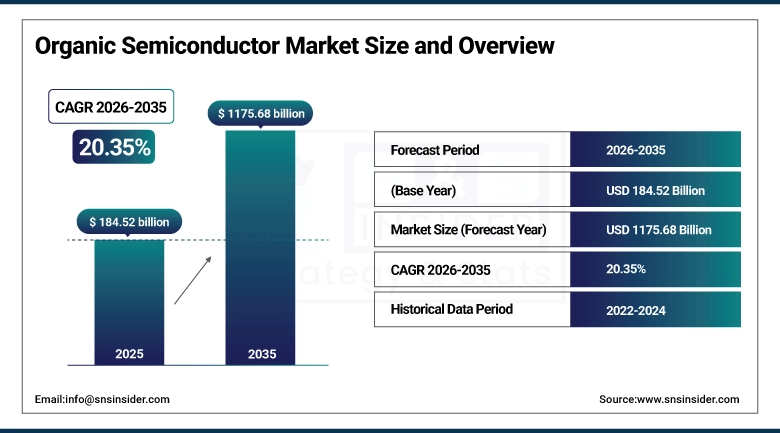
As per the SNS Insider Report titled, Organic Semiconductor Market by Type, by Material, by Process Technology, by End Use Industry, and Region | Global Forecast 2026-2035, “The global Organic Semiconductor Market size valued at USD 184.52 billion in 2025, is anticipated to grow to USD 1175.68 billion by 2035, registering a CAGR of 20.35% over the 2026–2035 forecast period.”
Key Takeaways
-
As per the study findings, Polymeric Organic Semiconductors made up more than 61.40% share of the market in 2025 due to flexibility and light weight nature, along with wide range of uses in organic electronics.
-
Small Molecule Organic Semiconductors will be exhibiting the highest rate of growth during 2026-2035 on account of escalating demand for high-end OLED screens and applications in electronics.
-
The material segment led by Polyphenylene Vinylene (PPV) was dominant with a share of 21.60% of revenue generated in 2025 due to high electroluminescence properties and extensive use in organic displays.
-
Other advanced organic semiconductor materials are forecasted to experience the fastest growth until 2035 owing to rising research & development activities for conductive materials.
-
Vacuum Evaporation technology segment garnered around 33.40% share in 2025 due to its accuracy and broad use in OLED and thin film semiconductors manufacture.
-
The process technology segment of Inkjet Printing will exhibit the highest rate of growth during the forecast period on account of increased need for scalable printing solutions in electronics.
-
The consumer electronics category accounted for nearly 47.30% share of market revenue in 2025 attributable to higher demand for organic semiconductors in smartphones, displays, wearable gadgets, and flexible electronics.
-
The Automotive end-use segment will exhibit the highest growth rate between 2026-2035 on the back of adoption of organic electronic materials in automotive displays, lighting systems and smart interiors.
-
Asia-Pacific region held approximately 45.40% share of the total market value in 2025 and will continue to enhance its market position in upcoming years on the strength of advanced electronics manufacturing facilities and growing OLED panel manufacturing capabilities.
-
The North America region will make up approximately 23.80% of the overall global market share in 2025 supported by investments in semiconductor research & development.
Why Organic Semiconductor Market is Growing?
The Organic Semiconductor Market is witnessing considerable growth on account of growing demand for portable and lightweight electronic devices. These organic semiconductors can be processed at lower temperatures, possess mechanical flexibility, and can be used in large-area electronic processing.
Increasing use of OLED screens, wearable electronic products, flexible screens, and printed electronic products is leading to high growth in market demand around the globe. Consumer electronics companies are increasingly using organic semiconductors to design thinner and energy-efficient electronic devices.
Recent technological developments in printed electronic products, conductive polymers, and solution-based semiconductor products are boosting growth in the market. Companies are increasingly making use of inkjet printing and roll-to-roll processes for manufacturing flexible organic semiconductors.
Electric vehicle development, adoption of smart lighting solutions, and increased usage of automotive electronic systems are also fueling growth in the market. The automotive industry is now integrating OLED lighting systems, smart electronic devices, and flexible electronic devices through organic semiconductors.
Organic Semiconductor Market Statistics
-
OLED display technologies continue to drive strong demand for organic semiconductor materials across smartphones, televisions, and wearable devices.
-
Flexible and printed electronics applications are significantly increasing adoption of organic semiconductor manufacturing technologies worldwide.
-
Inkjet printing technologies are gaining traction due to their scalability, customization capabilities, and lower manufacturing costs.
-
Automotive manufacturers are integrating organic semiconductor-based displays and lighting systems into connected and electric vehicles.
-
Consumer electronics remain the largest end-use industry due to rapid adoption of lightweight and flexible electronic products.
-
Asia-Pacific continues to dominate global OLED production and organic semiconductor manufacturing capacity.
-
Research institutions and technology companies are increasing investments in advanced organic materials and next-generation electronic devices.
Emerging Trends
In the Organic Semiconductor Market, some of the key disruptive trends being observed are the adoption of flexible and foldable electronics driven by advanced organic semiconducting materials. In addition, manufacturers are trying to enhance the charge mobility, stability, and durability of these semiconducting materials to achieve better performance in their electronic applications.
Among others, printed and wearable electronics are becoming the most prominent growth factors owing to growing demand for light-weight and highly customizable electronic devices. Some of the popular technologies in this regard include ink-jet printing technology and roll-to-roll processes.
Moreover, there is growing usage of organic semiconductors in smart healthcare applications, IoT sensors, and photovoltaic applications. The development of nanomaterials and bio-compatible electronic components is another key disruptive trend which is poised to significantly boost growth in the future.
Top 10 Companies
-
Samsung Electronics Co., Ltd.
-
LG Display Co., Ltd.
-
Universal Display Corporation
-
BASF SE
-
Merck KGaA
-
Sumitomo Chemical Co., Ltd.
-
DuPont de Nemours Inc.
-
Novaled GmbH
-
AU Optronics Corp.
-
Sony Corporation
About the Author

Get in touch