
Advanced Connectivity in E-Commerce and Retail Market Report Scope & Overview:
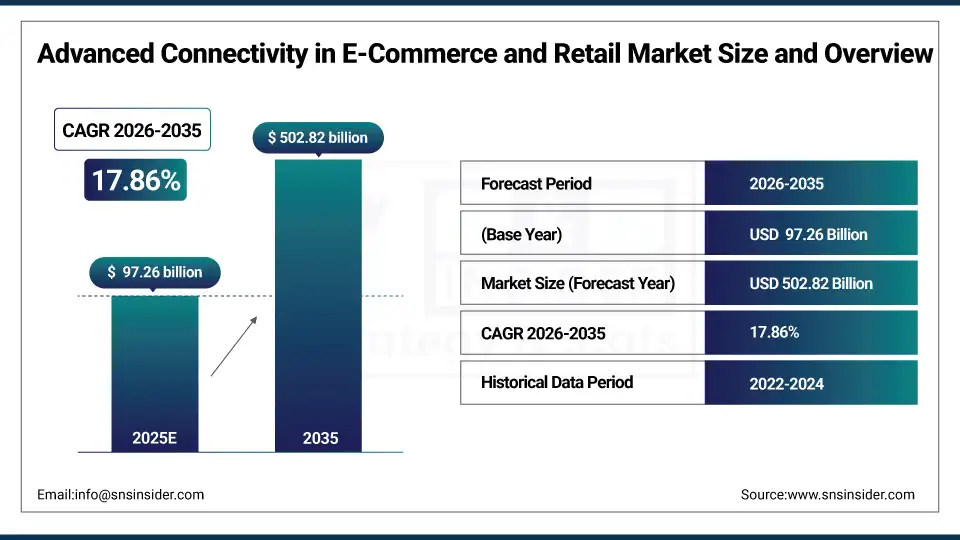
The Advanced Connectivity in E-Commerce and Retail Market size is valued at USD 97.26 Billion in 2025 and is expected to reach USD 502.82 Billion by 2035 and grow at a CAGR of 17.86% over the forecast period 2026-2035.
Because of growing adoption of e-commerce and omnichannel retail strategies present by large retail chains, SMEs and online platforms around the world, the Advanced Connectivity in E-commerce and Retail market are expected to show considerable growth. Changing consumer needs & behavior leads to adopting advanced connectivity solutions for real-time inventory management, smart store operations, and personalized customer experiences. The evolving 5G, Wi-Fi 6/7, LPWAN, IoT sensors, and cloud-based connectivity platforms facilitate seamless data exchange, improve operational efficiency and strengthen supply chain performance, resulting in broader deployment trend across the retail ecosystem.
According to industry studies, over 65% of Advanced Connectivity in E-Commerce and Retail demand is driven by 5G and Wi-Fi 6/7 technologies, fueled by their high data transfer speeds, low latency, and widespread adoption for enabling real-time inventory management, smart store operations, and personalized customer engagement across large retail chains, SMEs, and e-commerce platforms.
To Get more information On Advanced Connectivity in E-Commerce and Retail Marke - Request Free Sample Report
Advanced Connectivity in E-Commerce and Retail Market Trends:
-
Increasing adoption of 5G, Wi-Fi 6/7, and LPWAN connectivity solutions to enable real-time inventory management and smart store operations.
-
Growing deployment of IoT-enabled devices and sensors for automated supply chain tracking, inventory monitoring, and customer engagement.
-
Rising demand for cloud and edge computing platforms to support data-driven analytics and seamless omnichannel retail experiences.
-
Advancements in AI-driven personalization and analytics to enhance customer experiences and optimize retail operations.
-
Expanding focus on omnichannel integration is driving unified data management across online platforms and physical stores globally.
U.S. Specialty Advanced Connectivity in E-Commerce and Retail Market Insights:
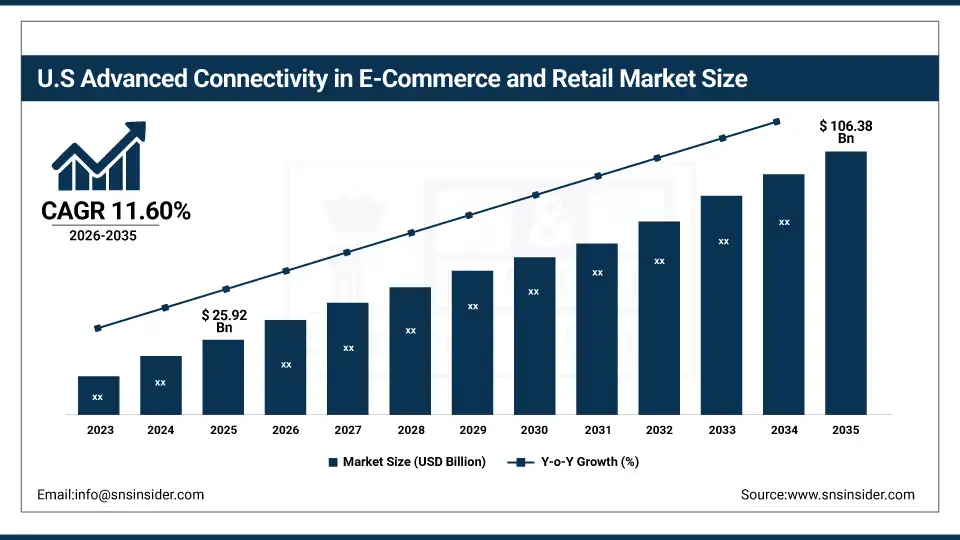
The U.S. Advanced Connectivity in E-Commerce and Retail Market size is USD 25.92 Billion in 2025 and is expected to reach USD 106.38 Billion by 2035, growing at a CAGR of 11.60% over the forecast period of 2026-2035.
Factors such as rapid adoption of e-commerce, widespread deployment of smart retail technologies, and high demand for seamless omnichannel experiences are some of the major driving forces for the U.S. Advanced Connectivity in E-Commerce and Retail market. Growing implementation of 5G, Wi-Fi 6/7, and LPWAN networks, the presence of leading connectivity solution providers, and advancements in IoT-enabled devices and cloud-based platforms facilitate operational efficiency, real-time inventory management, and enhanced customer engagement.
Advanced Connectivity in E-Commerce and Retail Market Growth Drivers:
-
Rising Adoption of Advanced Connectivity Technologies
The utilization of 5G, Wi-Fi 6/7, LPWAN, IoT devices, and cloud platforms deployed on wide retail chains, SMEs, and E-Commerce platforms have emerged to be the major growth driver of the Advanced Connectivity in E-Commerce and Retail market. Retailers are using these technologies to facilitate real-time inventory management, intelligent store operations and customised customer engagement. Increasing need for omnichannel shopping experience and data-driven decisions serves as a catalyst for encouraging adoption and aiding market growth.
Advanced Connectivity in E-Commerce and Retail Market Growth Restraints:
-
High Implementation Costs and Integration Challenges
Limited adoption of advanced connectivity solutions can be attributed to high deployment costs, difficulties in integrating IoT and cloud platforms with existing retail systems, and the need to educate personnel on how to adopt the change. Whether it is due to budget limitations at SMEs, data security, or interoperability with other systems, or the difficulty in integrating with legacy systems, each of these factors can slow deployment. Moreover, a mass rollout could take time due to the absence of unified protocols dividing devices and territories.
Advanced Connectivity in E-Commerce and Retail Market Growth Opportunities:
-
Emergence of AI, Edge Computing, and Omnichannel Solutions
Incorporating AI analytics, edge processing and IoT-based automation within the physical retail setting provides some huge opportunities. Retailers are spending more on smart store solutions, predictive inventory systems, and customer engagement platforms. Strong growth is also expected as global e-commerce penetration accelerates, leading to greater need for seamless and connected digital experiences, along with the launch of new cloud-based connectivity platforms that provide real-time insights into operations, greater agility and enable better decision-making.
Advanced Connectivity in E-Commerce and Retail Market Segmentation Analysis:
-
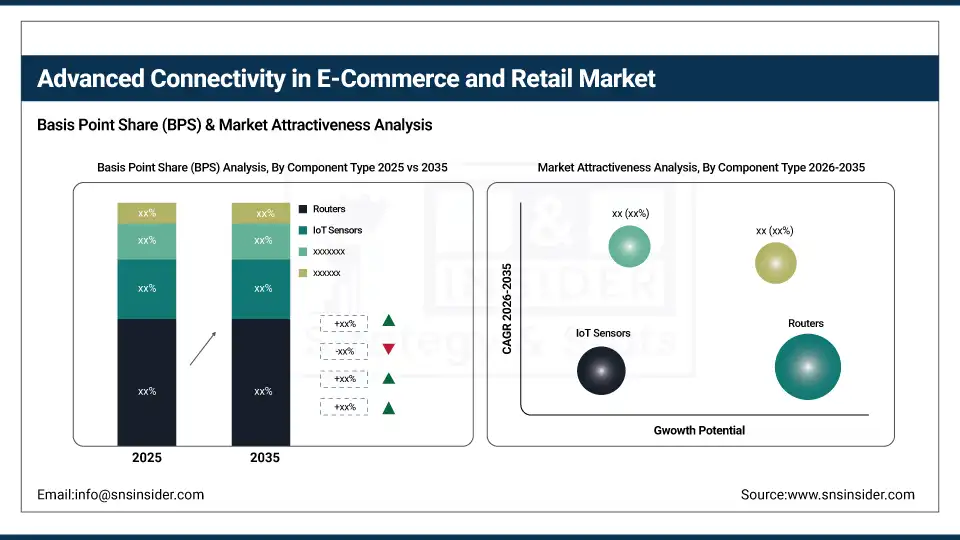
By Component Type: In 2025, Routers dominated with around 50% share; Connectivity Platforms are the fastest-growing segment during 2026–2035.
-
By Technology: In 2025, 5G Networks dominated with about 55% share; LPWAN is the fastest-growing segment during 2026–2035.
-
By Application: In 2025, Supply Chain Management dominated with nearly 45% share; Customer Engagement is the fastest-growing segment during 2026–2035.
-
By End-user Industry: In 2025, Large Retail Chains dominated with around 60% share; SMEs are the fastest-growing segment during 2026–2035.
By Component Type: Routers Lead as Connectivity Platforms Gain Traction.
Routers accounted for approximately 50% of the market in 2025, representing the best for the majority of retail infrastructure. They link in-store point-of-sale systems, inventory management tools, and IoT devices, thus becoming a crucial vehicle for seamless daily operations. Take large retailers like Walmart and Target, which depend on high-capacity routers to manage data streaming from hundreds of sensors, mobile checkouts, and analytics dashboards, and have everything running smoothly. While at the same time connectivity platforms are slowly playing catch-up. These platforms all add several systems together, to create an ecosystem with highly integrated cloud services, IoT devices, and real-time analytics, unlike routers, which do not integrate multiple components. As Cisco, Microsoft and IBM add to their lines, now even mid-sized retailers can access these platforms, and this segment is expected to grow most quickly through 2035, as firms look for smooth end-to-end connectivity.
By Technology: 5G Networks Lead as LPWAN Expands Rapidly.
Roughly 55% of the market were 5G networks in 2025, offering high speed and built to support so many devices at once. Meanwhile, retailers in tech-savvy cities (like Tokyo and Seoul) have implemented smart shelves, augmented reality-enabled product displays, and 5G-powered automated checkout systems to showcase how rapid, low-latency communications can improve the shopping experience. LPWAN or Low Power Wide Area Networks, are a fast-growing technology segment. This offers low-power and long-range connectivity suited for thousands of distributed sensors in warehouses, logistics fleets and even smaller stores. Despite 5G commitments, analysts predict LPWAN adoption to take off more quickly in Southeast Asia and Latin America, where infrastructure prices to leverage 5G are still steep, but retailers want IoT-fueled revenue drivers and automation.
By Application: Supply Chain Management Leads as Customer Engagement Surges.
In 2025, connectivity solutions were mainly used to manage supply chains, claiming almost 45% of application utilization. They are useful for tracking inventory, shipments management, and automating the replenishment process, while also minimizing errors and optimizing efficiency. The range of connected supply chains benefits is well represented by Amazon's warehouse network, featuring IoT-enabled shelves and predictive inventory analytics. However, customer engagement will likely continue to outpace the next 10 years. As a result, many retailers are investing in connected solutions for providing personalized promotions, interactive in-store experiences, and real-time adaptive loyalty programs that track shopper habits. The industry is moving its attention away from simply managing products to rather improving the overall customer journey.
By End-user Industry: Large Retail Chains Lead as SMEs Accelerate Adoption.
By 2025, over 60% of the market belonged to large retail chains. Due to scale, technology and budget, they have the ability to deploy advanced connectivity solutions rapidly. Breakthrough examples already exist across the world, such as the smart store network and predictive analytics platforms from retailers like Tesco in the U.K. and Target in the U.S. At the same time, SMEs are the most rapidly expanding segment up to 2035. The availability of cloud-based platforms, easy-to-deploy IoT devices, and subscription-based connectively capabilities enables smaller retailers in places like Berlin, Bangalore, and Mexico City to sensor their inventory and track customer behavior in real-time, without any significant upfront investments. It democratizes advanced retail technology, enabling smaller players to go head-to-head with the big box stores.
Advanced Connectivity in E-Commerce and Retail Market Regional Analysis:
North America Advanced Connectivity in E-Commerce and Retail Market Insights:
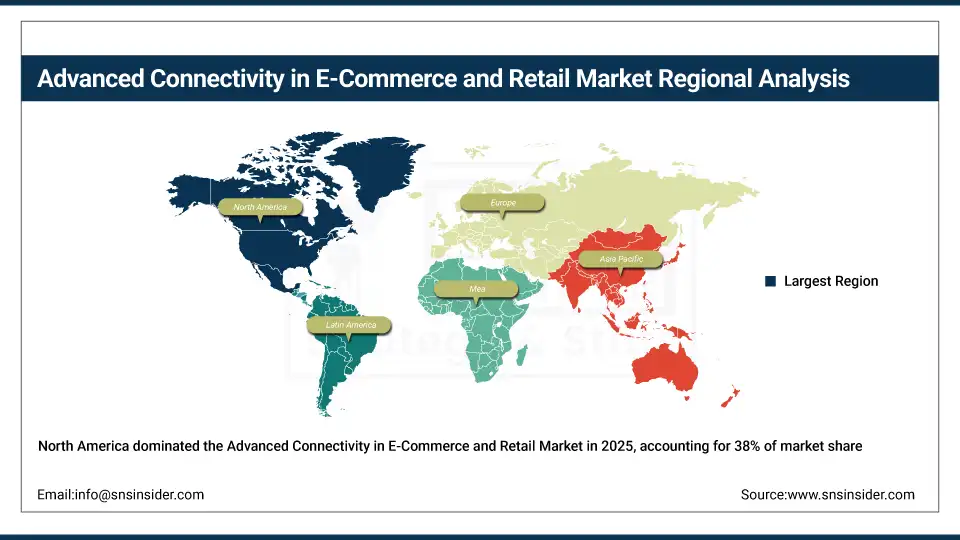
North America continued its dominance and held around 38% of the regional market share in the global Advanced Connectivity in E-Commerce and Retail landscape in 2025. This is heavily attributed to the rapid adoption of high-speed connectivity solutions, widespread underpinnings of IoT devices, and a matured e-commerce ecosystem within the region. We also see large retail chains in the U.S. and Canada investing heavily in 5G networks, Wi-Fi 6/7 infrastructure and smart store platform as practice for enhancing operational efficiency and customer engagement - think Walmart, Target, Best buy, etc. With well-established technology providers, a strong presence of research & development along with regulatory shelters, North America is emerging globally as the jewel in the crown market for regulated market for cannabis in Canada.
Get Customized Report as per Your Business Requirement - Enquiry Now
Asia Pacific Advanced Connectivity in E-Commerce and Retail Market Insights:
Asia Pacific is considered emerging and fastest growing region for Advanced Connectivity in E-Commerce and Retail worldwide, where growth rate (CAGR) will be 22.20% during 2026–2035. It's already growing at a fast pace attributed to booming e-commerce, enlarging SME retail networks, and growing uptake of smart retail solutions in countries like China, India, Japan, and South Korea. Retailers are making use of LPWAN-enabled IoT sensors, edge computing solutions, and cloud-based connectivity platforms to intelligently manage stock and connect with customers. Government efforts advocating for digital backbone, surging smartphone penetration, and increasing investment on retail technology is also driving adoption; thus, Asia Pacific is a lucrative market for connectivity solution over the decade.
Europe Advanced Connectivity in E-Commerce and Retail Market Insights:
The growth of Advanced Connectivity in E-Commerce and Retail in Europe is driven by established retail infrastructure backed by a mature digital ecosystem. Countries including Germany, the U.K., and France are spearheading adoption with retailers using AI-based analytics, cloud connectivity platforms, and Internet of Things (IoT) devices to augment the efficiency of supply chains, and improve in-store consumer experiences. What continues to drive market maturation is the regulatory stability, high digital & financial literacy among consumers, and significant investments in retail innovation from local players.
Latin America Advanced Connectivity in E-Commerce and Retail Market Insights:
Latin America is slowly but surely finding its footing as retailers spend on new connectivity technologies to fill infrastructure voids and drive efficiencies. São Paulo, Mexico City, Buenos Aires and others are preening the feathers of their avian flocks, rolling out IoT sensors, cloud-based platforms and networks of integrated retail. This growth is being driven by greater recognition of omnichannel retail advantages, increased e-commerce penetration, and enhanced network infrastructure. Although the regions total lags behind that of North America and Europe, the market is growing in the area.
Middle East and Africa Advanced Connectivity in E-Commerce and Retail Market Insights:
Advanced connectivity adoption in retail in the Middle East and Africa region is growing moderately, with expanding urban retail hubs and the emergence of smart stores being witnessed in urban areas including locations such as Dubai, Johannesburg, and Nairobi. Ability of Retailers: Retailers are evolving, attaching these connectivity platforms with IoT devices and cloud-based management systems to track inventory and engage customers better. Increasing investments in digital infrastructure, government efforts aimed at spurring e-commerce, and partnerships between technology vendors and regional merchants are gradually enhancing the reach of the market which will augment growth in the coming years.
Advanced Connectivity in E-Commerce and Retail Market Competitive Landscape:
Cisco Systems, Inc. is a global leader in networking and enterprise connectivity solutions, supplying routers, switches, and secure network architectures that support advanced retail and e-commerce infrastructures.
-
In 2025, Cisco launched its “Cisco Unified Edge” platform to process AI workloads locally in retail stores and other edge sites, enhancing throughput and responsiveness for real‑time applications.
Huawei Technologies Co., Ltd. is a major provider of ICT infrastructure, including 5G‑Advanced networks and IoT systems that enable high‑performance connectivity for industries including retail.
-
In 2025, Huawei and China Telecom introduced 5G‑A Intelligent Ultra Pooling Uplink technology, boosting uplink speeds and reducing latency by over 30% to enhance connectivity for AI and IoT applications.
Nokia Corporation is a Finnish telecommunications equipment company focused on network infrastructure, mobile solutions, and cloud‑native connectivity platforms that support next‑generation retail networks
-
In early 2026, Nokia expanded its “Network as Code” ecosystem with Google Cloud, integrating programmable APIs to accelerate connectivity services and enterprise applications globally.
Advanced Connectivity in E-Commerce and Retail Market Key Players:
-
Cisco Systems, Inc.
-
Huawei Technologies Co., Ltd.
-
Ericsson AB
-
Qualcomm Technologies, Inc.
-
Intel Corporation
-
Amazon Web Services, Inc.
-
Microsoft Corporation
-
IBM Corporation
-
Verizon Communications Inc.
-
SAP SE
-
Salesforce Inc.
-
Hewlett Packard Enterprise Company
-
Alibaba Group
-
Netgear, Inc.
-
VusionGroup (Vusion)
-
Samsara Inc.
-
Tata Consultancy Services Limited (TCS)
-
NTT DATA Corporation
| Report Attributes | Details |
|---|---|
| Market Size in 2025 | USD 97.26 Billion |
| Market Size by 2035 | USD 502.82 Billion |
| CAGR | CAGR of 17.86% From 2026 to 2035 |
| Base Year | 2025 |
| Forecast Period | 2026-2035 |
| Historical Data | 2022-2024 |
| Report Scope & Coverage | Market Size, Segments Analysis, Competitive Landscape, Regional Analysis, DROC & SWOT Analysis, Forecast Outlook |
| Key Segments | • By Component Type: (Routers, IoT Sensors, Connectivity Platforms) • By Technology: (5G Networks, Wi-Fi 6/7,LPWAN) • By Application: (Supply Chain Management, Inventory, Customer Engagement) • By End User: (Large Retail Chains, E-Commerce Platforms, SMEs) |
| Regional Analysis/Coverage | North America (US, Canada), Europe (Germany, UK, France, Italy, Spain, Russia, Poland, Rest of Europe), Asia Pacific (China, India, Japan, South Korea, Australia, ASEAN Countries, Rest of Asia Pacific), Middle East & Africa (UAE, Saudi Arabia, Qatar, South Africa, Rest of Middle East & Africa), Latin America (Brazil, Argentina, Mexico, Colombia, Rest of Latin America). |
| Company Profiles | Cisco Systems, Inc., Huawei Technologies Co., Ltd., Nokia Corporation, Ericsson AB, Qualcomm Technologies, Inc., Intel Corporation, Amazon Web Services, Inc., Microsoft Corporation, IBM Corporation, Verizon Communications Inc., Oracle Corporation, SAP SE, Salesforce Inc., Hewlett Packard Enterprise Company, Alibaba Group, Netgear, Inc., VusionGroup (Vusion), Samsara Inc., Tata Consultancy Services Limited (TCS), NTT DATA Corporation |
Frequently Asked Questions
The Advanced Connectivity in E-Commerce and Retail market is expected to grow at a CAGR of 17.86% during 2026-2035.
The market was valued at USD 97.26 Billion in 2025 and is projected to reach USD 502.82 Billion by 2035.
The key drivers of the Advanced Connectivity in E-Commerce and Retail market are rising e-commerce adoption, IoT and smart device deployment, 5G and high-speed connectivity expansion, real-time supply chain management, and demand for personalized customer experiences.
The Technology segment, led by 5G networks, Wi-Fi 6/7, and LPWAN IoT solutions, dominated the Advanced Connectivity in E-Commerce and Retail market due to widespread adoption, enabling real-time data exchange, smart store operations, and seamless omnichannel customer experiences.
North America dominated the Advanced Connectivity in E-Commerce and Retail market in 2025.
