
Agricultural Micronutrients Market Report Scope & Overview:
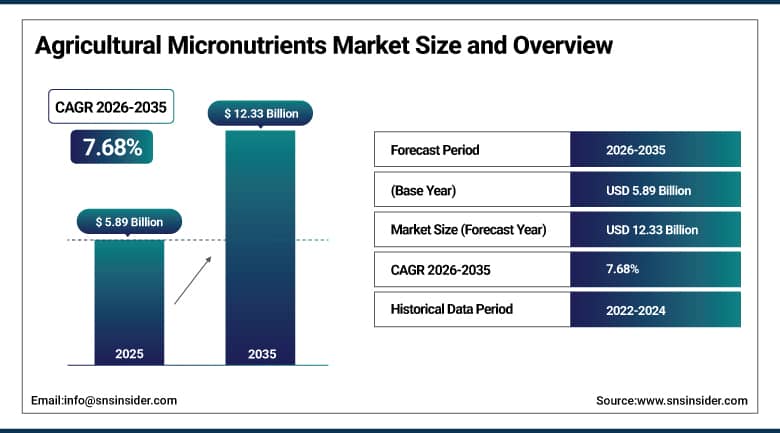
The Agricultural Micronutrients Market was valued at USD 5.89 billion in 2025 and is expected to reach USD 12.33 billion by 2035, growing at a CAGR of 7.68% from 2026–2035.
The agricultural micronutrients market is experiencing high growth on a global level because of growing deficiencies in soil nutrients along with the demand for increased crop production. The trend of using fertilizers containing micronutrients has become prevalent in cereals & grains, legumes, fruits & nuts, vegetables, and plantations crop industries. The trend of sustainable farming practices along with yield improvement has driven the trend towards increased use of chelated as well as non-chelated micronutrients fertilizers. The trend of integrating technology in nutrient management has gained momentum.
Development of micronutrient technologies shall emerge due to expansion of precision agriculture (PA), climate-resilient farming practices (CRFP), and soil health programs (SHIPs). Chelation technologies (EDTA, DTPA, EDDHA, IDHA) improving nutrient absorption efficiency (NAE) are gaining strong adoption. In Asia-Pacific (APAC), fertigation systems (FTG) and high-value crop nutrition (HVCNM) are expanding rapidly. Advanced micronutrient formulations can improve crop yield efficiency (CYE) by around 15%–35%, and up to 40% in severely deficient soils.
To Get More Information On Agricultural Micronutrients Market - Request Free Sample Report
Agricultural Micronutrients Market Trends
-
-
Growing adoption of precision agriculture (PA) and soil testing technologies is driving targeted micronutrient application across crops. This improves efficiency and reduces fertilizer wastage.
-
Increasing shift toward chelated micronutrients (EDTA, DTPA, EDDHA, IDHA) is enhancing nutrient absorption efficiency (NAE) in deficient soils. This supports better crop yield stability.
-
Rising demand for high-value horticultural crops is boosting use of zinc, boron, and iron micronutrients. Fruits and vegetables show strong response to correction practices.
-
Expansion of fertigation systems (FTG) and drip irrigation is increasing soluble micronutrient adoption in Asia-Pacific (APAC). This improves water and nutrient delivery efficiency.
-
Growth in sustainable agriculture and climate-smart farming is promoting balanced soil nutrition and reduced chemical usage. Governments support soil health programs globally.
-
Advancements in nano-micronutrients and controlled-release fertilizers are improving nutrient availability and reducing leaching losses. This enhances long-term crop productivity.
-
U.S. Agricultural Micronutrients Market Size Outlook.
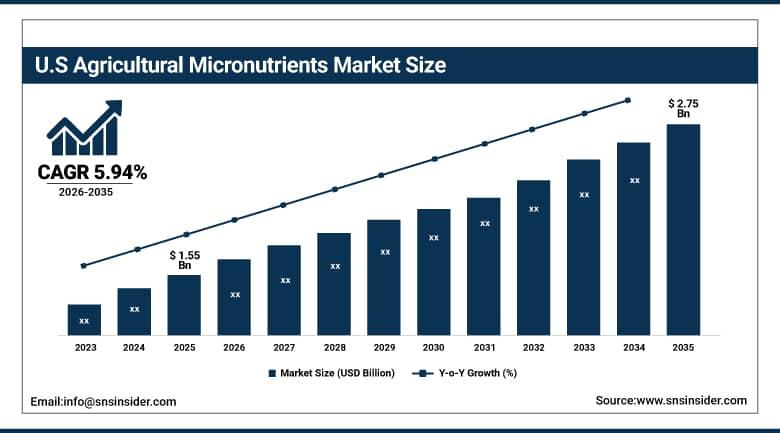
The U.S. Agricultural Micronutrients Market was valued at USD 1.55 billion in 2025 and is expected to reach around USD 2.75 billion by 2035, growing at a CAGR of 5.94% from 2026–2035.
The U.S. agricultural micronutrients market is expanding at a strong pace owing to increasing demand for high crop productivity and soil health improvement solutions across major farming regions. Market growth can be attributed to rising adoption of micronutrient fertilizers such as zinc, boron, iron, and manganese in large-scale agriculture. Growth in precision farming, sustainable agriculture, and specialty crop production is contributing to higher demand for efficient nutrient management solutions.
The U.S. market for agricultural micronutrients will register significant growth owing to high adoption of improved soil testing (ST) techniques and fertigation technology for nutrient delivery systems (FTNDS). The high demand of CCPs, HF, and CPs is expected to fuel market growth. According to agricultural statistics, about 30%-40% of US soils suffer from MND in major agricultural states, which has led to an increase in usage of CFs. Due to increasing emphasis on SFPs and supported SHIPs of USDA, there has been high adoption of MNFs in the US agriculture industry.
Agricultural Micronutrients Market Segment Analysis
-
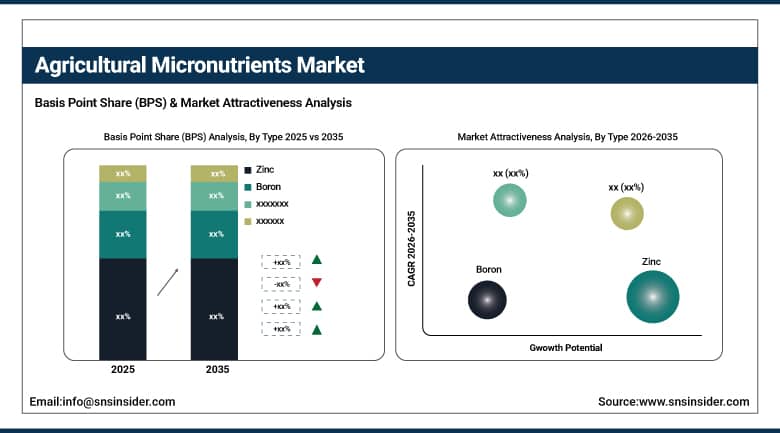
By Type, zinc dominated the agricultural micronutrients market with 37.85% share in 2025; while boron is the fastest growing segment with CAGR of 11.61% during 2026 to 2035.
-
By Form, chelated micronutrients dominated the industrial noise control market with 57.64% share in 2025 and it is also fastest growing segment with CAGR of 8.50% during 2026 to 2035.
-
By Crop Type, cereals dominated the agricultural micronutrients market with 41.78% share in 2025; while pulses & oilseeds is the fastest growing segment with CAGR of 11.72% during 2026 to 2035.
-
By Mode of Application, soil application dominated the agricultural micronutrients market with 35.18% share in 2025; while fertigation is the fastest growing segment with CAGR of 9.63% during 2026 to 2035.
By Type, zinc dominated the agricultural micronutrients market, while boron is the fastest growing segment.
Zinc segment held the dominant position within the agricultural micronutrients market during 2025 owing to the prevalence of zinc deficiencies in soils worldwide. The nutrient plays a crucial role in the activation of enzymes, growth control, and yield enhancement. In addition, widespread applications of zinc in staple crops such as wheat, rice, and maize have contributed significantly to increased market demand. Furthermore, active initiatives by governments towards soil health and the use of fertilizers will augment zinc demand.
Boron segment is anticipated to record the fastest CAGR from 2026 to 2035 attributed to increasing demands within horticulture and fruits. Boron is vital in ensuring proper cell wall formation and flowering of the plants. Its widespread application within alkaline and sandy soils that suffer from deficiencies is fueling the market further. Adoption of precision farming techniques will drive up the demand for boron. An increase in exports of fruits will drive demand.
By Form, chelated micronutrients dominate the agricultural micronutrients market and is also the fastest growing segment.
Chelated Micronutrients segment led the agricultural micronutrients market in 2025, attributed to high nutrient availability and increased absorption rates. Chelation through EDTA, DTPA, and EDDHA enhances stability in alkaline and calcareous soils. It is favored by farmers because of improved yield response, reduced loss of nutrients, and long-term efficacy in cereals, fruits, and vegetable crops cultivated worldwide.
It is also forecasted to register the fastest CAGR during the period from 2026 to 2035, owing to the increasing use of precision farming practices. Soils' degradation coupled with deficiencies in micronutrients contributes significantly to the growing need for such solutions. Expansion in high-end horticultural crops and fertilization methods is also anticipated to support growth. Improved nutrient efficiency and minimized wastage make chelation methods highly favorable in modern agricultural practices.
By Crop Type, cereals dominated the agricultural micronutrients market, while pulses & oilseeds is the fastest growing segment.
Cereal is the leading market segment that accounts for the dominated revenue share in the global agricultural micronutrients market in 2025. It owes this position to the widespread cultivation of wheat, rice, and maize across the world. They occupy huge agricultural land and constantly need nutrients replenishment. The heavy reliance on zinc and boron, among other micronutrients, for improving yields and restoring soil fertility is adding further strength to their adoption. Their demands do not drop either in developed or developing countries.
Pulse & Oilseeds will exhibit the fastest CAGR during 2026 to 2035 owing to the growing demand for protein-rich food as well as edible oils across the globe. Rising concerns about soil nutrient depletion among farmers who cultivate pulses are driving the adoption of micronutrients in the field. Soybean, lentil, and chickpea are found to respond positively to fertilizer containing micronutrients. Various government campaigns aimed at promoting sustainable agriculture and diversifying crops are further facilitating its growth.
By Mode of Application, soil application dominated the agricultural micronutrients market, while fertigation is the fastest growing segment.
Soil Application segment captured the leading position in terms of dominated revenue in the agricultural micronutrients market in 2025. The major factor behind its dominance was that it is extensively used in conventional farming techniques and easy to apply in bulk quantities to varied crops. Farmers find soil application preferable owing to the longevity of nutrient supply and its economic viability. The Soil Application technique works best on cereals and field crops planted on a large scale.
Fertigation segment is anticipated to expand at the fastest pace between 2026-2035 owing to the growing popularity of precision farming along with irrigation. In addition, fertigation offers efficient supply of nutrients through the water, which helps improve their absorption efficacy and prevent wastage. Growing preference for high-value and greenhouse farming drives its usage. Fertigation works well in controlled farms and water-limited conditions.
Regional Analysis:
|
Region |
Major Country |
Share within Region, 2025(%) |
|---|---|---|
|
North America |
United States |
78.64% |
|
Europe |
Germany |
20.18% |
|
Asia Pacific |
China |
30.45% |
|
Middle East & Africa |
UAE |
6.10% |
|
Latin America |
Brazil |
9.85% |
North America Agricultural Micronutrients Market Insights.
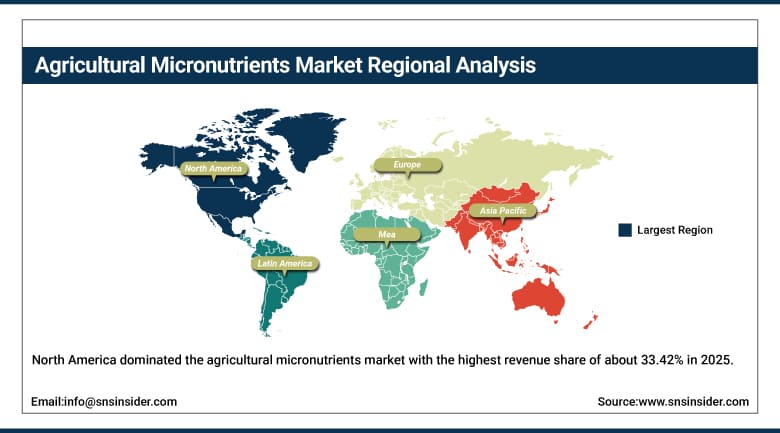
North America dominated the agricultural micronutrients market with the highest revenue share of about 33.42% in 2025 due to strong commercial farming systems and advanced soil management practices. The region benefits from high adoption of precision agriculture technologies and widespread use of micronutrient fertilizers across cereals and horticulture crops in the United States and Canada. Strong presence of large-scale agribusiness companies and advanced fertilizer manufacturers is further supporting market expansion steadily. Rising focus on soil health improvement crop yield optimization and sustainable farming practices is also accelerating micronutrient adoption across agricultural industries.
According to the United States Department of Agriculture (USDA), about 30% - 40% of the soils in the US are affected by micronutrient deficiencies (MND), and hence there is an increase in the use of corrective fertilizers (CF). There are increased investments in soil testing technologies (STT) and climate-smart agriculture programs (CSAP) that promote the use of Zn, B, and Fe micronutrients; meanwhile, SA/SRI initiatives promoted by the governments are increasing soil fertility management practices in NA.
Get Customized Report as Per Your Business Requirement - Enquiry Now
Europe Agricultural Micronutrients Market Insights.
Europe can be considered one of the most progressive agricultural micronutrients markets owing to the presence of well-regulated policies in agriculture. By 2025, Europe is responsible for contributing substantially to the market share owing to the high adoption rate in cereal, fruits, and vegetable growing systems. Nations like Germany, France, Italy, and the United Kingdom are emphasizing on soil fertility management and minimizing the excessive use of chemicals in their agricultural practices.
According to the European Commission and industry estimates, a significant share of agricultural soils in Europe face micronutrient imbalances, increasing demand for corrective soil nutrition. Strict environmental regulations and the Common Agricultural Policy (CAP) are supporting sustainable micronutrient usage. Rising adoption of organic and precision farming practices is further accelerating demand for chelated micronutrient formulations across European agriculture steadily.
Asia Pacific Agricultural Micronutrients Market Insights.
Asia Pacific holds a significant revenue share of about 9.95% in 2025 and is expected to grow at the fastest CAGR due to large agricultural land area and rising food demand. Growth is driven by increasing adoption of micronutrient fertilizers in cereals pulses oilseeds and horticultural crops across China India Japan and Southeast Asia. Government initiatives supporting soil health improvement and precision farming are further accelerating market expansion significantly. Increasing adoption of fertigation systems and high-value crop cultivation is boosting micronutrient demand across the region steadily.
As per estimates provided by the FAO and industry experts, more than 40% of soil areas in APAC have been found to be lacking in micronutrients such as zinc (Zn) and boron (B). Growth in the use of DIS and GHF technologies has led to growing demand for advanced nutrient application technologies. Growing knowledge about SFM and CPI is also contributing to market growth in the region.
Middle East & Africa and Latin America Agricultural Micronutrients Market Insights.
Middle East and Africa & Latin America have been seen as gaining prominence in the agri-micronutrients market owing to growing emphasis on food security and increased crop production. Nations like UAE, Saudi Arabia, South Africa, Brazil, and Mexico are increasingly using micronutrient fertilizers for cereal cultivation, fruit trees, vegetable gardens, and plantation farming. Growth in modern farming techniques and soil enrichment programs is contributing to sustained growth in the market. Growing need for sustainable agriculture and increased agricultural yield is adding fuel to this growth trajectory.
Based on industry reports, micronutrient fertilizer application (MFA) in UAE and Brazil has been increasing in 2025 owing to their AMPs and food security policies. The growth in GHFs, DISs, and PAT has increased the demand for micronutrients fertilizers in dry regions. The soil nutrient deficiency in MEA is reported to be 30% to 45%, while that in LATAM is from 25% to 35%, which is increasing the consumption of zinc, boron, and iron.
Market Dynamics:
Growth Drivers: Expansion of Precision Agriculture and Advanced Fertilizer Application Technologies Worldwide
Increasing popularity of precision agriculture techniques and advanced agricultural equipment is driving growth in the consumption of micronutrients in current agricultural activities. Precision agriculture techniques like soil testing, fertigation systems, and drip irrigation systems help in delivering nutrients precisely and minimizing fertilizer waste. Farmers are moving towards precision agriculture as a result of which there is increased focus on precise nutrient delivery with a view to increasing crop yields. Increasing use of chelated micronutrients is helping in better absorption of nutrients in alkaline and nutrient-poor soils.
Precision agriculture adoption improves crop yield by approximately 12%–35%, enhances nutrient use efficiency by 20%–45%, and reduces fertilizer consumption by 20%–50%, while improving water use efficiency by up to 70% in advanced fertigation systems.
Restraints: Lack of Soil Testing Infrastructure and Awareness Among Farmers in Emerging Economies
Lack of soil testing facilities coupled with lack of information regarding deficiencies of nutrients in soil acts as major barriers for the growth of this market in developing nations. It is difficult for many farmers to recognize what kind of deficiency exists in their soil because of lack of facilities for soil testing. Lack of availability of local extension services creates problems in applying fertilizers correctly. This hampers efficient production as well as efficient utilization of nutrients. Poor development of educational institutions in agriculture sector makes it difficult for people to adopt new technologies related to nutrients management.
Opportunities: Increasing Demand for High-Value Horticultural and Cash Crops Creating Strong Growth Potential
Growth in global demand for fruits and vegetables along with other high value crops is leading to increased opportunity for micronutrient fertilizers. Such crops are demanding nutrient management solutions for better quality, appearance, sizes, and life after harvesting. Increasing adoption of micronutrient fertilizers is being witnessed owing to their ability to increase the quality of exports. Increased commercial farming practices and increased greenhouses are driving fertilizer usage. Increased retail networks and export markets are increasing soil nutrition solutions investment.
Increasing adoption of micronutrient fertilizers is driven by rising export-oriented agriculture (EOA), as improved nutrient management enhances crop quality and international market acceptance. Export-focused farms show 15%–25% higher usage of micronutrient blends compared to traditional farming systems due to stricter quality standards and residue requirements in global trade markets.
Recent Developments
-
-
2026: Yara International ASA expanded its micronutrient portfolio, enhancing zinc (Zn), boron (B), and iron (Fe) delivery efficiency and improving global soil fertility management systems.
-
2025: The Mosaic Company strengthened its specialty fertilizers segment with integrated micronutrient solutions, improving soil nutrient balance and crop productivity across major agricultural regions.
-
2025: Israel Chemicals Ltd. (ICL Group) expanded water-soluble and chelated micronutrient products, enhancing nutrient uptake efficiency and supporting high-value crop production globally.
-
2024: BASF SE advanced its sustainable agriculture portfolio with micronutrient-enabled solutions, supporting precision farming adoption and improving soil nutrient efficiency worldwide.
-
Agricultural Micronutrients Market Key Players are:
-
Yara International ASA
-
Nutrien Ltd.
-
The Mosaic Company
-
Israel Chemicals Ltd. (ICL Group)
-
BASF SE
-
Syngenta AG
-
Corteva Agriscience
-
UPL Limited
-
Haifa Group
-
Valagro S.p.A.
-
Koch Agronomic Services LLC
-
CF Industries Holdings Inc.
-
Nufarm Limited
-
Wilbur-Ellis Company LLC
-
Helena Agri-Enterprises LLC
-
SQM (Sociedad Química y Minera de Chile)
-
Coromandel International Limited
-
Aries Agro Limited
-
Stoller Enterprises Inc.
-
JR Simplot Company
Agricultural Micronutrients Market Report Scope:
| Report Attributes | Details |
|---|---|
| Market Size in 2025 | USD 5.89 Billion |
| Market Size by 2035 | USD 12.33 Billion |
| CAGR | CAGR of 7.68% From 2026 to 2035 |
| Base Year | 2025 |
| Forecast Period | 2026-2035 |
| Historical Data | 2022-2024 |
| Report Scope & Coverage | Market Size, Segments Analysis, Competitive Landscape, Regional Analysis, DROC & SWOT Analysis, Forecast Outlook |
| Key Segments | • By Type (Zinc, Boron, Iron, Manganese, Molybdenum, Copper, Other Micronutrients) • By Form (Chelated Micronutrients (EDTA, EDDHA, DTPA, IDHA, others), Non-Chelated Micronutrients) • By Crop Type (Cereals, Pulses & Oilseeds, Fruits & Vegetables, Plantation & Commercial Crops, Others (Turf, Ornamentals)) • By Mode of Application (Foliar, Fertigation, Soil Application, Seed Treatment & Other Advanced Methods) |
| Regional Analysis/Coverage | North America (US, Canada), Europe (Germany, UK, France, Italy, Spain, Russia, Poland, Rest of Europe), Asia Pacific (China, India, Japan, South Korea, Australia, ASEAN Countries, Rest of Asia Pacific), Middle East & Africa (UAE, Saudi Arabia, Qatar, South Africa, Rest of Middle East & Africa), Latin America (Brazil, Argentina, Mexico, Colombia, Rest of Latin America). |
| Company Profiles | Yara International ASA, Nutrien Ltd., The Mosaic Company, Israel Chemicals Ltd. (ICL Group), BASF SE, Syngenta AG, Corteva Agriscience, UPL Limited, Haifa Group, Valagro S.p.A., Koch Agronomic Services LLC, CF Industries Holdings Inc., Nufarm Limited, Wilbur-Ellis Company LLC, Helena Agri-Enterprises LLC, SQM (Sociedad Química y Minera de Chile), Coromandel International Limited, Aries Agro Limited, Stoller Enterprises Inc., JR Simplot Company |

Frequently Asked Questions
The agricultural micronutrients market is expected to grow at a CAGR of 7.68% from 2026 to 2035.
The agricultural micronutrients market was valued at USD 5.89 Billion in 2025.
The market is driven by rising soil nutrient deficiencies, increasing demand for higher crop productivity, and expansion of precision agriculture and fertigation systems globally.
The Soil Application segment dominated the market with 35.18% share in 2025 due to its cost-effectiveness and suitability for large-scale farming.
North America dominated the market in 2025 with about 33.42% share, supported by advanced farming practices and strong commercial agriculture systems.
