
AI-Based Helmet Market Report Scope & Overview:
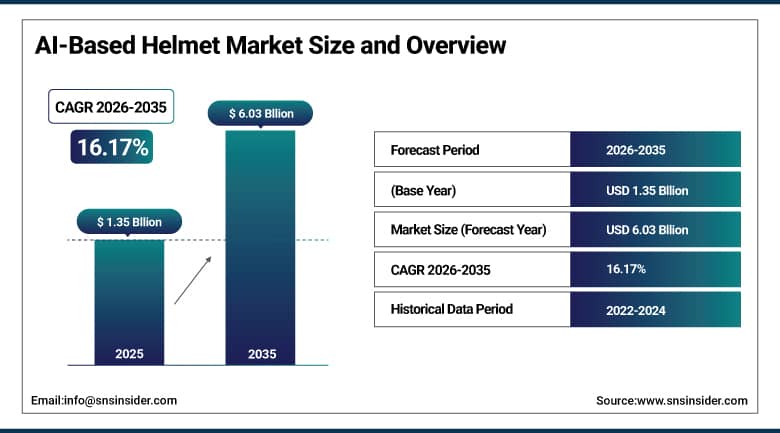
The AI-Based Helmet Market was valued at USD 1.35 billion in 2025 and is expected to reach USD 6.03 billion by 2035, growing at a CAGR of 16.17% from 2026–2035.
The AI-based helmet market is witnessing strong growth in the global market owing to rising demand for smart safety solutions. Increasing workplace accidents and safety regulations are boosting adoption. Growing industrial automation and construction activities are supporting market expansion. Manufacturers are focusing on AI-powered real-time monitoring systems. Rising demand for worker protection in hazardous environments is driving innovation. Increasing integration of AR and computer vision is further accelerating market adoption.
According to the ITF and WHO road safety statistics, there are an estimated 1.19 million fatalities resulting from road accidents every year, with more than 90% of these deaths occurring in low- and middle-income nations.
As per global medical and traffic safety data, helmet usage decreases head injuries for bikers by up to 69% and the risk of fatalities by around 37%. European Commission transport safety information highlights the critical importance of this protection, showing that around 80% of bikers who perish in fatal road crashes sustain severe head impacts.
To Get More Information On AI-Based Helmet Market - Request Free Sample Report
AI-Based Helmet Market Trends:
-
The quick uptake of Industry 4.0 ecosystems is causing an increase in the use of AI helmets to monitor workers and enhance safety.
-
The development of smart factories is leading to the adoption of IoT-enabled AI helmets to predict potential hazards and improve efficiencies.
-
Increased adoption of augmented reality in helmets is improving navigation, hazard detection, and hands-free communication in industries worldwide.
-
Innovations in computer vision technology are leading to efficient real-time environmental assessment, which enhances hazard detection in workplaces.
-
The growing deployment of edge AI computing technology is helping in reducing latency and AIding decision-making.
-
Digital transformation efforts are causing an increase in the use of smart wearable safety devices in industries.
U.S. AI-Based Helmet Market Outlook:
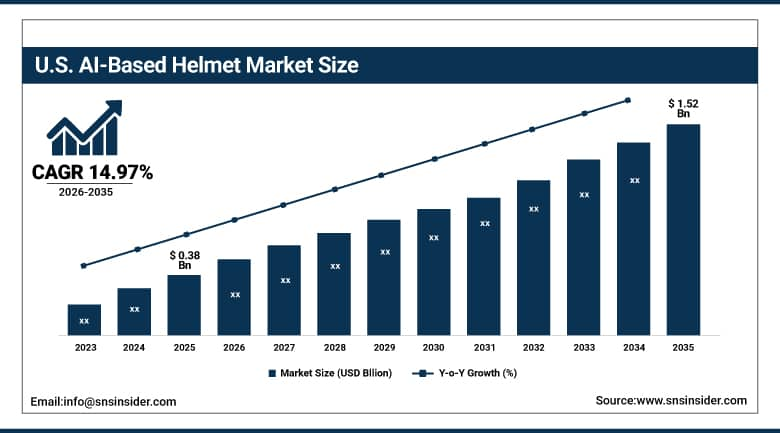
The U.S. AI-Based Helmet Market was valued at USD 0.38 billion in 2025 and is expected to reach around USD 1.52 billion by 2035, growing at a CAGR of 14.97% from 2026–2035.
The U.S. AI-based helmet market is expanding steadily owing to strong demand for industrial safety solutions. Increasing adoption of smart wearable technologies is supporting market growth. Rising workplace safety regulations and compliance requirements are driving adoption across industries. Growth in construction, manufacturing, and defense sectors is further accelerating demand. Manufacturers are focusing on AI-powered real time monitoring and analytics systems. Increasing integration of computer vision and AR technologies is strengthening market penetration.
According to traffic safety data from the National Highway Traffic Safety Administration, motorcyclists remain heavily overrepresented in fatal crashes, accounting for roughly 15% to 16% of all traffic fatalities despite constituting only about 3% of all registered vehicles in the United States. Furthermore, data from the U.S. Bureau of Labor Statistics highlights risks in industrial sectors, where head injuries consistently make up nearly 5% of all non-fatal occupational injuries across the general workforce, rising to a staggering 25% of all fatalities within the construction industry.
AI-Based Helmet Market Segment Analysis:
-
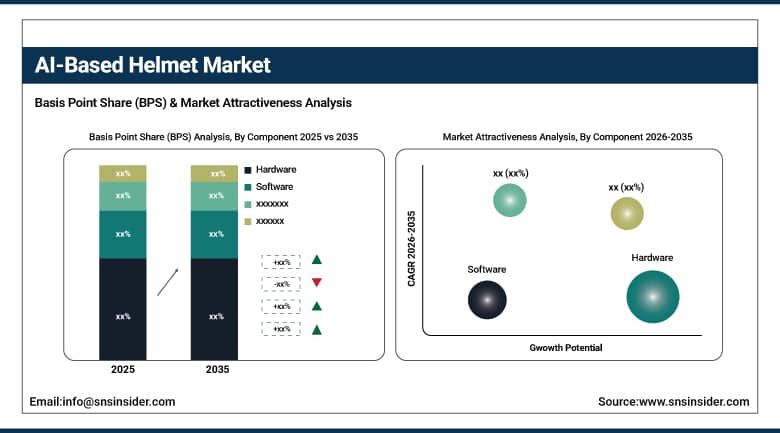
By Component, hardware dominated the market with 68.45% share in 2025; while software is the fastest growing segment with CAGR of 22.67% during 2026 to 2035.
-
By Technology, computer vision-enabled helmets dominated the market with 64.80% share in 2025; while Edge AI / On-device AI processing is the fastest growing segment with CAGR of 24.94% during 2026 to 2035.
-
By Application, industrial safety dominated the market with 51.75% share in 2025; while transportation is the fastest growing segment with CAGR of 22.63% during 2026 to 2035.
-
By Distribution Channel, offline dominated the market with 71.25% share in 2025; while online is the fastest growing segment with CAGR of 22.49% during 2026 to 2035.
-
By End Use, industrial users dominated the market with 53.90% share in 2025; while individual consumers are the fastest growing segment with CAGR of 23.75% during 2026 to 2035.
By Component, hardware dominated the AI-based helmet market, while software is the fastest growing segment.
Hardware segment dominated the AI-based helmet market with the highest revenue share in 2025. This dominance is driven by the strong demand for physical components such as sensors, cameras, communication modules, and display units. These hardware systems form the core of AI-Based Helmet functionality. Increasing industrial safety requirements and defense modernization programs further support adoption. High durability and real time data capturing capability make hardware essential for operational environments.
Software segment is expected to grow at the fastest CAGR from 2026–2035 due to rising integration of advanced AI algorithms and analytics platforms. Increasing demand for real time data processing, predictive safety alerts, and intelligent decision making is driving growth. Software enables computer vision, NLP, and edge AI functionalities. Continuous upgrades and cloud integration capabilities further enhance adoption. Growing need for smart, connected, and adaptive safety systems is accelerating software demand globally.
By Technology, computer vision-enabled helmets dominated the AI-based helmet market, while Edge AI / On-device AI processing is the fastest growing segment.
Computer Vision Enabled Helmets sub-segment held the dominated revenue share in the AI-based helmet market in 2025. High adoption in the industrial safety monitoring and hazard detection system drives market dominance. These helmets offer precise visual analytics and object recognition. Rising regulation and requirements of accident prevention systems drive market growth. Existing implementation of safety infrastructure is another reason behind market domination.
Edge AI/On-device AI Processing sub-segment will witness the fastest CAGR from 2026 to 2035 owing to increasing demand for decision-making capability in real-time without relying on cloud. It helps in reducing latency and improving efficiency in critical conditions. Increasing demand for secure and private data processing is driving market growth. Increasing adoption in defense and industrial automation systems is adding to market growth. Advancements in AI chips is helping in achieving scalability.
By Application, industrial safety dominated the AI-based helmet market, while transportation is the fastest growing segment.
Industrial Safety segment that accounted for the dominated revenue share in 2025. This is due to stringent safety rules and increased incidents of accidents occurring in the industrial sector. The increase in usage of smart helmets in sectors such as construction, mining, and manufacturing will boost market growth in the future years. Application of AI for the purpose of real-time monitoring of hazards will drive the growth in the market.
Transportation segment is anticipated to exhibit the fastest growth rate during 2026 to 2035. Growth is fueled by rising demand for intelligent safety features and connectivity in transportation. Increase in issues related to safety on roads and application of AI technology in navigational support will lead to the growth in demand in the coming years. Growth in logistics and intelligent transport infrastructure will drive market demand.
By Distribution Channel, offline dominated the AI-based helmet market, while online is the fastest growing segment.
The offline segment holds the leading position in the AI-based helmet market in terms of revenue share in 2025. This is mAInly attributed to high inclination towards buying the product directly from safety equipment distributors and industrial suppliers. The need for physical inspection and validation of compliance along with bulk purchase agreements makes enterprises more inclined towards offline channels. Lack of knowledge about smart helmets in developing economies is another factor favoring offline channels in the market.
The online segment is projected to register a faster CAGR during 2026-2035 because of increased digitization and rising use of e commerce. Increased avAIlability of information related to products and comparison portals is helping in boosting the confidence of buyers. Individual buyers and small businesses opt for online channels for convenience and cost effectiveness. Growth in manufacturer’s direct to customer approach and better logistics is helping in boosting online sales.
By End Use, industrial users dominated the AI-based helmet market, while individual consumers are the fastest growing segment.
Industries segment led the AI-based helmet market in terms of generating the dominated revenue share in 2025. This segment held a market lead position due to high adoption in manufacturing, construction, mining, and industrial applications. The strict adherence to safety measures for protecting employees from injuries is one of the mAIn factors driving the use of smart protection devices. Automation trends will drive the use of smart helmets in the upcoming years.
Consumer Individuals segment is estimated to grow at a significant CAGR during the forecast period 2026-2035. Consumer adoption of smart helmets in various sports, cycling, biking, and other adventure activities is expected to drive the market growth. The increasing consumer awareness regarding accident prevention is contributing towards the growing popularity of smart helmets. Advancements in cost-effective wearable devices and features such as navigation and communication support the product adoption by consumers.
Regional Analysis:
|
Region |
Major Country |
Share within Region, 2025(%) |
|---|---|---|
|
North America |
United States |
72.40% |
|
Europe |
Germany |
25.80% |
|
Asia Pacific |
China |
42.30% |
|
Middle East & Africa |
UAE |
16.70% |
|
Latin America |
Brazil |
46.20% |
North America AI-Based Helmet Market Insights.
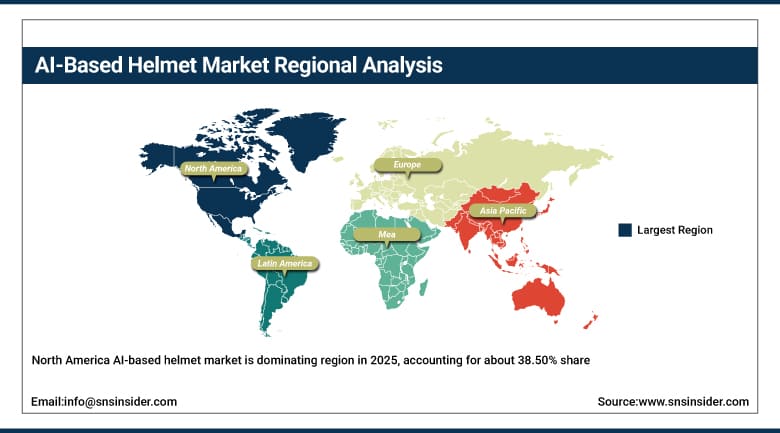
North America AI-based helmet market is dominating region in 2025, accounting for about 38.50% share, driven by strong demand from industrial safety and defense sectors. The region benefits from advanced technology infrastructure and early adoption of AI-enabled wearables. Increasing workplace safety regulations are significantly strengthening product penetration. Expansion of manufacturing, construction, and oil and gas industries is accelerating demand. Strong focus on AI driven safety innovation further reinforces the region’s dominant position in the market.
According to official USDOT safety data, motorcycle riders account for roughly 15% of traffic fatalities despite making up only 3% of registered vehicles. To mitigate these risks, Transport Canada reports that mandatory helmet laws successfully drive rider compliance above 95%. Meanwhile, workplace head trauma remains a critical concern; the U.S. Bureau of Labor Statistics notes that more than 6,000 non-fatal head injuries occur annually within the construction sector alone.
Get Customized Report as Per Your Business Requirement - Enquiry Now
Europe AI-Based Helmet Market Insights.
Europe AI-based helmet market is characterized by stable growth in 2025 owing to strong industrial safety regulations and digital transformation initiatives. Key countries include Germany, France, United Kingdom, and Italy. Rising adoption of smart safety equipment in manufacturing and automotive sectors is driving growth. Increasing focus on worker protection standards is boosting demand. Growth in industrial automation and logistics industries is further supporting market expansion. Strict EU safety compliance frameworks are encouraging AI helmet innovation.
In accordance with the Digital Decade indicators monitored by the European Commission and Eurostat, the EU targets 75% tech adoption among businesses by 2030, with large industries leading the charge as over 75% already utilize advanced analytics and cloud capabilities. Meanwhile, transport safety reports from the European Road Safety Observatory show a pressing need for protective innovation, noting that motorcyclists alone constitute 16% of all traffic fatalities across the EU.
Asia Pacific AI-Based Helmet Market Insights.
Asia Pacific is the fastest growing region in the AI-based helmet market, registering a CAGR of about 17.61% during 2026–2035. Rapid industrialization and expanding infrastructure development are driving strong demand across China, India, Japan, South Korea, and Southeast Asia. Growth in manufacturing and construction activities is boosting adoption. Increasing workplace safety awareness and smart factory initiatives are further accelerating market expansion. Rising technology manufacturing hubs are supporting large scale AI helmet production.
According to the International Telecommunication Union, the Asia-Pacific region represents a massive share of global digital growth, driven by rapid mobile broadband expansion across leading member economies. This digital foundation is critical, as WHO Global Health Observatory data indicates that Asia-Pacific accounts for over 60% of global road traffic fatalities. To address this crisis, the Asian Development Bank and regional governments are increasing their focus on sustainable transport, actively integrating smart mobility and sensor-based safety technologies into major transport infrastructure investments.
Middle East & Africa and Latin America AI-Based Helmet Market Insights.
The Middle East & Africa along with Latin America regions are witnessing steady growth due to increasing industrial safety investments and infrastructure development projects. Key contributing countries include Brazil, Mexico, UAE, Saudi Arabia, and South Africa. Rising adoption in oil and gas, construction, and mining sectors is driving demand. Growth in smart city initiatives is further supporting market expansion. Increasing focus on worker safety standards is boosting regional adoption of AI-enabled helmets.
According to data from the ILO and WHO, there are an estimated 2.78 million occupational fatalities annually, with low- and middle-income regions bearing the highest burden of industrial accidents. World Bank data shows varying contexts for executing safety programs: the urban population stands at over 81% in Latin America, compared to roughly 42% in Sub-Saharan Africa. Furthermore, ITU digital connectivity indicators highlight that while mobile broadband penetration has surged past 75% in Latin America, it remains more constrained in Africa at closer to 40%, impacting how easily mobile safety technologies can be implemented across these workforces.
Market Dynamics:
Growth Drivers: Growing integration of AI, AR, and computer vision technologies enhancing smart safety helmet functionality globally
Development in AI, augmented reality, and computer vision technology has made helmets more advanced. The devices can process data in real-time and provide navigation and warning services to the users. Growing use of edge computing using AI computing is increasing processing speed and lowering latency. Growing demand for hands-free communication and situational awareness in dangerous conditions has been driving this development. Technological advancement and lower costs of sensors are helping in the adoption of smart helmet technology.
According to indicators from the International Labour Organization, global fatalities from occupational hazards reach 2.78 million each year, with a major share of these tragedies occurring in hazardous sectors like construction and manufacturing. To combat these risks, occupational health frameworks increasingly highlight the rise of digital surveillance and wearable safety tech, as high-risk industries rapidly adopt smart sensors to monitor worker health and prevent accidents in real time.
Restraints: Data privacy concerns and cybersecurity risks limiting trust and adoption of AI-Based Helmet technologies globally
AI-driven helmets generate and share information related to the work environment and the user, posing serious issues relating to data privacy and security. Risks associated with data being accessed by an unauthorized party, data breaches, and hacks can be reasons why users do not use them. Industries that are operating under sensitive operations are hesitant to use such devices. Absence of cyber-security standards poses more risks. Data regulations for AI surveillance system are another reason for slow adoption.
Opportunities:Expansion of smart manufacturing and Industry 4.0 ecosystems creating strong growth opportunities for AI-Based Helmet Market
The fast growth in smart factories and the Industrial Revolution 4.0 is driving the need for the deployment of artificial intelligence-based safety wearables. The integration of the Internet of Things, Robotics and the connectivity of systems will be increasing the need for monitoring workers in real time. AI based helmets not only give safety alerts but also help to improve efficiency in operations by providing insights. Increased investment in digitalization is supporting the use of such technology.
According to the World Robotics report by the International Federation of Robotics, annual global installations of industrial robots hover around 550,000 units, with Asia's regional share exceeding 70%. This rapid shift toward Industry 4.0 is mirrored in the World Economic Forum’s Global Lighthouse Network, which has expanded to over 220 advanced factories and value chains recognized for scaling AI, IoT, and next-generation automation. Furthermore, indicators from the OECD highlight that while foundational digital technologies are near-universal, advanced AI-driven production technology is rapidly becoming a competitive baseline among leading large manufacturing firms.
Recent Developments:
-
2026: viAct.ai deployed cloud-integrated industrial AI video analytics software to enforce PPE compliance and monitor active workplace hazard zones.
-
2025: Bullard integrated compact thermal imaging modules and data-linked sensor arrays into advanced hard hats for firefighting and manufacturing teams.
-
2025: RealWear, Inc. scaled its rugged, modular assisted-reality device ecosystem built to clip securely onto baseline industrial safety hard hats.
-
2024: Airoh pioneered specialized high-speed rider safety technology by developing protective motorcycle helmet prototypes integrated with structural airbag systems.
AI-Based Helmet Market Key Players are:
-
Sena Technologies, Inc.
-
LIVALL Tech Co., Ltd.
-
Schuberth GmbH
-
HJC Helmets
-
Shoei Co., Ltd.
-
Arai Helmet, Ltd.
-
Cosmo Connected
-
CrossHelmet
-
Caberg SpA
-
Airoh
-
MSA Safety Incorporated
-
Honeywell International Inc.
-
3M Company
-
Drägerwerk AG & Co. KGaA
-
RealWear, Inc.
-
viAct.ai
-
Bullard
-
JSP Limited
-
Centurion Safety Products Ltd.
-
Uvex Group
AI-Based Helmet Market Report Scope:
| Report Attributes | Details |
|---|---|
| Market Size in 2025 | USD 1.35 Billion |
| Market Size by 2035 | USD 6.03 Billion |
| CAGR | CAGR of 16.17% From 2026 to 2035 |
| Base Year | 2025 |
| Forecast Period | 2026-2035 |
| Historical Data | 2022-2024 |
| Report Scope & Coverage | Market Size, Segments Analysis, Competitive Landscape, Regional Analysis, DROC & SWOT Analysis, Forecast Outlook |
| Key Segments | • By Component (Hardware, Software, Services) • By Technology (Computer Vision-Enabled Helmets, Edge AI / On-device AI Processing, Augmented Reality (AR)-Based Helmets, Natural Language Processing (NLP) Integration) • By Application (Industrial Safety, Transportation, Military & Defense, Sports & Adventure, Public Safety & Law Enforcement, Others) • By Distribution Channel (Offline, Online) • By End Use (Industrial Users, Individual Consumers, Defense & Security Forces, Enterprises & Logistics Operators, Government & Public Safety Agencies) |
| Regional Analysis/Coverage | North America (US, Canada), Europe (Germany, UK, France, Italy, Spain, Russia, Poland, Rest of Europe), Asia Pacific (China, India, Japan, South Korea, Australia, ASEAN Countries, Rest of Asia Pacific), Middle East & Africa (UAE, Saudi Arabia, Qatar, South Africa, Rest of Middle East & Africa), Latin America (Brazil, Argentina, Mexico, Colombia, Rest of Latin America). |
| Company Profiles | Sena Technologies, Inc., LIVALL Tech Co., Ltd., Schuberth GmbH, HJC Helmets, Shoei Co., Ltd., Arai Helmet, Ltd., Cosmo Connected, CrossHelmet, Caberg S.p.A., Airoh, MSA Safety Incorporated, Honeywell International Inc., 3M Company, Drägerwerk AG & Co. KGaA, RealWear, Inc., viAct.ai, Bullard, JSP Limited, Centurion Safety Products Ltd., uvex group |
Frequently Asked Questions
The Hardware segment dominated the market in 2025 due to strong demand for sensors, cameras, communication modules, and display systems.
The major growth factors include rising workplace accidents and strict safety regulations, increasing adoption of smart safety wearables, rapid industrial automation and construction activities, integration of AI technologies such as computer vision, AR, and edge AI, and growing demand for real-time monitoring and hazard detection in high-risk environments.
The AI-based helmet market is expected to grow at a CAGR of 16.17% from 2026 to 2035.
The AI-based helmet market was valued at USD 1.35 billion in 2025.
North America dominated the AI-based helmet market in 2025 due to early AI wearable adoption, strict safety regulations, and strong industrial demand.
