
AI-RAN Compute Infrastructure Market Report Scope & Overview:
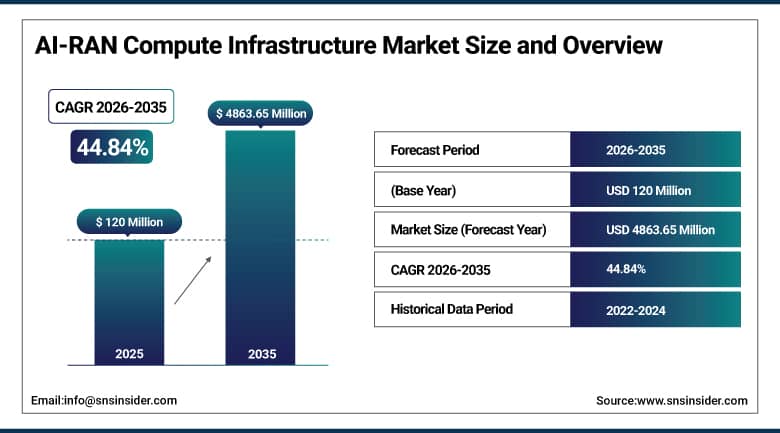
The AI-RAN Compute Infrastructure Market was valued at USD 120 million in 2025 and is expected to reach USD 4863.65 million by 2035, growing at a CAGR of 44.84% from 2026-2035.
The AI-RAN Compute Infrastructure Market is witnessing rapid growth due to increasing AI workloads, rising mobile data traffic, and growing demand for high-performance computing at the network edge. The growing trend in the telecom industry involves the use of artificial intelligence-driven computer systems in order to help achieve real-time network optimization, smart traffic management, AI inference, and RAN services. The increasing use of technologies such as 5G, edge computing, Open RAN, and cloud native networks is creating more demand for GPUs, AI accelerators, high-performance networking, and computer systems. Moreover, developments in AI-RAN solutions are paving the way for using shared infrastructure for both wireless networks and AI processes.
NVIDIA describes AI-RAN as enabling wireless networks to become platforms for distributed high-performance edge AI computing, supporting real-time AI applications close to users and devices
To Get More Information On AI-RAN Compute Infrastructure Market - Request Free Sample Report
AI-RAN Compute Infrastructure Market Trends
-
Rising adoption of AI-native 5G networks is driving demand for accelerated computing infrastructure supporting real-time AI workloads and advanced RAN applications.
-
Increasing deployment of GPUs and specialized AI accelerators is enabling telecom operators to consolidate RAN processing and AI workloads on shared infrastructure.
-
Growing adoption of Open RAN architectures is accelerating demand for programmable, virtualized, and AI-enabled computing platforms across telecommunications networks.
-
Rising demand for edge AI inference is expanding distributed compute deployment closer to radio sites, enabling low-latency intelligent network services.
U.S. AI-RAN Compute Infrastructure Market Outlook
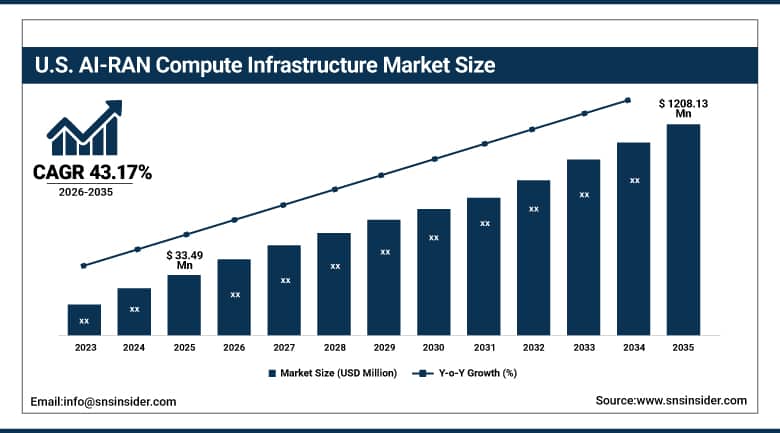
The U.S. AI-RAN Compute Infrastructure Market was valued at USD 33.49 million in 2025 and is expected to reach USD 1208.13 million by 2035, growing at a CAGR of 43.17% from 2026-2035.
The U.S. AI-RAN Compute Infrastructure Market is witnessing rapid growth owing to increasing demands from AI, growing mobile data usage, and the need for high-performance computing at the edge of the network. Telecom providers are increasingly implementing compute infrastructure with AI capabilities in order to offer real-time network optimization, traffic management using AI, and AI-RAN applications. The growing adoption of 5G networks, edge computing, Open RAN, and cloud-native networks is also contributing to the growing demand for GPUs, AI accelerators, high-speed networking, and compute infrastructure. Furthermore, developments in the AI-RAN technology integration are leading to the development of infrastructure that can serve both wireless networking and AI workloads efficiently. The demand for low-latency processing, high network performance, energy efficiency, and autonomous network operations is also fueling market growth in the United States.
NTIA announced in March 2026 that its Public Wireless Supply Chain Innovation Fund would shift toward U.S.-based AI-native network architecture, including a future funding opportunity focused on integrating AI into Radio Access Networks.
AI-RAN Compute Infrastructure Market Segment Analysis
-
By Platform Type, AI Inference at RAN Edge dominates the AI-RAN Compute Infrastructure Market with 48% share in 2025; Distributed RAN AI Processing is expected to grow at the fastest CAGR of 51.30% from 2026–2035.
-
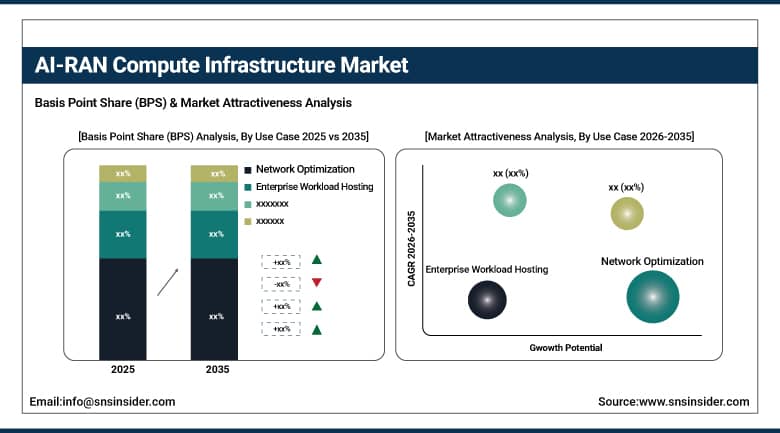
By Use Case, Network Optimization dominates the Network Orchestration Market with 46% share in 2025; Enterprise Workload Hosting is expected to grow at the fastest CAGR of 47.59% from 2026–2035.
By Use Case, Network Optimization dominates the AI-RAN Compute Infrastructure Market, Enterprise Workload Hosting grows fastest.
The Network Optimization segment dominated the AI-RAN Compute Infrastructure Market with the highest revenue share of about 46% in 2025, Driven by increasing complexities in the network and the need for efficiency in the use of resources. Optimization through AI helps in traffic management, capacity planning, interference avoidance, and decision-making in the network. It assists operators to optimize their network performance and lower operational costs.
The Enterprise Workload Hosting segment is expected to grow at the fastest CAGR of 47.59% from 2026–2035, motivated by the growing convergence of telecoms infrastructure with enterprise computing. AI-RAN infrastructure allows telcos to provide enterprise AI, analytics, and edge computing workloads at closer proximity to end-users. Increased deployment of edge AI, industrial IoT, private 5G, and real-time enterprise apps fuels growth even more.
By Platform Type, AI Inference at RAN Edge dominates the AI-RAN Compute Infrastructure Market, Distributed RAN AI Processing grows fastest.
The AI Inference at RAN Edge segment dominated the AI-RAN Compute Infrastructure Market with the highest revenue share of about 48% in 2025, due to rising demand for AI operations that have low latency directly on the RAN side. The edge inference technology helps in providing real-time optimization of the network, lower data transmission needs, higher resource efficiency, and faster intelligent decision-making.
The Distributed RAN AI Processing segment is expected to grow at the fastest CAGR of 51.30% from 2026–2035, Driven by increased use of distributed computing and AI capabilities at RAN sites. This architectural approach facilitates local computing, lowers latency, enhances scalability and workload distribution. Increased 5G densification and use of edge computing further drive the adoption of this architectural model.
Regional Analysis
|
Region |
Major Country |
Share within Region, 2025 (%) |
|---|---|---|
|
North America |
United States |
91.0% |
|
Europe |
Germany |
23.0% |
|
Asia Pacific |
China |
41.0% |
|
Middle East & Africa |
UAE |
17.0% |
|
Latin America |
Brazil |
35.0% |
Asia Pacific AI-RAN Compute Infrastructure Market Insights
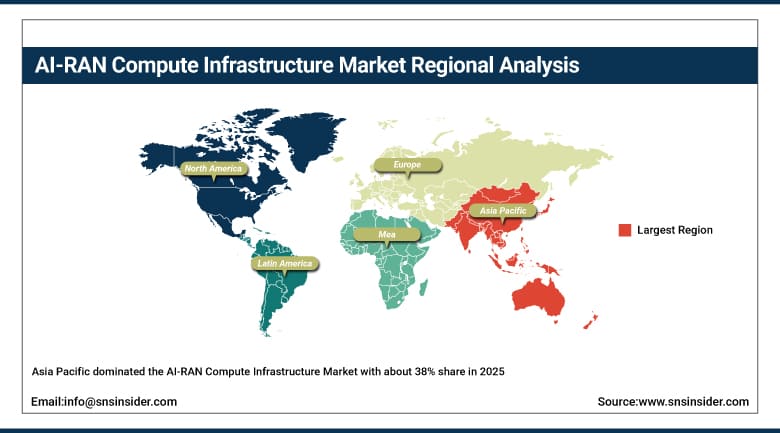
Asia Pacific dominated the AI-RAN Compute Infrastructure Market with about 38% share in 2025 and is expected to grow at the fastest CAGR of 46.96% from 2026–2035, driven by rapid 5G deployment, rising data traffic, expanding edge computing, and strong AI investments. Government digitalization initiatives, telecom modernization, semiconductor capabilities, and increasing demand for high-performance, AI-enabled networks further accelerate regional market adoption and growth.
The China AI-RAN Compute Infrastructure Market accounted for a market share of 41.0%, Backed by 5G infrastructure, substantial telecommunications infrastructure and investment in artificial intelligence. Growth in data traffic, edge computing implementation, and high-speed network processing is fuelling growth in the market. Digitalization efforts by governments, semiconductor technology, and investments in artificial intelligence will enhance China’s standing in the region.
Get Customized Report as Per Your Business Requirement - Enquiry Now
North America AI-RAN Compute Infrastructure Market Insights
North America’s AI-RAN Compute Infrastructure Market is aided by a robust telecommunications infrastructure, early adoption of 5G technology, and significant investment in AI-enabled networking. Edge computing is becoming more prevalent, there is a need for high performance network processing capabilities, and leading companies in the semiconductor and technology space can be found here. Other areas of investment include Open RAN, cloud, and networks.
The U.S. AI-RAN Compute Infrastructure Market accounted for a market share of 91.0%, Supported by an advanced telecommunication infrastructure, wide coverage of 5G, and significant investments in AI and network computing. High demands for high-performance edge computing, network optimizations, and cloud-native infrastructure have resulted in a higher uptake rate. The availability of major tech firms and significant investments in AI-telecommunication has further boosted the American market.
Europe AI-RAN Compute Infrastructure Market Insights
Europe’s AI-RAN Compute Infrastructure Market It is enabled by the expansion of 5G network infrastructure, increased deployment of AI, and investments in network virtualization. AI-powered computing is being adopted by telecom service providers for better performance of the network, automation, and resource optimization. The presence of government initiatives related to digital infrastructure, development of Open RAN, and energy-efficient networks, along with robust telecom research, drives regional market growth.
The Germany AI-RAN Compute Infrastructure Market accounted for a market share of 23.0%, Driven by state-of-the-art telecommunications infrastructure, increased use of 5G technology, and investments in AI and network virtualization. Increasing demand for intelligent network optimization and edge computing technology is contributing to market growth. Digital transformation projects, adoption of Open RAN, and investments in energy-efficient networks infrastructure add to the strength of Germany in Europe.
Middle East & Africa and Latin America AI-RAN Compute Infrastructure Market Insights
The Middle East & Africa and Latin America AI-RAN Compute Infrastructure Markets are backed by efforts to increase 5G rollouts, digital transformation, and telecom infrastructure investment. The growing need for high performance computing in networks and edge is driving adoption. Government-led connectivity projects, smart cities programs, cloud infrastructure development, and AI-driven network modernization efforts provide additional opportunities in these emerging markets.
The UAE AI-RAN Compute Infrastructure Market accounted for a market share of 17.0%, backed by rapid digital transformation, increased 5G coverage, and rising investments in AI. The growing uptake of edge computing, cloud-based technologies, and smart cities is fueling the need for AI-powered networks. Government policies on digital transformation, telecommunications advancements, and technological collaboration are additional drivers of market growth in the UAE.
Growth Drivers: Growing demand for high-performance AI computing at the network edge is accelerating AI-RAN compute infrastructure adoption
The rapid expansion of generative AI, agentic AI, physical AI, and other latency-sensitive applications is increasing demand for computing capabilities closer to end users. With AI-RAN, telecoms can run their RAN processing along with their AI processing on common accelerated compute infrastructure. The AI-RAN Alliance considers sharing of compute to be one of the critical architectures that will enhance infrastructure efficiency and allow for the provision of new AI services at the network edge. Furthermore, the commercial version of AI-RAN by Nokia brings acceleration capabilities directly into the RAN environment, showcasing how the industry is moving towards becoming AI-native. This is leading to increased interest in GPU and accelerator devices.
Restraints: High infrastructure costs, power consumption, and cooling requirements can limit AI-RAN compute infrastructure adoption
AI-RAN compute infrastructure requires high-performance GPUs, CPUs, accelerators, servers, networking equipment, power systems, and advanced cooling capabilities, increasing deployment and operating costs for telecom operators. The computational requirements for AI are considerable, and adding AI computation on top of the intensive workloads involved in RAN operations adds to these requirements. There will thus be a need to take into account computing capacity, network performance, power use, and infrastructure usage in the deployment of AI-RAN. Even as new architectural designs are being proposed to enhance efficiency and increase computing capacity within the same infrastructure, the investment needed in terms of accelerated computing and infrastructure is not insignificant. This could hinder uptake of AI-RAN, especially by operators with budgetary constraints in their infrastructures.
Opportunities: Expansion of distributed edge AI inference and AI workload hosting is creating significant growth opportunities
AI-RAN enables telecom operators to use distributed network infrastructure for AI inference and workload hosting closer to end users. Such a capability will be useful in low-latency use cases like industrial automation, robotics, computer vision, autonomy, intelligent IoT, and physical AI. The AI-RAN Alliance sees AI-on-RAN as a key area where AI can be deployed on mobile network infrastructure, while NVIDIA and T-Mobile have shown use cases of physical AI using distributed edge AI infrastructure. Operators can even earn from the computing capabilities that they can share with enterprise and application providers. The increasing need for AI services in real time can provide operators with additional earning possibilities.
Recent Developments:
-
2026 : NVIDIA Corporation expanded its AI-RAN compute infrastructure ecosystem through deployments with T-Mobile and Nokia, using NVIDIA AI infrastructure and AI Aerial to support AI-RAN workloads and the integration of AI applications with telecom networks.
-
2026 : Ericsson AB demonstrated Cloud RAN running on NVIDIA AI infrastructure with T-Mobile, advancing the use of accelerated computing platforms for AI-RAN and supporting the convergence of RAN and AI workloads.
-
2026 : Samsung Electronics Co., Ltd. demonstrated AI-RAN using NVIDIA AI infrastructure and AMD EPYC processors, including AI-based MIMO beamforming and multi-cell testing aimed at scalable commercial deployments.
-
2025 : Nokia Corporation strengthened its AI-RAN compute infrastructure strategy through a strategic partnership with NVIDIA, including a USD 1 million NVIDIA investment in Nokia to accelerate AI-RAN innovation and the transition toward AI-native 5G-Advanced and 6G networks.
AI-RAN Compute Infrastructure Market Key Players are:
-
NVIDIA
-
Nokia
-
Intel
-
Samsung
-
Fujitsu
-
Dell Technologies
-
HPE
-
AMD
-
Qualcomm
-
Huawei
-
Cisco
-
NEC
-
Mavenir
-
ZTE
-
Supermicro
-
Lenovo
-
Red Hat
-
VMware
AI-RAN Compute Infrastructure Market Report Scope:
| Report Attributes | Details |
|---|---|
| Market Size in 2025 | USD 120.00 Million |
| Market Size by 2035 | USD 4863.65 Million |
| CAGR | CAGR of 44.84% From 2026 to 2035 |
| Base Year | 2025 |
| Forecast Period | 2026-2035 |
| Historical Data | 2022-2024 |
| Report Scope & Coverage | Market Size, Segments Analysis, Competitive Landscape, Regional Analysis, DROC & SWOT Analysis, Forecast Outlook |
| Key Segments | • By Platform Type (AI Inference at RAN Edge, GPU-Accelerated Base Station, Distributed RAN AI Processing) • By Use Case (Network Optimization, Enterprise Workload Hosting, Real-Time Analytics) |
| Regional Analysis/Coverage | North America (US, Canada), Europe (Germany, UK, France, Italy, Spain, Russia, Poland, Rest of Europe), Asia Pacific (China, India, Japan, South Korea, Australia, ASEAN Countries, Rest of Asia Pacific), Middle East & Africa (UAE, Saudi Arabia, Qatar, South Africa, Rest of Middle East & Africa), Latin America (Brazil, Argentina, Mexico, Colombia, Rest of Latin America). |
| Company Profiles | NVIDIA, Ericsson, Nokia, Intel, Samsung, Fujitsu, Dell Technologies, HPE, AMD, Qualcomm, Huawei, Cisco, NEC, Mavenir, ZTE, Advantech, Supermicro, Lenovo, Red Hat, and VMware. |

Frequently Asked Questions
Key players in the AI-RAN Compute Infrastructure Market include NVIDIA Corporation, Ericsson, Nokia Corporation, Intel Corporation, and Samsung Electronics Co., Ltd., among others.
Key opportunities in the AI-RAN Compute Infrastructure Market include expansion of 5G and 6G networks, increasing AI workload deployment at the RAN edge, and growing demand for GPU-accelerated and distributed computing infrastructure.
The market is driven by increasing AI workloads at network edges, along with growing adoption of 5G, AI-powered RAN optimization, GPU acceleration, and cloud-native infrastructure.
The AI Inference at RAN Edge segment dominated the AI-RAN Compute Infrastructure Market, accounting for approximately 48.20% market share.
The Asia Pacific region dominated the AI-RAN Compute Infrastructure Market in 2025 with a 38.50% share, driven by high firearm sales and strong defense procurement.
