
Network API Monetization Market Report Scope & Overview:
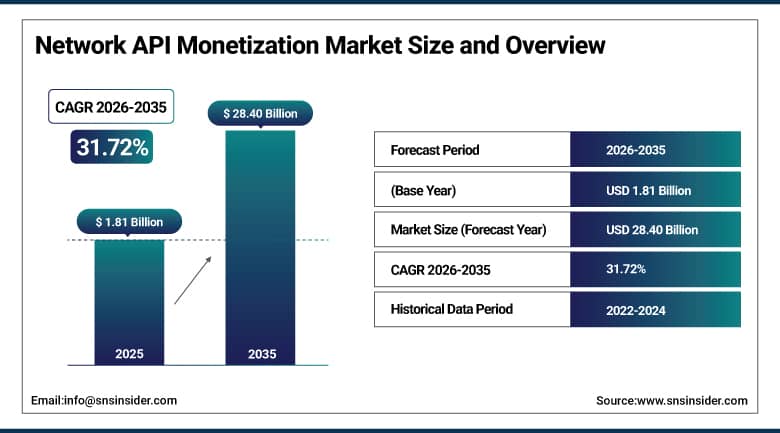
The Network API Monetization Market was valued at USD 1.81 billion in 2025 and is expected to reach USD 28.40 billion by 2035, growing at a CAGR of 31.72% from 2026-2035.
The Network API Monetization Market is witnessing rapid growth owing to increased demands for revenue generation through network capabilities and the rising popularity of programmable network services. The increasing trend of telecommunications operators exposing their network capabilities through APIs to allow applications and organizations to use services such as quality-on-demand, number verification, device location, and fraud prevention is expected to fuel the demand for network APIs. Moreover, the increasing deployment of 5G networks, edge computing, IoT, cloud services, and digital platforms will lead to an increase in the demand for network APIs. In addition, the growing cooperation between telecommunications operators, technology companies, and enterprises is helping in the growth of the API ecosystem and the monetization of APIs. The increasing capability exposure, API management, and standardization of APIs will help in making them more scalable and accessible.
As of March 2026, 86 operator groups representing more than 300 networks and 80% of global mobile connections were aligned around the GSMA Open Gateway API framework, with more than 60 channel partners commercializing network APIs.
To Get More Information On Network API Monetization Market - Request Free Sample Report
Network API Monetization Market Trends
-
Rising deployment of 5G standalone networks is driving demand for programmable network APIs that enable operators to monetize advanced connectivity capabilities.
-
Increasing enterprise demand for fraud prevention, identity verification, and authentication APIs is accelerating adoption across financial services, retail, and digital platforms.
-
Growing adoption of quality-on-demand, network slicing, and edge enablement APIs is creating new monetization opportunities across enterprise and industrial applications.
-
Increasing standardization through CAMARA and GSMA Open Gateway is improving interoperability and enabling developers to access network capabilities across multiple operators.
U.S. Network API Monetization Market Outlook
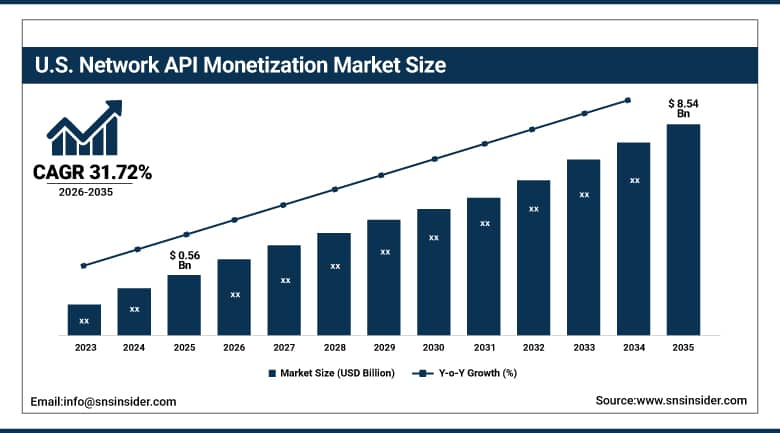
The U.S. Network API Monetization Market was valued at USD 0.56 billion in 2025 and is expected to reach USD 8.54 billion by 2035, growing at a CAGR of 31.34% from 2026-2035.
The U.S. Network API Monetization Market is witnessing rapid growth This is because of an increased demand for new sources of income through network capabilities as well as an increase in the adoption of programmable network services. Telecom companies are increasingly exposing their network capabilities through APIs to allow enterprises as well as software developers to use services including quality on demand, number verification, device location, and fraud detection. The continued rise in the number of technologies including 5G, edge computing, internet of things (IoT), cloud computing and digital platforms is also increasing the demand for network APIs. Furthermore, the increased collaboration among telecom companies, technology providers, and enterprises is facilitating the growth of API ecosystems as well as innovative monetization solutions. The developments in network exposure, API management and standard interfaces are also helping in scalability and accessibility.
GSMA identifies Verizon, AT&T, and T-Mobile as U.S. operators deploying Open Gateway APIs, including Simple Edge Discovery, Device Status/SIM Swap, and Quality on Demand.
Network API Monetization Market Segment Analysis
-
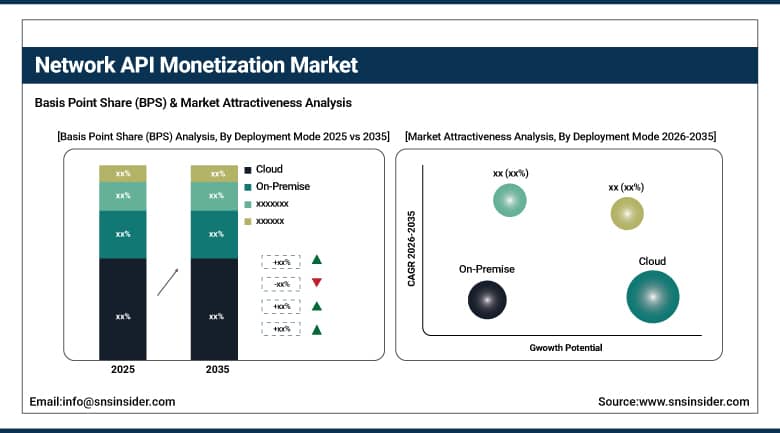
By Deployment Mode, Cloud dominates the Network API Monetization Market with 57% share in 2025; Cloud is expected to grow at the fastest CAGR of 32.28% from 2026–2035.
-
By API Type, Number Verification and SIM Swap APIs dominate the Network API Monetization Market with 21% share in 2025; Quality On Demand APIs are expected to grow at the fastest CAGR of 34.55% from 2026–2035.
-
By Component, API Monetization Platform dominates the Network API Monetization Market with 24% share in 2025; Analytics & Monitoring is expected to grow at the fastest CAGR of 34.68% from 2026–2035.
-
By End-User Industry, Financial Services dominates the Network API Monetization Market with 23% share in 2025; Automotive and Connected Mobility is expected to grow at the fastest CAGR of 34.76% from 2026–2035.
By Deployment Mode, Cloud leads adoption; Cloud scales fastest.
The Cloud segment accounted for the leading 57% revenue share of the Network API Monetization Market in 2025, backed by its scalability, flexibility, reduced infrastructural needs, and seamless integration with advanced digital systems. Cloud deployment allows telecommunications firms to centrally control APIs, quickly roll out new services, facilitate distributed computing, and cope with varying demand without heavy infrastructural investments. The rising popularity of cloud-native solutions, 5G technology, edge computing, and digital services has prompted more and more network operators to move API monetization features to cloud ecosystems.
Cloud deployment is projected to register the fastest CAGR of 32.28% during the forecast period 2026–2035, This can be attributed to the growing adoption of cloud-native telecoms infrastructure and rising need for scalable digital platforms. Telecom network providers are implementing cloud-based systems to facilitate easier deployment of APIs, lower infrastructure needs, enhanced operational flexibility, and the ability to deploy workloads in distributed environments. With the emergence of 5G technology, edge computing, real-time services, and programmable networks, the demand for flexible API monetization cloud infrastructure is likely to grow, thereby contributing to robust growth.
By API Type, Number Verification and SIM Swap APIs lead adoption; Quality On Demand APIs scale fastest.
The Number Verification and SIM Swap APIs segment held the leading position with a 21% revenue share in 2025, because of increased demands for security of the identification process, fraud prevention, and authentication in online systems. Financial companies, online shopping websites, telecommunications companies, and digital applications are increasingly using these APIs to authenticate the user and detect any fraudulent activity associated with SIMs. Increased use of mobile payments, account takeovers, and increased focus on authentication have further boosted the demand for these network APIs.
Quality On Demand APIs are projected to register the fastest CAGR of 34.55% during the forecast period 2026–2035, The reason behind this is growing need for assured network performance, low latency, and reliable connections for their digital applications. With the adoption of 5G, cloud computing, connectivity of devices, immersive applications, and real-time services by businesses, they are demanding for programmable networks that will help them with prioritization and enhanced connectivity. The growth in the use of latency-sensitive applications is likely to drive the uptake of Quality on Demand APIs through the forecast period.
By Component, API Monetization Platform leads adoption; Analytics & Monitoring scales fastest.
The API Monetization Platform segment accounted for the leading 24% revenue share in 2025, facilitated by the increasing demands from telecommunications companies to manage, expose, protect, package, and monetize network APIs via a central platform. These platforms allow operators to manage the lifecycle of the API, developer onboarding, authentication, authorization, billing, and partnership via a single platform. The increasing emphasis on making new sources of income via network functionalities and expanding API ecosystems and digital partnerships have increased the need for complete API monetization platforms.
Analytics & Monitoring is projected to register the fastest CAGR of 34.68% during the forecast period 2026–2035, As there is an ever-growing demand for real-time visibility into usage, performance, user behavior, and efficiency of monetization efforts of APIs. With increased complexity in the network ecosystem of APIs, the need for analytics tools is growing among providers that want to track usage, quality of service, anomalies, and optimize their commercial approach. The increasing focus on data-driven decisions, developer experience, performance improvement of APIs, and revenue management is likely to boost the market further.
By End-User Industry, Financial Services leads adoption; Automotive and Connected Mobility scales fastest.
The Financial Services segment led the market with a 23% revenue share in 2025, because more and more banks, financial institutions, payments providers, and fintech organizations use network APIs to authenticate, verify identities, prevent fraud, and ensure the security of their transactions. The growing number of mobile and online transactions as well as the proliferation of digital banking have created the need for more network security tools. Increasing risks of cyberattacks, account takeovers, regulations, and digital financial services have made the integration of network APIs even stronger.
Automotive and Connected Mobility is projected to register the fastest CAGR of 34.76% during the forecast period 2026–2035, driven by the rising adoption of connected cars, intelligent transport systems, fleet management systems, and advanced mobility solutions. Network APIs will help enable vehicle connectivity, location services, QoD connectivity services, and real-time communications that new automotive applications will need. The expansion of 5G, connected roads, self-driving technology, and vehicle to everything (V2X) technology is expected to drive the need for network programmability in the automotive space.
Regional Analysis
|
Region |
Major Country |
Share within Region, 2025 (%) |
|---|---|---|
|
North America |
United States |
91.0% |
|
Europe |
Germany |
24.0% |
|
Asia Pacific |
China |
38.0% |
|
Middle East & Africa |
UAE |
18.0% |
|
Latin America |
Brazil |
42.0% |
North America Network API Monetization Market Insights
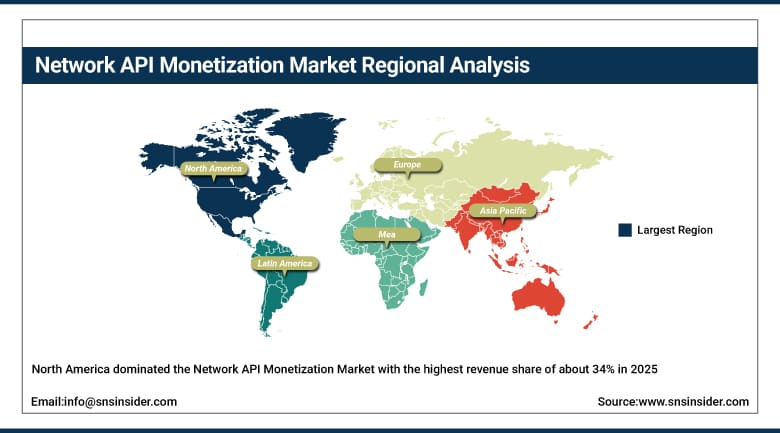
North America dominated the Network API Monetization Market with the highest revenue share of about 34% in 2025, This growth is attributed to the existence of advanced telecom networks, implementation of 5G networks, and adoption of programmable network services. The demand for API-enabled identity management, anti-fraud systems, and communication services, coupled with significant investments made by telecom companies and technology firms, reinforces this trend.
The U.S. Network API Monetization Market accounted for a market share of 91.0%, Backed by state-of-the-art telecom networks, adoption of 5G and high demand for programmable networking solutions. Increasing use of identity verification, fraud prevention and communication APIs among enterprises is contributing to market growth. The investments made by leading telecoms, tech firms and cloud companies further boost the market in the United States.
Get Customized Report as Per Your Business Requirement - Enquiry Now
Europe Network API Monetization Market Insights
Asia Pacific is expected to grow at the fastest CAGR of about 32.97% from 2026–2035, backed by fast-growing deployment of 5G, rising number of smartphones and growing digitization. Increasing use of network APIs among businesses, fintech, e-commerce, digital service providers and modernization efforts in the telecom industry backed by investment in cloud native infrastructure in China, India, Japan and South Korea are fueling growth further.
The Germany Network API Monetization Market accounted for a market share of 24.0%, fueled by advanced telecommunications networks, higher 5G rollout and digital transformation of enterprises. Growing needs for security, fraud prevention and connectivity services are fostering market growth. Cloud-native, network upgrades and APIs by telecom companies are adding to this trend within Germany.
Asia Pacific Network API Monetization Market Insights
Europe Network API Monetization Market is witnessing steady growth, supported through the expansion of 5G technology, digitization of enterprises, and adoption of programmable networks. Service providers are offering more network functionality through APIs that can facilitate identity verification, fraud detection, and improved connectivity services. Regulation, cloud services, and telecommunication infrastructure investment are also helping in the development of the regional market.
The China Network API Monetization Market accounted for a market share of 38.0%, enabled by fast 5G rollout, extensive digitalization, and robust telecom infrastructure. Growing usage of network APIs in the fintech, e-commerce, and digital service sector is creating an opportunity. Digital programs by the government, telecom modernization, cloud computing and enterprise demand for programmable networks are contributing to the market growth in China.
Middle East & Africa and Latin America Network API Monetization Market Insights
The Middle East & Africa and Latin America Network API Monetization Market is Slowly widening with the growth in the use of 5G, digital transformation, and the need for programmable connectivity services. Operators are working towards investing in API-based services for authentication, fraud detection, and enterprise services. The development of cloud services, fintech services, smartphones, and telecommunications is helping further to grow the regional market.
The UAE Network API Monetization Market accounted for a market share of 18.0%, Enabled by modern telecommunications systems, wide use of 5G and robust digital transformation efforts. The increasing need for programmable connections, identity management and fraud protection is driving adoption. Smart city efforts by governments, investments in cloud infrastructure, fintech developments and telecom system upgrades are aiding the development of the UAE market.
Growth Drivers: Growing deployment of 5G, 5G-Advanced, and programmable networks is accelerating demand for network API monetization
The expansion of 5G Standalone and 5G-Advanced networks is pushing communication service providers to transcend beyond basic connectivity charges and generate value from the capabilities of the network using programmable interfaces. The APIs of the network enable enterprises and software developers to utilize capabilities such as quality of demand, insights of the network, location, authentication, fraud detection, and differentiation in connectivity without necessarily being interfaced with individual network infrastructures. Operators continue to look for additional value from their investments in advanced network infrastructure. Network APIs are identified by GSMA as key value drivers of 5G capabilities and its 2026 initiative focuses on moving towards intelligent and programmable networks.
Restraints: Limited enterprise awareness and difficulty demonstrating clear business value can constrain network API monetization
Although network API adoption is increasing, operators continue to face challenges converting technical availability into meaningful commercial revenues. Companies might be aware of the features of network APIs, but they might not necessarily view these APIs as products worth buying. Most of the features that network APIs can provide are integrated into larger solutions, such as fraud prevention and authentication. In its study for 2026, GSMA found there to be a constant disparity between enterprise awareness and operator revenues, as network APIs are mostly consumed but rarely bought. There are a number of obstacles that come into play when trying to monetize these APIs, including pricing and value communication issues.
Opportunities: Expansion of GSMA Open Gateway, CAMARA, and API aggregator ecosystems is creating significant monetization opportunities
The rapid expansion of standardized network API ecosystems is creating opportunities for operators to reach a much broader developer and enterprise base. According to GSMA in March 2026, 86 operator groups with over 300 operators and 80% of the global mobile connections were on the same page with respect to their adoption of Open Gateway API framework together with more than 60 channel partners. The aggregators and cloud platforms can offer a way to simplify access to the functionalities of the networks to the developers through one single platform that cuts across several operators and markets. This will be achieved through an ecosystem where the integration challenges are addressed and thus facilitate faster application development as well as enabling monetization of network functions.
Recent Developments:
-
2026 : Nokia expanded its Network as Code ecosystem, adding new network API capabilities and partnerships to help communications service providers expose network functions through standardized APIs and create new monetization opportunities.
-
2026 : Infobip strengthened its Network API offering through its collaboration with T-Mobile, using network APIs for enterprise fraud protection and enabling operators to create additional value from programmable network capabilities.
-
2026 : Ericsson advanced network API monetization through its continued participation in GSMA Open Gateway and CAMARA, supporting standardized exposure of operator network capabilities such as quality-on-demand, verification, and location services to developers and enterprises.
-
2025 : Nokia expanded the commercial availability of its Network as Code platform by making network APIs accessible through Google Cloud Marketplace, enabling developers to access capabilities across multiple mobile networks and supporting new network-based application and monetization opportunities.
Network API Monetization Market key players are:
-
Ericsson
-
Nokia
-
Amdocs
-
Cisco
-
Microsoft
-
Vonage
-
Comviva
-
Sinch
-
Huawei
-
Oracle
-
Mavenir
-
MATRIXX Software
-
Netcracker
-
Telesign
-
Syniverse
-
Tata Communications
-
Google
-
AWS
Network API Monetization Market Report Scope:
| Report Attributes | Details |
|---|---|
| Market Size in 2025 | USD 1.81 Billion |
| Market Size by 2035 | USD 28.40 Billion |
| CAGR | CAGR of 31.72% From 2026 to 2035 |
| Base Year | 2025 |
| Forecast Period | 2026-2035 |
| Historical Data | 2022-2024 |
| Report Scope & Coverage | Market Size, Segments Analysis, Competitive Landscape, Regional Analysis, DROC & SWOT Analysis, Forecast Outlook |
| Key Segments | • By API Type (Quality On Demand APIs, Number Verification and SIM Swap APIs, Device Status APIs, Location Verification APIs, Other APIs) • By Component (API Monetization Platform, API Gateway and Network Exposure Function, API Management Tools, Analytics & Monitoring, Other Components) • By Deployment Mode (Cloud, On-Premise, Hybrid) • By End-User Industry (Automotive and Connected Mobility, Financial Services, Healthcare, Retail & E-commerce, Telecommunications, Media & Entertainment, Other Industries) |
| Regional Analysis/Coverage | North America (US, Canada), Europe (Germany, UK, France, Italy, Spain, Russia, Poland, Rest of Europe), Asia Pacific (China, India, Japan, South Korea, Australia, ASEAN Countries, Rest of Asia Pacific), Middle East & Africa (UAE, Saudi Arabia, Qatar, South Africa, Rest of Middle East & Africa), Latin America (Brazil, Argentina, Mexico, Colombia, Rest of Latin America). |
| Company Profiles | Ericsson, Nokia, Amdocs, Infobip, Cisco, Microsoft, Vonage, Comviva, Sinch, Huawei, Oracle, Mavenir, MATRIXX Software, Netcracker, Twilio, Telesign, Syniverse, Tata Communications, Google, and AWS. |

Frequently Asked Questions
Key players in the Network API Monetization Market include Ericsson, Nokia, Amdocs, Infobip, and Cisco Systems, Inc., among others.
Key opportunities in the Network API Monetization Market include expansion of 5G network APIs, increasing enterprise adoption of programmable networks, and growing demand for API-enabled services such as identity verification and fraud prevention.
The market is driven by increasing demand for programmable network capabilities, along with growing adoption of 5G, IoT, cloud computing, and API-based digital services.
The Number Verification and SIM Swap APIs segment dominated the Network API Monetization Market, accounting for approximately 21.10% market share.
The North America region dominated the Network API Monetization Market in 2025 with a 34.00% share, driven by high firearm sales and strong defense procurement.
