
AI-RAN Market Report Scope & Overview:
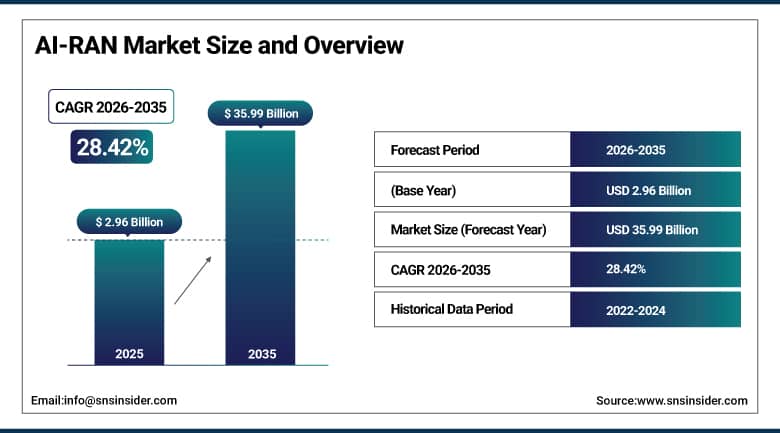
The AI-RAN Market size was valued at USD 2.96 billion in 2025 and is expected to reach USD 35.99 billion by 2035, growing at a CAGR of 28.42% from 2026–2035.
The global AI-RAN (Artificial Intelligence Radio Access Network) market is witnessing rapid growth in the global market owing to increasing adoption of artificial intelligence across radio access networks. Rising deployment of Open RAN, virtualized RAN, cloud-native infrastructure, and intelligent network automation is accelerating market expansion. Telecom operators are focusing on AI-powered radio resource management, energy efficiency optimization, predictive network maintenance, and autonomous network orchestration. Growing investments in edge AI computing, GPU-accelerated infrastructure, and RAN intelligent controllers are supporting technology advancement. Increasing demand for 5G network optimization, real-time traffic management, network slicing, and scalable wireless connectivity is further driving market adoption.
As stated by the GSMA and the International Telecommunication Union, the number of 5G subscriptions around the globe was about 3 billion, whereas the global 5G coverage increased to almost 55-60%. The specifications for 3GPP Release 18 and the O-RAN Alliance have now incorporated AI and machine learning in the Radio Access Network. These developments enable automatic traffic management, prediction of maintenance, energy efficiency, and efficient use of spectrum in future wireless networks.
To Get More Information On AI-RAN Market - Request Free Sample Report
AI-RAN Market Trends
-
Automation by means of AI technologies revolutionizes radio access networks due to the development of intelligent traffic optimization and resource management systems.
-
The fast expansion of the 5G network promotes the usage of AI-RAN solutions around the world.
-
Open RAN approaches foster compatibility, multi-vendor environment, and adaptive AI-based deployment strategies for radio access networks.
-
The connection with edge computing provides for AI processing and real-time decision-making within distributed radio access networks.
-
Research on 6G technologies facilitates the implementation of AI wireless communication paradigms.
-
Telecommunications companies, cloud service providers, and semiconductor firms cooperate for development and introduction of AI-RAN solutions.
U.S. AI-RAN (Artificial Intelligence Radio Access Network) Market Size Outlook
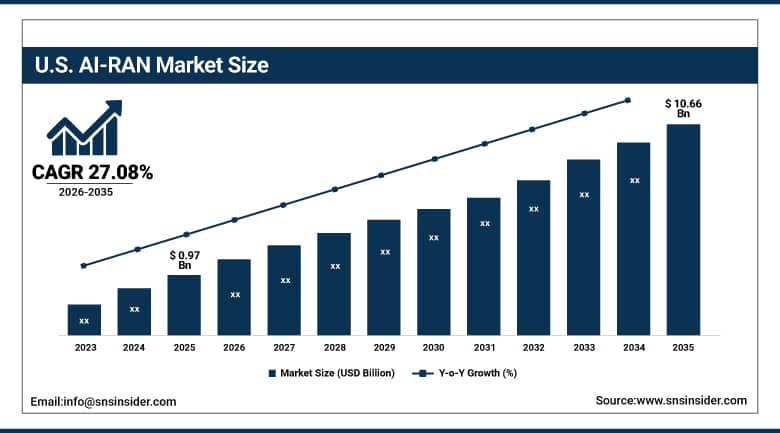
The U.S. AI-RAN (Artificial Intelligence Radio Access Network) Market was valued at USD 0.97 billion in 2025 and is expected to reach around USD 10.66 billion by 2035, growing at a CAGR of 27.08% from 2026–2035.
The U.S. AI-RAN market is expanding rapidly owing to rising deployment of artificial intelligence across advanced radio access network infrastructure. Increasing adoption by telecom operators, cloud providers, and enterprise communication networks is supporting market growth nationwide. Rising investments in Open RAN, virtualized RAN, edge AI computing, and GPU-accelerated infrastructure are driving network efficiency and intelligent automation. Growth in 5G expansion and cloud-native network architectures is further accelerating AI-RAN deployments across industries. Technology providers are focusing on autonomous network orchestration, predictive maintenance, and AI-powered radio resource optimization across wireless ecosystems. Increasing demand for real-time traffic management, energy-efficient operations, and intelligent network control is strengthening long-term market penetration.
According to the U.S. Federal Communication Commission and the National Telecommunications and Information Administration, commercial 5G coverage is now available for more than 98% of the U.S. population, enabling AI-enabled RAN deployment. The CHIPS Program Office at the U.S. Department of Commerce continues to improve AI infrastructure via large investments in semiconductors, while O-RAN Alliance Release 5 improves AI radio resource management, Massive MIMO beamforming, and network predictive optimization.
AI-RAN Market Segment Analysis
-
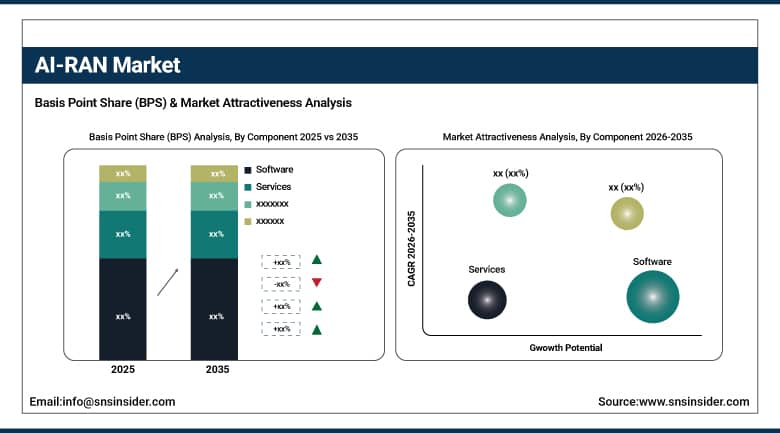
By Component, software dominated the market with 48.20% share in 2025; while services are the fastest growing segment with CAGR of 33.01% during 2026 to 2035.
-
By RAN Architecture, open RAN (O-RAN) dominated the market with 52.40% share in 2025; while virtualized RAN (vRAN) are the fastest growing segment with CAGR of 32.28% during 2026 to 2035.
-
By Deployment, on-premises dominated the market with 68.30% share in 2025; while cloud is the fastest growing segment with CAGR of 33.23% during 2026 to 2035.
-
By End User, telecom operators dominated the market with 74.50% share in 2025; while enterprises are the fastest growing segment with CAGR of 34.33% during 2026 to 2035.
By Component, software dominated the AI-RAN market, while services is the fastest growing segment.
Software segment held a dominated share in the AI-RAN market in terms of revenues in 2025. The growth in the software segment was fueled by increased adoption of AI-based network optimization, radio resource intelligence, and traffic orchestration. Telecom operators were opting for software solutions to enhance network efficiency, simplify network operations, and perform real-time analysis of telecom networks. The increasing use of open RAN, cloud-native technology, and AI automation boosted the software segment worldwide.
Services segment is projected to register the fastest CAGR during 2026-2035. With the increase in AI-RAN installations, the need for consulting, integration, deployment, optimization, and managed services is rising across the telecom industry. The network operators need expertise to deploy AI models, virtual RAN environments, and cloud-native solutions. The continuous upgrades of software, lifecycle management, predictive maintenance, and AI model optimization are leading to a higher adoption of services in next-gen RAN deployments.
By RAN Architecture, open RAN (O-RAN) dominated the AI-RAN market, while virtualized RAN (vRAN) is the fastest growing segment.
Open RAN (O-RAN) segment held a dominated share of AI-RAN market revenue in 2025 due to its widespread adoption by telecommunication operators around the world because of the adoption of open and interoperable architectures of networks. O-RAN allows multi-vendor integration, lowering deployment costs, and improving flexibility through standardization of interfaces. Additionally, rising investments in 5G technology upgrades, AI-based RAN optimizations, and cloud-native infrastructure contributed significantly to growth. Finally, robust collaborations within the industry also aided in commercial implementations.
Virtualized RAN (vRAN) Segment is forecasted to grow at the highest CAGR during 2026-2035. The reason behind this is because of increased adoption of the telecom ecosystem towards software-defined and cloud-native architectures. vRAN offers flexibility, efficiency, and increased scalability with the help of virtualization and automation features. Edge computing, 5G standalone networks, and intelligent workload management also fueled the growth in this area. Additionally, growing demand for flexible and programmable RANs further added to the growth.
By Deployment, on-premises dominated the AI-RAN market, while cloud is the fastest growing segment.
On-Premises segment led the AI-RAN Market by generating the dominated share of revenues in 2025. Big telecom operators were found favoring on-premises deployments for more control over the network infrastructure, confidential data of subscribers, and critical applications. Investments made in 4G and 5G infrastructure facilitated large-scale adoption across major regions. Increased security, low latency, compliance with regulations, and easy integration with existing radio access network systems increased the dominance of On-Premises deployments.
Cloud segment will experience the fastest CAGR between 2026 and 2035. Adoption of cloud-native systems, Open RAN solutions, and network function virtualization solutions is increasing deployment rates across the telecom industry. The increasing need for scalability of the AI workload, centralized management, and flexibility in allocating resources to reduce costs is boosting the adoption of Cloud. Deployment of edge computing, AI automation, and 6G infrastructure will increase the Cloud deployment rate.
By End User, telecom operators dominated the AI-RAN market, while enterprises are the fastest growing segment.
Telecom operators held the dominated revenue share in 2025. This dominance can be credited to massive investments in 5G networks, AI-based radio access networks, and nation-wide initiatives for network upgradation. Telecom operators have been fast at integrating open RAN, intelligent automation, and AI-powered traffic optimization for increased efficiency. Capital expenditure, large subscriber base, and constant expansion of spectrum range were the other factors aiding wide adoption of AI-RAN solutions.
Enterprises segment was anticipated to witness the fastest growth in terms of CAGR between 2026 and 2035. This rapid growth can be attributed to deployment of private 5G networks, edge AI computing, and intelligent wireless connectivity solutions by enterprises. The growing use of AI-RAN solutions can be attributed to the increasing adoption of such solutions to increase operational efficiency and to support industrial automation.
Regional Analysis
|
Region |
Major Country |
Share within Region, 2025(%) |
|---|---|---|
|
North America |
United States |
78.60% |
|
Europe |
Germany |
24.80% |
|
Asia Pacific |
China |
41.20% |
|
Middle East & Africa |
UAE |
17.10% |
|
Latin America |
Brazil |
43.60% |
North America AI-RAN Market Insights.
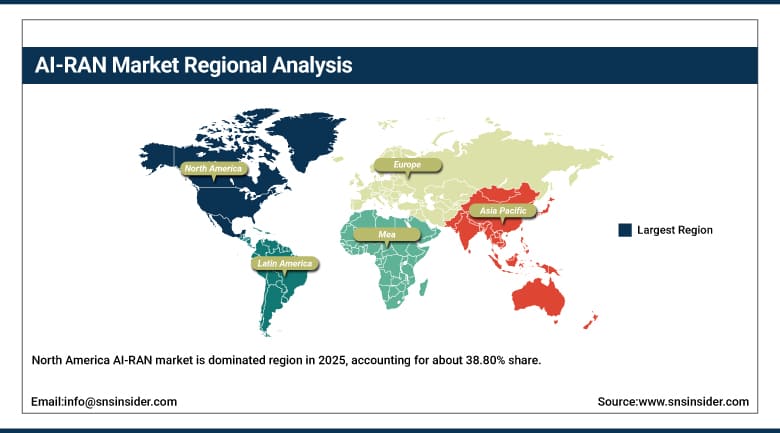
North America AI-RAN market is dominated region in 2025, accounting for about 38.80% share, driven by rapid deployment of artificial intelligence across advanced radio access network infrastructure. The region benefits from strong 5G investments, leading cloud providers, and established telecommunications technology companies. Increasing adoption of Open RAN, edge AI computing, and cloud-native network architectures is strengthening market growth. Expansion of intelligent network automation technologies further reinforces the region’s dominant position in the market.
As stated in GSMA Mobile Economy North America 2025 report, 5G is the dominant technology used for mobile connections, with 60 percent of the users of the mobile internet being on 5G networks. By 2030, its adoption rate will reach 89 percent. AI-driven optimization of RAN facilitated by 3GPP Release 18 and O-RAN Alliance allows for traffic management, automated beamforming, energy efficiency, and improved network performance in North America.
Get Customized Report as Per Your Business Requirement - Enquiry Now
Europe AI-RAN Market Insights.
Europe AI-RAN market is characterized by stable growth in 2025 owing to increasing investments in intelligent wireless infrastructure and advanced network automation technologies. Key countries include Germany, France, United Kingdom, Italy, and Spain. Rising deployment of Open RAN, edge computing, and AI-powered network management platforms is supporting market expansion. Increasing adoption of cloud-native telecommunications infrastructure is strengthening long-term industry development. Technological advancements continue encouraging autonomous network optimization and intelligent radio access operations across the region.
According to the State of the Digital Decade and GSMA Mobile Economy Europe reports by the European Commission, the level of basic 5G population coverage within the European Union stood at about 94%. The region is now concentrating on the expansion of 5G Standalone network deployments. According to ETSI and 3GPP Release 18, artificial intelligence and machine learning have been standardized for 5G-Advanced networks.
Asia Pacific AI-RAN Market Insights.
Asia Pacific is the fastest growing region in the AI-RAN market, registering a CAGR of about 30.22% during 2026–2035. Rapid 5G expansion and increasing artificial intelligence adoption are driving strong market demand across China, Japan, India, South Korea, and Southeast Asia. Rising investments in Open RAN infrastructure, cloud-native networks, and edge AI platforms are accelerating regional market growth. Growing digital transformation initiatives continue supporting widespread AI-RAN deployment across telecommunications infrastructure.
The GSMA Mobile Economy Asia Pacific 2025 Report states that 5G connections will represent half of all regional mobile connections in 2030. According to GSA, more than 70 mobile operators in the world are already deploying or planning to deploy Open RAN. Asia-Pacific is dominating in the commercialization of Open RAN deployments. All these trends are driving the AI-RAN adoption in terms of intelligent spectrum management, automatic network operation, and energy savings.
Middle East & Africa and Latin America AI-RAN Market Insights.
The Middle East & Africa along with Latin America regions are witnessing steady growth due to expanding 5G deployments and increasing investments in digital telecommunications infrastructure. Key contributing countries include Saudi Arabia, UAE, South Africa, Brazil, Mexico, and Argentina. Growing adoption of Open RAN technologies, cloud-native networking, and AI-enabled automation is supporting market expansion. Continued investments in intelligent wireless infrastructure are strengthening long-term regional opportunities.
As per the ICT Development Index 2025 of the International Telecommunication Union and GSMA Mobile Economy report, digital infrastructure within the regions of the Middle East, Africa, and Latin America is developing rapidly because of the rapid deployment of 5G technologies. The mobile broadband population coverage is above 85%, providing the necessary platform for more advanced solutions. The national AI efforts have been helping with AI-based network automation and traffic management along with intelligent RAN optimization.
Market Dynamics
Growth Drivers: Rising 5G deployments accelerate AI-enabled intelligent radio access network modernization globally
The fast-paced growth of 5G networks is making an enormous impact on the rising demand for AI-based RAN in global telecom networks. Artificial intelligence is being used by telecom operators to enhance the spectrum efficiency and decrease the complexity of operations in radio access networks. Traffic management and prediction using AI help in allocating resources efficiently in real time. The use of open RAN and cloud-native architecture adds to the strength of intelligent networks in wireless networks. Investments in self-managing networks and edge AI computing are ensuring quick service provision.
According to International Telecommunication Union, there is an increase in population coverage beyond 51% globally in 2024 due to the development of infrastructures. These developments have made it easier to adopt AI enabled Radio Access Network. Introduction of native machine learning in the mobile infrastructures has facilitated real-time traffic optimization, energy efficiency, and intelligent use of network resources.
Restraints: Legacy infrastructure interoperability challenges slow seamless multi-vendor Open RAN AI-RAN integration
Several communication service providers have existing radio networks that are not compatible with the latest AI-enabled network management tools. Having several hardware and software suppliers makes things difficult when working with diverse network environments. Differences in standardization and new specifications of the Open RAN make the deployment inconsistent when upgrading the network. Testing and technical validation are needed for maintaining service integrity in the presence of the implementation of the new technology. Lack of experienced professionals in both areas is an additional barrier to success.
Opportunities: 6G research and edge computing accelerate next-generation AI-RAN innovation opportunities
The global investments made on the 6G technology are driving innovations in making autonomous and AI-native wireless communication architecture. The AI-RAN will be an essential component in helping with intelligent spectrum management and self-optimizing network services in communication systems of the future. The edge computing capabilities are leading to quick processing of AI workloads near the connected devices with low latency. The collaborations of telecommunication operators, cloud service providers, and semiconductor companies are boosting innovations in the field of intelligent radio access networks. AI algorithms and network virtualization improvements are anticipated to create business opportunities in AI-RAN market in the long run.
The ITU and global 6G Flagship efforts have indicated that the 6G standardization process will be geared towards commercial rollouts around 2030. Current efforts focus on AI-enabled communications, sensing integration, and edge intelligence. The European Commission's SNS JU backs up next-generation connectivity studies via many projects. On the other hand, global 5G connections stand at about 3 billion, making a solid platform for AI-RAN designs and distributed edge computing integration.
Recent Developments
-
2026: Nvidia collaborated with major telecom partners to successfully test its GPU-accelerated AI-RAN platform for next-generation network traffic.
-
2025: Ericsson ran extensive commercial trials of its AI-native scheduler on live 5G Advanced network traffic across major cities.
-
2025: SoftBank collaborated with Ericsson to successfully prototype running Cloud RAN orchestration and workloads on accelerated infrastructure.
-
2024: Ericsson became a founding member of the AI-RAN Alliance to accelerate AI integration into cell technology.
AI-RAN Companies are:
-
NVIDIA
-
SoftBank
-
Nokia
-
Samsung Electronics
-
Microsoft
-
Amazon Web Services
-
Arm
-
Qualcomm
-
Huawei
-
ZTE
-
Fujitsu
-
NEC Corporation
-
Rakuten Group
-
Dell Technologies
-
Hewlett Packard Enterprise
-
Cisco Systems
-
Keysight Technologies
-
Mavenir
AI-RAN Market Report Scope:
| Report Attributes | Details |
|---|---|
| Market Size in 2025 | USD 2.96 Billion |
| Market Size by 2035 | USD 35.99 Billion |
| CAGR | CAGR of 28.42% From 2026 to 2035 |
| Base Year | 2025 |
| Forecast Period | 2026-2035 |
| Historical Data | 2022-2024 |
| Report Scope & Coverage | Market Size, Segments Analysis, Competitive Landscape, Regional Analysis, DROC & SWOT Analysis, Forecast Outlook |
| Key Segments | • By Component (Software, Hardware, Services) • By RAN Architecture (Open RAN (O-RAN), Virtualized RAN (vRAN), Hybrid RAN) • By Deployment (On-Premises, Cloud) • By End User (Telecom Operators, Enterprises, Government & Others) |
| Regional Analysis/Coverage | North America (US, Canada), Europe (Germany, UK, France, Italy, Spain, Russia, Poland, Rest of Europe), Asia Pacific (China, India, Japan, South Korea, Australia, ASEAN Countries, Rest of Asia Pacific), Middle East & Africa (UAE, Saudi Arabia, Qatar, South Africa, Rest of Middle East & Africa), Latin America (Brazil, Argentina, Mexico, Colombia, Rest of Latin America). |
| Company Profiles | NVIDIA, SoftBank, Ericsson, Nokia, Samsung Electronics, Microsoft, Amazon Web Services, Arm, Intel Corporation, Qualcomm, Huawei, ZTE, Fujitsu, NEC Corporation, Rakuten Group, Dell Technologies, Hewlett Packard Enterprise, Cisco Systems, Keysight Technologies, Mavenir. |

Frequently Asked Questions
North America dominated the AI-RAN market in 2025.
The major growth factors include AI adoption in RAN, 5G expansion, Open RAN implementation, edge AI computing, network automation, and cloud-native telecom infrastructure investments.
: The AI-RAN market was valued at USD 2.96 billion in 2025.
The AI-RAN market is expected to grow at a CAGR of 28.42% from 2026 to 2035.
