
Network Orchestration Market Report Scope & Overview:
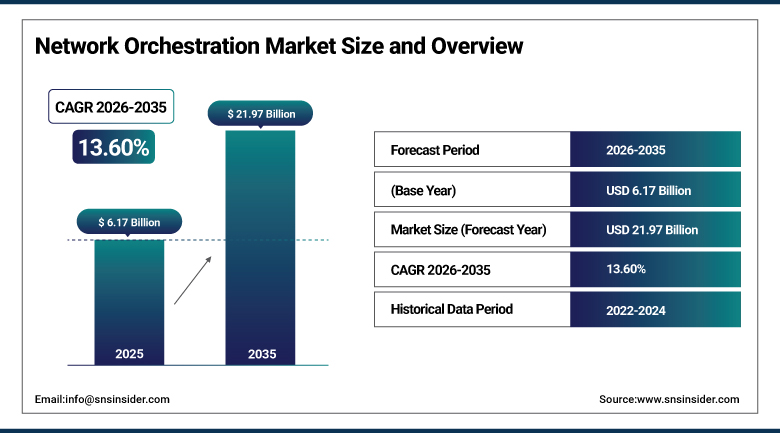
The Network Orchestration Market was valued at USD 6.17 billion in 2025 and is expected to reach USD 21.97 billion by 2035, growing at a CAGR of 13.60% from 2026-2035.
The Network Orchestration Market is witnessing strong growth Due to complexities in the network environment, growing demand for automation, and the requirement for effective management of heterogeneous network infrastructure. There is an increasing adoption of Network Orchestration solution for automating provisioning, configuration, monitoring, and management of network resources in physical, virtual, and cloud environments. Growth in 5G network, Software Defined Networking, Network Functions Virtualization, Edge Computing, and Cloud Services is leading to more demand for automated network management. Also, development in artificial intelligence, machine learning, and intent-based networking is increasing visibility, efficiency, and decision making in the network environment. Requirement for minimizing manual intervention, reducing configuration errors, optimizing network resources, and deploying network services is aiding market growth.
TM Forum's 2026 Autonomous Operations Target Operating Model positions AI agents between business intent and technical execution, enabling real-time orchestration, trusted decision-making, and self-optimizing operations.
To Get more information Network Orchestration Market - Request Free Sample Report
Network Orchestration Market Trends
-
Rising deployment of 5G networks is driving demand for network orchestration platforms supporting dynamic resource allocation, network slicing, and automated service delivery.
-
Increasing adoption of cloud-native and multi-cloud architectures is accelerating demand for centralized orchestration across distributed network environments and workloads.
-
Growing integration of artificial intelligence and machine learning is enabling predictive analytics, automated troubleshooting, intelligent optimization, and self-healing network capabilities.
-
Rising network complexity from edge computing, IoT, and virtualization is encouraging enterprises to adopt automated provisioning and lifecycle management solutions.
U.S. Network Orchestration Market Outlook
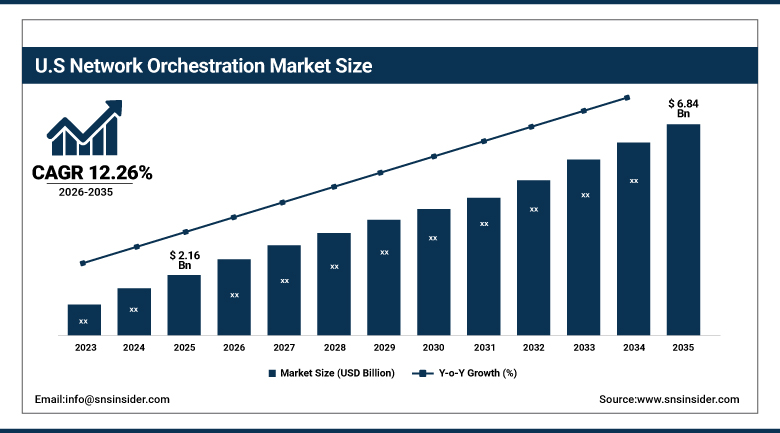
U.S. Network Orchestration Market was valued at USD 2.16 billion in 2025 and is expected to reach USD 6.84 billion by 2035, growing at a CAGR of 12.26% from 2026-2035.
The U.S. Network Orchestration Market is witnessing strong growth owing to increasing complexity in networks, growing automation requirement, and the need for effective management of different types of network infrastructure. Network orchestration platforms are being adopted by organizations for automating the provisioning, configuration, monitoring, and resource allocation processes in physical, virtual, and cloud environments. The increasing adoption of 5G networks, software defined networks, network function virtualization, edge computing, and cloud services is boosting the requirement for network automation. Moreover, developments in artificial intelligence, machine learning, and intent-based networking are helping in enhancing the visibility, operational efficiency, and decision-making in the process. The need for minimizing manual operations, configuration errors, resource optimization, and faster deployment of services is driving the market growth in the United States.
NTIA's 2026 AI-RAN initiative highlights integration of multi-vendor network environments and network-function virtualization as priorities for U.S. wireless infrastructure.
Network Orchestration Market Segment Analysis
-
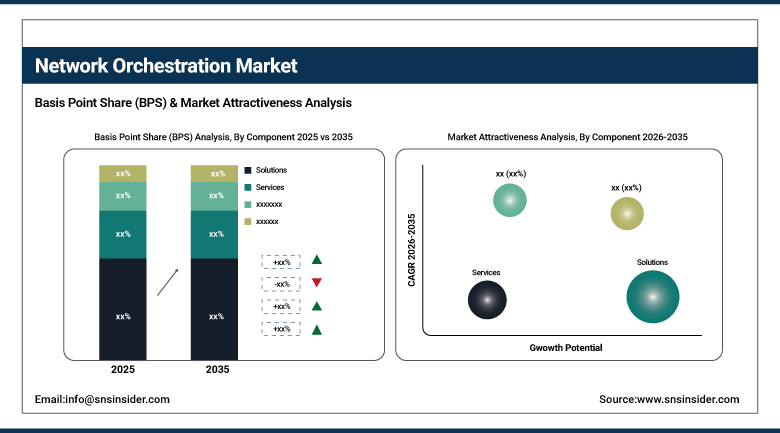
By Component, Solutions dominate the Network Orchestration Market with 63% share in 2025; Services are expected to grow at the fastest CAGR of 14.48% from 2026–2035.
-
By Deployment Mode, Cloud dominates the Network Orchestration Market with 54% share in 2025; Cloud is expected to grow at the fastest CAGR of 15.33% from 2026–2035.
-
By Organization Size, Large Enterprises dominate the Network Orchestration Market with 71% share in 2025; Small and Medium Enterprises are expected to grow at the fastest CAGR of 15.75% from 2026–2035.
-
By Application, Provisioning dominates the Network Orchestration Market with 27% share in 2025; Security is expected to grow at the fastest CAGR of 15.54% from 2026–2035.
-
By End User, Telecommunications dominates the Network Orchestration Market with 32% share in 2025; Information Technology and Cloud Service Providers are expected to grow at the fastest CAGR of 14.89% from 2026–2035.
By Component, Solutions dominate the Network Orchestration Market, Services grow fastest.
The Solutions segment dominated the Network Orchestration Market with the highest revenue share of about 63% in 2025, The reason for that is the increasing demand for network management, automation, and optimization. These solutions help companies to simplify network operations, eliminate manual configurations, optimize resources usage, and deliver better services, and, therefore, are vital for the efficient management of dynamic multi-vendor networks.
The Services segment is expected to grow at the fastest CAGR of 14.48% from 2026–2035, driven by rising demand for services related to deployment, integration, consultancy, and orchestration management. Organizations will need more specific skill sets in order to deploy orchestration technologies, integrate their existing infrastructure, personalize processes, and constantly manage complicated networks especially amid the growing use of automation technology.
By Deployment Mode, Cloud dominates the Network Orchestration Market, Cloud grows fastest.
The Cloud segment dominated the Network Orchestration Market with the highest revenue share of about 54% in 2025, mostly as a result of rising adoption of cloud services, the need for scalability, and the need for centralized management of distributed infrastructures. Cloud orchestration helps businesses automate the process of network provisioning, optimize their resources, and become more flexible in managing multi-cloud and hybrid environments.
The Cloud segment is expected to grow at the fastest CAGR of 15.33% from 2026–2035, due to increasing fast migrations to cloud-native architecture, hybrid clouds, and multiple cloud strategies. Companies are using cloud orchestration because of automation of network activities, resource allocation, better scalability, and cost-effectiveness of processes. Increased demand for software-defined infrastructure drives cloud orchestration even more.
By Organization Size, Large Enterprises dominate the Network Orchestration Market, Small and Medium Enterprises grow fastest.
The Large Enterprises segment dominated the Network Orchestration Market with the highest revenue share of about 71% in 2025, due to their complex and extensive network infrastructure, more technology spending, and high demand for automation. Big businesses need centralized orchestration for handling multiple sites, vendors, and networks, as well as increasing efficiency and minimizing misconfiguration.
The Small and Medium Enterprises segment is expected to grow at the fastest CAGR of 15.75% from 2026–2035, This is due to the increasing availability of affordable cloud-based orchestration tools and digitization. SMEs have adopted automation technology for the purpose of minimizing reliance on specialized IT personnel, simplifying the management of networks, enhancing scalability, and managing operational costs.
By Application, Provisioning dominates the Network Orchestration Market, Security grows fastest.
The Provisioning segment dominated the Network Orchestration Market with the highest revenue share of about 27% in 2025, driven by the increasing need for automation in network configuration and fast deployment of services. Network provisioning tools eliminate the need for human intervention, help avoid configuration mistakes, allocate resources faster, and increase efficiency, thus rendering network provisioning an important feature for companies that deal with complicated network infrastructures.
The Security segment is expected to grow at the fastest CAGR of 15.54% from 2026–2035, due to rising cyber threats, growing attack surfaces, and complex networks. Enterprises are using security orchestration features that help automate threat detection, responses, and policy compliance. The use of zero trust architecture and automation in security policies increases the demand for orchestration-based network security solutions.
By End User, Telecommunications dominates the Network Orchestration Market, Information Technology and Cloud Service Providers grow fastest.
The Telecommunications segment dominated the Network Orchestration Market with the highest revenue share of about 32% in 2025, with the backing of comprehensive network infrastructure, expanding 5G deployment, and increasing need for automation of service management. Telecommunication companies depend on orchestration technology for automation of provisioning processes, efficient utilization of network resources, multi-vendor environment management, fast deployment of services, and improved network resilience.
The Information Technology and Cloud Service Providers segment is expected to grow at the fastest CAGR of 14.89% from 2026–2035, fueled by growing adoption of cloud computing, increased investment in data center infrastructure, and growing need for scalable network automation. Such providers need orchestration to effectively run their distributed environment, provision resources, and offer reliable services to their clients.
Regional Analysis
|
Region |
Major Country |
Share within Region, 2025 (%) |
|---|---|---|
|
North America |
United States |
91.0% |
|
Europe |
Germany |
23.5% |
|
Asia Pacific |
China |
39.5% |
|
Middle East & Africa |
UAE |
15.0% |
|
Latin America |
Brazil |
34.5% |
North America Network Orchestration Market Insights
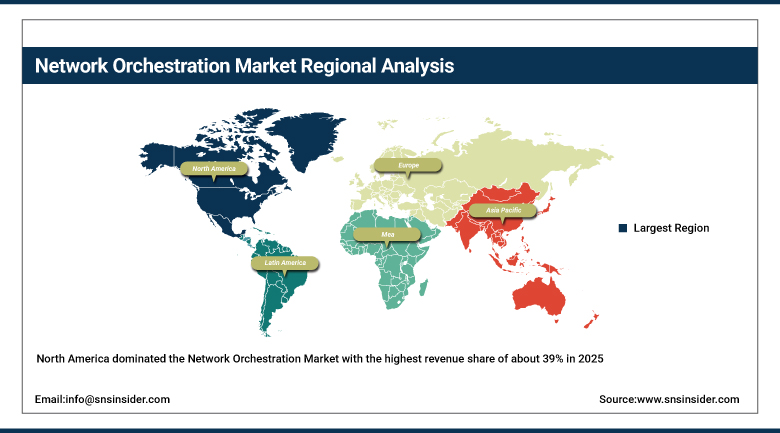
North America dominated the Network Orchestration Market with the highest revenue share of about 39% in 2025, backed by an advanced telecommunications infrastructure, wide cloud deployment, and significant investments in network automation technologies. The rising need for effective network management, 5G rollouts, and complexity in enterprise networks are boosting its adoption. The presence of major technology vendors and robust digital transformation efforts add to the region’s market dominance.
The U.S. Network Orchestration Market accounted for a market share of 91.0%, Backed up by modern telecommunications network infrastructure, cloud computing usage, and high levels of investment in network automation. The rising implementation of 5G, rising network complexity, and need for efficient network management are boosting its usage. Having leading technology companies, large enterprise networks, and effective digital transformation makes the case even stronger for the U.S. market.
Get Customized Report as per Your Business Requirement - Enquiry Now
Europe Network Orchestration Market Insights
Europe’s Network Orchestration Market is enabled by the presence of sophisticated telecommunications infrastructures, growing cloud adoption, and high demand for automatic network management. Introduction of 5G networks, increased network complexity, and digitization drives organizations to implement orchestration solutions. High emphasis on cybersecurity, network efficiency, and modernization of infrastructures, combined with reliable vendors of technologies, drives the market development in Europe.
The Germany Network Orchestration Market accounted for a market share of 23.5%, driven by the state-of-the-art telecom infrastructure, increasing cloud adoption, and effective enterprise digitalization. The rising demand for network automation, 5G implementation, and improved efficiency is promoting market growth. The country’s investments in cyber security, network modernization, and software-defined networking, as well as its presence of technology vendors, makes Germany well positioned among European countries.
Asia Pacific Network Orchestration Market Insights
Asia Pacific is expected to grow at the fastest CAGR of about 16.91% from 2026–2035, Driven by digital transformation, growing 5G infrastructure, and growing adoption of cloud services. Growing data volume, growing demand for connectivity in enterprises, and automated network management are driving the adoption of the technology. Digitalization programs in government sector, growing data center infrastructure, and investment in modernization of telecommunications sector are additional drivers for market growth.
The China Network Orchestration Market accounted for a market share of 39.5%, backed by fast 5G deployment, development of telecommunications infrastructure, and digital transformation. Data traffic increase and growing network complexity are fueling the need for automated network management. Digitalization efforts backed by the government, development of cloud and data center infrastructure, and high levels of technological advancement in the country provide additional impetus for network orchestration.
Middle East & Africa and Latin America Network Orchestration Market Insights
The Middle East & Africa and Latin America Network Orchestration Markets These trends are driven by improved telecommunications infrastructure, greater use of the cloud, and increased digital transformation. Increasing 5G deployment and growing network complexity are fueling the need for network management automation. In addition, investments in smart cities, data centers, and connectivity infrastructure, as well as government digitalization efforts, are also driving regional market growth opportunities.
The UAE Network Orchestration Market accounted for a market share of 15.0%, backed up by fast digital transformation, growing telecommunication infrastructure and cloud technology adoption. The rise in 5G adoption and the need for effective network management is leading to the market adoption. Digitalization policies of governments, smart city initiatives, construction of data centers and collaboration with international tech companies are further driving the market growth in UAE.
Market Dynamics
Growth Drivers: Increasing deployment of 5G, cloud-native networks, and distributed infrastructure is accelerating demand for network orchestration
The growing deployment of 5G, software-defined networking, cloud-native network functions, edge computing, and multi-cloud infrastructure is increasing the complexity of network environments and accelerating demand for network orchestration solutions. Today’s networks need to be dynamically orchestrated in terms of physical and virtual resource management across the radio access, transport, core, cloud, and edge domains. The network orchestration solutions provide automation of such tasks as resource allocation, provisioning, configuration, and lifecycle management, making the coordination of such environments more efficient. According to market analysis, the factors driving the growth of this technology are 5G adoption, cloud-based orchestration, edge connections, and growing complexity of networks.
Restraints: High implementation complexity and integration with legacy infrastructure can limit network orchestration adoption
Network orchestration platforms must often integrate with heterogeneous infrastructure containing legacy hardware, virtualized network functions, cloud platforms, OSS/BSS systems, controllers, and equipment from multiple vendors. Developing a consistent flow of processes within such an environment can be technically difficult because different systems have their own interfaces, data models, protocols, and process flows. In such cases, significant investments might be required in order to fully orchestrate the entire system through integration, modernization, testing, and staff training. The situation gets more complicated when orchestration needs to take place not only in the RAN but also in the transport, core, cloud, and edge domains. According to TM Forum, higher degrees of autonomous operations involve complex technology transformation within multiple network domains.
Opportunities: Expansion of autonomous networks and closed-loop orchestration is creating significant growth opportunities
The transition from conventional automation toward autonomous networks presents major opportunities for network orchestration providers. An advanced orchestration platform can serve as an execution layer that integrates AI-enabled decision-making among multiple network domains by allowing for automated service lifecycle management, as well as provisioning, assurance, remediation, and optimization. The autonomous-network framework of Level 4 defined by TM Forum is focused on intent-based and predictive decision-making together with closed-loop management. Meanwhile, industry deployments are shifting the focus from controlled pilots to production networks. In the pursuit of zero touch, orchestration platforms should link AI analytics with network controllers, service management, and automated remediation processes. Such an environment offers an opportunity for vendors of end-to-end orchestration platforms that integrate automation of RAN, transport, core, cloud, and edge services.
Recent Developments:
-
2026 : Nokia Corporation advanced its network orchestration portfolio through its autonomous networking and service orchestration initiatives, supporting automated network configuration, service lifecycle management, and AI-driven optimization across complex telecom environments.
-
2026 : Ericsson AB strengthened its Service Orchestration and Assurance capabilities, focusing on autonomous network operations, intent-based automation, and automated service lifecycle management for 5G and next-generation networks.
-
2026 : Netcracker Technology Corporation continued expanding its intelligent network orchestration portfolio, combining service orchestration, automation, AI, and network assurance to help communications service providers manage increasingly complex multi-vendor networks.
-
2025 : Amdocs Limited advanced its end-to-end service orchestration capabilities through the Amdocs Intelligent Network Suite, supporting automated orchestration of services including SD-WAN and network slicing.
Network Orchestration Market key players are:
-
Dell Technologies
-
Huawei
-
IBM
-
Cisco
-
HPE
-
Ericsson
-
NEC
-
Nokia
-
Amdocs
-
Ciena
-
ZTE
-
Arista Networks
-
Fortinet
-
Juniper Networks
-
Extreme Networks
-
Ribbon Communications
-
Fujitsu
-
Netcracker
-
Itential
-
Mavenir
Network Orchestration Market Report Scope:
| Report Attributes | Details |
|---|---|
| Market Size in 2025 | USD 6.17 Billion |
| Market Size by 2035 | USD 21.97 Billion |
| CAGR | CAGR of 13.60% From 2026 to 2035 |
| Base Year | 2025 |
| Forecast Period | 2026-2035 |
| Historical Data | 2022-2024 |
| Report Scope & Coverage | Market Size, Segments Analysis, Competitive Landscape, Regional Analysis, DROC & SWOT Analysis, Forecast Outlook |
| Key Segments | • By Component (Solutions, Services) • By Deployment Mode (On-Premises, Cloud) • By Organization Size (Small and Medium Enterprises, Large Enterprises) • By Application (Provisioning, Policy Management, Network Monitoring, Security, Other Applications) • By End User (Telecommunications, Information Technology and Cloud Service Providers, Enterprises, Banking, Financial Services and Insurance (BFSI), Healthcare, Government, Other End Users) |
| Regional Analysis/Coverage | North America (US, Canada), Europe (Germany, UK, France, Italy, Spain, Russia, Poland, Rest of Europe), Asia Pacific (China, India, Japan, South Korea, Australia, ASEAN Countries, Rest of Asia Pacific), Middle East & Africa (UAE, Saudi Arabia, Qatar, South Africa, Rest of Middle East & Africa), Latin America (Brazil, Argentina, Mexico, Colombia, Rest of Latin America). |
| Company Profiles | Dell Technologies, Huawei, IBM, Cisco, HPE, Ericsson, NEC, Nokia, Amdocs, Ciena, ZTE, Arista Networks, Fortinet, Juniper Networks, Extreme Networks, Ribbon Communications, Fujitsu, Netcracker, Itential, and Mavenir. |

Frequently Asked Questions
Key opportunities in the Network Orchestration Market include expansion of 5G networks, increasing adoption of cloud-native infrastructure, and growing demand for automated network provisioning and service management.
The market is driven by increasing network complexity and demand for automation, along with growing adoption of 5G, cloud computing, virtualization, and software-defined networking.
The Solutions segment dominated the Network Orchestration Market, accounting for approximately 63.00 % market share.
The North America region dominated the Network Orchestration Market in 2025 with a 38.50% share, driven by high firearm sales and strong defense procurement.
