
AI Traffic Management Network Market Report Scope & Overview:
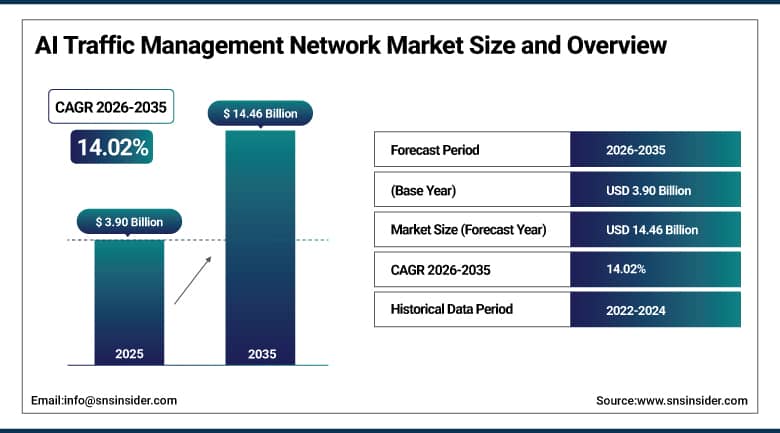
The AI Traffic Management Network Market was valued at USD 3.90 Billion in 2025 and is expected to reach USD 14.46 Billion by 2035, growing at a CAGR of 14.02% from 2026–2035.
The AI traffic management network market is experiencing consistent growth due to increasing demand for intelligent, efficient, and reliable traffic management solutions. The expansion of smart cities, connected transportation infrastructure, urbanization, 5G networks, and intelligent transportation systems is driving demand for real-time traffic monitoring, automated traffic signal control, traffic flow optimization, incident detection, and predictive traffic management. Investments in artificial intelligence and machine learning, computer vision, Internet of Things (IoT), cloud computing, edge computing, and V2X communication are enhancing traffic visibility, decision-making, operational efficiency, and network responsiveness. Companies are focusing on real-time data processing, congestion reduction, predictive analytics, adaptive traffic control, and improved transportation safety.
In March 2026, Intertraffic Amsterdam 2026 showcased AI-powered intelligent transportation solutions, including smart traffic signal control, AI-based incident detection, smart highway systems, and intelligent parking technologies. The developments are expected to support growing global demand for AI-driven traffic management as cities and transportation agencies seek to reduce congestion, improve road safety, and optimize mobility operations, strengthening adoption of intelligent traffic management networks.
To Get More Information On AI Traffic Management Network Market - Request Free Sample Report
AI Traffic Management Network Market Trends
-
Growing demand for intelligent and efficient traffic management is driving the adoption of AI-powered solutions to address increasing congestion, traffic delays, and transportation safety requirements.
-
Rising deployment of smart cities, connected transportation infrastructure, 5G networks, and intelligent transportation systems is increasing demand for real-time traffic monitoring, predictive analytics, and automated traffic control.
-
Increasing adoption of artificial intelligence and machine learning, computer vision, Internet of Things (IoT), cloud computing, edge computing, and V2X communication is supporting the development of more responsive and data-driven traffic management networks.
-
Growing focus on reducing congestion, improving traffic flow, enhancing road safety, minimizing travel times, and optimizing transportation infrastructure is creating opportunities for AI traffic management solution providers.
-
Advancements in AI-driven analytics, computer vision, connected sensors, edge processing, adaptive traffic signal control, and predictive traffic management are improving network performance and supporting the adoption of intelligent traffic management solutions.
U.S. AI Traffic Management Network Market Outlook
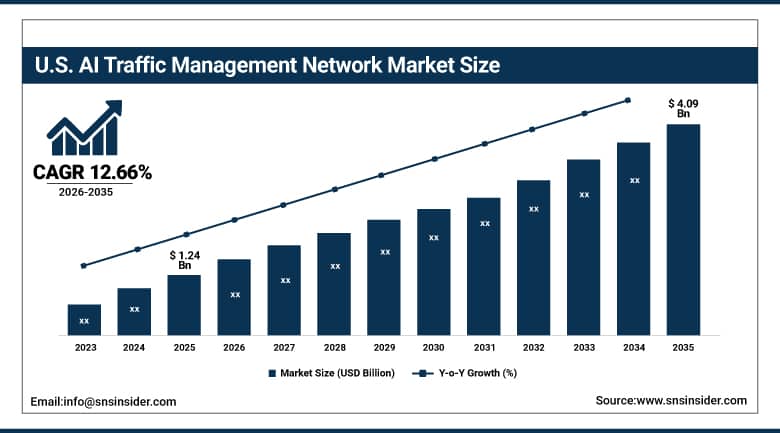
The U.S. AI Traffic Management Network Market was valued at USD 1.24 Billion in 2025 and is expected to reach around USD 4.09 Billion by 2035, growing at a CAGR of 12.66% from 2026–2035.
The U.S. AI traffic management network market is growing steadily due to rising demand for intelligent, connected, and efficient transportation infrastructure. The expansion of smart cities, artificial intelligence, 5G networks, connected vehicles, and intelligent transportation systems is driving demand for real-time traffic monitoring, predictive traffic management, and automated traffic control. Investments in AI-enabled traffic infrastructure and smart transportation upgrades are improving traffic flow, operational efficiency, safety, and network responsiveness. Growing deployment of intelligent traffic signals, traffic monitoring systems, connected transportation networks, and smart city infrastructure is supporting market demand. Companies are focusing on artificial intelligence and machine learning, computer vision, Internet of Things (IoT), cloud computing, edge computing, V2X communication, and AI-driven traffic optimization to enhance transportation efficiency and decision-making.
In February 2026, the U.S. Department of Transportation highlighted the deployment of AI-enabled adaptive traffic signals in Charleston, South Carolina, using sensors and caeras to monitor road conditions and adjust traffic signals in real time. The development is expected to support increasing U.S. adoption of AI-based traffic management as transportation agencies invest in intelligent signal control, congestion reduction, and safer urban mobility infrastructure
AI Traffic Management Network Market Segment Analysis
-
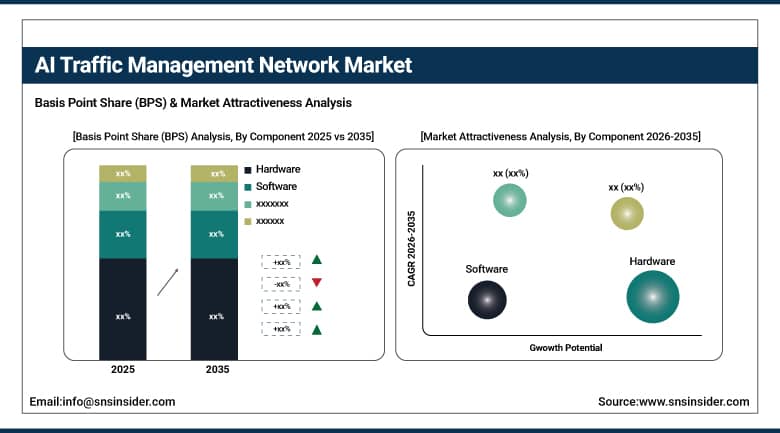
By Component, hardware dominated the AI traffic management network market with a 46.35% share in 2025, while software is projected to be the fastest-growing segment, registering a 16.93% CAGR during 2026–2035.
-
By Solution, traffic monitoring and surveillance dominated the AI traffic management network market with a 24.86% share in 2025, while AI-based traffic signal control is projected to be the fastest-growing segment, registering an 18.54% CAGR during 2026–2035.
-
By Technology, artificial intelligence and machine learning dominated the AI traffic management network market with a 31.46% share in 2025, while edge computing is projected to be the fastest-growing segment, registering a 19.32% CAGR during 2026–2035.
-
By Deployment, on-premises dominated the AI traffic management network market with a 47.28% share in 2025, while cloud-based is projected to be the fastest-growing segment, registering a 19.45% CAGR during 2026–2035.
-
By Application, urban traffic management dominated the AI traffic management network market with a 29.84% share in 2025, while smart city traffic management is projected to be the fastest-growing segment, registering a 19.20% CAGR during 2026–2035.
-
By End Use, government authorities dominated the AI traffic management network market with a 33.86% share in 2025, while smart city operators are projected to be the fastest-growing segment, registering a 22.25% CAGR during 2026–2035.
By Component, hardware dominated the AI traffic management network market, while software is expected to grow fastest.
Hardware held the dominant position in the AI traffic management network market in 2025, supported by its critical role in traffic monitoring cameras, intelligent traffic signals, connected sensors, roadside equipment, communication infrastructure, and edge devices. Increasing investment in intelligent transportation infrastructure, real-time traffic monitoring, connected transportation systems, and AI-enabled traffic control is driving demand for advanced hardware. The growing deployment of smart sensors, traffic detection equipment, cameras, and intelligent roadside infrastructure is further supporting hardware adoption.
Software is expected to register the highest CAGR during the forecast period from 2026 to 2035. The increasing adoption of AI-powered traffic analytics, predictive traffic management, adaptive signal control, incident detection, traffic flow optimization, and real-time decision-making is generating strong demand for advanced software platforms. Growing use of artificial intelligence and machine learning, computer vision, cloud-based platforms, and data analytics is expected to further accelerate software deployment across intelligent transportation networks.
By Application, urban traffic management dominated the AI traffic management network market, while smart city traffic management is expected to grow fastest.
Urban traffic management held the dominant position in the AI traffic management network market in 2025, supported by increasing urbanization, rising traffic congestion, and growing demand for efficient and intelligent transportation systems. Cities are increasingly adopting AI-powered traffic monitoring, adaptive traffic signal control, traffic flow optimization, and real-time traffic analytics to improve mobility and reduce congestion. The expansion of connected transportation infrastructure and intelligent mobility initiatives is further supporting market growth.
Smart city traffic management is expected to register the highest CAGR during the forecast period from 2026 to 2035. The rapid development of smart cities, connected transportation networks, IoT-enabled infrastructure, and AI-driven mobility platforms is generating strong demand for integrated traffic management solutions. Increasing adoption of real-time traffic optimization, predictive traffic management, intelligent signal control, and connected vehicle technologies is expected to accelerate the deployment of smart city traffic management solutions.
By End Use, government authorities dominated the AI traffic management network market, while smart city operators are expected to grow fastest.
Government authorities held the dominant position in the AI traffic management network market in 2025, supported by their responsibility for managing public roads, traffic infrastructure, transportation safety, and urban mobility systems. Increasing government investment in intelligent transportation infrastructure, smart traffic monitoring, adaptive signal systems, and AI-enabled traffic management is driving market adoption. Growing focus on congestion reduction, road safety, transportation efficiency, and modernization of public infrastructure is further supporting demand.
Smart city operators are expected to register the highest CAGR during the forecast period from 2026 to 2035. The expansion of smart city infrastructure, connected mobility platforms, IoT-enabled transportation systems, and AI-based traffic analytics is creating significant demand for intelligent traffic management solutions. Increasing integration of traffic monitoring, predictive analytics, adaptive signal control, connected vehicles, and centralized mobility platforms is expected to accelerate adoption among smart city operators.
Regional Analysis
|
Region |
Major Country |
Share within Region, 2025(%) |
|---|---|---|
|
North America |
United States |
82.40% |
|
Europe |
Germany |
34.30% |
|
Asia Pacific |
China |
48.54% |
|
Middle East & Africa |
Saudi Arabia |
23.50% |
|
Latin America |
Brazil |
23.00% |
North America AI Traffic Management Network Market insights
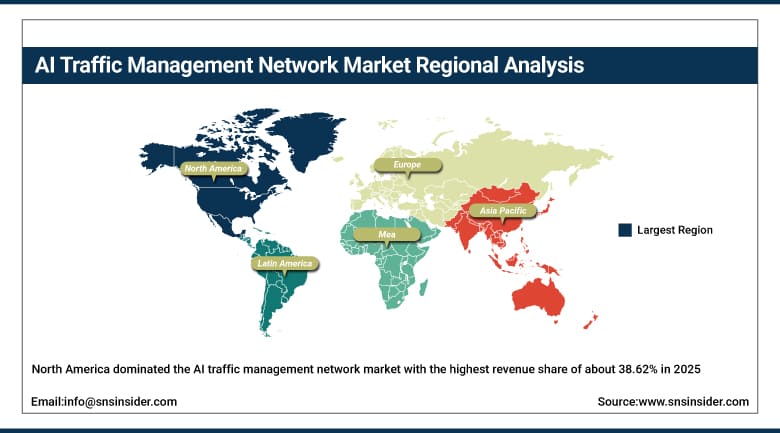
North America dominated the AI traffic management network market with the highest revenue share of about 38.62% in 2025, supported by its advanced transportation infrastructure, extensive deployment of intelligent transportation systems, and strong adoption of artificial intelligence, connected vehicles, and smart mobility technologies. The region has been an early adopter of AI-enabled traffic monitoring, adaptive traffic signal control, computer vision, Internet of Things (IoT), cloud computing, edge computing, and V2X communication. Significant investments in smart city infrastructure, intelligent highways, connected transportation networks, and real-time traffic management are increasing demand for advanced AI-based solutions.
Growing urbanization, traffic congestion, road safety requirements, and increasing demand for efficient transportation operations are further encouraging transportation authorities and municipalities to deploy AI-powered traffic monitoring, predictive analytics, incident detection, adaptive traffic signals, and traffic flow optimization. These factors collectively support the region's leading revenue contribution and sustained demand for next-generation AI traffic management networks.
Get Customized Report as Per Your Business Requirement - Enquiry Now
Europe AI Traffic Management Network Market insights
The AI traffic management network market in Europe is expected to witness steady growth over the forecast period, supported by the expansion of intelligent transportation systems, increasing smart city development, connected vehicle adoption, and growing demand for efficient and sustainable urban mobility. Rising traffic congestion, road safety requirements, digital transformation, and investments in intelligent transportation infrastructure are encouraging transportation authorities to upgrade existing traffic management systems. Increasing adoption of artificial intelligence and machine learning, computer vision, IoT-enabled sensors, cloud-based platforms, edge computing, and V2X communication is further supporting regional demand for advanced traffic management solutions.
Asia Pacific AI Traffic Management Network Market insights
Asia Pacific is expected to grow at the fastest CAGR of about 16.61% from 2026 to 2035, driven by rapid urbanization, expanding transportation infrastructure, accelerating smart city development, and increasing deployment of AI-powered intelligent transportation systems. Countries including China, Japan, South Korea, India, Singapore, and other Southeast Asian economies are investing substantially in smart mobility infrastructure, connected transportation networks, intelligent highways, and digital traffic management platforms to address rising congestion and transportation demands.
The increasing adoption of intelligent traffic signals, AI-enabled surveillance cameras, connected sensors, vehicle-to-everything communication, and edge-based traffic analytics is expected to accelerate modernization across the region. Growing smart city investments, rising vehicle ownership, increasing urban congestion, and government initiatives focused on improving road safety and transportation efficiency will further support Asia Pacific's rapid market growth through 2035.
Middle East & Africa and Latin America AI traffic management network market insights
The AI traffic management network market in the Middle East & Africa and Latin America is expected to witness consistent growth from 2026 to 2035, supported by expanding transportation infrastructure, increasing urbanization, smart city initiatives, 5G deployment, and investments in intelligent transportation systems. Growing traffic congestion and the need to improve road safety, transportation efficiency, and mobility are creating demand for AI-based traffic monitoring, adaptive traffic signals, predictive analytics, incident detection, and traffic flow optimization.
In Latin America, Brazil is anticipated to remain a key country-level market due to its large urban population, expanding transportation infrastructure, increasing traffic congestion, and growing adoption of smart city and digital mobility solutions. Other Latin American countries are also expected to contribute to regional growth through investments in intelligent transportation systems, traffic monitoring, connected infrastructure, smart mobility platforms, and modernization of urban transportation networks.
Growth Driver: Increasing demand for intelligent and real-time traffic management is driving market growth
One of the key factors driving the growth of the global AI traffic management network market is the increasing need to manage rising traffic congestion, improve road safety, and optimize transportation network efficiency. Rapid urbanization, increasing vehicle volumes, and growing demand for reliable mobility are encouraging transportation authorities, municipalities, and smart city operators to adopt AI-enabled traffic management solutions. Artificial intelligence and machine learning, computer vision, Internet of Things (IoT), cloud computing, and edge computing are enabling real-time traffic monitoring, congestion prediction, adaptive traffic signal control, incident detection, and traffic flow optimization.
Restraint: High deployment costs and technological complexity can limit market adoption
The high cost and technical complexity associated with deploying AI traffic management networks can restrict market adoption, particularly among smaller municipalities, transportation agencies, and organizations with limited infrastructure budgets. AI-enabled cameras, traffic sensors, intelligent traffic signals, edge computing devices, communication infrastructure, software platforms, and data management systems require significant investment. Upgrading existing traffic infrastructure to support AI-based monitoring, adaptive signal control, predictive analytics, and connected transportation applications may also require substantial changes to legacy systems.
Opportunity: Rapid expansion of smart cities and connected transportation infrastructure creates new market opportunities
The rapid expansion of smart cities and connected transportation infrastructure presents significant opportunities for AI traffic management solution providers. Increasing investments in intelligent transportation systems, connected vehicles, smart traffic signals, real-time monitoring networks, and digital mobility platforms are generating strong demand for AI-based traffic management technologies. As cities seek to reduce congestion, improve road safety, optimize traffic flows, and enhance public transportation efficiency, AI-powered solutions are becoming increasingly important for managing complex urban transportation networks.
Recent Developments
-
2026: Siemens AG continued expanding AI-enabled traffic management, adaptive signal control, and smart mobility solutions.
-
2026: Cisco Systems, Inc. continued strengthening connected transportation and real-time traffic management solutions.
-
2026: Huawei Technologies Co., Ltd. continued developing AI-based intelligent transportation and smart city solutions.
-
2026: Kapsch TrafficCom AG continued advancing intelligent traffic management, monitoring, and connected mobility solutions.
-
2026: SWARCO AG continued expanding adaptive traffic signals, traffic monitoring, and intelligent transportation systems.
-
2026: Miovision Technologies Inc. continued advancing AI-powered traffic analytics, smart intersections, and intelligent signal control.
AI Traffic Management Network Market Key Players are:
-
NVIDIA Corporation
-
Intel Corporation
-
Advanced Micro Devices, Inc. (AMD)
-
Cisco Systems, Inc.
-
Kapsch TrafficCom AG
-
SWARCO AG
-
Cubic Corporation
-
Iteris, Inc.
-
TomTom N.V.
-
Q-Free ASA
-
PTV Group
-
Thales Group
-
Hitachi Ltd.
-
IBM Corporation
-
Huawei Technologies Co., Ltd.
-
NEC Corporation
-
Miovision Technologies Inc.
-
INRIX, Inc.
AI Traffic Management Network Market Report Scope:
| Report Attributes | Details |
|---|---|
| Market Size in 2025 | USD 3.90 Billion |
| Market Size by 2035 | USD 14.46 Billion |
| CAGR | CAGR of 14.02% From 2026 to 2035 |
| Base Year | 2025 |
| Forecast Period | 2026-2035 |
| Historical Data | 2022-2024 |
| Report Scope & Coverage | Market Size, Segments Analysis, Competitive Landscape, Regional Analysis, DROC & SWOT Analysis, Forecast Outlook |
| Key Segments | • By Component (Hardware, Software, Services) • By Solution (Traffic Monitoring and Surveillance, AI-Based Traffic Signal Control, Traffic Flow Optimization, Incident Detection and Management, Route Guidance and Traffic Prediction, Integrated Traffic Management) • By Technology (Artificial Intelligence and Machine Learning, Computer Vision, Internet of Things (IoT), Cloud Computing, Edge Computing, V2X Communication) • By Deployment (On-Premises, Cloud-Based, Hybrid) • By Application (Urban Traffic Management, Highway and Freeway Management, Public Transportation Management, Emergency Vehicle Management, Parking and Curbside Management, Smart City Traffic Management) • By End Use (Government Authorities, Transportation Agencies, Municipalities, Commercial Enterprises, Smart City Operators, Others) |
| Regional Analysis/Coverage | North America (US, Canada), Europe (Germany, UK, France, Italy, Spain, Russia, Poland, Rest of Europe), Asia Pacific (China, India, Japan, South Korea, Australia, ASEAN Countries, Rest of Asia Pacific), Middle East & Africa (UAE, Saudi Arabia, Qatar, South Africa, Rest of Middle East & Africa), Latin America (Brazil, Argentina, Mexico, Colombia, Rest of Latin America) |
| Company Profiles | NVIDIA Corporation, Intel Corporation, Advanced Micro Devices, Inc. (AMD), Cisco Systems, Inc., Siemens AG, Kapsch TrafficCom AG, SWARCO AG, Cubic Corporation, Econolite Group, Inc., Iteris, Inc., TomTom N.V., Q-Free ASA, PTV Group, Thales Group, Hitachi Ltd., IBM Corporation, Huawei Technologies Co., Ltd., NEC Corporation, Miovision Technologies Inc., INRIX, Inc. |

Frequently Asked Questions
Key players in the AI traffic management network market include Siemens AG, Cisco Systems, Inc., Huawei Technologies Co., Ltd., Kapsch TrafficCom AG, SWARCO AG, Miovision Technologies Inc., Cubic Corporation, , among others.
Key opportunities include smart cities, intelligent transportation systems, connected vehicles, AI traffic monitoring, adaptive signals, edge computing, and V2X communication.
The market is primarily driven by increasing traffic congestion, growing demand for road safety, smart city development, and the rising adoption of AI-based traffic monitoring, traffic prediction, adaptive signal control, and traffic flow optimization.
The Artificial Intelligence and Machine Learning segment dominated the AI traffic management network market, accounting for approximately 31.46% market share in 2025.
North America dominated with a 38.62% share in 2025, supported by advanced transportation infrastructure and strong adoption of intelligent traffic technologies.
