
AI Speech Recognition Chip Market Report Scope & Overview:
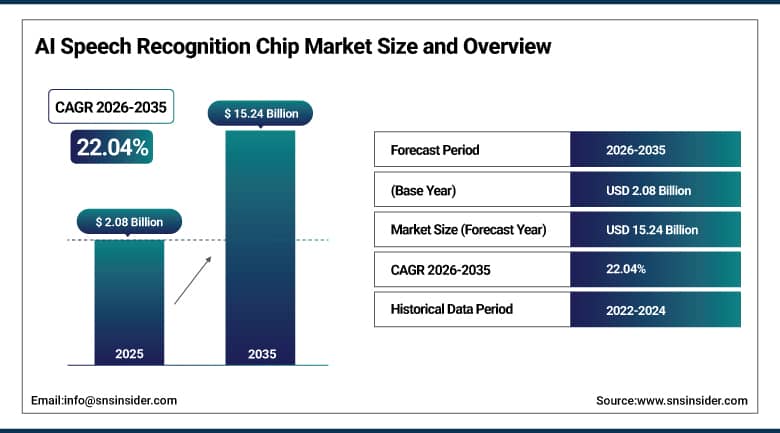
The AI Speech Recognition Chip Market was valued at USD 2.08 Billion in 2025 and is expected to reach USD 15.24 Billion by 2035, growing at a CAGR of 22.04% from 2026 to 2035.
Voice has quietly become one of the more natural ways people expect to interact with technology, and the specialized silicon making that interaction fast, private, and reliable has turned into a genuinely important semiconductor category in its own right. Rapid adoption of voice-enabled technologies across consumer electronics, automotive, healthcare, and enterprise applications keeps pushing chipmakers to design increasingly sophisticated, purpose-built processors rather than relying on general-purpose compute to handle speech workloads.
Increasing demand for hands-free, natural human-machine interaction, paired with rising integration of voice assistants in smartphones, smart speakers, and connected vehicles, is driving market expansion, and advancements in edge AI, low-power chip designs, and on-device processing keep improving both privacy and latency in ways cloud-only speech recognition simply couldn't match. Expanding use of speech recognition in contact centers, industrial automation, and medical documentation is broadening the category's reach well beyond its consumer electronics origins.
Market Size and Forecast
-
Market Size in 2026E: USD 2.54 Billion
-
Market Size by 2035: USD 15.24 Billion
-
CAGR: 22.04% from 2026 to 2035
-
Fastest Growing Region: Asia Pacific
-
Largest Region: North America
To Get More Information On AI Speech Recognition Chip Market - Request Free Sample Report
AI Speech Recognition Chip Market Trends
-
Rapid proliferation of voice-enabled devices across consumer electronics, automotive, healthcare, and enterprise sectors keeps expanding demand for dedicated speech recognition silicon.
-
Advancements in artificial intelligence, neural networks, and natural language processing keep improving speech accuracy and multilingual support, encouraging broader adoption.
-
The shift toward edge AI and on-device speech processing is accelerating demand for chips that deliver low latency, reduced power consumption, and stronger data privacy.
-
Increasing automation in contact centers, industrial systems, and smart manufacturing environments keeps strengthening market growth.
-
Rising investment in AI semiconductor research and development continues pushing chip performance and efficiency forward at a rapid pace.
The U.S. AI Speech Recognition Chip Market Outlook
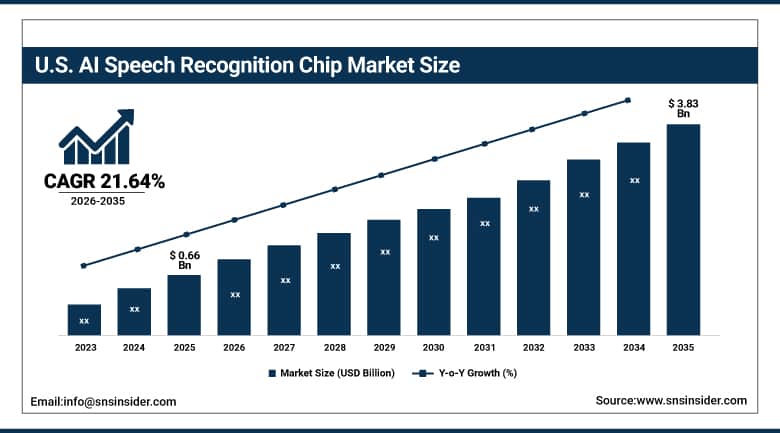
The U.S. AI Speech Recognition Chip Market was valued at approximately USD 0.66 Billion in 2026 and is expected to reach approximately USD 3.83 Billion by 2035, growing at a CAGR of approximately 21.64%.
Growth in the U.S. market is being driven by strong adoption of voice-enabled consumer devices, rising integration of AI assistants in automotive and smart home applications, and significant investment in AI semiconductor innovation. Increasing demand for on-device processing, data privacy, and low-latency speech recognition keeps accelerating market growth across American chipmakers and device manufacturers alike. The presence of major semiconductor companies, early adoption of voice-enabled devices, extensive AI research, and strong investment in edge computing and speech recognition technology across consumer, automotive, and enterprise applications continues to reinforce the country's leadership position within North America.
Qualcomm showcased the Snapdragon X Elite at Computex 2025, emphasizing AI PC performance and on-device AI capabilities that support advanced speech and voice workloads across both PCs and mobile devices, while Intel launched its Core Ultra 200V series of AI-enabled processors in 2024, boosting on-device AI capability in laptops through integrated neural processing units.
AI Speech Recognition Chip Market Segment Analysis
-
By Chip Type, ASIC dominated with a 36.35% share in 2025 and is also expected to grow at the fastest CAGR of 22.61% through 2035.
-
By Technology, On-Device (Edge) Speech Recognition dominated with a 59.47% share in 2025, while Hybrid (Edge + Cloud) is the fastest-growing technology segment at a CAGR of 22.90%.
-
By Vertical, Consumer Electronics dominated with a 38.57% share in 2025, while Automotive & Transportation is the fastest-growing vertical at a CAGR of 22.89%.
-
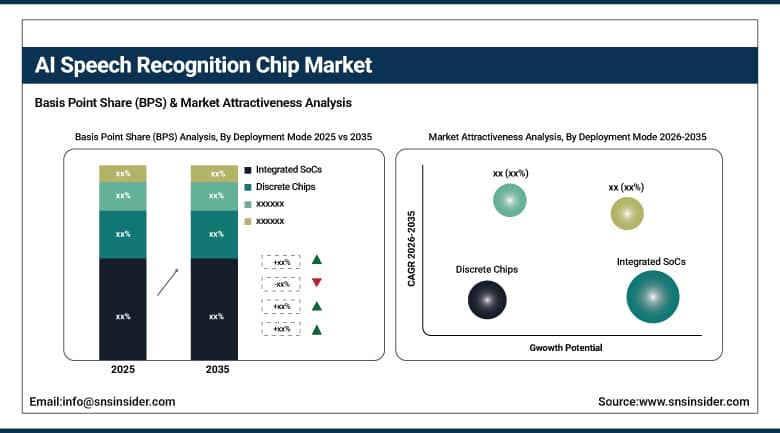
By Deployment Mode, Integrated SoCs dominated with a 53.64% share in 2025 and is also expected to grow at the fastest CAGR of 22.38% through 2035.
By Deployment Mode, Integrated SoCs lead and grow fastest
Integrated SoCs dominated the deployment-mode segment in 2025, at 53.64% share, due to their high integration, compact design, and ability to combine processing, AI acceleration, and connectivity in a single chip. These features make SoCs genuinely ideal for smartphones, wearables, automotive, and IoT devices where board space and power budget are both at a premium.
Integrated SoCs are also expected to grow fastest through 2035, driven by demand for efficient, low-power, and scalable solutions in edge voice processing and next-generation AI-enabled applications. As device manufacturers keep pushing for smaller form factors without sacrificing capability, that pressure toward integration is what's kept SoCs extending their lead on both dominance and growth simultaneously, much like the closely related ASIC chip-type segment.
By Chip Type, ASIC leads and grows fastest
ASICs dominated the chip-type segment in 2025, and are set to keep growing fastest through 2035, an unusual dual-leadership pattern reflecting how well-suited application-specific integrated circuits are to speech processing tasks specifically. ASICs deliver high efficiency and customization for specific speech processing workloads, and their ability to handle real-time, on-device speech recognition while supporting edge AI solutions has made them the preferred choice for manufacturers and developers building purpose-built voice hardware rather than relying on general-purpose chips.
What's kept ASICs ahead on both dominance and growth is the fundamental trade-off they solve well: general-purpose processors simply can't match the power efficiency and latency that a chip designed specifically for speech recognition workloads can deliver. As voice-enabled devices proliferate across ever more power- and latency-sensitive applications, from wearables to always-listening smart speakers, that efficiency advantage keeps reinforcing ASICs' lead rather than ceding ground to more flexible but less optimized alternatives.
By Technology, On-Device Edge leads, Hybrid Edge + Cloud grows fastest
On-device (Edge) Speech Recognition was leading in the technology component during the year 2025, occupying 59.47% of the market, due to growing demands for secure, timely and instantaneous speech processing capabilities. This type of solution allows processing speech on the device itself, eliminating dependence on the Internet connection and contributing significantly to privacy, which becomes increasingly important for customers as they become more aware of how exactly their voice data is being processed.
Hybrid solutions (Edge+Cloud) are developing rapidly and are expected to be the fastest-growing until 2035, since they combine advantages of edge and cloud-based solutions for more complicated computations. It provides manufacturers with an opportunity to provide customers with privacy and efficiency of edge processing for simple speech recognition commands and using the power of cloud technologies to conduct more complicated searches, which makes the development of hybrid solutions more profitable than developing solutions based solely on edge or cloud computing.
By Vertical, Consumer Electronics leads, Automotive & Transportation grows fastest
Consumer Electronics dominated the vertical segment in 2025, at 38.57% share, driven by widespread adoption of smartphones, smart speakers, wearables, and other voice-enabled devices that consumers interact with daily. That sheer scale of consumer device ownership incorporating some form of voice interaction has kept consumer electronics the largest single vertical for AI speech recognition chips.
Automotive & Transportation is expected to grow fastest through 2035, as vehicles increasingly integrate voice assistants and in-car systems for navigation, climate control, and infotainment management. Automakers are finding that voice control lets drivers manage vehicle systems without taking their hands off the wheel or their eyes off the road, and that genuine safety benefit, combined with rising vehicle electrification and software-defined vehicle architectures, is pushing automotive adoption ahead of every other vertical in growth terms.
Regional Analysis
|
Region |
Major Country |
Share within Region, 2025 (%) |
|---|---|---|
|
North America |
United States |
81.20% |
|
Europe |
Germany |
24.45% |
|
Asia Pacific |
China |
33.80% |
|
Middle East & Africa |
UAE |
26.20% |
|
Latin America |
Brazil |
37.40% |
North America AI Speech Recognition Chip Market Insights
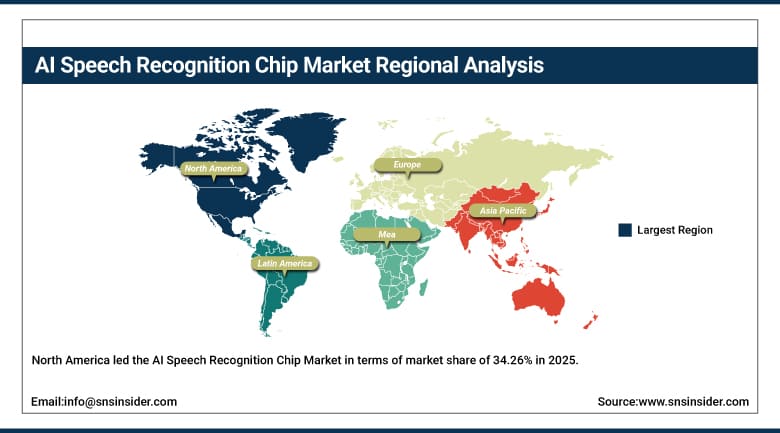
North America led the AI Speech Recognition Chip Market in terms of market share of 34.26% in 2025. This dominance of the region is attributed to the superior technological framework available there, followed by early adoption of voice-enabled electronic devices, and a significant presence of semiconductor manufacturers based in the region.
United States was the leading country within North America in 2025 owing to the presence of key players, adoption of voice-enabled devices, investments in AI research, and edge computing and speech recognition technologies. Further regional demand was generated from Canada due to its growing technology industry, thus making North America the largest addressable market for AI speech recognition chips.
Get Customized Report as Per Your Business Requirement - Enquiry Now
Europe AI Speech Recognition Chip Market Insights
Europe held a 21.34% share of the AI Speech Recognition Chip Market in 2025, with growth driven by increasing adoption of voice-enabled devices across automotive, industrial, and healthcare sectors. The region continues investing in smart manufacturing, connected vehicles, and AI-driven automation, contributing to steady market expansion and adoption of both edge and cloud-based speech recognition solutions across multiple industries.
Germany leads regional demand within Europe, supported by advanced AI research and strong technology infrastructure across its automotive and industrial sectors. The UK and France contribute substantial additional demand, and continued investment in connected vehicles and industrial automation should keep European demand for AI speech recognition chips climbing steadily through the forecast period.
Asia Pacific AI Speech Recognition Chip Market Insights
The Asia Pacific region is anticipated to witness the fastest growth, registering a CAGR of 22.72%, during the forecast period from 2022 to 2035. The rapid uptake of smartphones, smart speakers, and connected devices in the region, alongside growing investments made by governments in AI technology and semiconductor manufacturing, are factors that will fuel growth in the market. Other factors, such as the expanding applications of the technology in the automotive, healthcare, and industrial automation industries, will contribute towards this growth.
China leads the Asian Pacific region because of the rapid growth in the consumer electronics industry and smart devices; significant investments made by the Chinese Government in AI technology and semiconductor manufacturing are also responsible for China's dominance in the market. India, Japan, and South Korea are some other regions that contribute greatly to the rapid growth in the Asian Pacific region.
MEA & Latin America AI Speech Recognition Chip Market Insights
Latin America and the Middle East & Africa AI Speech Recognition Chip Markets have been described as emerging markets with high adoption rates in 2025. Factors that are boosting demand include higher smartphone penetration, digital transformation, and an increased interest in speech-enabled gadgets. Though there are low adoption rates compared to North America, Europe, and the Asia Pacific, the two regions are experiencing significant growth in the industry owing to developing infrastructure, increased internet connectivity, and adoption of AI-enabled industrial, healthcare, and telecommunication applications in the initial stages.
Leading demand in the Middle East & Africa region has been driven by investments in digital transformation and smart technologies, which is supplemented by Saudi Arabia and South Africa. The leading country driving demand in the Latin American region has been Brazil owing to higher smartphone penetration and an increased interest in speech-enabled gadgets.
Market Dynamics
Growth Drivers: Rapid adoption of voice-enabled devices and edge AI
Rapid deployment of voice-controlled gadgets has been identified as the key factor responsible for the growing demand for AI speech recognition chips across various application verticals, including consumer electronics, automotive, healthcare, and enterprises. Increasing demand among consumers to interact via speech in various devices like smartphones, smart speakers, wearables, and connected cars, along with progress in technologies related to artificial intelligence, neural networks, and natural language processing, has resulted in greater usage of chips and encouraged their adoption in an increasingly global clientele.
Transition towards edge AI, which involves speech processing in devices itself, is further driving demand for AI chips offering low latency, low energy consumption, and greater security, which cannot be provided by cloud-based speech processing alone. Automation of processes in call centers, industry, and intelligent manufacturing facilities, together with greater research and development in AI semiconductors, is further fueling market growth.
Restraints: Processing limitations and integration complexity
The market for AI speech recognition chips is constrained by low-power devices' limited processing capacity, which can compromise recognition accuracy in demanding, real-time applications. Accuracy problems in noisy surroundings remain a genuine challenge, since even sophisticated chips can struggle to isolate speech from background noise in real-world environments like moving vehicles or crowded public spaces.
Complicated hardware integration and data privacy concerns add a further layer of restraint, and despite the increasing need for voice-enabled applications, adoption may be slowed by inconsistent standards and platform compatibility problems across different device ecosystems. Manufacturers integrating speech recognition chips into new product lines often face genuine engineering complexity ensuring reliable performance across the full range of real-world acoustic conditions their devices will encounter.
Opportunities: Domestic semiconductor manufacturing and healthcare applications
Expanding large-scale domestic semiconductor manufacturing capacity represents a genuinely significant opportunity for the broader AI chip ecosystem, strengthening supply reliability and long-term scalability for foundational components that speech recognition chips depend on. Increased availability of advanced wafer production supports higher output efficiency, cost optimization, and consistent quality, and that improving supply chain resilience should help ease some of the component availability constraints that have periodically slowed the broader semiconductor industry.
Expanding use of speech recognition in medical documentation and healthcare applications represents a second meaningful opportunity, as AI-driven transcription and voice-based clinical documentation tools increasingly depend on accurate, low-latency, privacy-preserving speech processing. Vendors that can meet healthcare's stringent accuracy and data-privacy requirements stand to capture a genuinely valuable, high-margin segment of the broader speech recognition chip market as clinical AI adoption continues expanding.
Recent Developments:
-
2025: Qualcomm showcased the Snapdragon X Elite at Computex 2025, emphasizing AI PC performance and on-device AI capabilities that support advanced speech and voice workloads in PCs and mobile devices.
-
2024: Intel launched the Core Ultra 200V series of AI-enabled x86 processors at IFA 2024, boosting AI capability and performance in laptops with integrated neural processing units for on-device AI tasks.
AI Speech Recognition Chip Market key players are:
-
Qualcomm Incorporated
-
Intel Corporation
-
NXP Semiconductors N.V.
-
Texas Instruments Incorporated
-
Analog Devices, Inc.
-
Synaptics Incorporated
-
Cirrus Logic, Inc.
-
Knowles Corporation
-
STMicroelectronics N.V.
-
MediaTek Inc.
-
Samsung Electronics Co., Ltd.
-
Apple Inc.
-
Amazon.com, Inc.
-
Google LLC (Alphabet Inc.)
-
Infineon Technologies AG
-
Renesas Electronics Corporation
-
ON Semiconductor Corporation
-
Ambiq Micro, Inc.
-
Syntiant Corp.
-
XMOS Ltd.
AI Speech Recognition Chip Market Report Scope:
| Report Attributes | Details |
|---|---|
| Market Size in 2025 | USD 2.08 Billion |
| Market Size by 2035 | USD 15.24 Billion |
| CAGR | CAGR of 22.04% From 2026 to 2035 |
| Base Year | 2025 |
| Forecast Period | 2026-2035 |
| Historical Data | 2022-2024 |
| Report Scope & Coverage | Market Size, Segments Analysis, Competitive Landscape, Regional Analysis, DROC & SWOT Analysis, Forecast Outlook |
| Key Segments | • by Chip Type (ASIC, FPGA, GPU, DSP) • by Technology (On-Device Edge Speech Recognition, Cloud-Based, Hybrid Edge + Cloud) • by Vertical (Consumer Electronics, Automotive & Transportation, Healthcare, Enterprise) • by Deployment Mode (Integrated SoCs, Discrete Chips) |
| Regional Analysis/Coverage | North America (US, Canada, Mexico), Europe (Eastern Europe [Poland, Romania, Hungary, Turkey, Rest of Eastern Europe] Western Europe] Germany, France, UK, Italy, Spain, Netherlands, Switzerland, Austria, Rest of Western Europe]), Asia Pacific (China, India, Japan, South Korea, Vietnam, Singapore, Australia, Rest of Asia Pacific), Middle East & Africa (Middle East [UAE, Egypt, Saudi Arabia, Qatar, Rest of Middle East], Africa [Nigeria, South Africa, Rest of Africa], Latin America (Brazil, Argentina, Colombia, Rest of Latin America) |
| Company Profiles | Qualcomm Incorporated, Intel Corporation, NXP Semiconductors N.V., Texas Instruments Incorporated, Analog Devices, Inc., Synaptics Incorporated, Cirrus Logic, Inc., Knowles Corporation, STMicroelectronics N.V., MediaTek Inc., Samsung Electronics Co., Ltd., Apple Inc., Amazon.com, Inc., Google LLC (Alphabet Inc.), Infineon Technologies AG, Renesas Electronics Corporation, ON Semiconductor Corporation, Ambiq Micro, Inc., Syntiant Corp., XMOS Ltd. |

Frequently Asked Questions
The AI Speech Recognition Chip Market is expected to grow at a CAGR of 22.04% from 2026 to 2035.
The AI Speech Recognition Chip Market was valued at USD 2.08 Billion in 2025.
The major growth factor is the growing adoption of voice-enabled devices, rising demand for real-time on-device processing, and increasing integration across consumer, automotive, healthcare, and industrial applications.
The ASIC segment dominated the AI Speech Recognition Chip Market with a 36.35% share by chip type in 2025.
North America dominated the AI Speech Recognition Chip Market in 2025 with a 34.26% share of total global market revenue.
