
AI Supercomputing Infrastructure Market Report Scope & Overview:
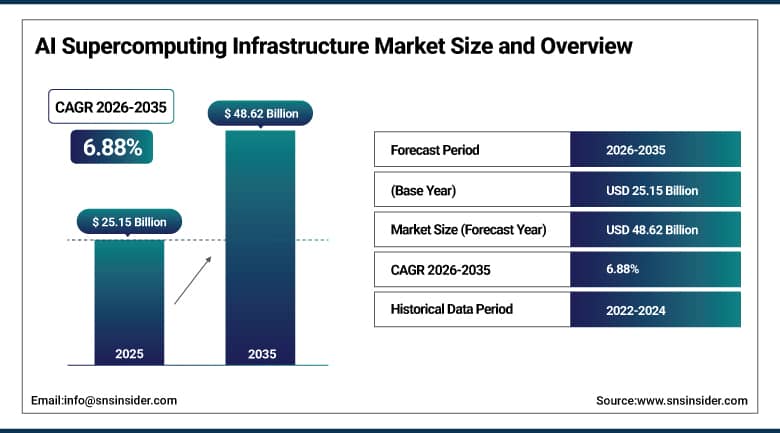
The AI Supercomputing Infrastructure Market was valued at USD 25.15 billion in 2025 and is expected to reach USD 48.62 billion by 2035, growing at a CAGR of 6.88% from 2026-2035.
The AI Supercomputing Infrastructure Market is witnessing steady growth due to rising need for high performance computing hardware that can support the requirements of sophisticated AI workloads. The growing adoption of generative AI, machine learning, deep learning, and large language models is resulting in increased need for GPUs, AI accelerators, fast networking technologies, and computing solutions. Increasing investments in hyperscale and enterprise data centers are helping in the deployment of such infrastructure. Moreover, innovations in AI optimized processors, high performance storage, liquid cooling systems, and clustering technologies are enhancing the efficiency of computations.
NSF's National AI Research Resource provides researchers with access to advanced computing systems, cloud resources, datasets, and AI models, demonstrating increasing demand for AI infrastructure.
To Get More Information On AI Supercomputing Infrastructure Market - Request Free Sample Report
AI Supercomputing Infrastructure Market Trends
-
Rising demand for generative AI and large-scale machine learning is driving investments in high-performance AI supercomputing infrastructure.
-
Increasing deployment of GPUs and specialized AI accelerators is accelerating development of powerful computing clusters for complex AI workloads.
-
Growing expansion of hyperscale data centers is increasing demand for high-speed networking, advanced cooling, and scalable AI computing infrastructure.
-
Advancements in AI processors, interconnect technologies, and memory architectures are improving computational performance, bandwidth, and energy efficiency.
-
Increasing adoption of large language models and foundation models is creating demand for massive computing capacity across training and inference workloads.
U.S. AI Supercomputing Infrastructure Market Outlook
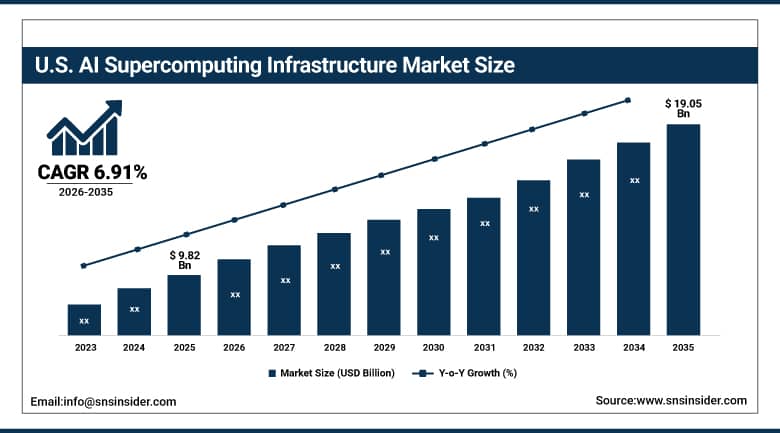
The U.S. AI Supercomputing Infrastructure Market was valued at USD 9.82 billion in 2025 and is expected to reach USD 19.05 billion by 2035, growing at a CAGR of 6.91% from 2026-2035.
The U.S. AI Supercomputing Infrastructure Market is experiencing significant growth due to growing demands for powerful computing systems that can run complex AI tasks. The quick adoption of generative AI, machine learning, deep learning, and large language models is fueling the demand for high-end GPUs, AI accelerators, high bandwidth network solutions, and scalable computing solutions. The expansion of hyperscale and enterprise data centers is helping with the deployment of the required infrastructure. Moreover, innovations in AI-enabled processors, high-performance storage solutions, liquid cooling technology, and cluster technology are helping to improve computing efficiency. The requirement of fast AI model training, processing of large amounts of data, and inference is further fueling AI supercomputer investments in the US.
NVIDIA began establishing U.S. manufacturing capacity for Blackwell chips and AI supercomputers, with more than 1 million square feet of manufacturing space commissioned across Arizona and Texas.
AI Supercomputing Infrastructure Market Segment Analysis
-
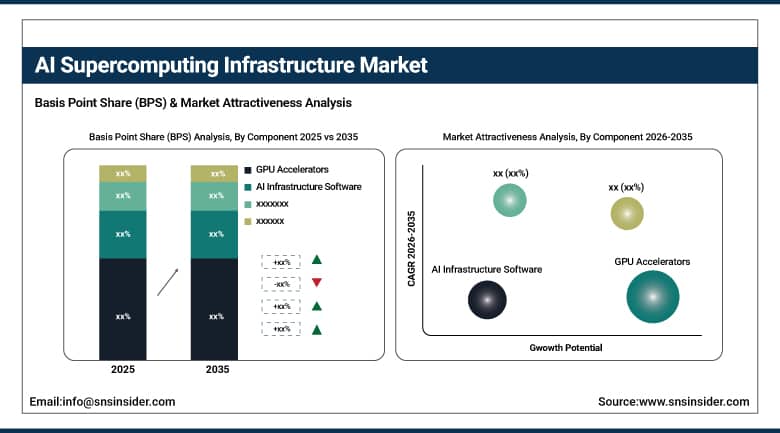
By Component, GPU Accelerators dominate the AI Supercomputing Infrastructure Market with 39% share in 2025; AI Infrastructure Software is expected to grow at the fastest CAGR of 10.45% from 2026–2035.
-
By Deployment Type, Custom AI Supercomputing Clusters dominate the AI Supercomputing Infrastructure Market with 43% share in 2025; Custom AI Supercomputing Clusters are expected to grow at the fastest CAGR of 7.36% from 2026–2035.
-
By Deployment Mode, Cloud-Based dominates the AI Supercomputing Infrastructure Market with 57% share in 2025; Cloud-Based is expected to grow at the fastest CAGR of 7.28% from 2026–2035.
-
By Cooling Infrastructure, Air Cooling dominates the AI Supercomputing Infrastructure Market with 54% share in 2025; Liquid Cooling is expected to grow at the fastest CAGR of 7.15% from 2026–2035.
-
By Application, Large Language Model (LLM) Training dominates the AI Supercomputing Infrastructure Market with 30% share in 2025; Generative AI Development is expected to grow at the fastest CAGR of 8.84% from 2026–2035.
-
By End-User, Hyperscalers & Cloud Providers dominate the AI Supercomputing Infrastructure Market with 39% share in 2025; Healthcare & Life Sciences Organizations are expected to grow at the fastest CAGR of 10.73% from 2026–2035.
By Component, GPU Accelerators dominate the AI supercomputing infrastructure market, AI Infrastructure Software grows fastest.
GPU Accelerators segment dominated the AI Supercomputing Infrastructure Market with the highest revenue share of about 39% in 2025 because of the ability to perform high-speed parallel processing needed for the training of artificial intelligence models. The GPUs excel at performing tasks that involve heavy computations. With the growing use of generative artificial intelligence and AI infrastructure, the need for GPUs is only going to increase.
AI Infrastructure Software segment is expected to grow at the fastest CAGR of 10.45% from 2026-2035 As a result of the growing need for efficient use of computing resources, load orchestration, model deployment, and infrastructure optimization. The software allows better GPU usage and helps create complex AI environments. The rising AI workloads and need for hybrid architectures are expected to boost its global popularity.
By Deployment Type, Custom AI Supercomputing Clusters dominate the AI supercomputing infrastructure market and grow fastest.
Custom AI Supercomputing Clusters segment dominated the AI Supercomputing Infrastructure Market with the highest revenue share of about 43% in 2025 resulting from the rising need for customized computational setups suitable for intensive AI computations. Such clusters allow companies to fine-tune their processing capabilities, networking, storage, and accelerators setup. Greater complexity of AI models and the development of specialized high-performance computing systems further bolster the adoption trend worldwide.
Custom AI Supercomputing Clusters segment is expected to grow at the fastest CAGR of 7.36% from 2026-2035 due to rising demand for dedicated hardware designed to meet specific requirements of AI processing. Companies will need to have customized settings for performance and security reasons. More spending on accelerators, fast connections, and large-scale AI solutions are likely to facilitate further cluster adoption around the world.
By Deployment Mode, Cloud-Based dominates the AI supercomputing infrastructure market and grows fastest.
Cloud-Based segment dominated the AI Supercomputing Infrastructure Market with the highest revenue share of about 57% in 2025 due to flexible access to powerful computing resources without having to make huge initial investments in infrastructure. Cloud Computing allows scalable computing resources, sophisticated accelerators, and quick provisioning for artificial intelligence workloads. Increasing use of AI services, remote infrastructure management, and cloud computing contributes to growing demand.
Cloud-Based segment is expected to grow at the fastest CAGR of 7.28% from 2026-2035 Due to increasing demands for AI-based computing resources that are scalable, adaptable, and cost-effective. Companies can expand their infrastructure depending on the needs of the workload while having access to powerful accelerators and software. Increasing use of AI technology, cloud-native approach, and preference for on-demand computing will speed up cloud adoption around the world.
By Cooling Infrastructure, Air Cooling dominates the AI supercomputing infrastructure market, Liquid Cooling grows fastest.
Air Cooling segment dominated the AI Supercomputing Infrastructure Market with the highest revenue share of about 54% in 2025 owing to the existing infrastructure and relative inexpensive implementation costs, among others. Air cooling is still popular when it comes to addressing normal heat loads. The already available cooling infrastructure, alongside the easy availability of air-cooling systems, makes it an ideal choice.
Liquid Cooling segment is expected to grow at the fastest CAGR of 7.15% from 2026-2035 Due to the increase in heat generation from high-density GPUs, AI accelerators, and computing systems. With liquid cooling being more efficient in terms of heat dissipation, there is increased computational density as opposed to air cooling methods. The increase in AI workloads and power densities in data centers will further drive its adoption worldwide.
By Application, Large Language Model (LLM) Training dominates the AI supercomputing infrastructure market, Generative AI Development grows fastest.
Large Language Model (LLM) Training segment dominated the AI Supercomputing Infrastructure Market with the highest revenue share of about 30% in 2025 because of the high computation intensity involved in training increasingly sophisticated AI models. Large Language Model training needs extensive computing power, fast networks, and extensive memory. More AI adoption by businesses and the rise of foundation models further reinforce the need for supercomputers.
Generative AI Development segment is expected to grow at the fastest CAGR of 8.84% from 2026-2035 This is due to the rapid proliferation of applications in text, image, video, code, and multimodal content generation. The development and deployment of such models require advanced computational infrastructure and accelerators. The increasing use by businesses, model innovation, and investment in applications of generative AI are anticipated to boost infrastructure requirements.
By End-User, Hyperscalers & Cloud Providers dominate the AI supercomputing infrastructure market, Healthcare & Life Sciences Organizations grow fastest.
Hyperscalers & Cloud Providers segment dominated the AI Supercomputing Infrastructure Market with the highest revenue share of about 39% in 2025 because of large-scale investments in data centers, AI accelerators, networking, and infrastructure for high-performance computing. These companies offer large-scale AI workloads for various clients. The development of cloud AI services, generation AI, and infrastructure development reinforces their competitive advantage in the market environment.
Healthcare & Life Sciences Organizations segment is expected to grow at the fastest CAGR of 10.73% from 2026-2035 due to increasing application of AI in drug discovery, medical imaging, genomics, clinical research, and personalized medicine. These applications entail large amounts of computing power to process the data. The digitization of healthcare, investment in AI research, and need for high-end computing is bound to fast-track infrastructure implementation worldwide.
Regional Insights
|
Region |
Major Country |
Share within Region, 2025 (%) |
|---|---|---|
|
North America |
United States |
94.0% |
|
Europe |
Germany |
22.0% |
|
Asia Pacific |
China |
44.0% |
|
Middle East & Africa |
UAE |
18.0% |
|
Latin America |
Brazil |
34.0% |
North America AI Supercomputing Infrastructure Market Insights
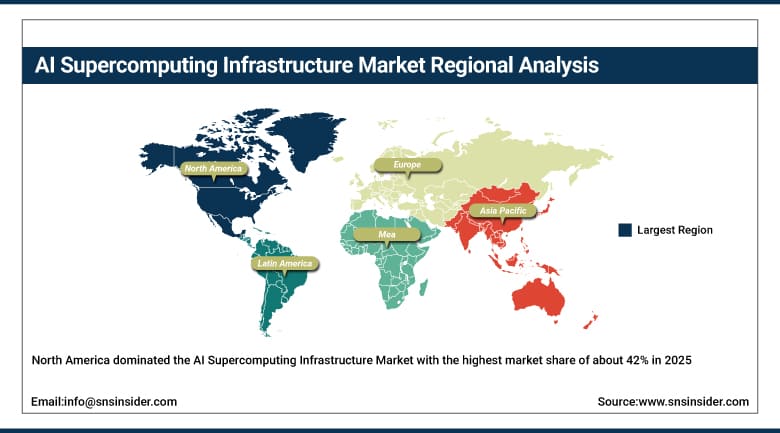
North America dominated the AI Supercomputing Infrastructure Market with the highest market share of about 42% in 2025, motivated by extensive research into AI, advanced data center facilities, and heavy investment in high-performance computing systems. The availability of top technology firms, hyperscale cloud companies, advanced GPU facilities, and government-sponsored AI programs adds to the advantages in the market dominance of the region.
The U.S. AI Supercomputing Infrastructure Market accounted for a market share of 94.0%, backed by a lot of AI research, high-performance computing systems, and significant funding from hyperscale cloud providers and technology firms. Increased demand for AI model training, computing capabilities through GPUs, and data center capacity is fueling market growth. There are also AI initiatives undertaken by governments and significant R&D expenditures.
Get Customized Report as Per Your Business Requirement - Enquiry Now
Europe AI Supercomputing Infrastructure Market Insights
Europe AI Supercomputing Infrastructure Market is a result of consistent growth, which is aided by greater use of artificial intelligence, more powerful capabilities of high-performance computing, and improved infrastructure of data centers. There is greater need for computing capacity for research purposes as well as in health care, manufacturing, and automotive sectors, which is prompting its adoption.
The Germany AI Supercomputing Infrastructure Market accounted for a market share of 22.0%, facilitated by strong research infrastructure, increased use of AI, and investment in high-performance computing. Applications in the manufacturing sector, automotive industry, healthcare, and scientific research are fueling adoption. Government-funded supercomputer projects, digitalization plans, and energy-efficient computing initiatives are helping market development in Germany.
Asia Pacific AI Supercomputing Infrastructure Market Insights
Asia Pacific is expected to grow at the fastest CAGR of about 7.69% from 2026–2035, facilitated through rapid adoption of AI, data-center capacity expansions, and rising investments in HPC infrastructures. The growing need for processing AI tasks within industries such as manufacturing, healthcare, finance, and technology sectors, as well as AI-related government programs and semiconductor investments, along with the development of cloud infrastructure within China, Japan, South Korea, and India, are driving regional growth even further.
The China AI Supercomputing Infrastructure Market accounted for a market share of 44.0%, backed by swift uptake of AI, development of data centers, and significant spending on supercomputing capabilities. The need for training AI models, automation of industries, and analytical solutions has driven its implementation. The government-supported AI programs, investment in semiconductors, homegrown computing capabilities, and increased capacity in cloud infrastructure have further bolstered China’s standing in the market.
Middle East & Africa and Latin America AI Supercomputing Infrastructure Market Insights
The Middle East & Africa and Latin America AI Supercomputing Infrastructure Market is growing gradually, fueled by growing adoption of AI, digital transformation, and investments in high performance computing infrastructure. Increasing demand for high-end computational requirements from government, finance, healthcare, and technology is generating opportunities. Development of data centers, cloud, government AI projects, and advanced computing technologies are also contributing to market growth in the region.
The UAE AI Supercomputing Infrastructure Market accounted for a market share of 18.0%, backed by greater investments into AI, digital transformation, and data center infrastructure. Greater demand for high performance computing in various government, finance, health care, and tech sectors is promoting usage. AI strategies backed by governments, cloud infrastructure build up, smart city projects, and advanced computing are also aiding in market growth in the UAE.
Growth Drivers: Rapid growth of generative AI and large language models is accelerating demand for high-performance AI supercomputing infrastructure globally
The rapid expansion of generative AI, large language models, and increasingly complex AI workloads is significantly driving demand for AI supercomputing infrastructure. Training and deployment of state-of-the-art models demand huge amounts of computational resources, high-performance memory, very fast interconnects, scalable storage and even accelerators. Hence, enterprises, hyperscaler cloud service providers, government organizations and research institutions are making heavy investments in building large-scale GPU clusters and AI-centric computing environments. Spending on AI infrastructure is growing at an unprecedented pace with accelerated compute still forming the fundamental structure of deployment.
Restraints: High capital expenditure and substantial power requirements can limit deployment of AI supercomputing infrastructure
High capital requirements remain a major restraint for AI supercomputing infrastructure deployment. A GPU cluster demands a considerable outlay of money in terms of accelerators, high-speed networks, storage, power, cooling, data center, and software infrastructure. Thus, sophisticated AI infrastructure needs huge initial investments, posing difficulties to adopt for entities lacking large amounts of funds. Another issue is the power usage since dense accelerator clusters need lots of electricity and sophisticated cooling technology. Infrastructure vendors need to make sure that there is sufficient grid capacity and that power and cooling systems should be designed specifically for AI infrastructure.
Opportunities: Rapid expansion of AI factories and hyperscale computing creates significant opportunities for next-generation supercomputing infrastructure providers
The rapid construction of AI-focused data centers and AI factories is creating substantial opportunities for AI supercomputing infrastructure providers. The hyperscalers and AI companies are making considerable investments in acquiring a large amount of computing power in light of growing demand for AI training and inference. Some recent deals in the area of infrastructure have been evidence that the investment being made in this regard is huge and includes a lot of deployments based on next-generation accelerators. Providers will be able to benefit from the investment in their business by making integrated platforms incorporating accelerators, fast networking, advanced storage, liquid cooling, and software optimization. Demand for infrastructure, therefore, should create many long-term opportunities due to the growing demand for clusters of AI workloads based on a very large number of accelerators.
Recent Developments:
-
2026 : NVIDIA continued expanding its AI supercomputing ecosystem with next-generation accelerated computing platforms, networking, and rack-scale systems designed to support increasingly large-scale AI training and inference workloads.
-
2026 : AMD continued advancing its Instinct accelerator portfolio and AI infrastructure platforms, focusing on higher compute performance, memory capacity, and energy efficiency for large-scale AI and HPC deployments.
-
2026 : Dell Technologies expanded its AI Factory portfolio with integrated rack-scale infrastructure combining servers, networking, storage, power, and cooling to support demanding enterprise AI and supercomputing workloads.
-
2026 : Hewlett Packard Enterprise continued expanding its AI supercomputing portfolio with accelerated computing, high-performance networking, and liquid-cooled infrastructure designed for large-scale AI training, inference, and high-performance computing environments.
AI Supercomputing Infrastructure Market Key Players are:
-
NVIDIA Corporation
-
Advanced Micro Devices, Inc.
-
Intel Corporation
-
Dell Technologies Inc.
-
Super Micro Computer, Inc.
-
Lenovo Group Limited
-
Cisco Systems, Inc.
-
Broadcom Inc.
-
Arista Networks, Inc.
-
Microsoft Corporation
-
Amazon Web Services, Inc.
-
Alphabet Inc.
-
Oracle Corporation
-
IBM Corporation
-
Fujitsu Limited
-
NEC Corporation
-
Cerebras Systems
-
SambaNova Systems
AI Supercomputing Infrastructure Market Report Scope:
| Report Attributes | Details |
|---|---|
| Market Size in 2025 | USD 25.15 Billion |
| Market Size by 2035 | USD 48.65 Billion |
| CAGR | CAGR of 6.88% From 2026 to 2035 |
| Base Year | 2025 |
| Forecast Period | 2026-2035 |
| Historical Data | 2022-2024 |
| Report Scope & Coverage | Market Size, Segments Analysis, Competitive Landscape, Regional Analysis, DROC & SWOT Analysis, Forecast Outlook |
| Key Segments | • By Component (GPU Accelerators, AI Servers & Rack Systems, High-Speed Networking Solutions, AI Infrastructure Software, Deployment & Managed Services) • By Deployment Type (DGX BasePOD, DGX SuperPOD, Custom AI Supercomputing Clusters) • By Deployment Mode (Cloud-Based, On-Premise) • By Cooling Infrastructure (Air Cooling, Liquid Cooling) • By Application (Large Language Model (LLM) Training, Generative AI Development, Autonomous Vehicle Simulation, Scientific & Research Computing, Drug Discovery & Healthcare AI, Financial AI Modeling, Digital Twin & Industrial AI) • By End-User (Hyperscalers & Cloud Providers, Government & Defense Agencies, Research & Academic Institutions, Healthcare & Life Sciences Organizations, BFSI Enterprises, Automotive Companies, Industrial Enterprises) |
| Regional Analysis/Coverage | North America (US, Canada), Europe (Germany, UK, France, Italy, Spain, Russia, Poland, Rest of Europe), Asia Pacific (China, India, Japan, South Korea, Australia, ASEAN Countries, Rest of Asia Pacific), Middle East & Africa (UAE, Saudi Arabia, Qatar, South Africa, Rest of Middle East & Africa), Latin America (Brazil, Argentina, Mexico, Colombia, Rest of Latin America). |
| Company Profiles | NVIDIA Corporation, Advanced Micro Devices, Inc., Intel Corporation, Dell Technologies Inc., Hewlett Packard Enterprise Company, Super Micro Computer, Inc., Lenovo Group Limited, Cisco Systems, Inc., Broadcom Inc., Arista Networks, Inc., Microsoft Corporation, Amazon Web Services, Inc., Alphabet Inc., Oracle Corporation, IBM Corporation, Huawei Technologies Co., Ltd., Fujitsu Limited, NEC Corporation, Cerebras Systems, and SambaNova Systems. |

Frequently Asked Questions
The AI Supercomputing Infrastructure Market is expected to grow at a CAGR of 6.88% from 2026 to 2035.
The AI Supercomputing Infrastructure Market was valued at USD 25.15 billion in 2025.
The major growth factor is rapid expansion of generative AI and large language models, driving demand for high-performance GPUs, high-speed networking, and scalable computing infrastructure for intensive AI workloads.
The GPU Accelerators segment dominated the AI Supercomputing Infrastructure Market in 2025.
North America dominated the AI Supercomputing Infrastructure Market in 2025.
