
Amaranth Oil Market Report Scope & Overview:
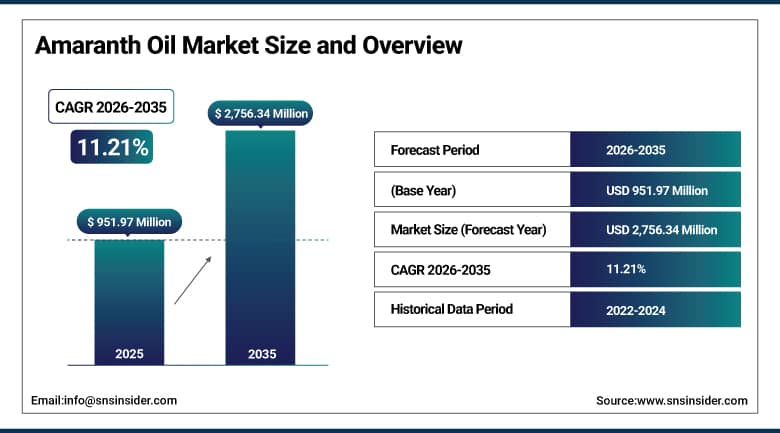
The Amaranth Oil Market was valued at USD 951.97 Million in 2025 and is expected to reach USD 2,756.34 Million by 2035, growing at a CAGR of 11.21% from 2026–2035.
The global amaranth oil market is growing at an exceptional pace. Amaranth oil is a rare and nutrient-dense vegetable oil extracted from the seeds of Amaranthus plants, valued for its extraordinary composition including high squalene content of approximately 6-8%, essential fatty acids, tocopherols, and phytosterols. Squalene’s exceptional moisturising, antioxidant, and skin-barrier properties make amaranth oil particularly prized in cosmetics and personal care formulations. The market is driven by growing demand for functional foods incorporating amaranth oil, the cosmetics industry’s shift toward natural and clean-label ingredient sourcing, and pharmaceutical interest in squalene’s bioactive properties for drug delivery and nutraceutical applications.
In 2023, Amaranth Bio Company expanded its cold-pressed amaranth seed oil production facility in Ukraine to meet growing European cosmetic industry demand for certified organic amaranth oil with above 7% squalene content. The expansion reflects the extraordinary commercial opportunity created by the clean beauty movement’s premium natural ingredient sourcing preference whose consumer willingness to pay for certified organic plant-derived squalene creates sustainable commercial motivation for amaranth oil production capacity investment.
To Get More Information On Amaranth Oil Market - Request Free Sample Report
Amaranth Oil Market Trends:
-
Growing demand for clean beauty and natural personal care products is increasing the use of amaranth oil due to its high squalene content and skin-conditioning benefits
-
The transition toward plant-based squalene sources is creating significant opportunities for amaranth oil as a sustainable and ethical alternative to animal-derived ingredients
-
Rising adoption of amaranth oil in functional foods and nutraceuticals is driven by its rich omega fatty acid profile and health-promoting properties
-
Advances in supercritical CO₂ extraction technology are improving amaranth oil purity, quality, and bioactive compound retention for premium applications
-
Increasing consumer preference for certified organic products is supporting strong demand and premium pricing for organic amaranth oil across food, cosmetic, and wellness industries
U.S. Amaranth Oil Market Outlook:
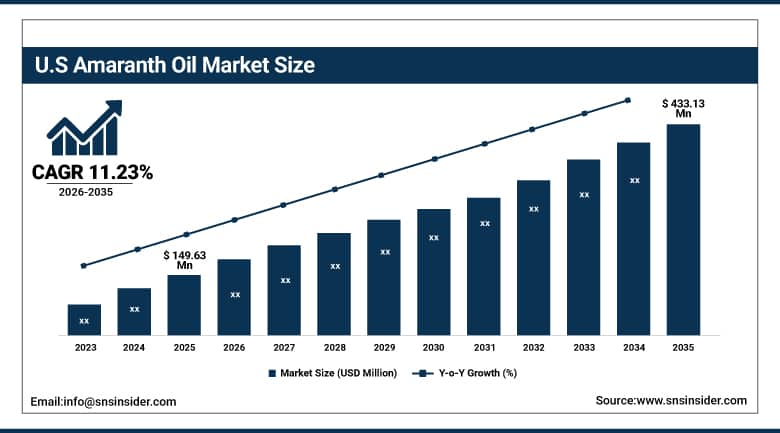
The U.S. Amaranth Oil Market was valued at approximately USD 149.63 Million in 2025 and is expected to reach approximately USD 433.13 Million by 2035, growing at a CAGR of approximately 11.23%.
The U.S. is a commercially significant amaranth oil market within North America. The natural cosmetics sector’s clean beauty preference, the dietary supplement industry’s functional oil adoption, and the pharmaceutical sector’s plant-derived squalene interest create diverse domestic demand channels. Whole Foods Market, Natural Grocers, and specialty natural health retailer distribution creates consumer access to amaranth oil dietary supplement products. FDA’s GRAS status review for amaranth oil food applications and the cosmetic ingredient review’s safety determination for topical use sustain regulatory confidence that supports commercial adoption.
Nu-World Foods expanded its amaranth oil product portfolio in 2024 with new certified organic cold-pressed amaranth oil in standardised squalene content specifications for U.S. cosmetic and nutraceutical formulators seeking consistent ingredient performance for product stability and efficacy claims. The standardised specification reflects the commercial requirement of cosmetic and nutraceutical manufacturers whose product performance claims require consistent active ingredient concentration that variable-composition botanical oil alternatives cannot reliably provide.
Amaranth Oil Market Segment Analysis:
-
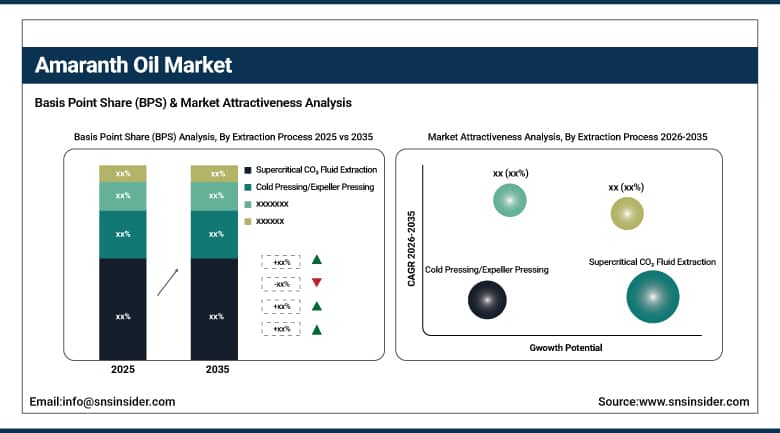
By Extraction Process, the Supercritical CO₂ Fluid Extraction segment dominated the Amaranth Oil Market with approximately 48% share in 2025, while the Cold Pressing segment is the fastest growing.
-
By Application, the Food & Beverages segment dominated the Amaranth Oil Market with approximately 38% share in 2025, while the Cosmetics & Personal Care segment is the fastest growing.
-
By End Use, the Cosmetics & Personal Care Industry segment dominated the Amaranth Oil Market with approximately 42% share in 2025, while the Nutraceutical & Dietary Supplement Industry segment is the fastest growing.
By Extraction Process, supercritical CO₂ dominates, cold pressing grows fastest
Supercritical CO₂ extraction retained the dominant extraction process position with approximately 48% of the amaranth oil market in 2025. The supercritical fluid extraction process’s commercial primacy reflects its superior product quality whose solvent-free, low-temperature extraction creates amaranth oil with maximum squalene concentration, preserved tocopherol content, and zero organic solvent residue that pharmaceutical and premium cosmetic quality specifications require. The pharmaceutical sector’s drug delivery vehicle application and the premium cosmetic sector’s active ingredient specification collectively create procurement motivation for supercritical CO₂ extracted amaranth oil whose premium per-litre commercial value sustains the extraction method’s market leadership despite higher processing cost relative to alternatives.
Cold pressing is the fastest-growing extraction process because the artisan food movement’s preference for minimally processed natural oils, the certified organic market’s simple processing requirement, and the consumer-facing natural beauty product’s clean extraction process communication create growing demand for cold-pressed amaranth oil. Cold pressing’s lower capital equipment requirement enables smaller-scale artisan production whose certified organic sourcing and regional provenance create commercial differentiation in premium natural food and beauty markets. Each new clean beauty brand that specifies cold-pressed organic amaranth oil creates procurement that sustains the growing extraction method’s commercial adoption.
By Application, food & beverages dominate, cosmetics grows fastest
Food and beverages retained the dominant application position with approximately 38% of the amaranth oil market in 2025. Culinary application’s role as the most accessible commercial entry point for amaranth oil creates consumer market volume whose health-conscious premium cooking oil category creates consistent procurement. Each gourmet food retailer that stocks cold-pressed amaranth oil for culinary use creates retail channel procurement whose aggregate across natural food retail creates the market’s broadest distribution infrastructure. Functional food formulation’s adoption of amaranth oil for its squalene and essential fatty acid nutritional content creates industrial-scale food manufacturer procurement that compounds with the functional food sector’s above-average growth rate.
Cosmetics and personal care is the fastest-growing application because the clean beauty movement’s extraordinary commercial momentum creates structured premium natural ingredient procurement from cosmetic formulators whose product line development requires above-average active ingredient sourcing investment. Squalene’s commercial transition from shark liver oil toward plant-derived amaranth alternatives reflects both ethical sourcing pressure and the cosmetic industry’s clean-label positioning whose marketing communication creates consumer demand that sustains premium natural ingredient specification.
By End Use, cosmetics dominates, nutraceuticals grow fastest
Cosmetics and personal care industry retained the dominant end-use position with approximately 42% of the amaranth oil market in 2025. The cosmetic industry’s above-average willingness to pay for premium natural active ingredients creates the highest per-litre commercial value that any end-use sector generates for amaranth oil suppliers. Each new facial serum, body oil, or anti-aging cream that specifies amaranth oil as a key active ingredient creates procurement whose premium cosmetic pricing creates above-average margin contribution relative to food and pharmaceutical applications. The luxury cosmetics sector’s certification requirements for organic and sustainably-sourced botanical ingredients create structured commercial relationships with certified amaranth oil suppliers.
Nutraceutical and dietary supplement industry is the fastest-growing end use because the global dietary supplement market’s expansion creates structured procurement for functional oil ingredients whose proven health benefit claims create consumer purchase motivation. Each omega-3/6 balance supplement that incorporates amaranth oil creates procurement whose squalene content documentation sustains health claim substantiation. The growing consumer awareness of squalene’s immune-supporting and antioxidant properties creates health supplement product development that sustains nutraceutical sector’s fastest-growing commercial trajectory.
Regional Analysis:
|
Region |
Major Country |
Share within Region, 2025 (%) |
|---|---|---|
|
North America |
United States |
87.4% |
|
Europe |
Germany |
22.3% |
|
Asia Pacific |
China |
44.8% |
|
Middle East & Africa |
UAE |
38.4% |
|
Latin America |
Brazil |
44.2% |
Europe Amaranth Oil Market Insights
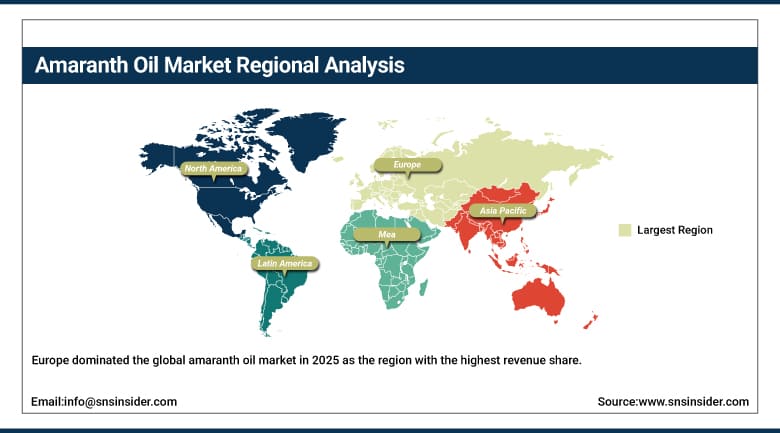
Europe dominated the global amaranth oil market in 2025 as the region with the highest revenue share. Central European production, particularly Ukraine’s and Russia’s amaranth cultivation infrastructure, combined with Western European cosmetic and pharmaceutical industry’s premium ingredient procurement creates the most commercially significant regional amaranth oil ecosystem globally. Germany accounts for approximately 22.3% of European revenues through its pharmaceutical industry’s squalene drug delivery vehicle procurement, the cosmetic industry’s natural ingredient sourcing, and Flavex Naturextrakte GmbH’s domestic commercial operations.
France, Poland, and the Netherlands are significant secondary markets where the cosmetic industry’s premium natural ingredient culture, the pharmaceutical sector’s botanical oil procurement, and the organic food sector’s functional oil adoption create consistent above-average per-unit commercial value.
Get Customized Report as Per Your Business Requirement - Enquiry Now
Asia Pacific Amaranth Oil Market Insights
Asia Pacific is the fastest-growing regional amaranth oil market, driven by the cosmetics industry’s extraordinary expansion in China, South Korea, and Japan, the growing nutraceutical market’s functional oil adoption, and India’s pharmaceutical industry’s plant-derived squalene interest. China accounts for approximately 44.8% of Asia Pacific revenues through its extraordinary cosmetic market’s natural ingredient adoption, the food supplement industry’s functional oil procurement, and the domestic amaranth oil producer development.
South Korea’s K-beauty industry’s above-average natural active ingredient specification and Japan’s premium cosmetic and pharmaceutical sector create significant secondary markets whose per-unit commercial value sustains above-average product specification investment.
North America Amaranth Oil Market Insights
North America is a growing amaranth oil market whose natural food and beauty culture creates structured demand for premium botanical oils. The United States accounts for approximately 87.4% of North American revenues through its clean beauty sector, natural food retailer distribution, and the dietary supplement industry’s functional oil adoption.
Canada contributes approximately 12.6% of North American revenues through its natural health product market’s certified organic oil procurement, the cosmetic ingredient supply chain, and the growing functional food sector’s premium ingredient specification.
MEA & Latin America Amaranth Oil Market Insights
UAE leads MEA revenues at approximately 38.4% through its luxury cosmetics market’s premium natural ingredient adoption, the growing dietary supplement sector, and the pharmaceutical industry’s botanical oil procurement. Brazil leads Latin American revenues at approximately 44.2% through its cosmetic industry’s natural ingredient focus, the growing functional food sector, and the domestic amaranth cultivation programme’s producer development.
Saudi Arabia’s luxury cosmetics sector and South Africa’s natural health product market create significant MEA secondary markets whose amaranth oil procurement reflects growing premium natural ingredient adoption.
Market Dynamics:
Growth Drivers: Clean beauty natural ingredient demand and plant-based squalene transition from shark-derived sources
The clean beauty movement’s extraordinary commercial momentum is the amaranth oil market’s most commercially compelling near-term growth driver. Consumer demand for cosmetic products formulated without synthetic or animal-derived ingredients creates premium natural active ingredient procurement whose aggregate across the global clean beauty market creates structural demand that compounds with clean beauty’s progressive mainstream adoption. Squalene’s transition from shark liver oil toward plant-derived amaranth alternatives reflects both consumer ethical concern and cosmetic brand sustainability commitment whose combined commercial motivation creates structured procurement migration that sustains amaranth oil demand.
Nutraceutical market’s adoption of amaranth oil for its unique squalene, omega-6, and tocopherol composition creates functional health product development procurement whose compound growth with the global dietary supplement market’s expansion creates consistent above-average commercial momentum. Each new health claim substantiation study demonstrating amaranth oil’s specific health benefit creates formulator adoption motivation that sustains procurement growth.
Restraints: Limited global amaranth cultivation area and extraction cost premium versus conventional plant oils
Amaranth cultivation’s geographic concentration in Central Europe and South America creates supply chain vulnerability whose production volume limitation prevents rapid commercial scale response to demand growth. Each seasonal production variation creates price volatility that moderates formulators’ ability to commit to long-term amaranth oil specification in cost-sensitive product categories.
Amaranth oil’s cost premium over conventional edible and cosmetic oils including sunflower, olive, and argan creates adoption barriers in price-sensitive market segments whose formulation economics do not justify amaranth oil’s premium over more cost-competitive alternatives. Each formulator whose product positioning does not support premium ingredient pricing creates market access limitation in mainstream retail channels.
Opportunities: Pharmaceutical squalene application and certified organic premium market expansion
Pharmaceutical squalene application represents the most commercially premium opportunity for amaranth oil producers whose high-purity supercritical CO₂ extracted product creates drug delivery vehicle procurement at above-cosmetic pricing. Each pharmaceutical company whose emulsion adjuvant, drug delivery vehicle, or topical therapeutic formulation specifies plant-derived squalene creates procurement that sustains premium pricing relationships.
Certified organic amaranth oil market expansion creates commercial differentiation opportunity whose organic certification premium sustains above-conventional pricing. Each new organic amaranth farming programme that achieves certification creates production capacity whose organic credential creates commercial access to premium clean beauty and natural health markets at above-standard price points.
Recent Developments:
-
2023: Amaranth Bio Company expanded its cold-pressed amaranth seed oil production facility in Ukraine in 2023 to meet growing European cosmetic industry demand for certified organic amaranth oil with above 7% squalene content.
-
2024: Nu-World Foods expanded its amaranth oil product portfolio in 2024 with new certified organic cold-pressed amaranth oil in standardised squalene content specifications for U.S. cosmetic and nutraceutical formulators.
-
2024: Proderna Biotech launched a new pharmaceutical-grade amaranth oil line in 2024 with enhanced supercritical CO₂ extraction purity for drug delivery vehicle and topical therapeutic formulation applications targeting European pharmaceutical manufacturer procurement.
Amaranth Oil Market Key Players:
-
Amaranth Bio Company
-
AMR Amaranth A.S.
-
Proderna Biotech Pvt. Ltd.
-
Nu-World Foods Inc.
-
Flavex Naturextrakte GmbH
-
Nans Products Pvt Ltd.
-
RusOliva Pvt. Ltd.
-
DK Mass S.R.O
-
Saar Srl
-
Amaranth Nord
-
IREL (India Rare Earths)
-
Fiorentini Alimentari S.p.A.
-
Now Foods
-
Swanson Health Products
-
Life Extension LLC
-
Vitacost.com
-
Argan Botanical Ltd.
-
Olvea Group
-
Aromantic Ltd.
-
BioActives Japan Corporation
Amaranth Oil Market Report Scope:
| Report Attributes | Details |
|---|---|
| Market Size in 2025 | USD 951.97 Million |
| Market Size by 2035 | USD 2,756.34 Million |
| CAGR | CAGR of 11.21% From 2026 to 2035 |
| Base Year | 2025 |
| Forecast Period | 2026-2035 |
| Historical Data | 2022-2024 |
| Report Scope & Coverage | Market Size, Segments Analysis, Competitive Landscape, Regional Analysis, DROC & SWOT Analysis, Forecast Outlook |
| Key Segments | • by Extraction Process (Supercritical CO₂ Fluid Extraction, Cold Pressing/Expeller Pressing, Solvent Extraction) • by Application (Food & Beverages, Cosmetics & Personal Care, Pharmaceuticals, Food Supplements/Nutraceuticals) • by End Use (Cosmetics & Personal Care Industry, Food & Beverage Industry, Pharmaceutical Industry, Nutraceutical & Dietary Supplement Industry) |
| Regional Analysis/Coverage | North America (US, Canada, Mexico), Europe (Eastern Europe [Poland, Romania, Hungary, Turkey, Rest of Eastern Europe] Western Europe] Germany, France, UK, Italy, Spain, Netherlands, Switzerland, Austria, Rest of Western Europe]), Asia Pacific (China, India, Japan, South Korea, Vietnam, Singapore, Australia, Rest of Asia Pacific), Middle East & Africa (Middle East [UAE, Egypt, Saudi Arabia, Qatar, Rest of Middle East], Africa [Nigeria, South Africa, Rest of Africa], Latin America (Brazil, Argentina, Colombia, Rest of Latin America) |
| Company Profiles | Amaranth Bio Company, AMR Amaranth A.S., Proderna Biotech Pvt. Ltd., Nu-World Foods Inc., Flavex Naturextrakte GmbH, Nans Products Pvt Ltd., RusOliva Pvt. Ltd., DK Mass S.R.O, Saar Srl, Amaranth Nord, IREL (India Rare Earths), Fiorentini Alimentari S.p.A., Now Food, Swanson Health Products, Life Extension LLC, Vitacost.com, Argan Botanical Ltd., Olvea Group, Aromantic Ltd., BioActives Japan Corporation |

Frequently Asked Questions
The Amaranth Oil Market is expected to grow at a CAGR of 11.21% from 2026 to 2035.
The Amaranth Oil Market was valued at USD 951.97 Million in 2025.
Growing demand for functional foods incorporating amaranth oil and the clean beauty movement’s natural ingredient sourcing driving cosmetic industry adoption of amaranth oil’s high squalene content for skin moisturising and antioxidant applications.
Supercritical CO₂ Fluid Extraction dominated the Amaranth Oil Market with approximately 48% share in 2025, while Cold Pressing is the fastest growing extraction process (SNS confirmed).
Europe dominated the Amaranth Oil Market in 2025 with the highest revenue share (SNS confirmed), while Asia Pacific is the fastest-growing region.
