
ANGPTL3 Inhibitors Market Report Scope and Overview:
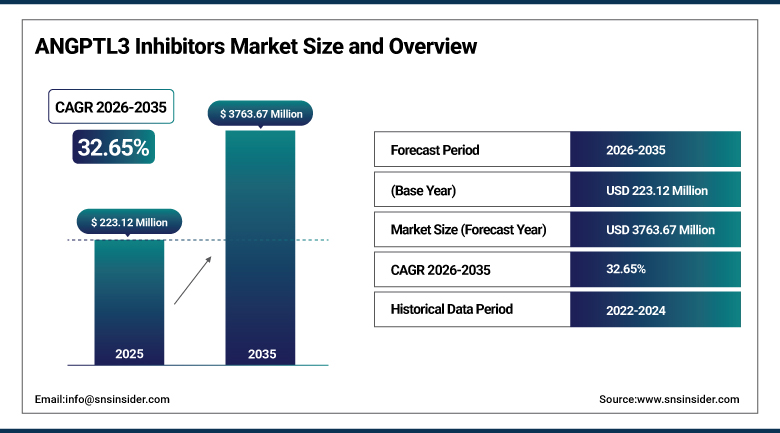
The ANGPTL3 Inhibitors Market was valued at USD 223.12 Million in 2025 and is projected to reach USD 3,763.67 Million by 2035, registering a CAGR of 32.65% from 2026 to 2035.
The ANGPTL3 Inhibitors Market is developing rapidly owing to the increase in its pipeline from a first-in-class monoclonal antibody of Regeneron to RNA interference, antisense, and gene editing therapies. The clinical effectiveness of ANGPTL3 inhibition for mixed hyperlipidemia and severe hypertriglyceridemia has been confirmed. In addition, the scope of indication for ANGPTL3 inhibitors has widened. Significant growth is being witnessed in the deployment of subcutaneous RNAi therapeutics offering infrequent dosing, in vivo base-editing platforms designed for one-time permanent treatment, and expanding real-world clinical evidence, considering that pharmaceutical companies, specialty clinics, and hospitals continue investing heavily in next-generation lipid-lowering technology that reaches patients underserved by conventional cholesterol therapies.
To Get more information ANGPTL3 Inhibitors Market - Request Free Sample Report
ANGPTL3 Inhibitors Market Trends
-
Rapid pipeline diversification continues beyond monoclonal antibodies into RNAi, antisense, and gene-editing modalities.
-
Growing clinical evidence continues supporting ANGPTL3 inhibition across mixed hyperlipidemia and severe hypertriglyceridemia.
-
Rising adoption of infrequent-dosing subcutaneous RNAi therapeutics continues improving long-term patient adherence.
-
Expanding in vivo base-editing research continues advancing toward potentially one-time, permanent lipid-lowering treatment.
-
Increasing real-world evidence generation continues supporting broader payer coverage for ANGPTL3-targeted therapies.
U.S. ANGPTL3 Inhibitors Market Outlook
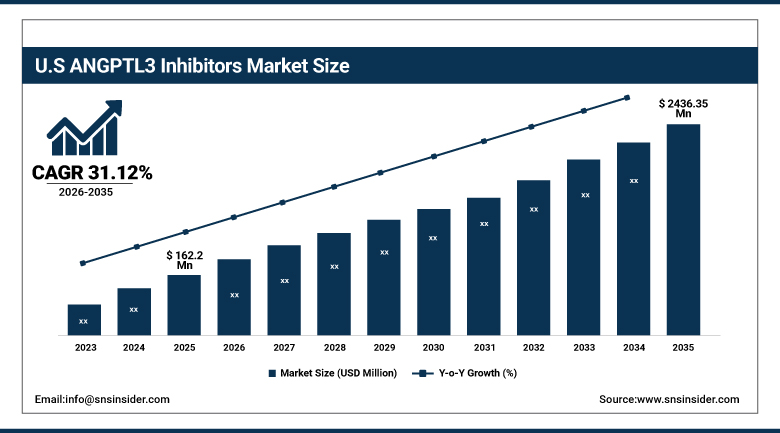
The U.S. ANGPTL3 Inhibitors Market was valued at approximately USD 162.2 Million in 2025 and is projected to reach approximately USD 2436.35 Million by 2035, registering a CAGR of approximately 31.12% from 2026 to 2035.
Demand across the United States continued to be shaped by the country's position as the first and largest commercial market for EVKEEZA, a dense concentration of lipid specialty clinics and academic medical centers treating homozygous familial hypercholesterolemia, and the country's leadership in RNAi and gene-editing clinical development. Rising deployment of next-generation pipeline candidates by leading biotechnology companies running late-stage trials continued reinforcing the country's position as both the largest and most clinically advanced ANGPTL3 inhibitor market. Growing adoption across specialty lipid clinics and academic medical centers added further layers of sustained domestic demand well beyond the original ultra-rare disease use case, with expanding mixed hyperlipidemia and severe hypertriglyceridemia indications increasingly relying on next-generation ANGPTL3-targeted therapies.
ANGPTL3 Inhibitors Market Segment Analysis
By Product
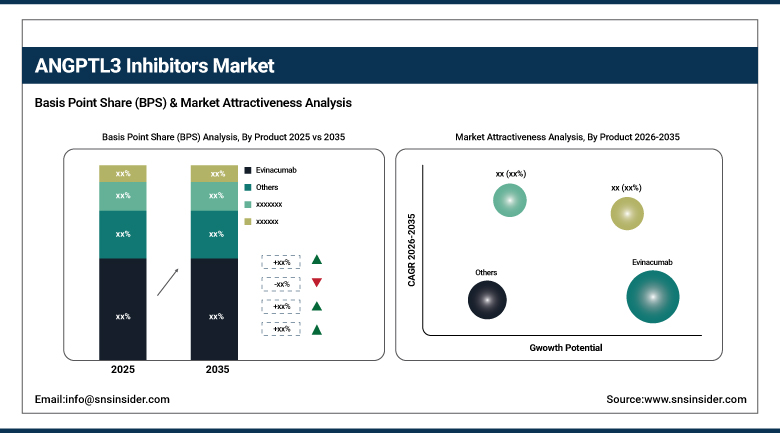
Evinacumab is a monoclonal antibody that inhibits angiopoietin-like protein 3 (ANGPTL3), helping reduce low-density lipoprotein cholesterol (LDL-C) levels through a mechanism independent of LDL receptors. It is used to treat homozygous familial hypercholesterolemia (HoFH), a rare genetic disorder associated with extremely high cholesterol levels and an increased risk of cardiovascular complications. Evinacumab is administered intravenously under medical supervision and provides an additional treatment option for patients who require further LDL-C reduction despite conventional lipid-lowering therapies.
By Disease Indication
Homozygous familial hypercholesterolemia (HoFH) is a rare inherited disorder characterized by extremely high low-density lipoprotein cholesterol (LDL-C) levels, increasing the risk of premature cardiovascular disease. ANGPTL3 inhibitors, particularly evinacumab, provide an additional treatment option for patients with HoFH who require substantial cholesterol reduction. The therapy works independently of LDL receptors, making it valuable for patients with severely impaired receptor function. The Others segment includes potential applications in other lipid disorders, subject to clinical evidence and regulatory approval.
Regional Analysis
North America ANGPTL3 Inhibitors Market Insights
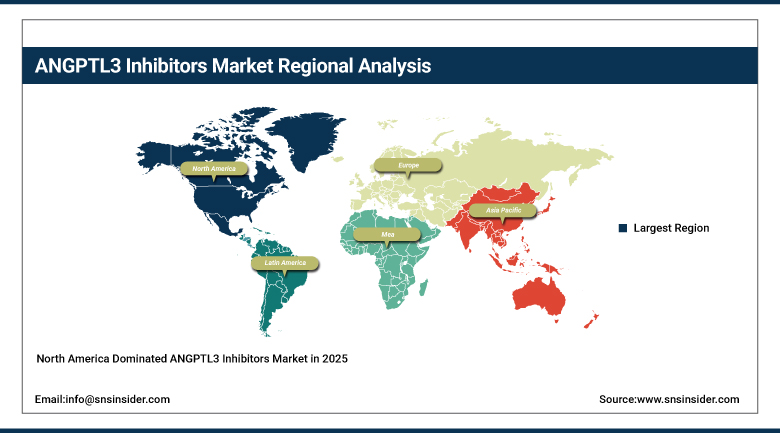
The North America ANGPTL3 Inhibitors Market is supported by advanced healthcare infrastructure, established pharmaceutical industries, and increasing attention to rare genetic lipid disorders. The United States represents a key market due to the availability of evinacumab (Evkeeza), an ANGPTL3 inhibitor used to treat homozygous familial hypercholesterolemia (HoFH). Established diagnostic capabilities, specialist treatment centers, and access to innovative therapies support regional market development.
Canada also contributes through its healthcare infrastructure and regulatory framework for rare disease treatments. Growing awareness of inherited cholesterol disorders and the need for additional lipid-lowering options create opportunities for market expansion. However, high treatment costs, limited eligible patient populations, reimbursement restrictions, and access disparities may affect adoption. Continued clinical research and improved patient identification could support future market development across North America.
Get Customized Report as per Your Business Requirement - Enquiry Now
Market Dynamics
Growth Drivers: Rising Genetic Lipid Disorder Diagnosis and Pipeline Diversification
The industry is driven by rising diagnosed prevalence of homozygous familial hypercholesterolemia and other genetic lipid disorders, growing pipeline diversification beyond monoclonal antibodies into RNAi, antisense, and gene-editing modalities, increasing clinical evidence supporting ANGPTL3 inhibition across broader hyperlipidemia indications, and expanding genetic testing infrastructure improving patient identification. As physician awareness of ANGPTL3's LDL receptor-independent mechanism continues rising, the need for effective treatment options for patients unresponsive to conventional cholesterol therapy continues driving adoption of ANGPTL3-targeted therapeutics.
Rising clinical evidence supporting ANGPTL3 inhibition beyond the ultra-rare HoFH indication continues reinforcing this driver, as positive mixed hyperlipidemia trial results open a substantially larger addressable patient population than the original approved indication. Growing competitive investment from RNAi, antisense, and gene-editing platform leaders continues expanding the diversity of modalities available for evaluation, and that combination of clinical validation and modality diversification is exactly what keeps demand climbing at such an extraordinary, sustained pace.
Restraints: High Treatment Costs and Ultra-Rare Disease Diagnosis Gaps
The substantial cost of ANGPTL3-targeted therapies continues posing a genuine restraint on faster market-wide expansion, particularly across emerging healthcare systems and smaller specialty clinics without the reimbursement infrastructure needed to support broad patient access to premium genetic lipid disorder treatment. That cost profile has kept large-scale ANGPTL3 inhibitor treatment access concentrated among a comparatively small number of well-resourced specialty lipid centers.
Persistent underdiagnosis of homozygous familial hypercholesterolemia and other genetic lipid disorders continues posing a further restraint, as many patients with severe genetic dyslipidemia remain unidentified due to limited genetic testing infrastructure and cascade screening programs in many healthcare systems. That diagnosis gap keeps a substantial portion of the eligible patient population outside the reach of currently available and pipeline ANGPTL3-targeted therapies.
Opportunities: Indication Expansion and Gene-Editing Innovation
Rising investment in mixed hyperlipidemia and severe hypertriglyceridemia indications represents a genuinely significant opportunity, as pipeline candidates increasingly demonstrate efficacy across patient populations far larger than the original ultra-rare HoFH approval. Companies positioned early in broader hyperlipidemia indication development stand to capture meaningful share as this therapeutic class continues expanding from a narrow orphan-disease niche into mainstream cardiometabolic treatment.
Advancing in vivo gene-editing platforms offers a second substantial opportunity, as one-time, potentially permanent ANGPTL3 reduction could fundamentally differentiate treatment economics compared with chronic, repeated-dosing therapies. Companies with proven, scalable gene-editing and RNAi delivery platforms stand to capture meaningful share as the therapeutic class matures from its current single-approved-product state into a genuinely diversified, multi-modality competitive market over the coming decade.
Recent Developments:
-
2025: FDA approves Evkeeza for children aged 1 to under 5 years. Regeneron announced that the U.S. FDA expanded Evkeeza's approved use to younger children with homozygous familial hypercholesterolemia (HoFH), alongside diet and other lipid-lowering therapies.
-
2025: Ultragenyx receives positive NICE recommendation for Evkeeza in the United Kingdom. Ultragenyx announced a positive final draft recommendation from the National Institute for Health and Care Excellence for Evkeeza to treat adults and adolescents aged 12 years and older with HoFH.
ANGPTL3 Inhibitors Market key players are:
-
Regeneron Pharmaceuticals, Inc.
-
Ultragenyx Pharmaceutical Inc.
ANGPTL3 Inhibitors Market Report Scope:
| Report Attributes | Details |
|---|---|
| Market Size in 2025 | USD 223.12 Million |
| Market Size by 2035 | USD 3,763.67 Million |
| CAGR | CAGR of 32.65% From 2026 to 2035 |
| Base Year | 2025 |
| Forecast Period | 2026-2035 |
| Historical Data | 2022-2024 |
| Report Scope & Coverage | Market Size, Segments Analysis, Competitive Landscape, Regional Analysis, DROC & SWOT Analysis, Forecast Outlook |
| Key Segments | • By Product (Evinacumab, Others) • By Disease Indication (Homozygous Familial Hypercholesterolemia (HoFH), Others) • By Distribution Channel (Hospital Pharmacies, Specialty Pharmaceutical Distribution) |
| Regional Analysis/Coverage | North America (US, Canada), Europe (Germany, UK, France, Italy, Spain, Russia, Poland, Rest of Europe), Asia Pacific (China, India, Japan, South Korea, Australia, ASEAN Countries, Rest of Asia Pacific), Middle East & Africa (UAE, Saudi Arabia, Qatar, South Africa, Rest of Middle East & Africa), Latin America (Brazil, Argentina, Mexico, Colombia, Rest of Latin America). |
| Company Profiles | Regeneron Pharmaceuticals, Inc., Ultragenyx Pharmaceutical Inc. |

Frequently Asked Questions
Key players include Regeneron Pharmaceuticals, Inc., Arrowhead Pharmaceuticals, Inc., Verve Therapeutics, Inc., Ionis Pharmaceuticals, Inc., and Silence Therapeutics plc, among others.
Key opportunities include expanding cardiovascular and metabolic disease indications, advances in RNA-based therapies, rising demand for triglyceride reduction, and growing development of targeted lipid-lowering treatments.
The major growth factor is rising diagnosed prevalence of genetic lipid disorders, growing pipeline diversification beyond monoclonal antibodies, and increasing clinical evidence supporting ANGPTL3 inhibition across broader hyperlipidemia indications.
The Monoclonal Antibodies segment dominated the ANGPTL3 Inhibitors Market by drug class, representing the largest share of revenue in 2025.
North America dominated the ANGPTL3 Inhibitors Market in 2025.
