
Green Corrosion Inhibitors Market Report Scope & Overview:
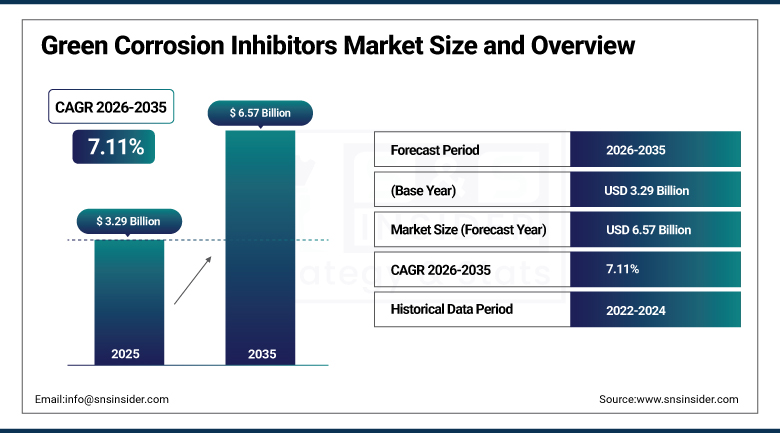
The Green Corrosion Inhibitors Market was valued at USD 3.29 billion in 2025 and is expected to reach USD 6.57 billion by 2035, growing at a CAGR of 7.11% from 2026-2035.
The Green Corrosion Inhibitors Market is witnessing steady growth owing to strict environmental regulations and high requirements for sustainable products that replace standard corrosion prevention agents. The sectors that include the oil and gas industry, the automotive industry, the construction sector, the marine industry, and manufacturing are more prone to using green inhibitors to protect the environment while providing efficient corrosion control. Higher awareness about the problems of water contamination and emission of dangerous chemicals encourages the use of biodegradable and non-toxic compositions. Besides, the development of bio-based inhibitors, increased investment in sustainable industrial production, and extended equipment life are other factors driving the use of green corrosion inhibitors.
In April 2025, IMO’s Marine Environment Protection Committee agreed to develop a legally binding framework for biofouling management, strengthening global focus on environmentally responsible marine protection technologies.
To Get more information On Green Corrosion Inhibitors Market - Request Free Sample Report
Green Corrosion Inhibitors Market Trends:
-
Rising environmental regulations and sustainability initiatives are driving demand for biodegradable and low-toxicity corrosion inhibitors across industrial applications.
-
Increasing adoption of eco-friendly corrosion protection solutions is expanding opportunities across oil and gas, marine, automotive, construction, and manufacturing sectors.
-
Growing concerns regarding hazardous chemical emissions and environmental contamination are encouraging industries to replace conventional corrosion inhibitors with greener alternatives.
-
Advancements in bio-based inhibitor formulations are improving corrosion protection performance, biodegradability, stability, and compatibility across diverse operating conditions.
-
Rising investments in renewable energy and sustainable infrastructure are creating new applications for green corrosion inhibitors in emerging industrial systems.
U.S. Green Corrosion Inhibitors Market Outlook:
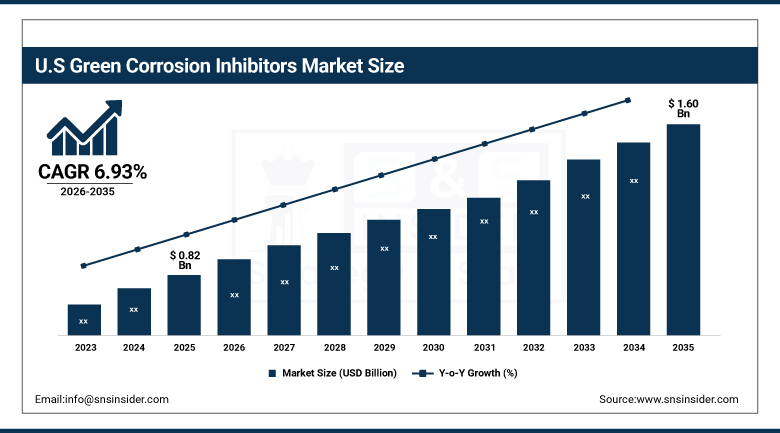
The U.S. Green Corrosion Inhibitors Market was valued at USD 0.82 billion in 2025 and is expected to reach USD 1.60 billion by 2035, growing at a CAGR of 6.93% from 2026-2035.
The U.S. Green Corrosion Inhibitors Market is experiencing steady growth on account of increasing environmental laws and rising requirements for sustainable and eco-friendly corrosion protection solutions in various industrial segments. Increasing use in oil and gas, automotive, marine, construction, and manufacturing industries is making the industry move towards the adoption of biodegradable and low toxicity corrosion inhibitors. Stricter environmental laws and increasing consciousness about the hazards of chemicals are making industries switch from conventional corrosion inhibitors to eco-friendly products. Furthermore, technological innovations in bio-based inhibitors, increasing investments in sustainable industrial processes, and decreasing maintenance costs are propelling market growth in the United States.
In 2025, the U.S. Energy Information Administration reported crude oil production of approximately 13.6 million barrels per day, supporting continued demand for corrosion protection and maintenance across the extensive oil and gas infrastructure.
Green Corrosion Inhibitors Market Segment Analysis:
-
By Type, Water-based Green Corrosion Inhibitors dominated the Green Corrosion Inhibitors Market with 64% share in 2025; Water-based Green Corrosion Inhibitors is expected to grow at the fastest CAGR of 7.58% from 2026–2035.
-
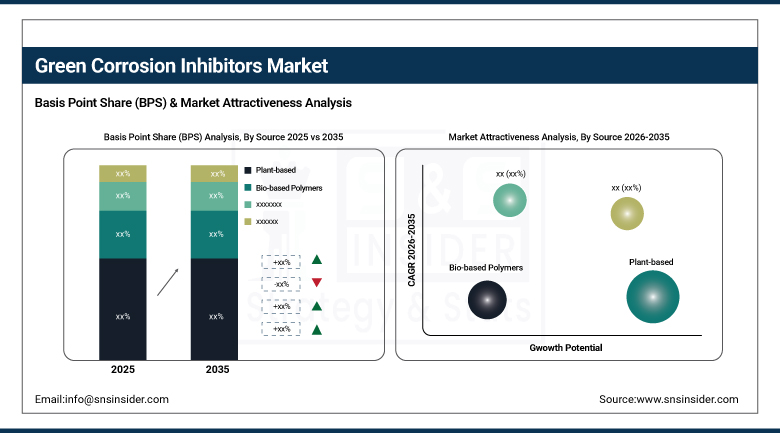
By Source, Plant-based dominated the Green Corrosion Inhibitors Market with 54% share in 2025; Bio-based Polymers is expected to grow at the fastest CAGR of 8.12% from 2026–2035.
-
By Distribution Channel, Direct Sales dominated the Green Corrosion Inhibitors Market with 61% share in 2025; Industrial Distributors is expected to grow at the fastest CAGR of 7.68% from 2026–2035.
-
By End-use Industry, Oil & Gas dominated the Green Corrosion Inhibitors Market with 28% share in 2025; Water Treatment is expected to grow at the fastest CAGR of 8.93% from 2026–2035.
By Type, Water-based Green Corrosion Inhibitors dominate the green corrosion inhibitors market and grow fastest.
Water-based Green Corrosion Inhibitors segment dominated the Green Corrosion Inhibitors Market with the highest market share of about 46% in 2025 Due to the ease of handling, low toxicity, excellent compatibility, and good protective performance of aqueous systems. The adaptability of such systems in cooling systems, pipelines, metal processing, and water treatment systems, in addition to stricter environmental legislations, have ensured their global dominance in the market.
Water-based Green Corrosion Inhibitors segment is expected to grow at the fastest CAGR of 7.58% from 2026-2035 as a result of rising demand for safer environmental compositions, limitations imposed on dangerous chemicals, and increasing requirements for water treatment in the industrial sector. Biodegradable nature, easy applicability, and adaptability to various operating conditions make the industry consider their adoption in place of existing inhibitor compositions.
By Source, Plant-based dominates the green corrosion inhibitors market, Bio-based Polymers grow fastest.
Plant-based segment dominated the Green Corrosion Inhibitors Market with the highest market share of about 54% in 2025 because of their plentiful and renewable sources, biodegradable nature, reduced levels of toxicity, and good environmental compatibility. Natural plant substances not only offer excellent inhibition effects but also lessen the ecological risks normally present with traditional chemical compounds. Increased emphasis on sustainability and growing regulations promote plant-derived inhibitors.
Bio-based Polymers segment is expected to grow at the fastest CAGR of 8.12% from 2026-2035 due to the rising demand for sustainable, degradable, and effective corrosion resistance materials. Bio-based polymers can offer the required protective property while limiting reliance on oil-based products. Developments in polymer technology, environmental legislation, and growing uses in industry water systems and infrastructure may foster the adoption of the product.
By Distribution Channel, Direct Sales dominate the green corrosion inhibitors market, Industrial Distributors grow fastest.
Direct Sales segment dominated the Green Corrosion Inhibitors Market with the highest market share of about 61% in 2025 because through direct sales, the company is able to offer customized formulations, technical support, supply reliability and specialized solutions. Industrial customers who order in bulk have a preference for products where there is need for close cooperation in selecting and optimizing performance.
Industrial Distributors segment is expected to grow at the fastest CAGR of 7.68% from 2026-2035 with an increasing trend among manufacturing companies to look for larger geographical coverage and easier access to varied industrial consumers. Distributors supply goods availability, technical services, logistics services, and regional market coverage. An increased use of distributors by small and medium size industries, especially in developing nations, can be anticipated.
By End-use Industry, Oil & Gas dominates the green corrosion inhibitors market, Water Treatment grows fastest.
Oil & Gas segment dominated the Green Corrosion Inhibitors Market with the highest market share of about 28% in 2025 because of high risk of corrosion on pipeline systems, storage tanks, refineries, drilling rigs, and production facilities. Green inhibitors provide protection of assets while fulfilling environmental requirements. Maintenance of infrastructure, safety needs of operations, and sustainability initiatives encourage use in the oil and gas industry.
Water Treatment segment is expected to grow at the fastest CAGR of 8.93% from 2026-2035 driven by growing water scarcity, increase in industrial water reuse and stringent environmental policies. Control of corrosion is necessary to protect the infrastructure of the plant, pipeline, and other processing units. Investment in the industrial water treatment plants, along with the need for bio-degradable chemicals, is anticipated to drive the use.
Regional Analysis:
|
Region |
Major Country |
Share within Region, 2025 (%) |
|---|---|---|
|
North America |
United States |
87.0% |
|
Europe |
Germany |
25.5% |
|
Asia Pacific |
China |
32.5% |
|
Middle East & Africa |
UAE |
22.0% |
|
Latin America |
Brazil |
41.0% |
North America Green Corrosion Inhibitors Market Insights
North America Green Corrosion Inhibitors Market is witnessing steady growth, supported by stringent environmental regulations, Increasing need for sustainability in corrosion protection and high levels of activities in oil and gas, water treatment, automotive, and manufacturing industries. Increased usage of biodegradable materials, investment in maintenance of infrastructure, and increasing emphasis on reduction of hazardous chemicals is encouraging the industries to move towards corrosion inhibition techniques that are environmentally friendly.
The U.S. Green Corrosion Inhibitors Market accounted for a market share of 87.0%, backed by the high demand for sustainable corrosion protection in the oil and gas industry, water treatment facilities, automotive, construction, and manufacturing industries. The rigorous environmental laws and initiatives being made for the reduction in the usage of hazardous chemicals have spurred the use of biodegradable inhibitors. Additionally, infrastructure development, industrial competencies, higher maintenance needs, and increasing environmental awareness are some other factors driving the market for green corrosion inhibitors in the U.S.
Europe Green Corrosion Inhibitors Market Insights
Europe Green Corrosion Inhibitors Market is experiencing steady growth, driven by stringent environmental regulations, sustainability programs, increasing demand for environmentally friendly products to protect from corrosion in the oil and gas industry, water treatment, automotive, marine, and manufacturing sectors. Increased attention to minimizing the use of harmful chemicals and biodegradable solutions is driving the growth of the market. Investments in aging infrastructure and maintenance along with green inhibitors are additional factors fueling the adoption in the region.
The Germany Green Corrosion Inhibitors Market accounted for a market share of 25.5%, backed by strict environmental norms, robust industrial operations, and rising demand for sustainable corrosion inhibitor solutions. Increased usage within the automotive, manufacturing, chemicals, water treatment, and industrial infrastructure industries is fostering growth within the market. The German drive towards minimizing the usage of harmful chemicals, promoting environmental sustainability, developing green technology, and managing the aged industrial infrastructure is contributing to the rising usage of biodegradable corrosion inhibitors.
Asia Pacific Green Corrosion Inhibitors Market Insights
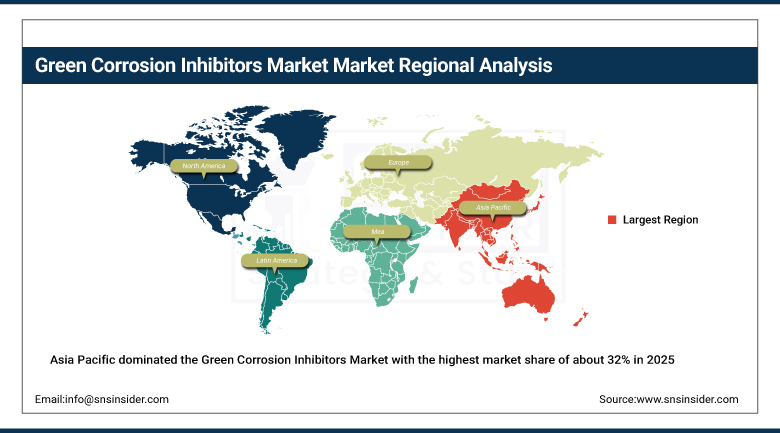
Asia Pacific dominated the Green Corrosion Inhibitors Market with the highest market share of about 32% in 2025, due to the factors such as fast-paced industrialization, increasing oil and gas operations, water treatment demand, and development of infrastructures. Increasing environmental concerns and sustainability requirements are boosting the adoption of corrosion inhibitor in the region. The region is also projected to exhibit the highest CAGR of around 8.20% during the forecast period 2026–2035 due to the factors such as expanding industrial activities, environmental concerns,
The China Green Corrosion Inhibitors Market accounted for a market share of 32.5%, backed by fast industrialization, expansion of oil and gas operations, development of infrastructure, and increased demand for water treatment solutions. Increasing environmental regulations and increased awareness about sustainable chemicals is driving the industries to opt for green corrosion inhibitor technology. Expansion of manufacturing industry, automotive industry, marine industry, and construction industry, and investment in industrial infrastructure is also helping in the growth of the green corrosion inhibitor market in China.
Get Customized Report as per Your Business Requirement - Enquiry Now
Middle East & Africa and Latin America Green Corrosion Inhibitors Market Insights
The Middle East & Africa and Latin America Green Corrosion Inhibitors Market is witnessing gradual growth, Enabled by oil and gas activities, infrastructure construction, water treatment processes, and increased industrial activities. Environmental consciousness and the increased use of sustainable chemicals are driving the need for biodegradable corrosion inhibitors. Increased maintenance needs of pipelines, storage tanks, marine structures, and industrial equipment, among other environmental regulations, are fueling the growth of the market.
The UAE Green Corrosion Inhibitors Market accounted for a market share of 22.0%, backed up by oil and gas exploration, infrastructure construction, and investment in water treatment plants. Environmental consciousness and attempts at lowering the use of toxic substances are prompting businesses to opt for sustainable methods of corrosion prevention. Increased industrial activities, pipeline maintenance needs, sustainability programs spearheaded by the government, and increased demand for eco-friendly products are also contributing to the uptake of green corrosion inhibitors in the UAE.
Market Dynamics:
Growth Drivers: Increasing environmental regulations and sustainability goals are accelerating adoption of eco-friendly corrosion protection solutions across industries
Increasing environmental regulations and sustainability commitments are driving demand for green corrosion inhibitors across industries. Traditional inhibitors often contain hazardous substances that pose environmental and occupational risks. Industries are increasingly adopting biodegradable alternatives that provide effective corrosion protection with minimal environmental impact. Oil & Gas, Water Treatment, Marine, Automotive, Construction, and Manufacturing sectors are adopting eco-friendly inhibitors. Stringent chemical discharge regulations and growing ESG commitments are further encouraging companies to replace conventional inhibitors with sustainable solutions, supporting market growth globally.
Restraints: Limited performance consistency under extreme operating conditions can challenge broader replacement of conventional corrosion inhibitors
Performance limitations under demanding conditions can restrain adoption of green corrosion inhibitors in certain industrial applications. Some bio-based formulations show varying effectiveness under high temperature, pressure, pH, salinity, and aggressive corrosion environments. Oil & gas, marine, and heavy industrial operations require highly reliable corrosion protection, making performance consistency essential. Green formulations may require optimized concentrations, additional additives, or specialized application methods to achieve comparable effectiveness. Concerns regarding long-term stability and protection efficiency may also discourage industries from replacing conventional inhibitors.
Opportunities: Increasing adoption of bio-based formulations creates significant opportunities for innovative sustainable corrosion inhibitor manufacturers globally
Growing demand for bio-based chemicals is creating opportunities for green corrosion inhibitor manufacturers. Companies are developing formulations using plant extracts, biodegradable polymers, amino acids, fatty acids, and other sustainable materials. Advances in green chemistry are improving inhibition efficiency while reducing toxicity and environmental impact. Increasing pressure from consumers, regulators, and corporations to adopt sustainable chemicals is further supporting demand. Oil & gas, water treatment, marine, automotive, and manufacturing industries are expected to benefit from these environmentally friendly formulations.
Recent Developments:
-
2026: Nouryon highlighted its oilfield-chemistry portfolio in 2026, including corrosion-inhibitor technologies designed to protect equipment and pipelines against corrosive oilfield environments.
-
2026: Solenis expanded its industrial water-treatment activities in 2026, supporting advanced chemical solutions that mitigate corrosion, scale, and biofilm across cooling-water and other water-intensive systems.
-
2025: BASF advanced corrosion-protection research using innovative coatings and corrosion inhibitors, including AI and machine learning to identify promising compounds and improve sustainable corrosion-management technologies.
-
2025: Cortec launched EcoLine® 3860, its first water-based acrylic anticorrosion coating incorporating renewable resins and containing 27% USDA-certified biobased content for sustainable metal protection.
Green Corrosion Inhibitors Market Key Players are:
-
BASF SE
-
Ecolab Inc.
-
Cortec Corporation
-
Nouryon
-
Henkel AG & Co. KGaA
-
Solenis LLC
-
Clariant AG
-
The Lubrizol Corporation
-
Arkema S.A.
-
LANXESS AG
-
Veolia Water Technologies
-
SUEZ Water Technologies & Solutions
-
Kemira Oyj
-
Buckman Laboratories International, Inc.
-
Dow Inc.
-
Solvay S.A.
-
Innospec Inc.
-
Baker Hughes Company
-
ChampionX Corporation
-
Ashland Inc.
Green Corrosion Inhibitors Market Report Scope:
| Report Attributes | Details |
|---|---|
| Market Size in 2025 | USD 3.29 Billion |
| Market Size by 2035 | USD 6.57 Billion |
| CAGR | CAGR of 7.11% From 2026 to 2035 |
| Base Year | 2025 |
| Forecast Period | 2026-2035 |
| Historical Data | 2022-2024 |
| Report Scope & Coverage | Market Size, Segments Analysis, Competitive Landscape, Regional Analysis, DROC & SWOT Analysis, Forecast Outlook |
| Key Segments | • By Type (Water-based Green Corrosion Inhibitors, Oil-based Green Corrosion Inhibitors) • By Source (Plant-based, Bio-based Polymers, Others) • By Distribution Channel (Direct Sales, Industrial Distributors) • By End-use Industry (Oil & Gas, Water Treatment, Power Generation, Chemical Processing, Metal Processing, Marine, Construction, Other End-use Industries) |
| Regional Analysis/Coverage | North America (US, Canada), Europe (Germany, UK, France, Italy, Spain, Russia, Poland, Rest of Europe), Asia Pacific (China, India, Japan, South Korea, Australia, ASEAN Countries, Rest of Asia Pacific), Middle East & Africa (UAE, Saudi Arabia, Qatar, South Africa, Rest of Middle East & Africa), Latin America (Brazil, Argentina, Mexico, Colombia, Rest of Latin America). |
| Company Profiles | BASF SE, Ecolab Inc., Cortec Corporation, Nouryon, Henkel AG & Co. KGaA, Solenis LLC, Clariant AG, The Lubrizol Corporation, Arkema S.A., LANXESS AG, Veolia Water Technologies, SUEZ Water Technologies & Solutions, Kemira Oyj, Buckman Laboratories International, Inc., Dow Inc., Solvay S.A., Innospec Inc., Baker Hughes Company, ChampionX Corporation, and Ashland Inc. |
Frequently Asked Questions
The Green Corrosion Inhibitors Market is expected to grow at a CAGR of 7.11% from 2026 to 2035
The Green Corrosion Inhibitors Market was valued at USD 3.29 billion in 2025.
Stringent environmental regulations and growing sustainability commitments are driving industries toward bio-based, non-toxic corrosion inhibitors that reduce hazardous chemical use and environmental impact.
The Water-based Green Corrosion Inhibitors segment dominated the Green Corrosion Inhibitors Market in 2025
