
Anisole Market Report Scope & Overview:
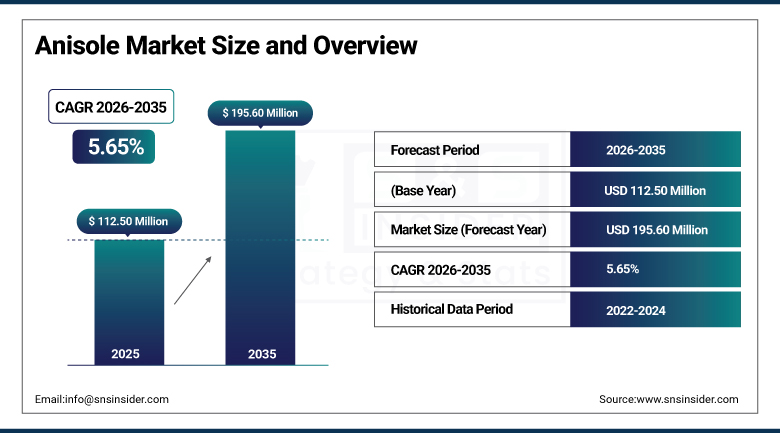
The Anisole Market was valued at USD 112.50 Million in 2025 and is expected to reach USD 195.60 Million by 2035, growing at a CAGR of 5.65% from 2026 to 2035.
The Anisole Market is experiencing steady growth fueled by increasing demand for methoxybenzene as one of the most important aromatic intermediates in various applications including drug synthesis, perfume and flavor production, and pesticide production processes. Anisole, which is a colorless liquid with distinctive sweet and anise smell, is considered stable and reactive chemical in terms of organic chemistry and thus it is widely used as a building block for APIs, specialty fragrances and crop protection chemical intermediates. The increasing demand for perfumes and personal care products across growing middle class consumer base in Asia-Pacific is expected to fuel demand for aromatic compounds produced from anisole in various applications such as perfumes, cosmetics and food flavoring processes, whereas the increasing use of high purity grade anisole for production of active pharmaceutical ingredients in pharmaceutical sector is expected to boost demand for anisole chemicals in drug synthesis processes.
In 2026, Solvay introduced a bio-based anisole product line derived from renewable phenol feedstocks, aimed at sustainability-focused fragrance and specialty chemical manufacturers seeking lower-carbon aromatic intermediates.
To Get more information On Anisole Market - Request Free Sample Report
Anisole Market Trends:
-
Rising demand for high-purity anisole grades is driven by expanding pharmaceutical intermediate synthesis applications worldwide.
-
Growing preference for bio-based anisole production is supporting sustainable chemistry initiatives across fragrance and flavor manufacturing.
-
Expanding perfume and personal care product portfolios in emerging economies is boosting anisole consumption across Asia-Pacific.
-
Increasing adoption of anisole as an agrochemical intermediate is supporting demand growth across crop protection formulation manufacturing.
-
Strategic capacity expansions by specialty chemical manufacturers are strengthening global anisole supply chain reliability.
U.S. Anisole Market Outlook:
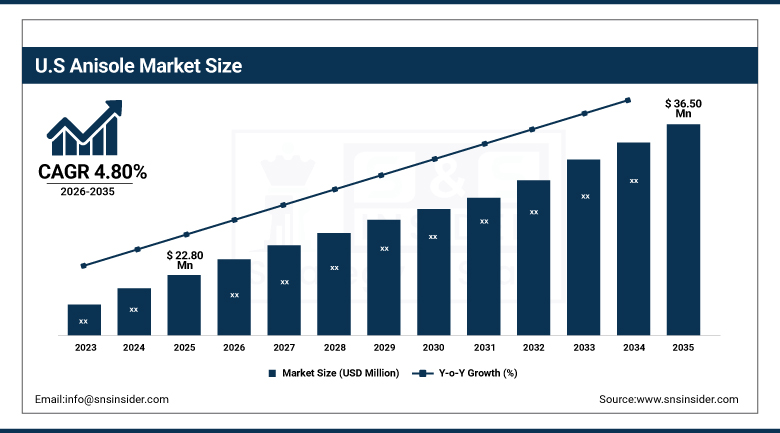
The U.S. Anisole Market was valued at USD 22.80 Million in 2025 and is projected to reach USD 36.50 Million by 2035, growing at a CAGR of 4.80% during 2026–2035.
The United States still accounts for a notable proportion of worldwide anisole demand owing to its already developed pharmaceutical production base and presence of a significant fragrance and flavor industry that relies on regular high-purity intermediates. Active pharmaceutical ingredients as well as various reagents are produced domestically by pharmaceutical and specialty chemicals producers, while anisole derivatives are in stable demand from the cosmetics industry. FDA regulation of the quality of pharmaceutical intermediates coupled with increasing domestic interest in sustainability of bio-based specialty chemicals is driving the supply dynamics in the U.S. anisole market.
In 2025, Camlin Fine Sciences launched a high-purity anisole grade targeting fragrance and flavor formulation customers across North America seeking consistent olfactory-grade raw material quality.
Anisole Market Segment Analysis:
-
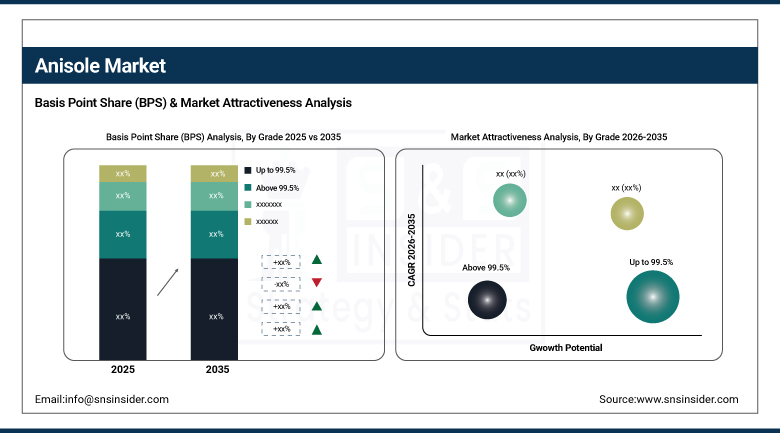
By Grade, Up to 99.5% dominated the Anisole Market with a 54.50% share in 2025, while Above 99.5% is the fastest-growing grade segment with a CAGR of 6.60% from 2026–2035.
-
By Source, Synthetic dominated the Anisole Market with a 68.30% share in 2025, while Bio-Based is the fastest-growing source segment with a CAGR of 7.80% from 2026–2035.
-
By Form, Liquid dominated the Anisole Market with a 82.60% share in 2025, while Powder is the fastest-growing form segment with a CAGR of 6.40% from 2026–2035.
-
By End-Use Industry, Fragrances & Perfumes dominated the Anisole Market with a 37.60% share in 2025, while Pharmaceutical is the fastest-growing end-use industry segment with a CAGR of 6.90% from 2026–2035.
By Grade, Up to 99.5% led while Above 99.5% is the fastest-growing segment.
The Up to 99.5% grade segment was the leading contributor in revenue share in the Anisole Market in 2025. The domination of this product is because of its economical nature and its suitability for various industrial uses, such as fragrances preparation, general chemical synthesis, and cosmetics ingredients. The purity of the product does not need a level of quality that requires a higher expense as it is not needed in the manufacture of pharmaceuticals. This type of grade is preferred by companies that wish to combine both product quality and production economy.
The Above 99.5% grade segment is expected to witness the highest CAGR during the forecast period 2026-2035. Growing demand for anisole in applications related to pharmaceuticals that require highly pure anisole as an active pharmaceutical ingredient or an analytical reagent due to the impact that trace amounts of impurities may have on the performance of the pharmaceutical, is aiding rapid growth for this segment. Increased focus by the pharmaceutical industry on high standards of quality control and growing high-end perfume formulation applications are sustaining above average growth for premium anisole products.
By Source, Synthetic led while Bio-Based is the fastest-growing segment.
The Synthetic category held major market share of the Anisole Market in 2025. Synthetic anisole, produced primarily through methylation of phenol using well-established industrial chemical processes, remains the dominant source category owing to its cost-effectiveness, consistent product quality, and widespread availability across established petrochemical supply chains, providing manufacturers across pharmaceutical, fragrance and chemical industries with a reliable, scalable production pathway that continues to underpin the majority of global commercial-scale anisole supply.
The Bio-Based segment is anticipated to grow at the fastest rate during the forecast period 2026-2035. The increasing demand for sustainable and renewably sourced specialty chemicals among consumers and regulators is leading to a faster uptake of bio-anisole that is made from plant-based phenols as feedstock. In sectors like perfumes and personal care, there is growing preference for reducing carbon footprints along the chain of aromatic ingredients by producers and hence driving this market at a relatively faster pace than others.
By Form, Liquid led while Powder is the fastest-growing segment.
The Liquid segment dominated the Anisole Market with a revenue share in 2025. The natural liquid state of anisole at room temperature has led to the liquid state being the natural choice and the commonly used commercial form in almost all the applications. The liquid form makes anisole easy to handle and dose. This makes the liquid form the most common commercial form in which anisole is supplied in the markets.
The Powder segment is expected to register the fastest CAGR during the forecast period 2026-2035. The increasing requirement for anisole formulations in capsule form that can be used in accordance with specific requirements of formulation, transportation, and storage in some selected pharmaceutical and specialty chemical applications is resulting in steady growth for this particular formulation of anisole.
By End-Use Industry, Fragrances & Perfumes led while Pharmaceutical is the fastest-growing segment.
The Fragrances & Perfumes segment dominated the Anisole Market with a revenue share in 2025. The unique sweet scent of anisole is why it is highly regarded as an important constituent of perfume and fragrance compound preparation, as it serves as not only an aroma but also a key component in the synthesis of other aromas, thus cementing the dominance of this industry due to increasing consumer demand for scents all over the world.
The Pharmaceutical segment is expected to witness the fastest CAGR during the forecast period 2026-2035. Increased production of pharmaceutical products globally, along with the well-established use of anisole as a synthesis intermediate of various APIs, is leading to a fast-growing demand for high-purity pharmaceutical grade of anisole, especially with growing capacity for production of generic drugs in new pharmaceutical centers in Asia Pacific.
Regional Insights
|
Region |
Major Country |
Share within Region, 2025 (%) |
|---|---|---|
|
Asia Pacific |
China |
41.20% |
|
North America |
United States |
74.60% |
|
Europe |
Germany |
28.40% |
|
Middle East & Africa |
UAE |
29.80% |
|
Latin America |
Brazil |
33.60% |
North America Anisole Market Insights
The North America Anisole Market was a significant contributor to the global market in 2025, supported by the region's well-established pharmaceutical manufacturing base, substantial fragrance and flavor industry presence, and stringent FDA regulatory oversight governing pharmaceutical intermediate quality standards. The region's continued emphasis on high-purity, analytically validated chemical inputs and growing interest in sustainably sourced bio-based specialty chemicals is expected to support steady market growth across the forecast period.
The US was the leading country within the North America Anisole Market in 2025, driven by its extensive pharmaceutical and specialty chemical manufacturing infrastructure and substantial personal care and fragrance industry demand. Canada is contributing to regional growth through its growing specialty chemical distribution network and expanding pharmaceutical contract manufacturing sector.
Europe Anisole Market Insights
The Europe region was a major contributor to the Anisole Market in 2025, backed by the region’s significant pharmaceutical manufacturing capability, and the highly established fragrance and flavor industry, especially the internationally famous perfume manufacturing centers of France. The stringent nature of the REACH regulatory system of the region related to chemical intermediates remains instrumental in the qualification of suppliers through
Germany is one of the major markets in Europe owing to its substantial pharmaceutical and specialty chemical manufacturing base and strong presence of active pharmaceutical ingredient producers requiring consistent high-purity anisole supply. France, home to a globally significant perfume and fragrance manufacturing cluster, is also contributing meaningfully to regional demand through its extensive fragrance compound production activity.
Asia Pacific Anisole Market Insights
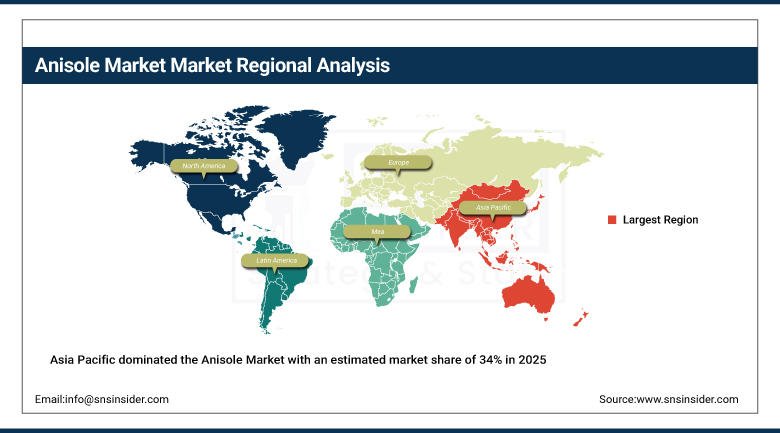
Asia Pacific dominated the Anisole Market with an estimated market share of 34% in 2025, owing to the region's extensive pharmaceutical and generic drug manufacturing base, substantial fragrance and flavor production capacity, and growing personal care and cosmetics industry across major economies. The region's cost-competitive specialty chemical manufacturing infrastructure and expanding downstream demand from pharmaceutical intermediate and fragrance compound producers continues to reinforce Asia Pacific's position as both the largest and fastest-growing anisole market globally, registering a CAGR of 6.90% during the forecast period 2026-2035.
China was the leading country within the Asia Pacific Anisole Market in 2025 of the regional market, Its growth is fueled by the vast capability that India has for producing specialty chemicals and pharmaceutical intermediates. The contribution made by India in promoting the growth of the region is quite substantial due to the rising manufacture of generics in the pharmaceutical sector and fragrances/flavors compounds.
Get Customized Report as per Your Business Requirement - Enquiry Now
Middle East & Africa and Latin America Anisole Market Insights
Middle East & Africa and Latin American regions are gradually expanding anisole consumption as domestic pharmaceutical and personal care manufacturing capacity grows, supported by increasing specialty chemical distribution infrastructure investment and rising consumer demand for fragrance and personal care products across the regions' major economies.
Brazil is set to be a prominent Latin American market fueled by its substantial domestic pharmaceutical manufacturing base and growing personal care and cosmetics industry requiring consistent aromatic intermediate supply. Specialty Chemical Distribution and Pharmaceuticals Contract Manufacturing is being invested in the Middle East & Africa region by the UAE, thereby building up regional market activity as the country builds its status as a regional center for pharmaceutical and personal care manufacturing.
Market Dynamics
Growth Drivers: Expanding pharmaceutical and fragrance applications driving market growth
The continuous expansion of global pharmaceutical manufacturing capacity, combined with rising consumer demand for fragrance and personal care products, is among the primary drivers of the Anisole Market. Anisole's established role as a key synthesis intermediate for numerous active pharmaceutical ingredients, combined with its distinctive aromatic properties valued across perfume, cosmetic, and flavor formulation, continues to support consistent demand across both established and emerging manufacturing hubs, particularly as generic pharmaceutical production capacity continues expanding across Asia-Pacific manufacturing centers.
The growing trend towards fragrances and personal care products among middle classes growing in emerging countries, in conjunction with the investments made by specialty chemical manufacturers for expanding their manufacturing capacity, will aid the market’s growth. Growing focus on the utilization of sustainable sources of aromatic intermediates due to sustainability measures adopted by the industry in addition to the stringent quality requirements from the pharmaceutical industry will aid the market to grow steadily.
Restraints: Raw material price volatility and regulatory compliance costs limiting market expansion
One of the most critical obstacles to market growth is the volatility in phenol and methanol feedstock pricing, which directly impacts anisole production economics and creates margin pressure for manufacturers operating under long-term supply contracts with pharmaceutical and fragrance industry customers requiring stable, predictable pricing.
Moreover, stringent regulatory compliance requirements governing pharmaceutical intermediate quality validation and chemical safety documentation, particularly under REACH in Europe and FDA oversight in the United States, require ongoing investment in quality control infrastructure and regulatory affairs capability that raises operational costs for manufacturers, particularly smaller specialty chemical producers with limited compliance resources. Besides, anisole's classification as a flammable and moderately hazardous chemical requires specialized handling, storage, and transportation infrastructure that adds further cost and complexity to the broader supply chain.
Opportunities: Bio-based production advancement and emerging market expansion creating new growth avenues
The increasing trend towards bio-based anisole production through renewable sources of phenols, along with the increased production capacity of medicines and personal care products in developing countries, opens up vast opportunities for the Anisole market. As fragrance companies and specialty chemicals firms move towards greener supply chains to cut down on the environmental impact of their aromatic compounds there is much scope for those that produce bio-based products.
There is considerable potential for growth in high-purity, pharmaceutical-grade anisole as global generic drug manufacturing capacity continues expanding, particularly across India and China where domestic active pharmaceutical ingredient production is scaling rapidly. The expansion of personal care and fragrance manufacturing infrastructure across Latin America and the Middle East, coupled with continued specialty chemical distribution network development, will continue to drive incremental demand for anisole across emerging manufacturing hubs throughout the forecast period.
Recent Developments:
-
2025: Atul Ltd. expanded its anisole production capacity at its Gujarat facility to meet rising demand from pharmaceutical intermediate manufacturers across Asia.
-
2026: Merck KGaA (MilliporeSigma) expanded its high-purity anisole reagent portfolio for pharmaceutical R&D and analytical laboratory customers.
Anisole Key Players are:
-
Evonik Industries AG
-
Atul Ltd.
-
Solvay S.A.
-
Tokyo Chemical Industry Co., Ltd. (TCI Chemicals)
-
Thermo Fisher Scientific Inc.
-
Emmennar Pharma Pvt. Ltd.
-
Benzo Chem Industries Pvt. Ltd.
-
Merck KGaA (MilliporeSigma)
-
Camlin Fine Sciences Ltd.
-
Ivy Fine Chemical
-
Loba Chemie Pvt. Ltd.
-
Deepak Nitrite Limited
-
Balaji Amines Ltd.
-
Finar Limited
-
Spectrum Chemical Manufacturing Corp.
-
Meghmani Finechem Limited
-
Central Drug House (P) Ltd.
-
Alta Laboratories Ltd.
Anisole Market Report Scope:
| Report Attributes | Details |
|---|---|
| Market Size in 2025 | USD 112.50 Million |
| Market Size by 2035 | USD 195.60 Million |
| CAGR | CAGR of 5.65% From 2026 to 2035 |
| Base Year | 2025 |
| Forecast Period | 2026-2035 |
| Historical Data | 2022-2024 |
| Report Scope & Coverage | Market Size, Segments Analysis, Competitive Landscape, Regional Analysis, DROC & SWOT Analysis, Forecast Outlook |
| Key Segments | • By Grade (Up to 99.5%, Above 99.5%) • By Source (Synthetic, Bio-Based) • By Form (Liquid, Powder) • By End-Use Industry (Pharmaceutical, Fragrances & Perfumes, Agrochemicals, Personal Care & Cosmetics, Food & Beverage & Others) |
| Regional Analysis/Coverage | North America (US, Canada), Europe (Germany, UK, France, Italy, Spain, Russia, Poland, Rest of Europe), Asia Pacific (China, India, Japan, South Korea, Australia, ASEAN Countries, Rest of Asia Pacific), Middle East & Africa (UAE, Saudi Arabia, Qatar, South Africa, Rest of Middle East & Africa), Latin America (Brazil, Argentina, Mexico, Colombia, Rest of Latin America). |
| Company Profiles | Evonik Industries AG, Atul Ltd., Solvay S.A., Tokyo Chemical Industry Co., Ltd. (TCI Chemicals), Surya Life Sciences Ltd., Thermo Fisher Scientific Inc., Emmennar Pharma Pvt. Ltd., Benzo Chem Industries Pvt. Ltd., Merck KGaA (MilliporeSigma), Camlin Fine Sciences Ltd., Ivy Fine Chemical, Loba Chemie Pvt. Ltd., Deepak Nitrite Limited, Balaji Amines Ltd., Otto Chemie Pvt. Ltd., Finar Limited, Spectrum Chemical Manufacturing Corp., Meghmani Finechem Limited, Central Drug House (P) Ltd., Alta Laboratories Ltd. |

Frequently Asked Questions
The market is driven by expanding pharmaceutical intermediate synthesis demand, rising fragrance and personal care product consumption, and growing interest in bio-based, sustainably sourced anisole.
The Fragrances & Perfumes segment dominated the Anisole Market in 2025, accounting for approximately 37.60% market share.
The Asia Pacific region dominated the Anisole Market in 2025 with a 32.40% market share, driven by its extensive pharmaceutical and fragrance manufacturing base.
Key opportunities include pharmaceutical intermediates, fragrances, agrochemicals, specialty chemicals, and expanding chemical manufacturing applications.
