
Synthetic Spider Silk Market Report Scope & Overview:
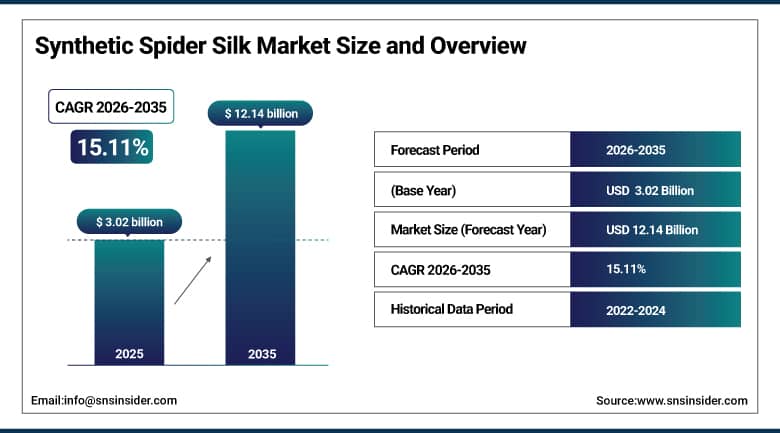
The Synthetic Spider Silk Market size is valued at USD 3.02 Billion in 2025 and is projected to reach USD 12.14 Billion by 2035, growing at a CAGR of 15.11% during the forecast period 2026–2035.
The Synthetically Produced Spider Silk Market analysis report presents a comprehensive evaluation of market dynamics, technological developments, and applications across industries. Growing requirements for eco-friendly fibers, extensive applications in biomedical engineering, increased utilization in aerospace & defense sectors, and developments in synthetic biology platforms are propelling market growth from 2026 to 2035.
Production of synthetically produced spider silk is expected to cross 102 thousand metric tons per year by 2030, driven by innovations in microbial fermentation, genetically engineered silkworms, and plants.
Market Size and Forecast:
-
Market Size in 2025: USD 3.02 Billion
-
Market Size by 2035: USD 12.14 Billion
-
CAGR: 15.11% from 2026 to 2035
-
Base Year: 2025
-
Forecast Period: 2026–2035
-
Historical Data: 2022–2024
To Get More Information On Synthetic Spider Silk Market - Request Free Sample Report
Synthetic Spider Silk Market Trends:
-
Commercialization of rapid rate due to scaling up by bioengineering companies through microbial fermentation and transgenic silkworms.
-
Hospital sector expansion with spider silk's compatibility with biomedical purposes including sutures, prosthetics, and medicines.
-
Aerospace industry and auto-industry utilization through composite material use for lightweight and efficient performance.
-
Military sector involvement in ballistic armor, helmets, and tactical clothing resulting in military demand for spider silk.
-
Demand for sustainability where spider silk substitutes traditional fibers and plastics that are petroleum-derived.
-
Synthetic biological research breakthroughs allowing consistent production in quality through engineering microorganisms.
-
Extensive venture capital and government-sponsored research activities within biotechnology firms.
-
High cost of manufacturing hinders large-scale use compared to nylon and polyester.
U.S. Synthetic Spider Silk Market Insights:
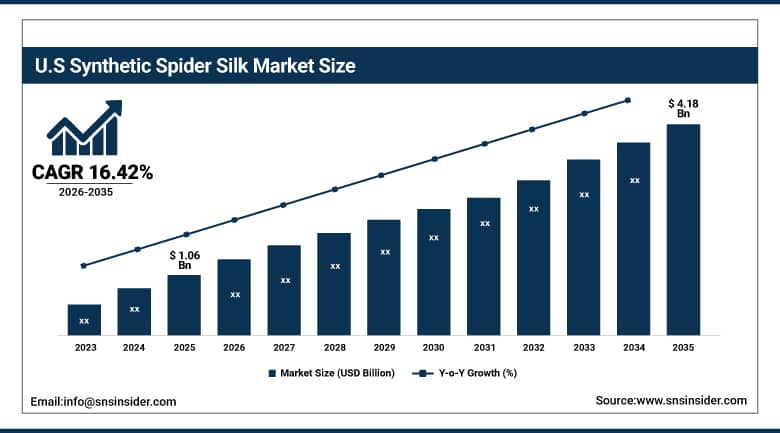
The U.S. Synthetic Spider Silk Market is projected to grow from USD 1.06 Billion in 2025 to USD 4.18 Billion by 2035, at a CAGR of 16.42%. Growth will be fueled by increased demand for sustainable and high-performing fabrics, the growing application of biodegradable biomaterials in biomedical engineering and regenerative medicine, widespread usage in the aerospace & defense sector for weight-reduction composites and bulletproof products, and advancements in novel manufacturing techniques including microbial fermentation, transgenic silkworms, and synthetic biology systems in hospitals, specialized healthcare centers, textile companies, and industry sectors.
Synthetic Spider Silk Market Growth Drivers:
-
Rising demand for sustainable textiles and advanced biomaterials is driving strong growth in the Synthetic Spider Silk Market.
The increasing number of applications of composites and lightweight armor for aerospace and defense purposes, increasing uses in healthcare for stitching and implant applications and regenerative structures, and increasing uses in packaging and coatings of industry have become some of the primary factors driving the market's growth. Hospitals, specialized clinics, textile producers, and military agencies are incorporating synthetic spider silk within their processes through developments made within microbial fermentation, silkworms engineered to produce synthetic spider silk, and biological production platforms.
More than 55% of textile producers, healthcare service providers, and military contractors used synthetic spider silk in 2025 for various applications.
Synthetic Spider Silk Market Restraints:
-
Growth in the Synthetic Spider Silk Market is restrained by high production costs, scalability challenges, and limited commercial availability compared to conventional fibers such as nylon and polyester.
The technical difficulties associated with the microbial fermentation process, transgenic silkworm technology, and genetic modification of plants have been a challenge in the mass production of artificial silk. Regulatory issues in the application of artificial silk in biomedicine have slowed down its uptake in health care facilities. Low consumer awareness and stiff competition from other materials such as synthetic polymers and carbon fiber have also made it difficult for artificial silk to penetrate the market.
In 2025, fewer than 30% of potential industrial and healthcare end users adopted synthetic spider silk at scale, reflecting ongoing barriers to commercialization and sustained market expansion.
Synthetic Spider Silk Market Opportunities:
-
The Synthetic Spider Silk Market presents significant opportunities through rising demand for eco-friendly and sustainable materials.
The material is finding more applications in regenerative medicine and advanced applications in health care, and there is great potential in the aerospace and defense industry due to the high strength-to-weight ratio and protection offered. With growing collaboration between biotech companies, textile makers, and defense industries, there is great potential to see commercial success, especially with the development of synthetic biology, fermentation technology, and transgenic silkworms for making mass production economical.
In 2025, over 60% of leading textile brands, healthcare innovators, and defense organizations-initiated pilot projects or partnerships involving synthetic spider silk.
Synthetic Spider Silk Market Segmentation Analysis:
-
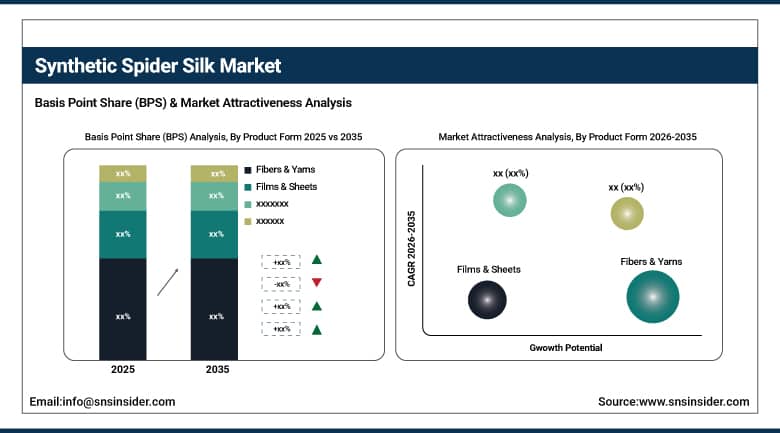
By Product Form, Fibers & Yarns dominated with 46.38% market share in 2025, whereas they are also projected to record the fastest CAGR of 15.67% through 2026–2035.
-
By Raw Material Source, Genetically Engineered Microorganisms (Yeast, Bacteria) held the largest market share of 42.08% in 2025, while they are also expected to grow at the fastest CAGR of 15.72% during 2026–2035.
-
By Functionality, High-Tensile Strength Materials accounted for the highest market share of 36.54% in 2025, while Biocompatible Medical Materials are expected to grow at the fastest CAGR of 16.07% during the forecast period.
-
By Technology, Synthetic Biology Platforms dominated with a 41.21% share in 2025, while Traditional Bio-Fermentation Methods are anticipated to expand at the fastest CAGR of 16.53% through 2026–2035.
By Product Form, Fibers & Yarns Dominate While It Grow Rapidly:
The Fibers & Yarns category accounted for a significant share of the market, owing to its prevalent usage in textiles, defense equipment, and various industrial applications that require strength and flexibility. This category is set to play a pivotal role in the synthesis of spider silk products, seeing high penetration rates from the fashion industry, aerospace sector, and militaries around the world.
The Fibers & Yarns category is also estimated to achieve the fastest growth rate over the forecast period due to increased need for eco-friendly fibers, growing use of the material for ballistic protection purposes, and increased application within lightweight composite materials.
By Raw Material Source, Genetically Engineered Microorganisms (Yeast, Bacteria) Dominate While it Grow Rapidly:
The Genetically Engineered Microorganisms (Yeast, Bacteria) category occupied the dominant market share, owing to their scalability, effectiveness, and capability to manufacture spider silk fibers consistently using fermentation technology. The category is anticipated to be a core component for commercializing synthetic spider silk, with wide-scale adoption in textiles, healthcare, and defense applications.
The Genetically Engineered Microorganisms category is also projected to record the fastest growth rate due to continuous advancements in synthetic biology technology, cost efficiency, and collaborations with various industries. The category's dominance in terms of market share, along with its rapid growth, highlights its significance in the future development of synthetic spider silk.
By Functionality, High-Tensile Strength Materials dominate while Biocompatible Medical Materials are expanding rapidly.
High-Tensile Strength Materials have the dominant market share, indicating their importance in industries such as aerospace, defense, and manufacturing, where strength and functionality play a vital role. These materials find extensive use in ballistic armor, ropes, and lightweight composites and form the foundation of the entire industry of spider silk.
The Biocompatible Medical Materials segment will witness the fastest growth, due to growing usage of spider silk in suture, scaffold, implant, and drug delivery applications. The fast growth is an indicator of the exceptional biocompatibility offered by spider silk, thus highlighting the healthcare industry as one of its most prospective markets.
By Technology, Synthetic Biology Platforms dominate while Traditional Bio-Fermentation Methods are expanding rapidly.
The Synthetic Biology Platforms technology has become the dominant solution due to it allows scientists to modify microorganisms that can manufacture spider silk reliably and efficiently. The technology is currently used extensively in the textile, healthcare, and military sectors, thanks to the innovations in genetic engineering and fermentation processes.
Traditional Bio-Fermentation Methods are anticipated to grow at the fastest pace as innovations in fermentation optimization and cost reduction make them increasingly viable for commercial-scale production. Their rapid expansion reflects growing interest from industrial manufacturers seeking alternative pathways to produce spider silk fibers and composites.
Synthetic Spider Silk Market Regional Analysis:
Asia Pacific Synthetic Spider Silk Market Insights:
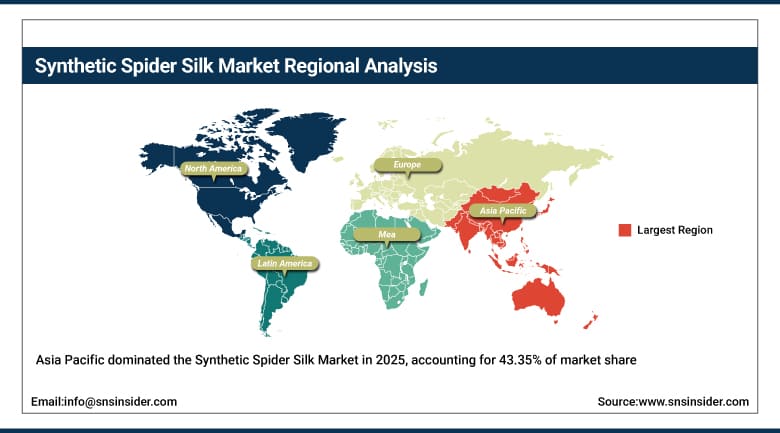
Asia Pacific has the lead in the market with 43.35% market share owing to its robust presence in the manufacture of textile goods, increased focus on sustainability, and greater investments in biotechnology. This region has countries such as Japan, South Korea, and India that are spearheading innovations in the fields of synthetic biology and transgenic silkworms. Applications in healthcare and the growing trend toward the military use of this silk in protective clothing will only serve to drive the market here even more.
Get Customized Report as Per Your Business Requirement - Enquiry Now
China Synthetic Spider Silk Market Insights:
The China Synthetic Spider Silk Market is influenced by mass textile manufacturing, sustainable development initiatives supported by the government, and investments in biomaterials technology. The market’s high utilization rate in the fashion and industrial packaging industries, and its growing demand for use in the biomedical industry, have established China as a frontrunner in commercializing synthetic spider silk.
North America Synthetic Spider Silk Market Insights:
North America is one of the fast-growing regions in the Synthetic Spider Silk Market at a CAGR of 16.43%. It is due to advanced biotechnological environments and high industrial demands in North America. Extensive research and development in the area of microbial fermentation technology and synthetic biology platforms are made possible through extensive collaborations between universities, biotechnology companies, and defense organizations. There is an increasing interest among healthcare professionals to explore synthetic spider silk for regenerative purposes and surgeries.
U.S. Synthetic Spider Silk Market Insights:
The United States leads the market for synthetic spider silk in North America due to high-end R&D, military demands, and the use of spider silk in the health care sector. Biotechnology companies and research organizations are developing techniques to produce spider silk on a large scale, putting the United States in an innovative position. Spider silk is being used in hospitals and specialty centers as biocompatible medical products, whereas it is also being used by aerospace and defense industries as protective gear.
Europe Synthetic Spider Silk Market Insights:
The U.S. is dominant in terms of production of synthetic spider silk in North America due to advanced research and development, military requirements, and the application of spider silk in the health care industry. The efforts of biotech firms and research institutions are contributing in the formation of methods that can be utilized for manufacturing spider silk on a larger scale, thus making the US one of the innovative countries. Spider silk has been employed as biocompatible products in hospitals while it is also used in defense and aerospace industries.
Germany Synthetic Spider Silk Market Insights:
The Germany Synthetic Spider Silk Market is fueled by cutting-edge biotechnology developments, significant healthcare adoption, and sustainability innovations. Companies in Germany are making innovative use of microbial fermentation and biotechnology platforms to produce large quantities of spider silk fiber products. Biocompatible material usage in surgeries and regeneration therapies within the healthcare sector, and spider silk-based composite materials being used for manufacturing lighter structures in the aviation and automobile industries, is driving growth in the market.
Latin America Synthetic Spider Silk Market Insights:
The Latin American Synthetic Spider Silk Market is an upcoming market, backed by developing textile industry sectors, increasing investments in the healthcare sector, and high demand for environmentally friendly products. Brazil and Mexico have been at the forefront of using spider silk in fashion items, packing, and biomedical products. Increased partnerships with other biotechnology companies from around the globe and the support of governments in fostering innovations that are friendly to the environment have contributed immensely to growth in the Latin American region.
Middle East & Africa Synthetic Spider Silk Market Insights:
The Middle East and Africa Synthetic Spider Silk Market is slowly but surely growing, owing to increased investment in material development, increased spending on health facilities, and sustainable solutions. In the UAE and Saudi Arabia, spider silk is finding applications in the aerospace and defense industry in protective and lightweight materials. In addition to this, the healthcare sector is looking toward spider silk for its biocompatibility, while industries have an interest in sustainable packaging solutions.
Synthetic Spider Silk Market Competitive Landscape:
Bolt Threads
Bolt Threads is an American biotech firm that specializes in innovative, eco-conscious materials, particularly the development of spider silk using genetically modified yeast fermentation. The firm stresses scalability, environmentally conscious technology, and uses in fashion, textiles, and healthcare products. In collaboration with well-known apparel companies, Bolt Threads incorporates the use of spider silk to develop sustainable clothing lines. They also explore other potential medical applications for their materials.
-
In April 2025, Bolt Threads expanded its partnership with Stella McCartney to develop luxury fashion products using its proprietary spider silk fiber, Microsilk.
AMSilk
AMSilk is a Germany-based biotechnology firm that develops and manufactures advanced biomaterials, especially synthetic spider silk protein made through microbial fermentation. Among AMSilk's product line are fibers, coatings, and hydrogels, which have been utilized in several industries such as aerospace, automotive, medicine, and sustainable textile manufacturing. In addition, AMSilk focuses on ensuring biocompatibility, strength, and eco-friendliness in its products to become a pioneer in spider silk production in large-scale industry settings.
-
In Junuary 2025, AMSilk partnered with Airbus to explore spider silk-based composites for lightweight aerospace applications.
Kraig Biocraft Laboratories
Kraig Biocraft Laboratories is a U.S. biotech company that specializes in using transgenic silkworm technology to create commercial quantities of spider silk fibers. With its cutting-edge gene-engineering technology, it is able to create silkworms that can produce spider silk with exceptional strength and flexibility. Moreover, this process is much more economical than using microbes for silk production. Kraig Biocraft primarily caters to the military, medical, and manufacturing industries, particularly in the production of protective textiles and biomedical equipment.
-
In June 2025, Kraig Biocraft Laboratories announced commercial-scale production of its Dragon Silk™ fibers for military protective gear applications.
Synthetic Spider Silk Market Key Players:
-
Bolt Threads
-
AMSilk
-
Kraig Biocraft Laboratories
-
Inspidere BV
-
Araknitek
-
Oxford Biomaterials
-
BioSteel (formerly Nexia Biotechnologies)
-
EntoGenetics Inc.
-
EcoSpider Silk
-
SynBio Technologies
-
Genecis Bioindustries
-
Modern Meadow
-
Ginkgo Bioworks
-
Zymergen
-
FibeRio Technology
-
Silksphere
-
Protein Evolution Inc.
-
Spider Silk Technologies
| Report Attributes | Details |
|---|---|
| Market Size in 2025 | USD 3.02 Billion |
| Market Size by 2035 | USD 12.14 Billion |
| CAGR | CAGR of 15.11% From 2026 to 2035 |
| Base Year | 2025 |
| Forecast Period | 2026-2035 |
| Historical Data | 2022-2024 |
| Report Scope & Coverage | Market Size, Segments Analysis, Competitive Landscape, Regional Analysis, DROC & SWOT Analysis, Forecast Outlook |
| Key Segments | • By Raw Material Source (Genetically Engineered Microorganisms (Yeast, Bacteria), Transgenic Silkworms, Plant-Based Genetic Engineering, Bioengineered Hosts, Others), • By Product Form (Fibers & Yarns, Films & Sheets, Hydrogels & Foams, Composites & Coatings, Others), • By Functionality (High-Tensile Strength Materials, Biocompatible Medical Materials, Lightweight Structural Materials, Eco-Friendly Packaging Materials, Others), • By Technology (Traditional Bio-Fermentation Methods, Synthetic Biology Platforms, Transgenic Silkworm Production, Plant-Based Genetic Engineering, Others) |
| Regional Analysis/Coverage | North America (US, Canada), Europe (Germany, UK, France, Italy, Spain, Russia, Poland, Rest of Europe), Asia Pacific (China, India, Japan, South Korea, Australia, ASEAN Countries, Rest of Asia Pacific), Middle East & Africa (UAE, Saudi Arabia, Qatar, South Africa, Rest of Middle East & Africa), Latin America (Brazil, Argentina, Mexico, Colombia, Rest of Latin America). |
| Company Profiles | Bolt Threads, AMSilk, Kraig Biocraft Laboratories, Spiber Inc., Inspidere BV, Araknitek, Oxford Biomaterials, BioSteel (formerly Nexia Biotechnologies), EntoGenetics Inc., Seevix Material Sciences, EcoSpider Silk, SynBio Technologies, Genecis Bioindustries, Modern Meadow, Ginkgo Bioworks, Zymergen, FibeRio Technology, Silksphere, Protein Evolution Inc., Spider Silk Technologies. |
Frequently Asked Questions
Asia-Pacific dominated with a 43.35% share in 2025, while North America is the fastest-growing region, expected to expand at a CAGR of 16.43% during 2026–2035.
High-Tensile Strength Materials dominated with a 36.54% share in 2025, while Biocompatible Medical Materials are projected to grow at the fastest CAGR of 16.07% during 2026–2035.
Growth is driven by rising demand for sustainable and eco-friendly materials, expanding applications in healthcare such as sutures, implants, and regenerative scaffolds, and strong adoption in aerospace and defense.
The market is valued at USD 3.02 Billion in 2025 and is projected to reach USD 12.14 Billion by 2035.
The Synthetic Spider Silk Market is projected to grow at a CAGR of 15.11% during 2026–2035.
Get in Touch
